Page 84 of 347
Engine Idling
Avoid prolonged idling, long periods of idling may be
harmful to your engine because combustion chamber
temperatures can drop so low that the fuel may not burn
completely. Incomplete combustion allows carbon and
varnish to form on piston rings, cylinder head valves,
and injector nozzles. Also, the unburned fuel can enter
the crankcase, diluting the oil and causing rapid wear to
the engine.
Stopping The Engine
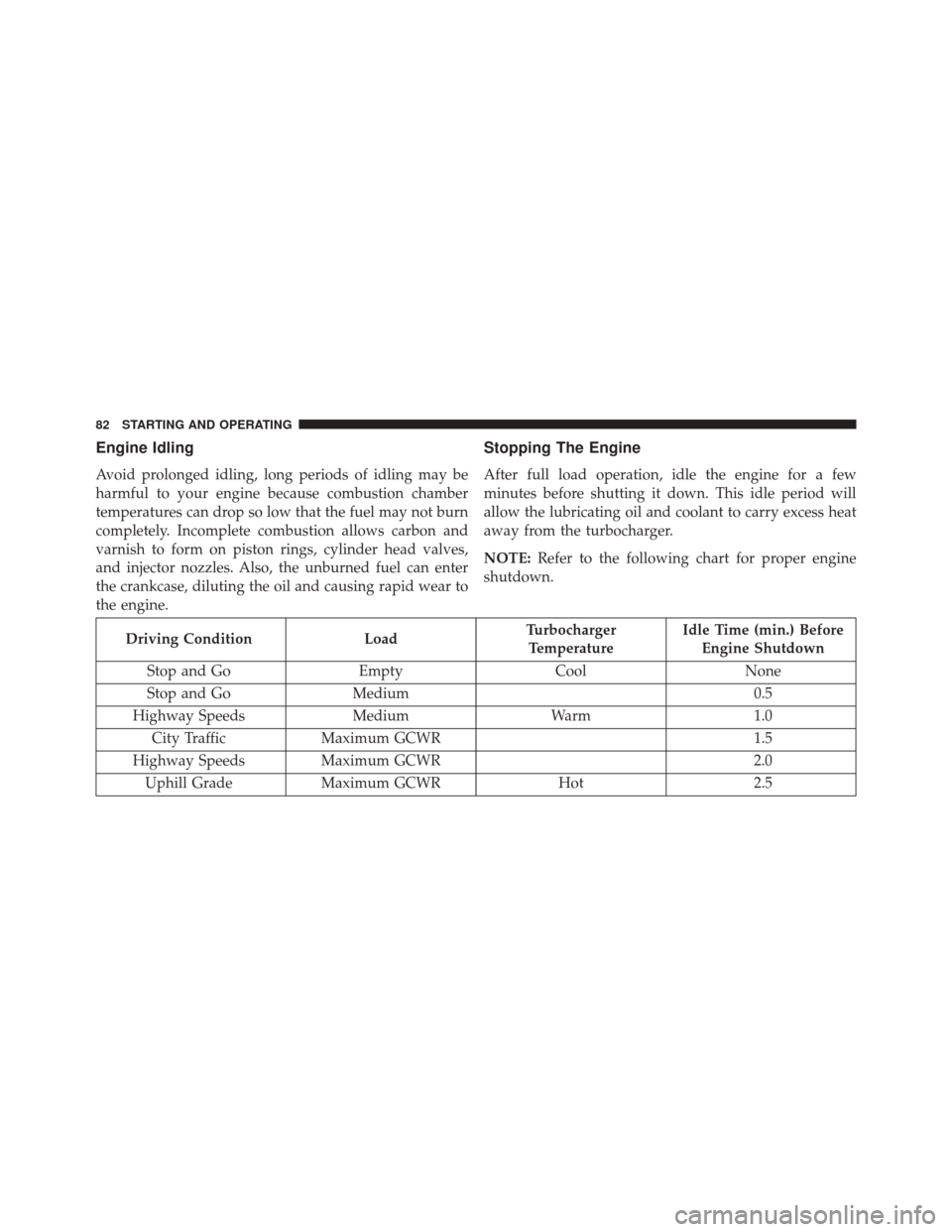
After full load operation, idle the engine for a few
minutes before shutting it down. This idle period will
allow the lubricating oil and coolant to carry excess heat
away from the turbocharger.
NOTE:Refer to the following chart for proper engine
shutdown.
Driving Condition LoadTurbocharger
Temperature Idle Time (min.) Before
Engine Shutdown
Stop and Go EmptyCoolNone
Stop and Go Medium 0.5
Highway Speeds MediumWarm 1.0
City Traffic Maximum GCWR 1.5
Highway Speeds Maximum GCWR 2.0
Uphill Grade Maximum GCWR Hot2.5
82 STARTING AND OPERATING
Page 85 of 347
NOTE:Under certain conditions the engine fan will run
after the engine is turned off. These conditions are under
high load and high temperature conditions.
Cooling System Tips — Automatic Transmission
To reduce the potential for engine and transmission
overheating in high ambient temperature conditions,
take the following actions:
• City Driving — When stopped, shift the transmission
into NEUTRAL and increase engine idle speed.
• Highway Driving — Reduce your speed.
• Up Steep Hills — Select a lower transmission gear.
• Air Conditioning — Turn it off temporarily.
NOTE: If the coolant temperature is too high the A/C
will automatically turn off.
Do Not Operate The Engine With Low Oil
Pressure
If the low oil pressure warning light turns on while
driving, stop the vehicle and shut down the engine as
soon as possible. A chime will sound when the light turns
on.
NOTE: Do not operate the vehicle until the cause is
corrected. This light does not show how much oil is in the
engine. The engine oil level must be checked under the
hood.
CAUTION!
If oil pressure falls to less than normal readings, shut
the engine off immediately. Failure to do so could
result in immediate and severe engine damage.
4
STARTING AND OPERATING 83
Page 86 of 347
Do Not Operate The Engine With Failed Parts
All engine failures give some warning before the parts
fail. Be on the alert for changes in performance, sounds,
and visual evidence that the engine requires service.
Some important clues are:
•engine misfiring or vibrating severely
• sudden loss of power
• unusual engine noises
• fuel, oil or coolant leaks
• sudden change, outside the normal operating range, in
the engine operating temperature
• excessive smoke
• oil pressure drop
ENGINE BLOCK HEATER — IF EQUIPPED
The engine block heater warms engine coolant and
permits quicker starts in cold weather. Connect the heater
cord to a ground-fault interrupter protected 110–115 Volt
AC electrical outlet with a grounded, three-wire exten-
sion cord.
Its use is recommended for environments that routinely
fall below -10°F (-23°C). It should be used when the
vehicle has not been running for long periods of time and
should be plugged in two hours prior to start. Its use is
required for cold starts with temperatures under -20°F
(-28°C).
To ensure reliable starting at these temperatures, use of
an externally powered electric engine block heater (avail-
able from your authorized dealer) is recommended.
84 STARTING AND OPERATING
Page 89 of 347
Biodiesel Fuel Requirements
A maximum blend of 5% biodiesel meeting ASTM speci-
fication D975 is recommended for use with your diesel
engine. If frequent operation with Biodiesel blends that
are between 6% and 20% (B6–B20) is desired, the main-
tenance schedule is subject to shorter intervals.
The oil and filter change along with fuel filter replace-
ment is subject to shorter intervals when operating your
engine on biodiesel greater than 5%. Do not use biodiesel
greater than 20%.
For regular use of biodiesel blends between 6% and 20%
(B6–B20) it is important that you understand and comply
with these requirements. Refer to the “Maintenance
Chart” in the “Maintenance Schedules” section for fur-
ther direction.
CAUTION!
Failure to comply with Oil Change requirements for
vehicles operating on biodiesel blends between 6%
and 20% (B6–B20) will result in premature engine
wear. Such wear is not covered by the New Vehicle
Limited Warranty.
Biodiesel is a fuel produced from renewable resources
typically derived from animal fat, rapeseed oil (Rapeseed
Methyl Ester (RME) base), or soybean oil (Soy Methyl
Ester (SME or SOME) base).
Biodiesel fuel has inherent limitations which require that
you understand and adhere to the following requirements
if you use blends of Biodiesel between 6% and 20%
(B6–B20). There are no unique restrictions for the use of B5.
4
STARTING AND OPERATING 87
Page 91 of 347
Fuel Water Separation — Must Use Mopar
Approved Fuel Filter Elements
Biodiesel fuel has a natural affinity to water and water
accelerates microbial growth. Your Mopar filtration sys-
tem is designed to provide adequate fuel water separa-
tion capabilities.
Fuel In Oil Dilution — Must Adhere To Required
Oil Change Interval
Fuel dilution of lubricating oil has been observed with
the use of Biodiesel fuel. Fuel in oil must not exceed 5%.
To ensure this limit is met your oil change interval must
be maintained with in the suggested schedule. The
regular use of biodiesel between 6% and 20% requires
intervals shorter than the outlined 10,000 miles and must
not exceed the suggested schedule. When routinely op-
erating on biodiesel between 6% and 20%, oil and filter
replacement intervals must not exceed 8,000 Miles or 6
months, which ever comes first.
Biodiesel Fuel Filter Change Intervals
The use of biodiese requires intervals shorter than the
outlined 30,000 miles (48 280 km) and must not exceed
the suggested schedule. When operating on biodiesel
between 6% and 20%, fuel filter replacement intervals
must not exceed 20,000 Miles (40 233 km).
NOTE:Under no circumstances should oil change inter-
vals exceed 8,000 miles (12 875 km) or 6 months, if
regular operation occurs with 6% - 20% biodiesel blends.
Under no circumstances should fuel filter intervals ex-
ceed 20,000 miles (40 233 km), if regular operation occurs
with 6% - 20% biodiesel blends. Failure to comply with
these Oil Change and fuel filter requirements for vehicles
operating on biodiesel blends up to B20 may result in
premature engine wear. Such wear is not covered by the
New Vehicle Limited Warranty. The engine may suffer
severe damage if operated with concentrations of bio-
diesel higher than 20%.
4
STARTING AND OPERATING 89
Page 101 of 347
MAINTAINING YOUR VEHICLE
CONTENTS
�ENGINE COMPARTMENT — 3.0L DIESEL . . . .100
� MAINTENANCE PROCEDURES ...........101
▫ Engine Oil ......................... .102
▫ Engine Air Cleaner Filter ................104
▫ Draining Fuel/Water Separator Filter .......107
▫ Underbody Mounted Fuel Filter Replacement . .110
▫ Priming If The Engine Has Run Out Of Fuel . .111
▫ Intervention Regeneration Strategy — Message
Process Flow ........................113 ▫
Maintenance-Free Batteries ..............113
▫ Cooling System ......................114
▫ Charge Air Cooler — Inter-Cooler .........120
▫ Brake System ....................... .120
� FLUID CAPACITIES ....................122
� FLUIDS, LUBRICANTS AND GENUINE
PARTS ............................. .123
▫ Engine ............................ .123
▫ Chassis ........................... .126
5
Page 102 of 347
ENGINE COMPARTMENT — 3.0L DIESEL
1 — Air Cleaner Filter5 — Battery
2 — Engine Oil Dipstick 6 — Power Distribution Center (PDC)
3 — Engine Oil Fill 7 — Washer Fluid Reservoir
4 — Brake Fluid Reservoir 8 — Engine Coolant
100 MAINTAINING YOUR VEHICLE
Page 104 of 347
Engine Oil
Engine Oil Selection
For best performance and maximum protection under all
types of operating conditions, the manufacturer recom-
mends engine oils that meet the requirements of FCA US
Material Standard MS-11106, and that are approved to
ACEA C3.
Checking Oil Level
To assure proper lubrication of your vehicle’s engine, the
engine oil must be maintained at the correct level. Check
the oil level at regular intervals. The best time to check
the oil level is before starting the engine after it has been
parked overnight. When checking oil after operating the
engine, first ensure the engine is at full operating tem-
perature, then wait for five minutes after engine shut-
down to check the oil.
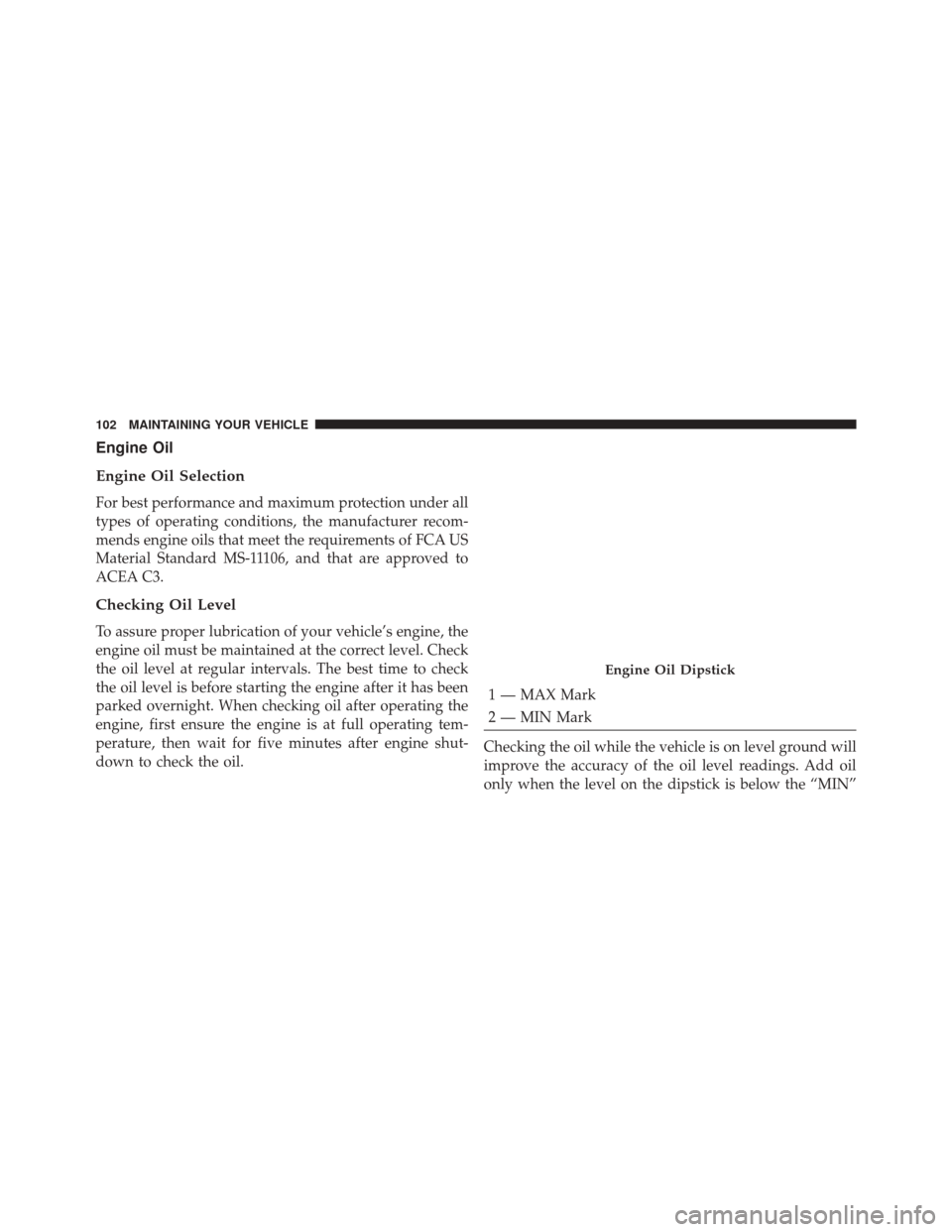
1 — MAX Mark
2 — MIN Mark
Checking the oil while the vehicle is on level ground will
improve the accuracy of the oil level readings. Add oil
only when the level on the dipstick is below the “MIN”
Engine Oil Dipstick
102 MAINTAINING YOUR VEHICLE