Page 228 of 347
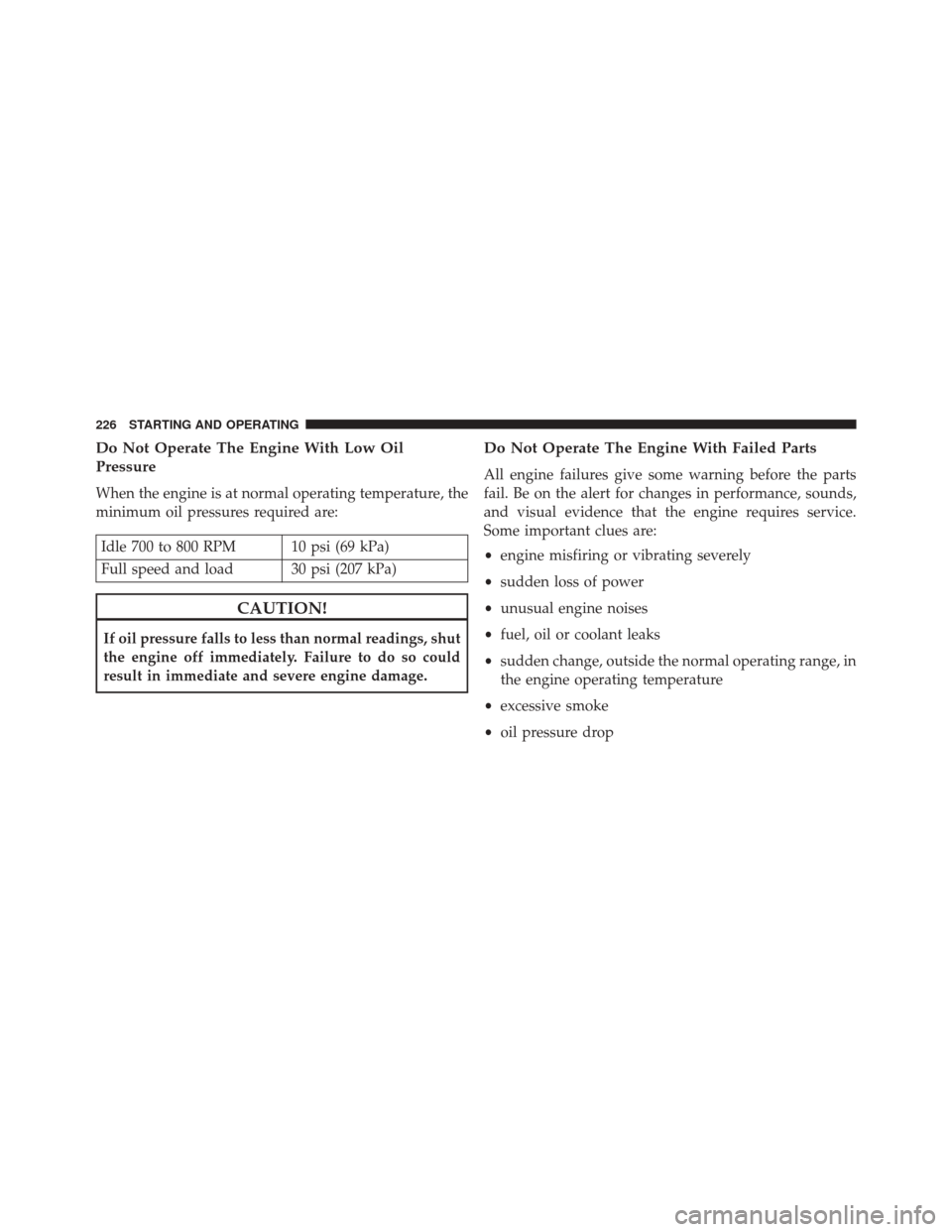
Do Not Operate The Engine With Low Oil
Pressure
When the engine is at normal operating temperature, the
minimum oil pressures required are:
Idle 700 to 800 RPM 10 psi (69 kPa)
Full speed and load 30 psi (207 kPa)
CAUTION!
If oil pressure falls to less than normal readings, shut
the engine off immediately. Failure to do so could
result in immediate and severe engine damage.
Do Not Operate The Engine With Failed Parts
All engine failures give some warning before the parts
fail. Be on the alert for changes in performance, sounds,
and visual evidence that the engine requires service.
Some important clues are:
•engine misfiring or vibrating severely
• sudden loss of power
• unusual engine noises
• fuel, oil or coolant leaks
• sudden change, outside the normal operating range, in
the engine operating temperature
• excessive smoke
• oil pressure drop
226 STARTING AND OPERATING
Page 257 of 347
Pickup Models And Chassis Cab Models Ordered
With B20 Option
Your vehicle has been validated and approved for the use
of Biodiesel in blends up to 20% (B20) provided that you
comply with the requirements outlined below. It is im-
portant that you understand and comply with these
requirements. Failure to comply with Oil Change require-
ments for vehicles operating on biodiesel blends up to
B20 will result in premature engine wear. Such wear is
not covered by the New Vehicle Limited Warranty.
Biodiesel is a fuel produced from renewable resources
typically derived from animal fat, rapeseed oil (Rapeseed
Methyl Ester (RME) base), or soybean oil (Soy Methyl
Ester (SME or SOME) base). Biodiesel fuel has inherent
limitations which require that you understand and ad-
here to the following requirements if you use blends of
Biodiesel greater then 5% but not greater than 20%
(B6-B20). There are no unique restrictions for the use ofB5. Use of blends greater than 20% is not approved. Use
of blends greater than 20% can result in engine damage.
Such damage is not covered by the New Vehicle Limited
Warranty.
Fuel Quality — Must Comply With ASTM
Standards
The quality of Biodiesel fuel may vary widely. Only fuel
produced by a BQ9000 supplier to the following specifi-
cations may be blended to meet Biodiesel blend (B6–B20)
fuel meeting ASTM specification D-7467:
•
Pretrodiesel fuel meeting ASTM specification D-975
and Biodiesel fuel (B100) meeting ASTM specification
D-6751.
Fuel Oxidation Stability — Must Use Fuel Within
Six Months Of Manufacture
Biodiesel fuel has poor oxidation stability which can
result in long term storage problems. Fuel produced to
4
STARTING AND OPERATING 255
Page 258 of 347
approved ASTM standards, if stored properly, provides
for protection against fuel oxidation for up to six months.
Fuel Water Separation — Must Use MOPAR®/
Cummins® Approved Fuel Filter Elements
You must use MOPAR®/Cummins® approved fuel filter
elements in both your engine mounted filter and frame
mounted filter.
Biodiesel fuel has a natural affinity to water and water
accelerates microbial growth. Your MOPAR®/
Cummins® filtration system is designed to provide ad-
equate fuel water separation capabilities.
Bio-Diesel Fuel Properties — Low Ambient
Temperatures
Biodiesel fuel may gel or solidify at low ambient tem-
peratures, which may pose problems for both storage and
operation. Precautions can be necessary at low ambienttemperatures, such as storing the fuel in a heated build-
ing or a heated storage tank, or using cold temperature
additives.
Fuel In Oil Dilution — Must Adhere To Required
Oil Change Interval
Fuel dilution of lubricating oil has been observed with
the use of Biodiesel fuel. Fuel in oil must not exceed 5%.
To ensure this limit is met your oil change interval must
be maintained to the following schedule:
•
Ram PickUp 2500/3500 Only — 15,000 Miles*
• Ram 3500/4500/5500 Chassis Cab — 12,500 Miles*
(*unless otherwise notified with a oil service message)
256 STARTING AND OPERATING
Page 259 of 347
CAUTION!
•Under no circumstances should oil change inter-
vals exceed 15,000 miles (24 000 km) pickup or
12,500 miles (20 000 km) chassis cab if operation
occurs with greater than 5% biodiesel blends. Oil
change intervals should not exceed 6 months in
either case. Failure to comply with these Oil
Change requirements for vehicles operating on
biodiesel blends up to B20 may result in premature
engine wear. Such wear is not covered by the New
Vehicle Limited Warranty.
• B20 Biodiesel capable: The engine may suffer se-
vere damage if operated with concentrations of
Biodiesel higher than 20%.
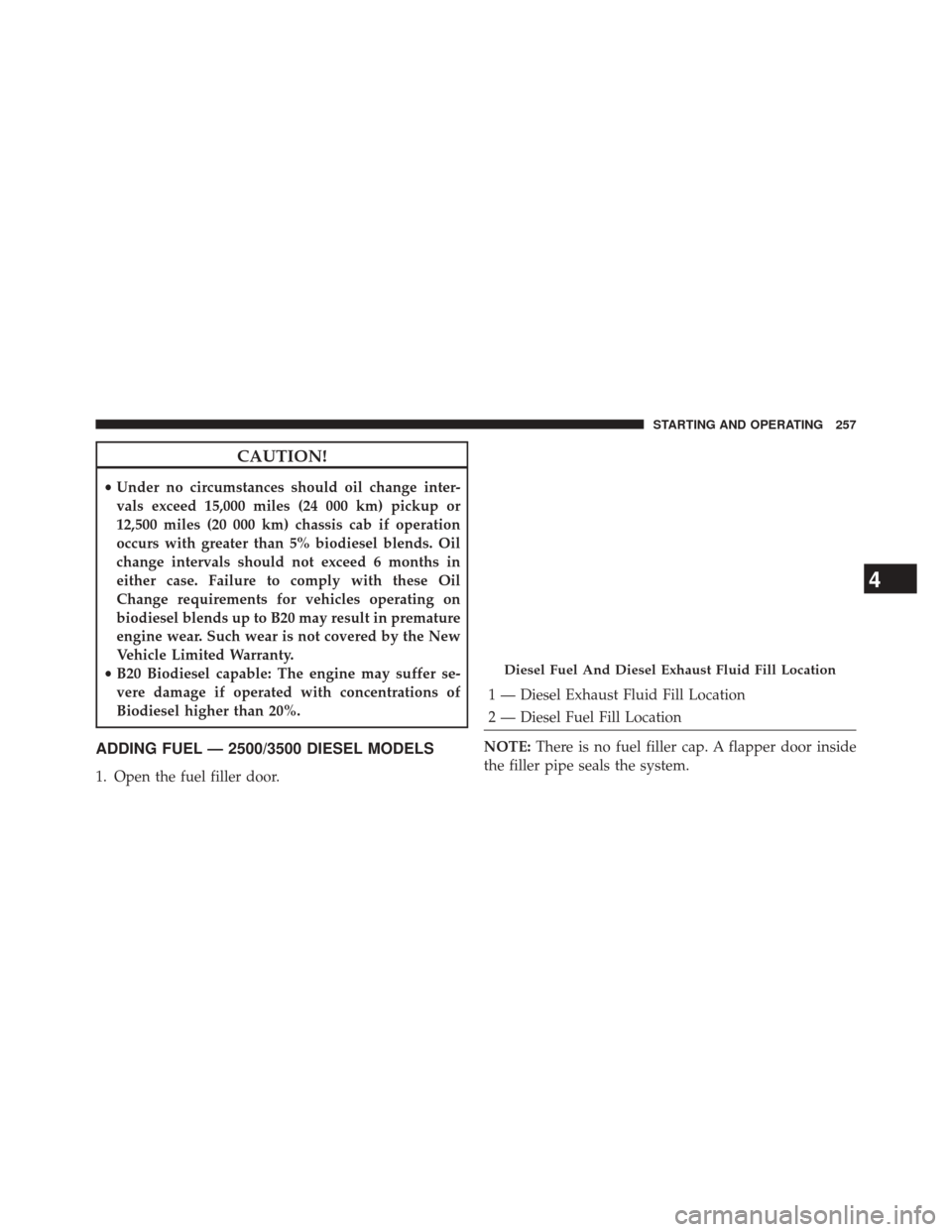
ADDING FUEL — 2500/3500 DIESEL MODELS
1. Open the fuel filler door.
1 — Diesel Exhaust Fluid Fill Location
2 — Diesel Fuel Fill Location
NOTE: There is no fuel filler cap. A flapper door inside
the filler pipe seals the system.
Diesel Fuel And Diesel Exhaust Fluid Fill Location
4
STARTING AND OPERATING 257
Page 283 of 347
Checking the oil while the vehicle is on level ground will
improve the accuracy of the oil level readings. Add oil
only when the level on the dipstick is below the “ADD”
mark. The total capacity from the ADD mark to the Full
mark is 2 qts (1.9L).
CAUTION!
Overfilling or underfilling the crankcase will cause
oil aeration or loss of oil pressure. This could damage
your engine.
Never operate the engine with oil level below the “ADD”
mark or above the upper “SAFE” mark.
Change Engine Oil
Refer to the “Maintenance Schedule” for the proper
maintenance intervals.
Engine Oil Selection
For best performance and maximum protection under all
types of operating conditions, the manufacturer only
recommends engine oils that are API CJ-4 certified and
meet the requirements of FCA US LLC. Use MOPAR or
an equivalent oil meeting FCA US Material Standard
MS-10902. Products meeting Cummins CES 20081 may
also be used. The identification of these engine oils are
typically located on the back of the oil container.
American Petroleum Institute (API) Engine Oil
Identification Symbol
This symbol means that the oil has
been certified by the American Petro-
leum Institute (API). The manufac-
turer only recommends API Certified
engine oils.
6
MAINTAINING YOUR VEHICLE 281
Page 284 of 347
Oils with a high ash content may produce damaging
deposits on cylinder head valves and/or aftertreatment
system damage. A maximum sulfated ash content of 1.00
mass % is recommended for all oil used in the engine.
The same oil change interval is to be followed for
synthetic oil as for petroleum based oil. Also, synthetic oil
must meet the same performance specifications as petro-
leum oil.
CAUTION!
Do not use chemical flushes in your engine oil as the
chemicals can damage your engine. Such damage is
not covered by the New Vehicle Limited Warranty.
Engine Oil Viscosity (SAE Grade)
In ambient temperatures above 0°F (-18°C), we recom-
mend you use SAE 15W-40 engine oil such as MOPAR,
Shell Rotella and Shell Rimula that meets FCA USMaterial Standard MS-10902 and the API CJ-4 engine oil
category is required. Products meeting Cummins CES
20081 may also be used. The identification of these
engine oils is typically located on the back of the oil
container.
In ambient temperatures below 0°F (-18°C), SAE 5W-40
we recommend you use
syntheticengine oil such as
MOPAR, Shell Rotella and Shell Rimula that meets FCA
US Material Standard MS-10902 and the API CJ-4 engine
oil category is required.
CAUTION!
Failure to use SAE 5W-40 synthetic engine oil in
ambient temperatures below 0°F (-18°C) could result
in severe engine damage.
282 MAINTAINING YOUR VEHICLE
Page 285 of 347
Engine oil not designated by the FCA US or Cummins
Material Standards and API CJ-4 should not be used, as
engine and exhaust system durability may be compro-
mised. The engine oil filler cap also shows the recom-
mended engine oil viscosity for your engine. For infor-
mation on engine oil filler cap location, refer to “Engine
Compartment” in “Maintaining Your Vehicle” for further
information.
Synthetic Engine Oils
You may use synthetic engine oils if the recommended oil
quality requirements are met and the recommended
maintenance intervals for oil and filter changes are
followed.
Materials Added To Engine Oil
The manufacturer strongly recommends against the ad-
dition of any additives (other than leak detection dyes) to
the engine oil. Engine oil is an engineered product and its
performance may be impaired by supplemental addi-
tives.
Engine Oil Filter
Refer to “Fluids, Lubricants, and Genuine Parts” in
“Maintaining Your Vehicle” for further information. The
engine oil filter should be changed at every engine oil
change.
6
MAINTAINING YOUR VEHICLE 283
Page 323 of 347
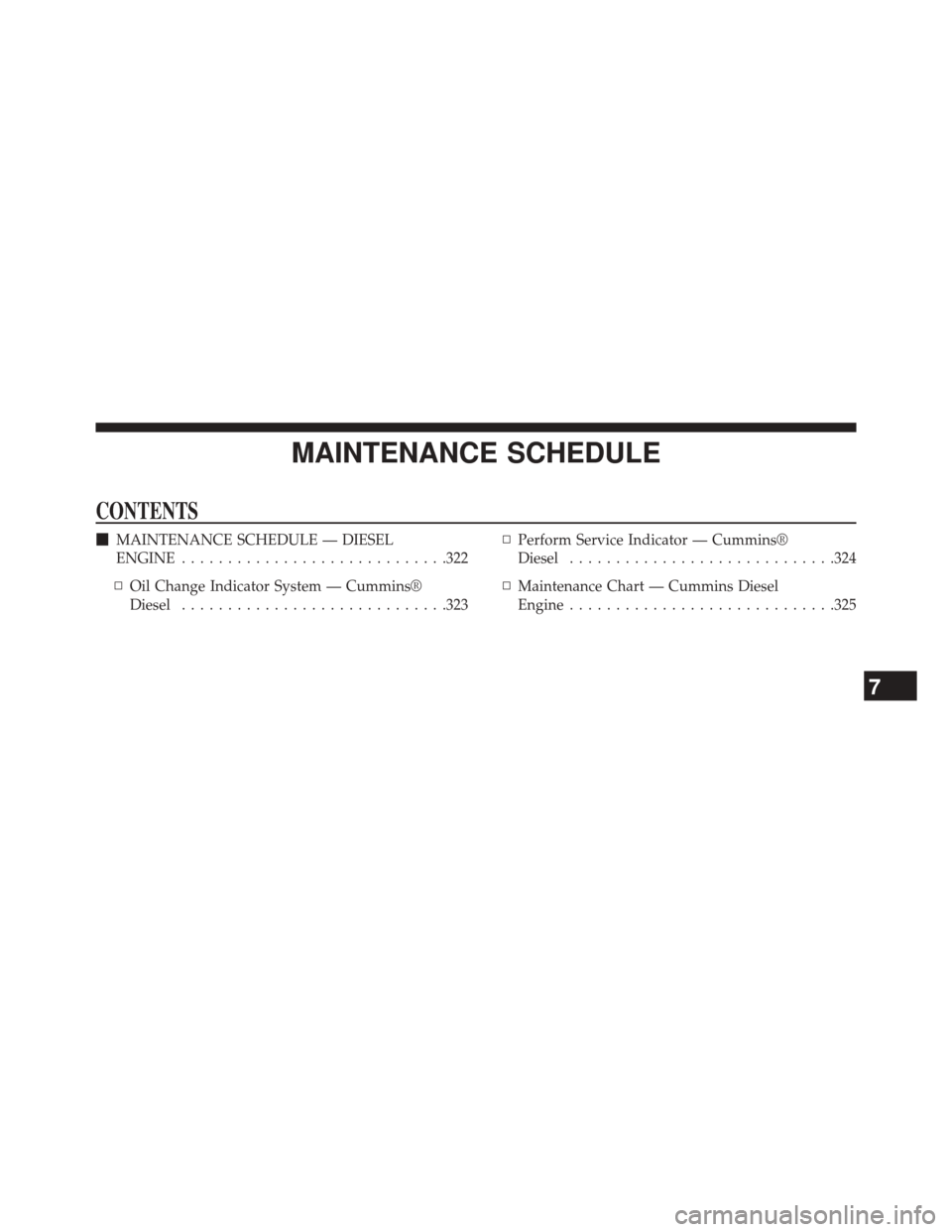
MAINTENANCE SCHEDULE
CONTENTS
�MAINTENANCE SCHEDULE — DIESEL
ENGINE ............................ .322
▫ Oil Change Indicator System — Cummins®
Diesel ............................ .323▫
Perform Service Indicator — Cummins®
Diesel ............................ .324
▫ Maintenance Chart — Cummins Diesel
Engine ............................ .325
7