Page 224 of 348
TRAILER TOWING
Trailer towing with this vehicle is not recommended.
RECREATIONAL TOWING (BEHIND
MOTORHOME, ETC.)
Towing This Vehicle Behind Another Vehicle
NOTE:This vehicle may be towed on a flatbed or
vehicle trailer provided all four wheels areOFFthe
ground.
CAUTION!
•DO NOT flat tow this vehicle. Damage to the
drivetrain will result.
•Do not dolly tow this vehicle. Use of a towing dolly
can cause significant damage to your vehicle. Dam-
age from improper towing is not covered under the
New Vehicle Limited Warranty.
•Towing this vehicle in violation of the above re-
quirements can cause severe transmission damage.
Damage from improper towing is not covered un-
der the New Vehicle Limited Warranty.
222 STARTING AND OPERATING
Page 225 of 348
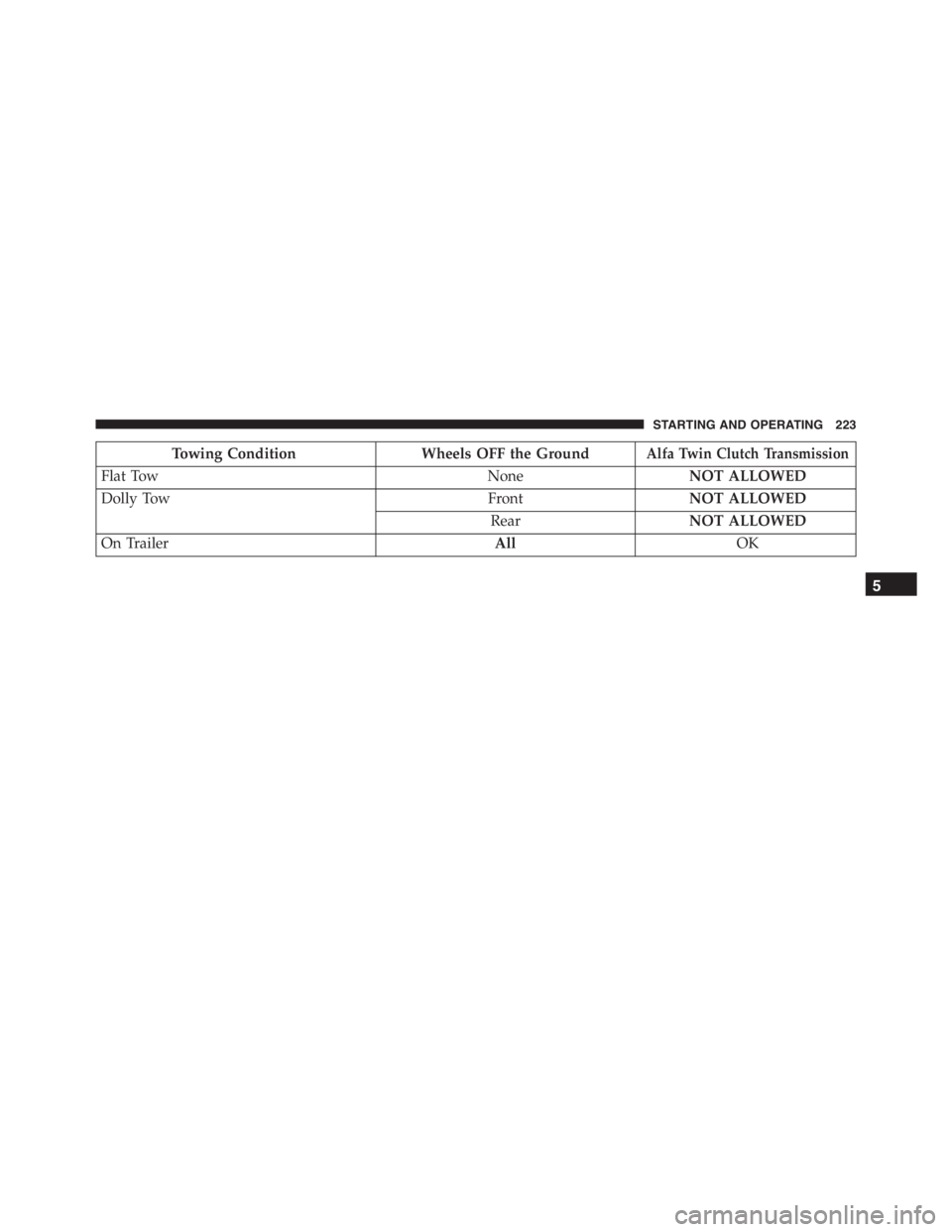
Towing Condition Wheels OFF the GroundAlfa Twin Clutch Transmission
Flat Tow NoneNOT ALLOWED
Dolly Tow FrontNOT ALLOWED
RearNOT ALLOWED
On TrailerAllOK
5
STARTING AND OPERATING 223
Page 227 of 348
WHAT TO DO IN EMERGENCIES
CONTENTS
�HAZARD WARNING FLASHER...........226
�IF YOUR ENGINE OVERHEATS............226
�WHEEL AND TIRE TORQUE
SPECIFICATIONS......................227
▫Torque Specifications...................228
�TIRE SERVICE KIT......................230
�JUMP-STARTING......................234
▫Preparations For Jump-Start..............234▫Jump-Starting Procedure................236
�FREEING A STUCK VEHICLE.............238
�
ENHANCED ACCIDENT RESPONSE SYSTEM . .240
�FRONT TOW EYE USAGE................242
�FIRE EXTINGUISHER — IF EQUIPPED.......2456
Page 229 of 348
CAUTION!
Driving with a hot cooling system could damage
your vehicle. If the temperature gauge reads 240°F
(116°C) or greater pull over and stop the vehicle. Idle
the vehicle with the air conditioner turned off until
the coolant temperature drops back into the normal
range 200–230°F (93–110°C). The digital warning light
may switch on (together with a message on the
display) to indicate that the coolant temperature is
too high; in this case, stop the engine and call for
service.
WARNING!
You or others can be badly burned by hot engine
coolant (antifreeze) or steam from your radiator. If
you see or hear steam coming from under the hood,
do not open the hood until the radiator has had time
to cool. Never try to open a cooling system pressure
cap when the radiator or coolant bottle is hot.
WHEEL AND TIRE TORQUE SPECIFICATIONS
Proper lug nut/bolt torque is very important to ensure
that the wheel is properly mounted to the vehicle. Any
time a wheel has been removed and reinstalled on the
vehicle the lug nuts/bolts should be torqued using a
properly calibrated torque wrench.
6
WHAT TO DO IN EMERGENCIES 227
Page 230 of 348
Torque Specifications
Lug Nut/Bolt Torque **Lug Nut/
Bolt SizeLug Nut/
Bolt
Socket
Size
72 Ft-Lbs (98 N·m) M12 x 1.25 17 mm
**Use only Alfa Romeo recommended lug nuts/bolts and
clean or remove any dirt or oil before tightening.
Inspect the wheel mounting surface prior to mounting
the tire and remove any corrosion or loose particles.
Tighten the lug nuts/bolts in a star pattern until each
nut/bolt has been tightened twice.
Wheel Mounting Surface
228 WHAT TO DO IN EMERGENCIES
Page 231 of 348
After 25 miles (40 km) check the lug nut/bolt torque to be
sure that all the lug nuts/bolts are properly seated
against the wheel.
WARNING!
To avoid the risk of forcing the vehicle off the jack,
do not tighten the lug nuts fully until the vehicle has
been lowered. Failure to follow this warning may
result in personal injury.
Torque Patterns
6
WHAT TO DO IN EMERGENCIES 229
Page 233 of 348
WARNING!(Continued)
•Do not use Tire Service Kit or drive the vehicle
under the following circumstances:
– If the puncture in the tire tread is approximately
1/4” (6 mm) or larger.
– If the tire has any sidewall damage.
– If the tire has any damage from driving with
extremely low tire pressure.
– If the tire has any damage from driving on a flat
tire.
– If the wheel has any damage.
– If you are unsure of the condition of the tire or
the wheel.
•Keep Tire Service Kit away from open flames or
heat source.
(Continued)
WARNING!(Continued)
•A loose Tire Service Kit thrown forward in a
collision or hard stop could endanger the occupants
of the vehicle. Always stow the Tire Service Kit in
the place provided. Failure to follow these warn-
ings can result in injuries that are serious or fatal to
you, your passengers, and others around you.
•Take care not to allow the contents of Tire Service
Kit to come in contact with hair, eyes, or clothing.
Tire Service Kit sealant is harmful if inhaled,
swallowed, or absorbed through the skin. It causes
skin, eye, and respiratory irritation. Flush immedi-
ately with plenty of water if there is any contact
with eyes or skin. Change clothing as soon as
possible, if there is any contact with clothing.
(Continued)
6
WHAT TO DO IN EMERGENCIES 231
Page 240 of 348
6. Once the engine is started, remove the jumper cables
in the reverse sequence:
Disconnecting The Jumper Cables
1. Disconnect the negative(-)jumper cable from the
engine(-)ground of the vehicle with the discharged
battery.
2. Disconnect the negative end(-)of the jumper cable
from the negative(-)post of the booster battery.
3. Disconnect the opposite end of the positive(+)jumper
cable from the positive(+)post of the booster battery.
4. Disconnect the positive(+)end of the jumper cable
from the positive(+)post of the vehicle with the
discharged battery.
If frequent jump-starting is required to start your vehicle
you should have the battery and charging system in-
spected at your authorized dealer.CAUTION!
Accessories plugged into the vehicle power outlets
draw power from the vehicle’s battery, even when not
in use (i.e., cellular phones, etc.). Eventually, if
plugged in long enough without engine operation,
the vehicle’s battery will discharge sufficiently to
degrade battery life and/or prevent the engine from
starting.
FREEING A STUCK VEHICLE
If your vehicle becomes stuck in mud, sand, or snow, it
can often be moved using a rocking motion. Turn the
steering wheel right and left to clear the area around the
front wheels. Then shift back and forth between DRIVE
and REVERSE while gently pressing the accelerator
pedal. Use the least amount of accelerator pedal pressure
238 WHAT TO DO IN EMERGENCIES