Page 182 of 348
Cornering Brake Control System (CBC)
The system acts when braking on corners, optimizing the
distribution of brake pressure on the four wheels: the
system prevents the wheels on the inside of the corner
(less affected by the weight of the car) from locking,
ensuring better stability and direction for the car.
Drag Torque Control System (DTC)
This is an integral part of the ESC system and intervenes
in the event of sudden downshifting, or during braking
when the ABS intervenes, restoring torque to the engine
and thus preventing excessive drag at the drive wheels,
which may lead the wheels to lock and a loss of car
stability, above all in low-grip conditions.
AntiSlip Regulation System (ASR)
WARNING!
•Electronic Stability Control (ESC) cannot prevent
the natural laws of physics from acting on the
vehicle, nor can it increase the traction afforded by
prevailing road conditions. ESC cannot prevent all
collisions, including those resulting from excessive
speed in turns, driving on very slippery surfaces, or
hydroplaning. ESC also cannot prevent collisions
resulting from loss of vehicle control due to inap-
propriate driver input for the conditions. Only a
safe, attentive, and skillful driver can prevent col-
lisions.The capabilities of an ESC equipped ve-
hicle must never be exploited in a reckless or
dangerous manner which could jeopardize the us-
er ’s safety or the safety of others.
(Continued)
180 STARTING AND OPERATING
Page 184 of 348
Hill Start Assist (HSA)
This is an integral part of the ESC system and facilitates
starting on slopes, activating automatically in the follow-
ing cases:
•Uphill: car stationary on a road with a gradient higher
than 5%, engine running, brake pressed and transmis-
sion in neutral (N) or gear other than reverse engaged.
•Downhill: car stationary on a road with a gradient
higher than 5%, engine running, brake pressed and
reverse (R) gear engaged.
When setting off, the ESC system control unit maintains
the braking pressure on the wheels until the engine
torque necessary for starting is reached, or in any case for
a maximum of two seconds, allowing your right foot to
be moved easily from the brake pedal to the accelerator.When the two seconds have elapsed, without starting,
the system is automatically deactivated, gradually releas-
ing the braking pressure. During this release stage, the
typical brake disengagement noise, indicating that the
car is going to move imminently, can be heard.
NOTE:
•HSA is not a parking brake; therefore, never leave the
vehicle without having engaged the parking brake,
turned the engine off and engaged first gear, so that
the vehicle is parked in safe conditions.
•There may be situations on small gradients (less than
8%), with vehicle laden, in which the Hill Holder
system may not activate, causing a slight reversing
motion and increasing the risk of collision with an-
other vehicle or object. The driver is, in any case,
responsible for safe driving.
182 STARTING AND OPERATING
Page 185 of 348
Hydraulic Brake Assistant System (HBA)
WARNING!
•The HBA system can’t overrule the natural laws of
physics, and can’t increase the grip available ac-
cording to the condition of the road.
•The HBA system cannot prevent accidents, includ-
ing those due to excessive speed on corners, driv-
ing on low-grip surfaces or aquaplaning.
•The capability of the HBA system must never be
tested irresponsibly and dangerously, in such a
way as to compromise the safety of the driver, the
other occupants of the car or any other road user.
The HBA system is designed to improve the car ’s braking
capacity during emergency braking. The system detects
emergency braking by monitoring the speed and force
with which the brake pedal is pressed, and consequentlyapplies the optimal brake pressure. This can reduce the
braking distance, the HBA system therefore completes
the ABS.
Maximum assistance from the HBA system is obtained
pressing the brake pedal very quickly. In addition, the
brake pedal should be pressed continuously during
braking, avoiding intermittent presses, to get the most
out of the system.
Do not reduce pressure on the brake pedal until braking
is no longer necessary.
The HBA system is deactivated when the brake pedal is
released.
5
STARTING AND OPERATING 183
Page 186 of 348
Electronic Q2 System (E-Q2)
The�Electronic Q2�system intervenes during accelera-
tion on corners, braking the inner drive wheel and thus
increasing the traction of the outer wheel (which bears
more of the car ’s weight): the torque is thus distributed
optimally between the drive wheels in accordance with
the driving conditions and road surface, permitting par-
ticularly effective, sporty driving.
Ready Alert Brake System (RAB)
This function activates automatically if the accelerator
pedal is released rapidly, reducing the brake pad travel
(both at front and back), with the aim of preparing the
braking system and enhancing its responsiveness, thus
reducing the stopping distance in the event of subse-
quent braking.
TIRE SAFETY INFORMATION
Tire Markings
1 — U.S. DOT Safety Standards
Code (TIN)4 — Maximum Load
2 — Size Designation 5 — Maximum Pressure
3 — Service Description 6 — Treadwear, Traction and
Temperature Grades 184 STARTING AND OPERATING
Page 237 of 348
WARNING!
•Remove any metal jewelry such as rings, watch
bands and bracelets that could make an inadvertent
electrical contact. You could be seriously injured.
(Continued)
WARNING!(Continued)
•Batteries contain sulfuric acid that can burn your
skin or eyes and generate hydrogen gas which is
flammable and explosive. Keep open flames or
sparks away from the battery.
NOTE:Be sure that the disconnected ends of the cables
do not touch while still connected to the other vehicle.
1. Firmly apply the parking brake, and turn the ignition
OFF.
2. Turn off the heater, radio, and all unnecessary electri-
cal accessories.
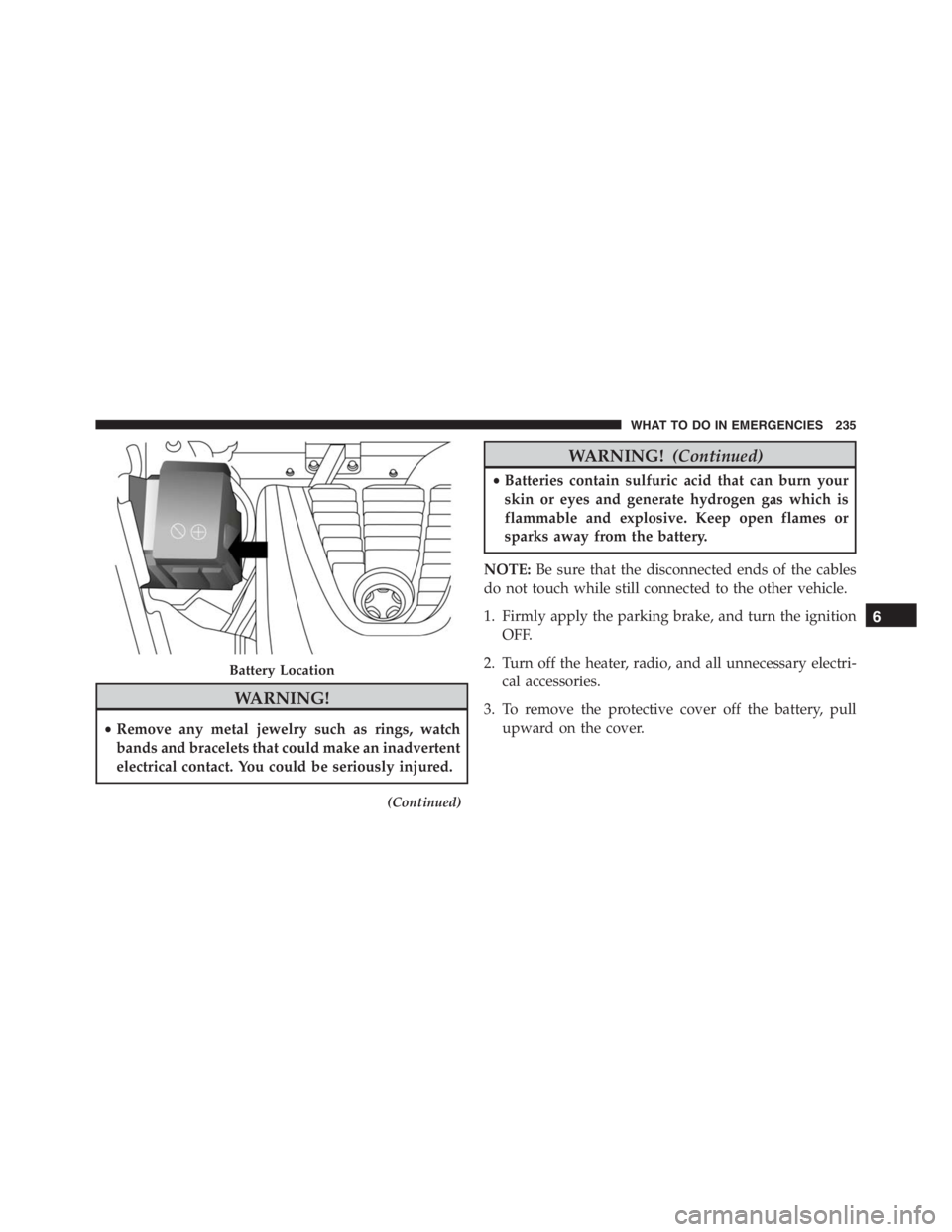
3. To remove the protective cover off the battery, pull
upward on the cover.
Battery Location
6
WHAT TO DO IN EMERGENCIES 235
Page 238 of 348
4. If using another vehicle to jump-start the battery, park
the vehicle within the jumper cables reach, set the
parking brake and make sure the ignition is OFF.
WARNING!
Do not allow vehicles to touch each other as this
could establish a ground connection and personal
injury could result.
Jump-Starting Procedure
WARNING!
Failure to follow this jump-starting procedure could
result in personal injury or property damage due to
battery explosion.
CAUTION!
Failure to follow these procedures could result in
damage to the charging system of the booster vehicle
or the discharged vehicle.
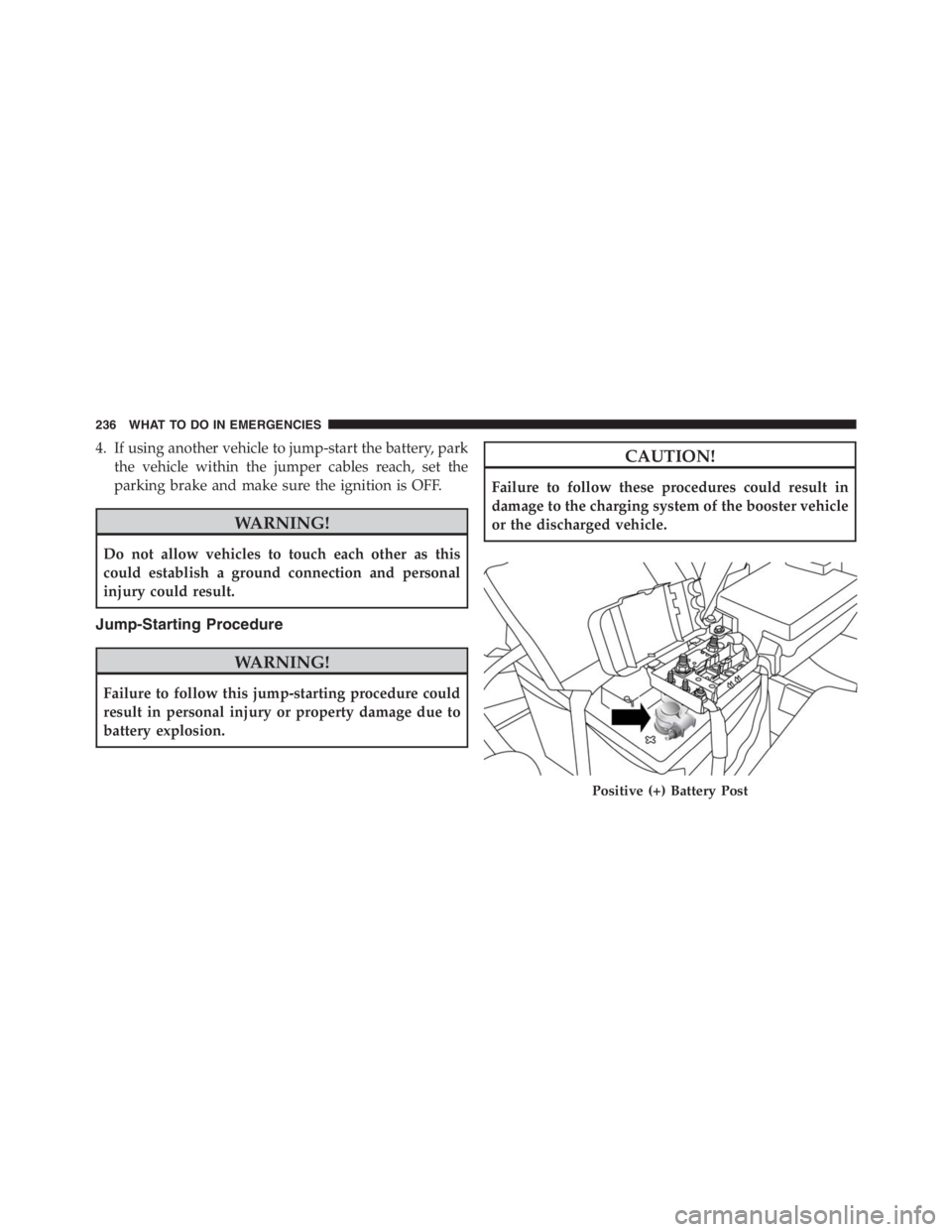
Positive (+) Battery Post
236 WHAT TO DO IN EMERGENCIES
Page 249 of 348
MAINTAINING YOUR VEHICLE
CONTENTS
�ENGINE COMPARTMENT — 1.750 TURBO . . .249
�ONBOARD DIAGNOSTIC SYSTEM — OBD II . .250
�REPLACEMENT PARTS..................250
�DEALER SERVICE......................251
�MAINTENANCE PROCEDURES...........251
▫Engine Oil..........................252
▫Engine Oil Filter......................254
▫Engine Air Cleaner Filter................254
▫Engine Cover........................255
▫Maintenance-Free Battery...............256▫Air Conditioner Maintenance.............257
▫Body Lubrication.....................258
▫Wiper Blades........................259
▫Windshield Washer Nozzles..............261
▫Adding Washer Solvent.................262
▫Exhaust System......................265
▫Cooling System......................268
▫Brake System........................274
▫Alfa Twin Clutch Transmission...........278
7
Page 250 of 348
▫Appearance Care And Protection From
Corrosion...........................280
�FUSES..............................287
▫Engine Compartment Fuses..............288
▫Dashboard Fuse Box...................290
�VEHICLE STORAGE....................292
�REPLACEMENT BULBS.................292
�BULB REPLACEMENT..................294
▫Front Light Clusters...................294
▫Front Side Marker.....................299
▫Rear Light Clusters....................300
▫Direction Indicators...................300▫Tail Lights/Brake Lights................301
▫Reversing Light......................301
▫Third Brake Lights....................302
▫License Plate Lights...................303
▫Roof Light..........................304
▫Luggage Compartment Roof Light.........305
�FLUID CAPACITIES....................306
�
FLUIDS, LUBRICANTS AND GENUINE PARTS . .307
▫Engine.............................307
▫Chassis............................309
248 MAINTAINING YOUR VEHICLE