2015 Peugeot 308 automatic brake
[x] Cancel search: automatic brakePage 163 of 416
161
308_en_Chap04_conduite_ed01-2015
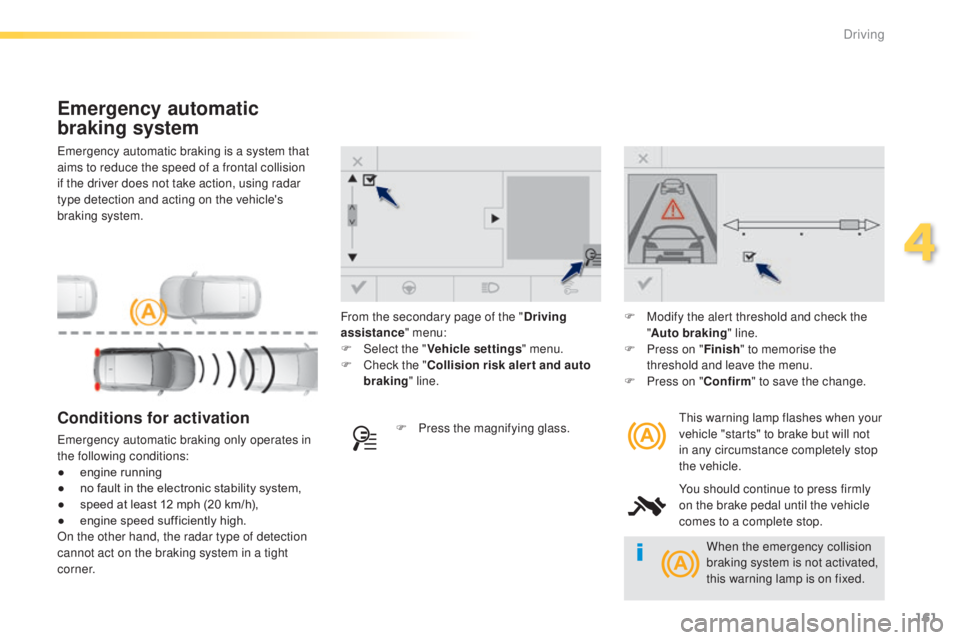
emergency automatic braking is a system that
aims to reduce the speed of a frontal collision
if the driver does not take action, using radar
type detection and acting on the vehicle's
braking system.
Emergency automatic
braking system
this warning lamp flashes when your
vehicle "starts" to brake but will not
in any circumstance completely stop
the vehicle.
You should continue to press firmly
on the brake pedal until the vehicle
comes to a complete stop.Conditions for activation
emergency automatic braking only operates in
the following conditions:
●
e
ngine running
●
n
o fault in the electronic stability system,
●
s
peed at least 12 mph (20 km/h),
●
e
ngine speed sufficiently high.
On the other hand, the radar type of detection
cannot act on the braking system in a tight
c o r n e r. F
P ress the magnifying glass.F
M
odify the alert threshold and check the
" Auto braking " line.
F
P
ress on "
Finish" to memorise the
threshold and leave the menu.
F
P
ress on "
Confirm" to save the change.
From the secondary page of the "
Driving
assistance " menu:
F
Sel
ect the "
Vehicle settings " menu.
F
C
heck the "
Collision risk alert and auto
braking " line.
When the emergency collision
braking system is not activated,
this warning lamp is on fixed.
4
Driving
Page 203 of 416
201
308_en_Chap06_securite_ed01-2015
electronic Stability Control (eSC) incorporating
the following systems:
-
a
nti-lock braking system (ABS) and the
electronic brake force distribution (
eB
FD),
-
em
ergency braking assistance (
eBA
),
-
w
heel anti-slip regulation (ASR) or traction
control,
-
d
ynamic stability control (DSC).
electronic stability control (eS C)
Definitions
Anti-lock braking system (ABS)
and electronic brake force
distribution (EBFD)
this system improves the stability and
manoeuvrability of your vehicle when braking
and contributes towards improved control in
corners, in particular on poor or slippery road
surfaces.
th
e ABS prevents wheel lock in the event of
emergency braking.
th
e electronic brake force distribution system
manages the braking pressure wheel by wheel.
Emergency braking assistance
(EBA)
In an emergency, this system enables you to
reach the optimum braking pressure more
quickly and therefore reduce the stopping
distance.
It is triggered according to the speed at which
the brake pedal is pressed.
t
h
is is felt by a
reduction in the resistance of the pedal and an
increase in the effectiveness of the braking.
Anti-slip regulation (ASR)
the ASR system (also known as tr action
Control) optimises traction in order to limit
wheel slip by acting on the brakes of the driving
wheels and on the engine. It also improves
the directional stability of the vehicle on
acceleration.
Dynamic stability control (DSC)
If there is a difference between the path
followed by the vehicle and that required by
the driver, the DSC monitors each wheel and
automatically acts on the brake of one or more
wheels and on the engine to return the vehicle
to the required path, within the limits of the laws
of physics.
6
Safety
Page 205 of 416
203
308_en_Chap06_securite_ed01-2015
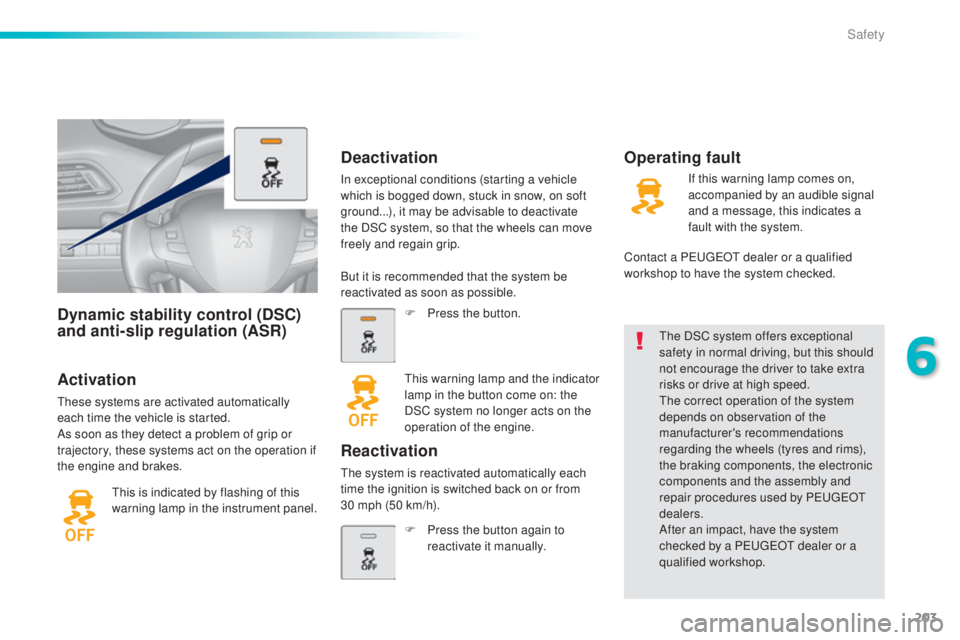
Dynamic stability control (DSC)
and anti-slip regulation (ASR)
Activation
these systems are activated automatically
each time the vehicle is started.
As soon as they detect a problem of grip or
trajectory, these systems act on the operation if
the engine and brakes.
th
is is indicated by flashing of this
warning lamp in the instrument panel.
th
e DSC system offers exceptional
safety in normal driving, but this should
not encourage the driver to take extra
risks or drive at high speed.th e correct operation of the system
depends on observation of the
manufacturer's recommendations
regarding the wheels (tyres and rims),
the braking components, the electronic
components and the assembly and
repair procedures used by P
e
uge
Ot
dealers.
After an impact, have the system
checked by a P
e
uge
Ot
dealer or a
qualified workshop.
Deactivation
In exceptional conditions (starting a vehicle
which is bogged down, stuck in snow, on soft
ground...), it may be advisable to deactivate
the DSC system, so that the wheels can move
freely and regain grip.
Operating fault
But it is recommended that the system be
reactivated as soon as possible.
F
P
ress the button.
th
is warning lamp and the indicator
lamp in the button come on: the
DSC system no longer acts on the
operation of the engine.
Reactivation
the system is reactivated automatically each
time the ignition is switched back on or from
30
mph (50 km/h). F
P
ress the button again to
reactivate it manually. If this warning lamp comes on,
accompanied by an audible signal
and a message, this indicates a
fault with the system.
Contact a P
e
uge
Ot
dealer or a qualified
workshop to have the system checked.
6
Safety
Page 240 of 416

238
308_en_Chap07_info-pratiques_ed01-2015
F Remove the bolt cover from each of the bolts using the tool 3 (according to
equipment).
F
F
it the security socket 4 on the
wheelbrace
1 to slacken the security bolt
(if
fitted).
F
S
lacken the other bolts using the
wheelbrace 1 o n l y. F
P osition the foot of the jack on the ground,
ensuring that it is directly below the
vehicle's jacking point A or B , the one
closest to the wheel to be changed.
Removing a wheel
Parking the vehicle
Immobilise the vehicle where it does not
block traffic: the ground must be level,
stable and not slippery.
Apply the parking brake unless it has
been programmed to automatic mode,
switch off the ignition and engage first
gear to block the wheels.
Check that the braking warning lamp
and the P warning lamp in the parking
brake control lever come on.
th
e occupants must get out of the
vehicle and wait where they are safe.
Never go underneath a vehicle raised
using a jack; use an axle stand.
Do not use:
-
t
he jack for any other purpose than lifting
the vehicle,
-
a j
ack other than the one supplied by the
manufacturer.
en
sure that the jack is stable. If the ground is slippery or loose, the jack may slip or drop -
Risk of injury!
en
sure that the jack is positioned only at one of the jacking points A or B under the vehicle,
making sure that the vehicle's contact sur face is centred on the head of the jack. Other wise
there is a risk of damage to the vehicle and/or of the jack dropping - Risk of injury!
Practical information
Page 271 of 416

269
308_en_Chap07_info-pratiques_ed01-2015
Driving advice
Distribution of loads
F Distribute the load in the trailer so that the heaviest items are as close as possible to
the axle and the nose weight approaches
the maximum permitted without
exceeding
it.
Air density decreases with altitude, thus
reducing engine performance. Above
1
000 metres, the maximum towed load must
be reduced by 10
% for every 1 000 metres of
altitude.
Side wind
F take into account the increased sensitivity to side wind.
Cooling
towing a trailer on a slope increases the
temperature of the coolant.
As the fan is electrically controlled, its cooling
capacity is not dependent on the engine speed.
F
t
o l
ower the engine speed, reduce your
speed.
th
e maximum towed load on a long incline
depends on the gradient and the ambient
temperature.
In all cases, keep a check on the coolant
temperature.
F
I
f the warning lamp and the
STOP warning lamp come on,
stop the vehicle and switch off
the engine as soon as possible.
Braking
towing a trailer increases the braking distance.to a void overheating of the brakes on a long
mountain type of descent, the use of engine
braking is recommended.
Ty r e s
F Check the tyre pressures of the towing vehicle and of the trailer, observing the
recommended pressures.
Lighting
F Check the electrical lighting and signalling on the trailer.
Refer to the "
te
chnical data" section for
details of the weights and towed loads
which apply to your vehicle.
th
e rear parking sensors will be
deactivated automatically if a genuine
P
e
uge
Ot
towbar is used.
7
Practical information
Page 294 of 416
292
308_en_Chap08_verifications_ed01-2015
Manual gearbox
the gearbox does not require any
maintenance (no oil change).
Refer to the manufacturer's service
schedule for the checking interval for
this component.Brake wear depends on the style
of driving, particularly in the case
of vehicles used in town, over short
distances. It may be necessary to
Brake pads
For information on checking brake
disc wear, contact a Pe
ugeOt
dealer or a qualified workshop.
Brake disc wear Electric parking brake
this system does not require any
routine servicing. However, in the
event of a problem, have the system
checked by a P
e
uge
Ot
dealer or a
qualified workshop.
Only use products recommended by
P
e
uge
Ot
or products of equivalent
quality and specification.
In order to optimise the operation of
units as important as those in the
braking system, P
e
uge
Ot
selects and
offers very specific products.
After washing the vehicle, dampness,
or in wintry conditions, ice can form
on the brake discs and pads: braking
efficiency may be reduced. Make light
brake applications to dry and defrost
the brakes.
Parking brake
If excessive travel or a loss of
effectiveness of this system is
noticed, the parking brake must be
checked, even between two services.
Checking this system must be done by a
P
e
uge
Ot
dealer or a qualified workshop. have the condition of the brakes checked, even
between vehicle services.
un
less there is a leak in the circuit, a drop in
the brake fluid level indicates that the brake
pads are worn. For more information, refer to the "
el
ectric
parking brake - Operating faults" section.
Automatic gearbox
the gearbox does not require any
maintenance (no oil change).
Refer to the manufacturer's service
schedule for details of the level
checking interval for this component.
Checks
Page 397 of 416

395
230 V socket .............................................8 8, 92
Audio streaming (Bluetooth) .........3
18, 321, 387
Automatic braking on risk of collision
.........................................22, 158, 161
Automatic emergency braking
..............15 8, 161
Automatic illumination of headlamps
......................................182, 18 6
Automatic operation of hazard warning lamps
..............................
............................195
Automatic rain sensitive windscreen wipers
...............
..................................189, 191
Auxiliary
................................................318, 322
Auxiliary socket
.......................91, 318, 322, 384 Capacity, fuel tank ..............................
............
76
CD .........................................................318, 378
CD MP3
.................................................318, 379
Central locking
..............................52, 57, 59, 68
Changing a bulb
....................................243-252
Changing a fuse
....................................253-258
Changing a wheel
.................................2 3 5 - 2 41
Changing a wiper blade
...................................................192, 26 4
Changing the date
.........................46, 47, 48, 49
Changing the remote control battery .........................................56, 66
Changing the time
...............................46, 47, 49
Checking levels
..................................... 2
88-290
Checking the engine oil level
..................................................32, 288
Checking tyre pressures (using the kit)
..............................
................234
Checks
...............
...................276, 277, 291, 292
Child lock
...............................
........................228
Children
...............................
..206, 208, 212-228
Child seats
..............................
..............212-2 27
Child seats, conventional
..............................218
Child seats, ISOFIX
......................
221, 223, 224
Closing the boot
..............................................63
Closing the doors
................................52, 58 - 60
Cold climate screen
.........................................................267
Collision risk alert
..............................
...........15 8
Colour screen
...............................
........302, 303
Connectors, audio
.......... 9
1, 318, 322, 382, 384
Container, AdBlue
.........................................286
Coolant level
...........................................28, 289
Coolant temperature indicator
........................................................28
Courtesy lamps
.............................................193
Cruise control
........................................ 13
9, 14 3
Cruise control active
.............................13 9, 14 6
Cup holder
...............................
........................88
B
C
Battery ........................................... 259 -262, 291
Battery, charging ........................................... 262
Battery, remote control
............................. 5
6, 66
Bicycle carrier
............................................... 271
Blind spot sensors
.................................. 16, 163
BlueHDi
......................................................... 279
Bluetooth (hands-free)
......................... 3
60, 385
Bluetooth (telephone)
...........................360, 385
Bonnet
........................................................... 275
Bonnet stay
................................................... 275
Boot
........................................................... 61, 62
Brake discs
.................................................... 2
92
Brake lamps
...............................
...........248, 250
Brake pads
.................................................... 292
Braking system warning lamp
................................................ 21
Accessories
..........................................
271, 272
Accessory position
.......................................
117
Accessory socket, 12V
.............................
88, 91
AdBlue
® ............................... ..........................279
Additive, AdBlue .............................. 26, 279-286
Adjusting headlamps
.................................... 188
Adjusting head restraints
................................ 83
Adjusting the steering wheel
..........................79
Advice on driving
.......................................... 112
Affaire version
............................................... 295
Airbags
.................................................... 23, 207
Airbags, curtain
..................................... 21
0, 211
Airbags, front ......................................... 208, 211
Airbags, lateral
...................................... 210, 211
Air conditioning
....................... 10, 102, 104, 108
Air conditioning, digital
................................. 105
Air conditioning, manual
.......................101, 103
Air distribution adjustment
............102, 104, 107
Air filter
.......................................................... 291
Air flow adjustment
....................... 101, 103, 107
Air intake
....................................................... 109
Air recirculation
..................................... 102, 109
Air vents
.......................................................... 99
Alarm
............................................................... 69
Anti-theft
................................................. 5 4 , 11 9
Armrest, front
............................................ 88, 90
Armrest, rear
................................................... 93
A
ssistance call
.............................. 196, 297, 298
Audible warning
............................................ 19 6
Audio cable
................................... 321, 322, 323
A
.
Alphabetical index
Page 412 of 416
2
Safety
308GTi_en_Chap06_securite_ed01-2015
Electronic Stability Control (ESC) incorporating the following systems: - anti-lock braking system (ABS) and the electronic brake force distribution (EBFD), - emergency braking assistance (EBA), - wheel anti-slip regulation (ASR) or traction control, - dynamic stability control (DSC).
Electronic stability control (ESC)
Definitions
Anti-lock braking system (ABS) and electronic brake force distribution (EBFD)
This system improves the stability and manoeuvrability of your vehicle when braking and contributes towards improved control in corners, in particular on poor or slippery road surfaces. The ABS prevents wheel lock in the event of emergency braking. The electronic brake force distribution system manages the braking pressure wheel by wheel.
Emergency braking assistance (EBA)
In an emergency, this system enables you to reach the optimum braking pressure more quickly and therefore reduce the stopping distance. It is triggered according to the speed at which the brake pedal is pressed. This is felt by a reduction in the resistance of the pedal and an increase in the effectiveness of the braking.
Anti-slip regulation (ASR)
The ASR system (also known as Traction Control) optimises traction in order to limit wheel slip by acting on the brakes of the driving wheels and on the engine. It also improves the directional stability of the vehicle on acceleration.
Dynamic stability control (DSC)
If there is a difference between the path followed by the vehicle and that required by the driver, the DSC monitors each wheel and automatically acts on the brake of one or more wheels and on the engine to return the vehicle to the required path, within the limits of the laws of physics.