Page 155 of 285
153
301_en_Chap09_info-pratiques_ed01-2014
Towing your vehicleTowing another vehicle
F On the front bumper, unclip the cover by
pressing on the left edge.
F
S
crew the towing eye in fully.
F
I
nstall the towing bar. Put the gear lever into neutral
(position
N for an electronic or
automatic gearbox).
Failure to follow this instruction may
cause damage to some components
(braking, transmission...) and the
absence of braking assistance when
the engine is restarted.
F U nlock the steering by turning the key
in the ignition one notch and release the
parking brake.
F
S
witch on the hazard warning lamps on
both vehicles.
F
M
ove off gently, drive slowly and for a short
distance. This towing is strictly prohibited (risk of
damaging your vehicle).
9
Practical information
Page 157 of 285

155
301_en_Chap09_info-pratiques_ed01-2014
Driving advice
Distribution of loads
F Distribute the load in the trailer so that the heaviest items are as close as possible to
the axle and the nose weight approaches the
maximum permitted without exceeding it.
Air density decreases with altitude, thus
reducing engine performance. Above
1
000 metres, the maximum towed load must
be reduced by 10
% for every 1 000 metres of
altitude.
Side wind
F Take into account the increased sensitivity to side wind.
Cooling
Towing a trailer on a slope increases the
temperature of the coolant.
As the fan is electrically controlled, its cooling
capacity is not dependent on the engine speed.
F
T
o lower the engine speed, reduce your
speed.
The maximum towed load on a long incline
depends on the gradient and the ambient
temperature.
In all cases, keep a check on the coolant
temperature.
F
I
f the warning lamp and the
STOP warning lamp come on,
stop the vehicle and switch off
the engine as soon as possible.
Braking
Towing a trailer increases the braking distance.
To avoid overheating of the brakes on a long
mountain type of descent, the use of engine
braking is recommended.
Ty r e s
F Check the tyre pressures of the towing vehicle and of the trailer, observing the
recommended pressures.
Lighting
F Check the electrical lighting and signalling on the trailer.
Refer to the "Technical data" section for details
of the weights and towed loads which apply to
your vehicle.
The rear parking sensors will be
deactivated automatically if a genuine
PEUGEOT towbar is used.
9
Practical information
Page 160 of 285

158
301_en_Chap09_info-pratiques_ed01-2014
* To avoid any risk of jamming of the pedals:
-
e
nsure that the mat is positioned and
secured correctly,
-
n
ever fit one mat on top of another.
"Protection":
mats*, seat covers, alarm, front and rear mud
flaps, boot liner, boot carpet, side rubbing
strips, bumper protective strips, transparent
boot sill protector, shield under engine...
The fitting of electrical equipment or
accessories which are not recommended
by PEUGEOT may result in a failure of
your vehicle's electronic system and
excessive electrical consumption.
Contact a PEUGEOT dealer
for information on the range of
recommended equipment and
accessories.
Installation of radio
communication transmitters
Before installing any after-market radio
communication transmitter, you can
contact a PEUGEOT dealer for the
specification of transmitters which can
be fitted (frequency, maximum power,
aerial position, specific installation
requirements), in line with the Vehicle
Electromagnetic Compatibility
Directive (2004/104/EC).Depending on the legislation in force in
the country, certain safety equipment
may be compulsory: high visibility
safety vests, warning triangles,
breathalyzers, spare bulbs, spare fuses,
fire extinguisher, first aid kit, mud flaps
at the rear of the vehicle.
By visiting a PEUGEOT dealer, you can also
obtain products for cleaning and maintenance
(exterior and interior) - including ecological
products in the "TECHNATURE" range, topping
up products (screenwash...), touch-up pens
and paint aerosols for the exact colour of your
vehicle, refills (cartridge for the temporary
puncture repair kit...), ...
"Multimedia":
audio systems, portable satellite and semi-
integral navigation systems, fixed and
Bluetooth hands-free kit, universal solar
charger, speakers and wiring, 230 V socket,
rear multimedia bracket, telephone bracket...
Practical information
Page 163 of 285

161
301_en_Chap10_verifications_ed01-2014
PEUGEOT & TOTAL,
A PARTNERSHIP TO DELIVER
B
ETTER
PERFORMANCE
!
Innovation, the key to success
The TOTAL Research and Development and
PEUGEOT teams work together to develop high
quality lubricants that meet the requirements
of PEUGEOT vehicles. For you, this is the
assurance that the performance of your engine
is optimised while also ensuring its durability.
The 208 HYbrid FE demonstrates the ability of
PEUGEOT and TOTAL to develop innovative
technologies and provide other ways of moving
towards the future.
208 HYbrid FE, a technology demonstrator with exceptional characteristics:
1.9 l/100 km (148.7 mpg) and 0 to 100 km/h (0 to 62 mph) in 8 seconds.
Reduced exhaust emissions,
a true reality
TOTAL lubricants are formulated to optimise the
efficiency of engines and the protection of the
emissions post-treatment systems. It is important
to observe the servicing recommendations
made by PEUGEOT to assure correct operation.
RECOMMENDS
10
Checks
Page 164 of 285
162
301_en_Chap10_verifications_ed01-2014
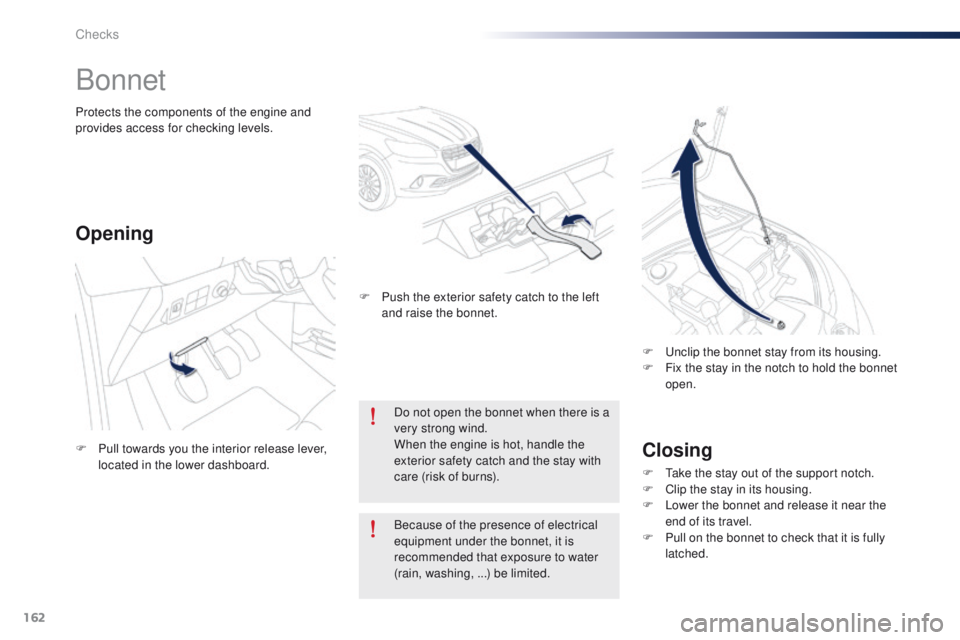
Bonnet
Closing
F Take the stay out of the support notch.
F C lip the stay in its housing.
F
L
ower the bonnet and release it near the
end of its travel.
F
P
ull on the bonnet to check that it is fully
latched.
F
U
nclip the bonnet stay from its housing.
F
F
ix the stay in the notch to hold the bonnet
open.
Do not open the bonnet when there is a
very strong wind.
When the engine is hot, handle the
exterior safety catch and the stay with
care (risk of burns).
Opening
F Push the exterior safety catch to the left and raise the bonnet.
F
P
ull towards you the interior release lever,
located in the lower dashboard.
Protects the components of the engine and
provides access for checking levels.
Because of the presence of electrical
equipment under the bonnet, it is
recommended that exposure to water
(rain, washing, ...) be limited.
Checks
Page 165 of 285
163
301_en_Chap10_verifications_ed01-2014
Petrol engines
1. Screenwash fluid reservoir.
2. Coolant header tank.
3.
A
i r f i l t e r.
4.
B
rake fluid reservoir.
5.
Battery.
6.
Fusebox.
7.
E
ngine oil dipstick.
8.
E
ngine oil filler cap.
To avoid damaging the electrical units,
never use a high pressure jet wash in
the engine compartment.
10
Checks
Page 166 of 285
164
301_en_Chap10_verifications_ed01-2014
To avoid damaging the electrical units,
never use a high pressure jet wash in
the engine compartment.
Diesel engine
1. Screenwash fluid reservoir.
2. Coolant header tank.
3.
A
i r f i l t e r.
4.
B
rake fluid reservoir.
5.
Battery.
6.
Fusebox.
7.
E
ngine oil dipstick.
8.
E
ngine oil filler cap.
9.
P
riming pump.
Checks
Page 167 of 285
165
301_en_Chap10_verifications_ed01-2014
Checking levels
Oil level
The check of the oil level is carried
out with the dipstick, located under
the bonnet. For the position of the dipstick,
refer to the under-bonnet view on a previous
page.
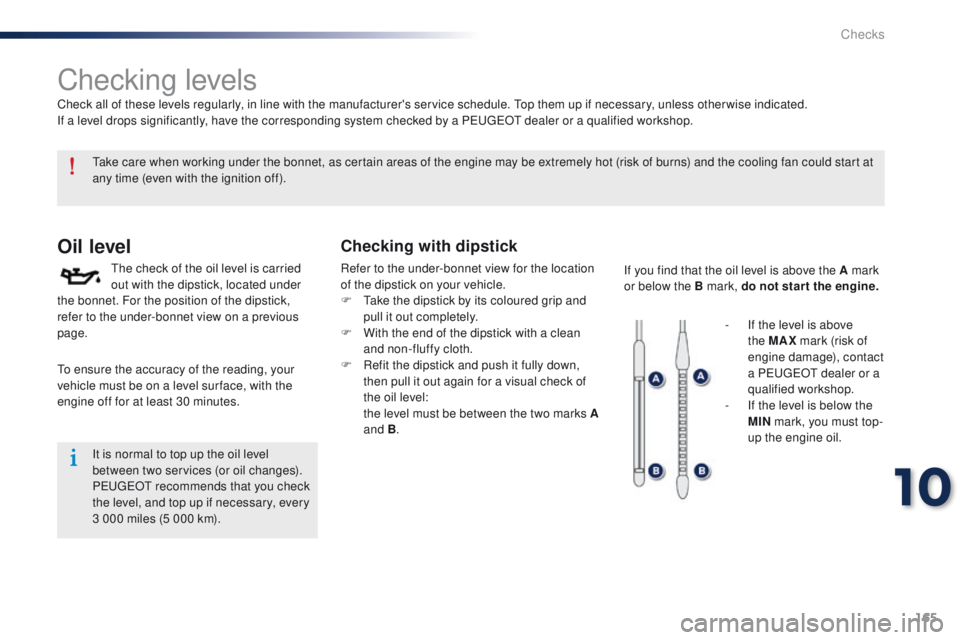
Checking with dipstick
Refer to the under-bonnet view for the location
of the dipstick on your vehicle.
F
T
ake the dipstick by its coloured grip and
pull it out completely.
F
W
ith the end of the dipstick with a clean
and non-fluffy cloth.
F
R
efit the dipstick and push it fully down,
then pull it out again for a visual check of
the oil level:
the level must be between the two marks
A
and B . If you find that the oil level is above the A mark
or below the B mark, do not star t the engine.
Take care when working under the bonnet, as certain areas of the engine may be extremely hot (risk of burns) and the cooling fan could start at
any time (even with the ignition off).
Check all of these levels regularly, in line with the manufacturer's service schedule. Top them up if necessary, unless other wise indicated.
If a level drops significantly, have the corresponding system checked by a PEUGEOT dealer or a qualified workshop.
It is normal to top up the oil level
between two services (or oil changes).
PEUGEOT recommends that you check
the level, and top up if necessary, every
3 000 miles (5 000 km).
To ensure the accuracy of the reading, your
vehicle must be on a level sur face, with the
engine off for at least 30 minutes.
-
I
f the level is above
the MAX mark (risk of
engine damage), contact
a PEUGEOT dealer or a
qualified workshop.
-
I
f the level is below the
MIN mark, you must top-
up the engine oil.
10
Checks