Page 52 of 341
50
208_en_Chap03_Indicateurs_ed01-2015
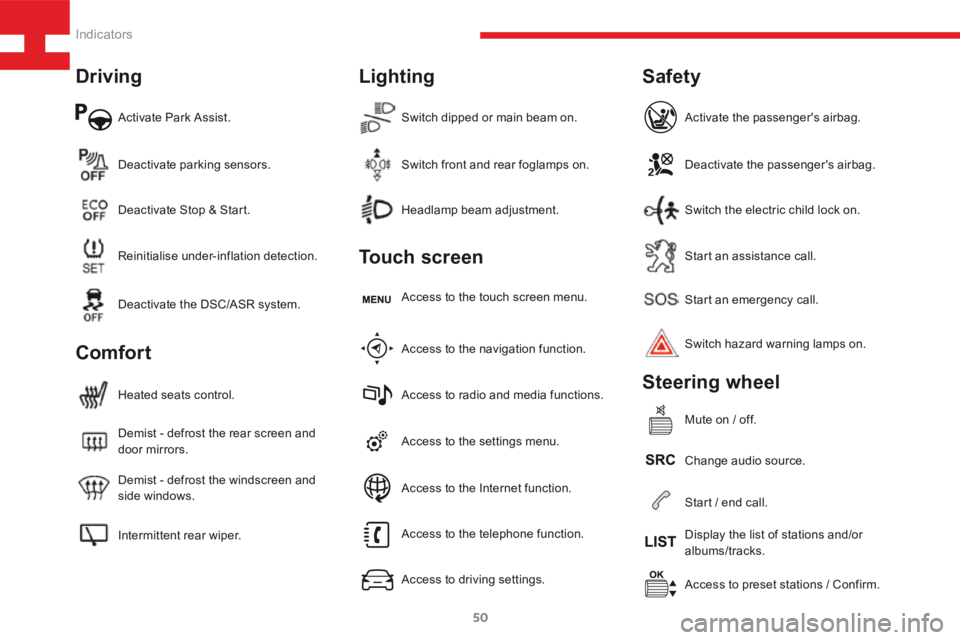
Activate Park Assist.
Intermittent rear wiper. Demist - defrost the windscreen and
side windows. Demist - defrost the rear screen and
door mirrors. Heated seats control.Access to the settings menu.Start an emergency call.
Access to preset stations / Confirm.
Headlamp beam adjustment.
Deactivate parking sensors.
Access to the navigation function. Access to the touch screen menu.Deactivate the passenger's airbag.
Change audio source. Switch hazard warning lamps on. Activate the passenger's airbag.
Mute on / off.
Switch dipped or main beam on.
Reinitialise under-inflation detection. Deactivate Stop & Start.
Access to radio and media functions.Start an assistance call.
Display the list of stations and/or
albums/tracks.
Switch front and rear foglamps on.
Deactivate the DSC/ASR system.
Access to the telephone function.
Access to driving settings.Switch the electric child lock on.
Start / end call.
Access to the Internet function.
Driving
Comfort Lighting
Touch screen
Safety
Steering wheel
Indicators
Page 63 of 341
61
208_en_Chap04_confort_ed01-2015
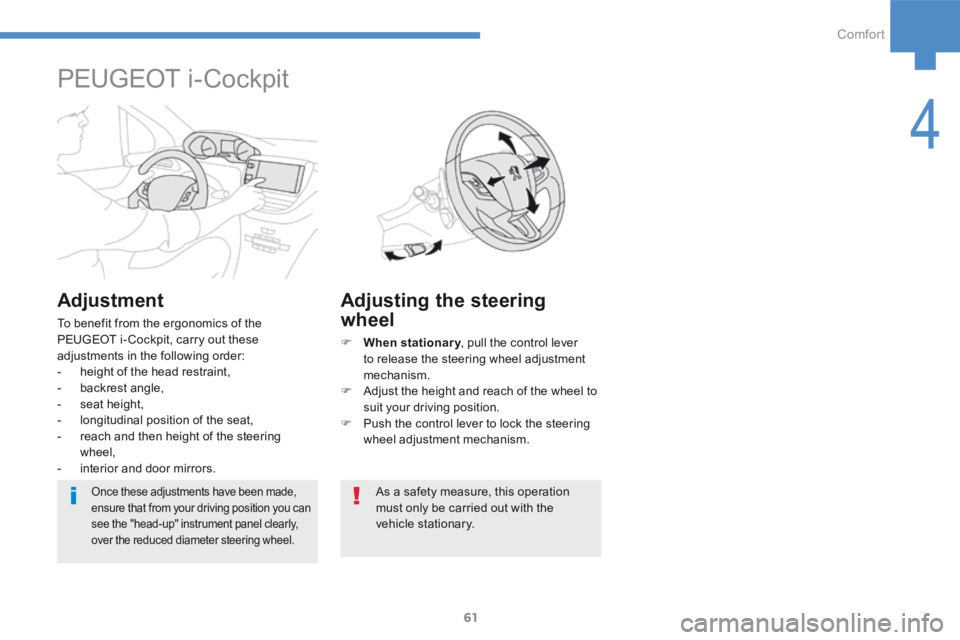
Adjusting the steering
wheel
F When stationary , pull the control lever
to release the steering wheel adjustment
mechanism.
F Adjust the height and reach of the wheel to
suit your driving position.
F Push the control lever to lock the steering
wheel adjustment mechanism.
As a safety measure, this operation
must only be carried out with the
vehicle stationary.
PEUGEOT i-Cockpit
Adjustment
To benefit from the ergonomics of the
PEUGEOT i- Cockpit, carry out these
adjustments in the following order:
- height of the head restraint,
- backrest angle,
- seat height,
- longitudinal position of the seat,
- reach and then height of the steering
wheel,
- interior and door mirrors.
Once these adjustments have been made,
ensure that from your driving position you can
see the "head-up" instrument panel clearly,
over the reduced diameter steering wheel.
4
Comfort
Page 64 of 341
62
208_en_Chap04_confort_ed01-2015
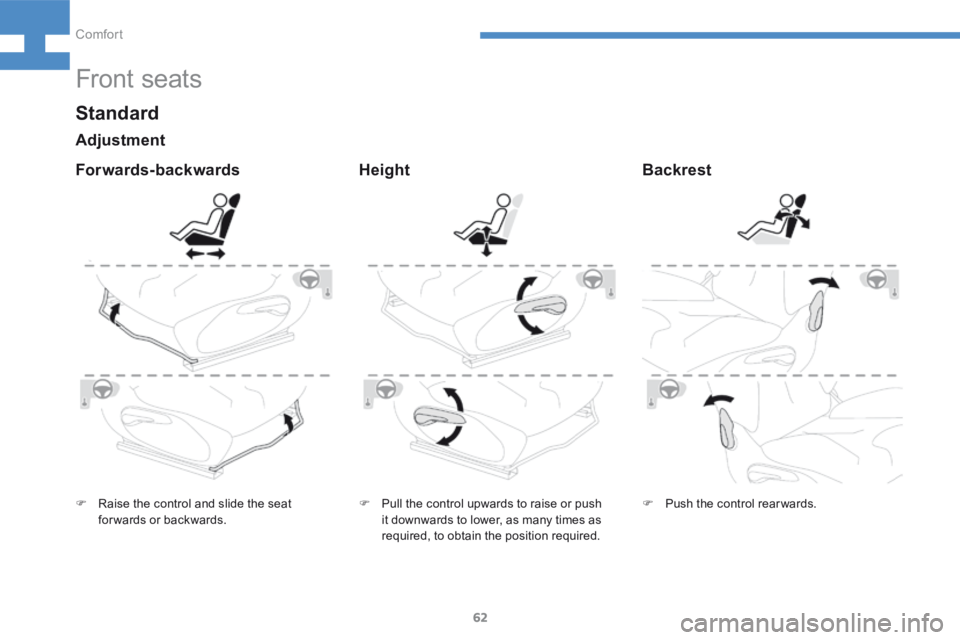
Front seats
F Raise the control and slide the seat
forwards or backwards. F
Pull the control upwards to raise or push
it downwards to lower, as many times as
required, to obtain the position required. F
Push the control rearwards.
Forwards-backwards HeightBackrest
Standard
Adjustment
Comfort
Page 65 of 341
63
208_en_Chap04_confort_ed01-2015
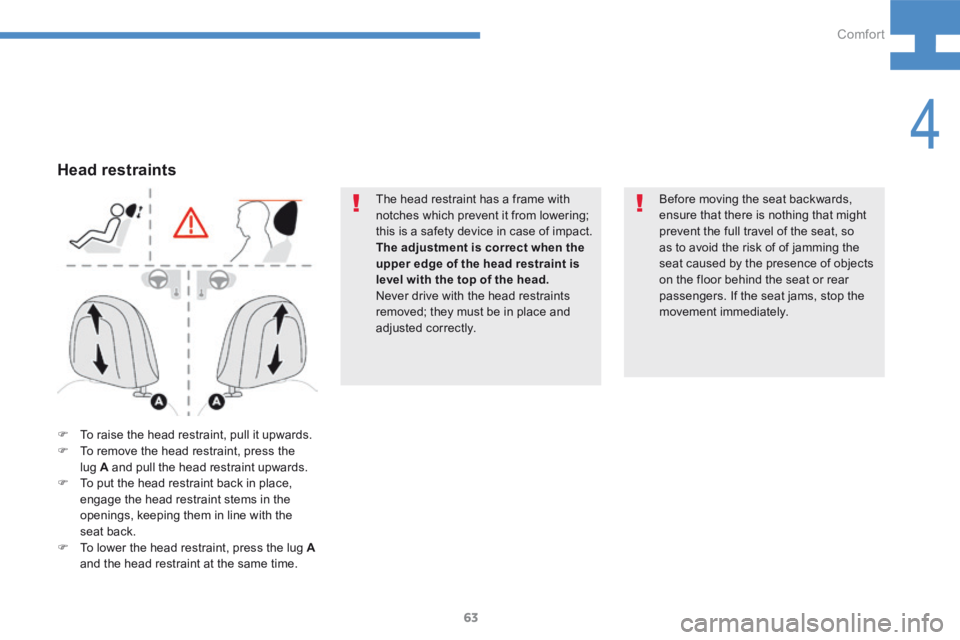
The head restraint has a frame with
notches which prevent it from lowering;
this is a safety device in case of impact.
The adjustment is correct when the
upper edge of the head restraint is
level with the top of the head.
Never drive with the head restraints
removed; they must be in place and
adjusted correctly.
Head restraints
F To raise the head restraint, pull it upwards.
F To remove the head restraint, press the
lug A and pull the head restraint upwards.
F To put the head restraint back in place,
engage the head restraint stems in the
openings, keeping them in line with the
seat back.
F To lower the head restraint, press the lug A
and the head restraint at the same time. Before moving the seat backwards,
ensure that there is nothing that might
prevent the full travel of the seat, so
as to avoid the risk of of jamming the
seat caused by the presence of objects
on the floor behind the seat or rear
passengers. If the seat jams, stop the
movement immediately.
4
Comfort
Page 66 of 341
64
208_en_Chap04_confort_ed01-2015
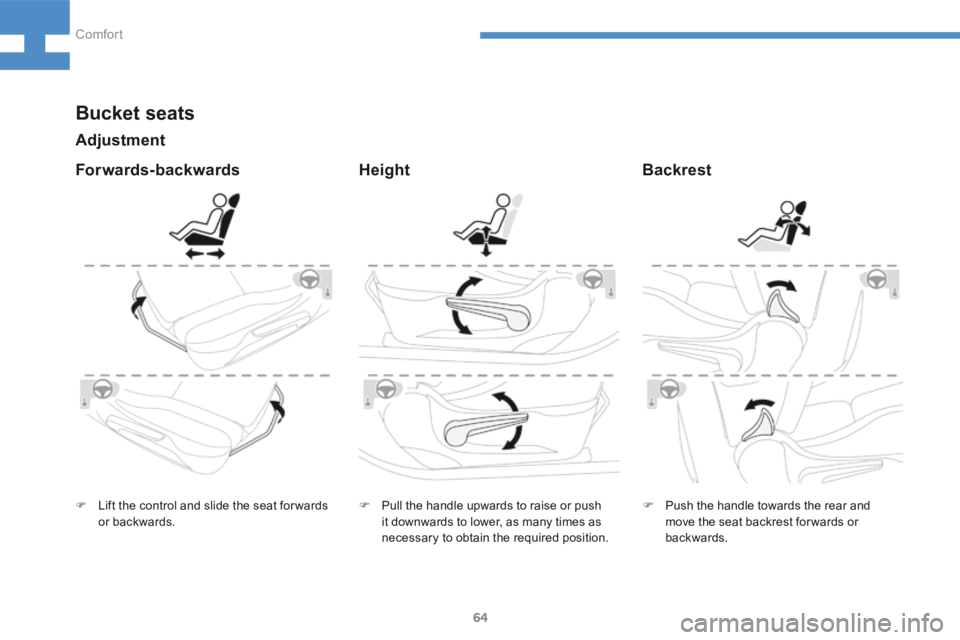
Bucket seats
HeightBackrest
Adjustment
F
Lift the control and slide the seat for wards
or backwards. F
Pull the handle upwards to raise or push
it downwards to lower, as many times as
necessary to obtain the required position. F
Push the handle towards the rear and
move the seat backrest for wards or
backwards.
Forwards-backwards
Comfort
Page 67 of 341
65
208_en_Chap04_confort_ed01-2015
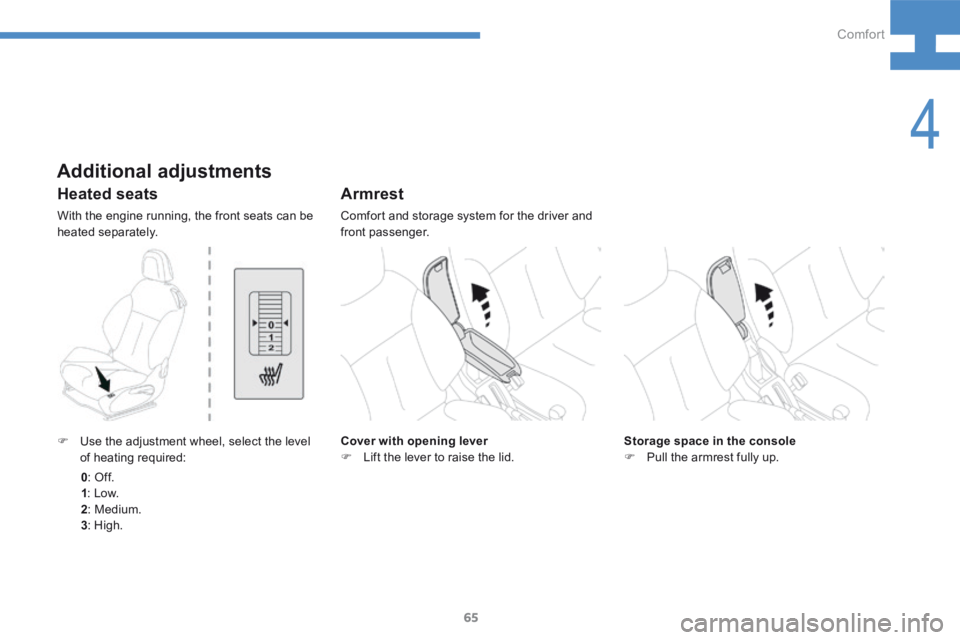
Heated seats
With the engine running, the front seats can be
heated separately.
Armrest
Comfort and storage system for the driver and
front passenger.
Cover with opening lever
F Lift the lever to raise the lid. Storage space in the console
F
Pull the armrest fully up.
Additional adjustments
F Use the adjustment wheel, select the level
of heating required:
0 : Of f.
1 : Low.
2 : Medium.
3 : High.
4
Comfort
Page 90 of 341
88
208_en_Chap04_confort_ed01-2015
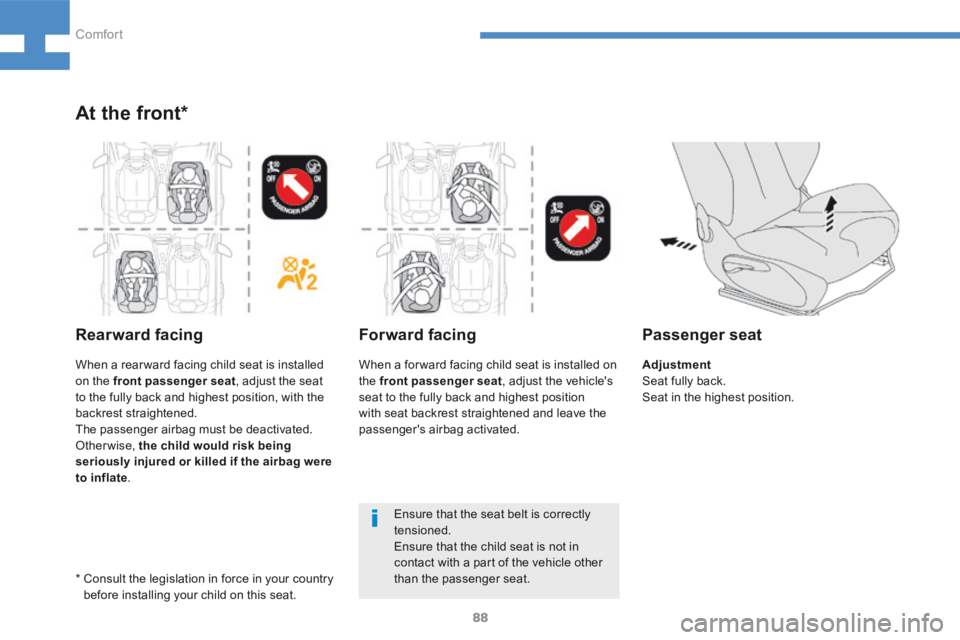
At the front*
Rearward facingForward facing
Ensure that the seat belt is correctly
tensioned.
Ensure that the child seat is not in
contact with a part of the vehicle other
than the passenger seat.
Passenger seat
When a rear ward facing child seat is installed
on the front passenger seat, adjust the seat
to the fully back and highest position, with the
backrest straightened.
The passenger airbag must be deactivated.
Otherwise, the child would risk being
seriously injured or killed if the airbag were
to inflate . When a for ward facing child seat is installed on
the front passenger seat
, adjust the vehicle's
seat to the fully back and highest position
with seat backrest straightened and leave the
passenger's airbag activated.
* Consult the legislation in force in your country
before installing your child on this seat. Adjustment
Seat fully back.
Seat in the highest position.
Comfort
Page 96 of 341
94
208_en_Chap04_confort_ed01-2015
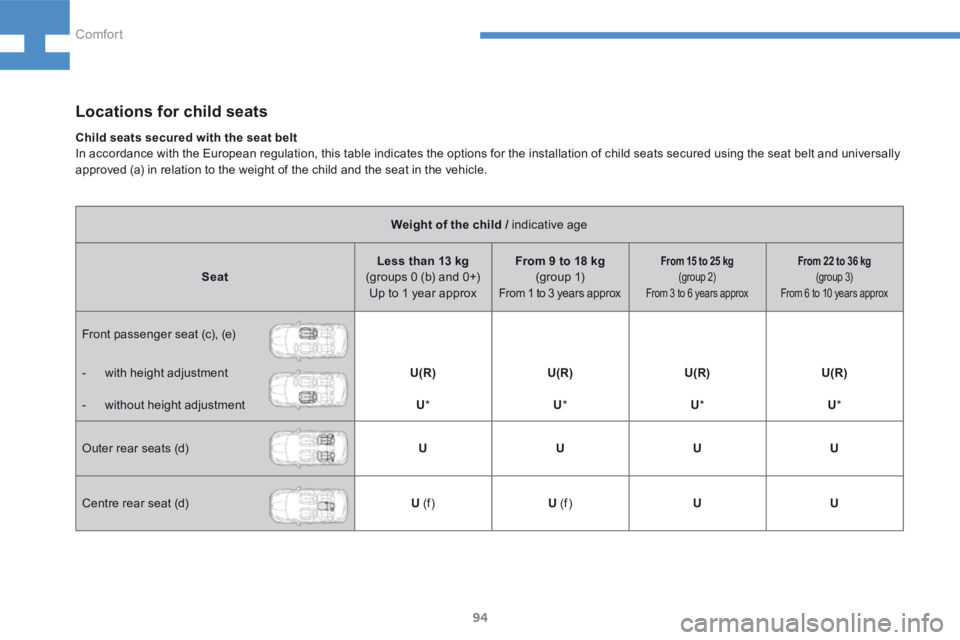
Locations for child seats
Weight of the child / indicative age
Seat Less than 13 kg
(groups 0 (b) and 0+) Up to 1 year approx From 9 to 18 kg
(g r o u p 1)
From 1 to 3 years approx
From 15 to 25 kg
(group 2)
From 3 to 6 years approx From 22 to 36 kg
(group 3)
From 6 to 10 years approx
Front passenger seat (c), (e)
- with height adjustment U(R) U(R) U(R)U(R)
- without height adjustment U* U* U* U*
Outer rear seats (d) UUUU
Centre rear seat (d) U (f )U (f ) UU
Child seats secured with the seat belt
In accordance with the European regulation, this table indicates the options for the installation of child seats secured using the seat belt and universally
approved (a) in relation to the weight of the child and the seat in the vehicle.
Comfort