Page 4 of 341
2
208_en_Chap00a_sommaire_ed01-2015
Unlocking - Key 11
D o o r s 11
3 - door 12
Starting 13
Switching off 15
Locking - Key 16
Parking brake 19
Stop & Start 20
Hill start assist 23
Ports and sockets - Connectivity 24
Details of the roof console 25
Sunroof blind 26
Mood lighting 27
Boot 28
Alarm 29
Advice 31
Access and starting Over view
Instrument panels
34
Date and time 36
Library of indicator and warning lamps 37
Library of symbols 49
Engine coolant temperature 51
Instrument panel dimmer 52
Gear shift indicator 59
Energy load 60
Indicators
PEUGEOT i- Cockpit 61
Front seats 62
One-piece rear seats 66
Ventilation 69
Demist - defrost 72
Heating 74
Air conditioning 76
Window controls 81
Wipers 83
Carrying children 87
Deactivating the passenger's front airbag 89
ISOFIX child seats 96
Child lock 101
Seat belts 102
Airbags 105
Comfort
Driving recommendations 109
M i r r o r s 11 0
Manual 5 gearbox 112
Manual 6 gearbox 112
Electronic 5 gearbox 113
Electronic 6 gearbox 113
Automatic 4 gearbox 116
Automatic 6 gearbox 116
Parking sensors 119
Reversing camera 121
Park Assist 122
Speed limiter 126
Cruise control 128
Active City Brake 133
Road holding 136
Trip computer 139
Eco-driving 142
Driving
Exterior view 4
Interior view 5
Instruments and controls 6
Middle console 8
Upper console 9
Lower console 9
Underbonnet view 10
Contents
Page 7 of 341
5
208_en_Chap01_vue-ensemble_ed01-2015
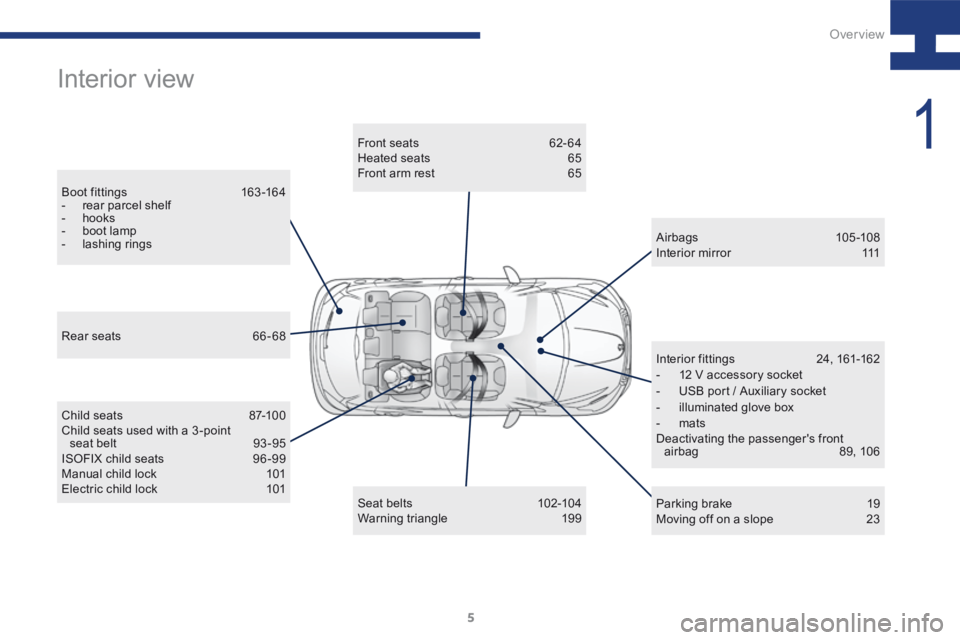
Interior view
Boot f ittings 163 -16 4
- rear parcel shelf
- hooks
- boot lamp
- lashing rings Front seats
62-64
Heated seats 65
Front arm rest 65
Child seats 87-100
Child seats used with a 3 -point seat belt 93 -95
ISOFIX child seats 96 -99
Manual child lock 101
Electric child lock 101 Airbags
105 -108
Interior mirror 111
Parking brake 19
Moving off on a slope 23
Interior fittings
24, 161-162
- 12 V accessory socket
- USB port / Auxiliary socket
- illuminated glove box
- mats
Deactivating the passenger's front airbag 89, 106
Seat belts 102-104
Warning triangle 199
Rear seats
66-68
1
Over view
Page 33 of 341
31
208_en_Chap02_ Acces-Demarrage_ed01-2015
Advice
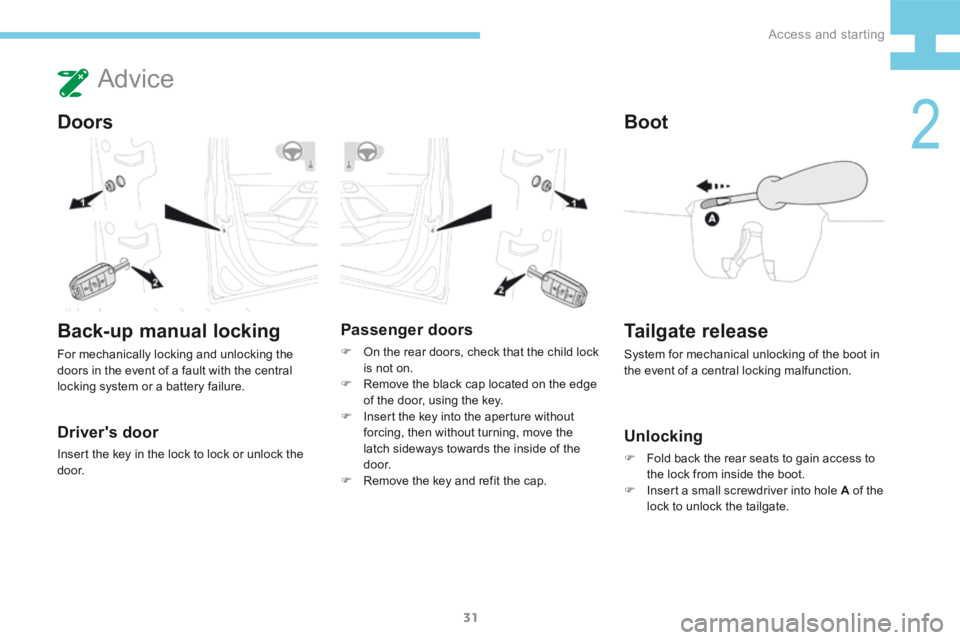
Doors
Driver's door
Insert the key in the lock to lock or unlock the
d o o r.
Tailgate release
System for mechanical unlocking of the boot in
the event of a central locking malfunction.
Unlocking
F Fold back the rear seats to gain access to
the lock from inside the boot.
F Insert a small screwdriver into hole A of the
lock to unlock the tailgate.
Back-up manual locking
For mechanically locking and unlocking the
doors in the event of a fault with the central
locking system or a battery failure.
Passenger doors
F On the rear doors, check that the child lock
is not on.
F Remove the black cap located on the edge
of the door, using the key.
F Insert the key into the aperture without
forcing, then without turning, move the
latch sideways towards the inside of the
d o o r.
F Remove the key and refit the cap.
Boot
2
Access and starting
Page 41 of 341
39
208_en_Chap03_Indicateurs_ed01-2015
Warning / indicator lampStateCause Action / Observations
Foot on the
clutch* fixed.
In the STOP mode of Stop & Start,
changing to START mode is refused
because the clutch pedal is not fully
down. You must declutch fully to allow the change to engine
S TA R T m o d e .
Stop & Star t fixed. When the vehicle stops (red lights,
traffic jams, ...) the Stop & Start
system has put the engine into STOP
mode. The warning lamp goes off and the engine restarts
automatically in START mode, as soon as you want to
move off.
flashes for a
few seconds, then
goes off. STOP mode is temporarily
unavailable.
or
START mode is invoked
automatically. For more information on special cases with STOP
mode and START mode, refer to the "Stop & Start"
section.
Automatic
wiping fixed.
The wiper control is pushed
downwards. Automatic front wiping is activated.
To deactivate automatic wiping, operate the control
stalk downwards or put the stalk into another position.
*
Except for the active matrix instrument panel.
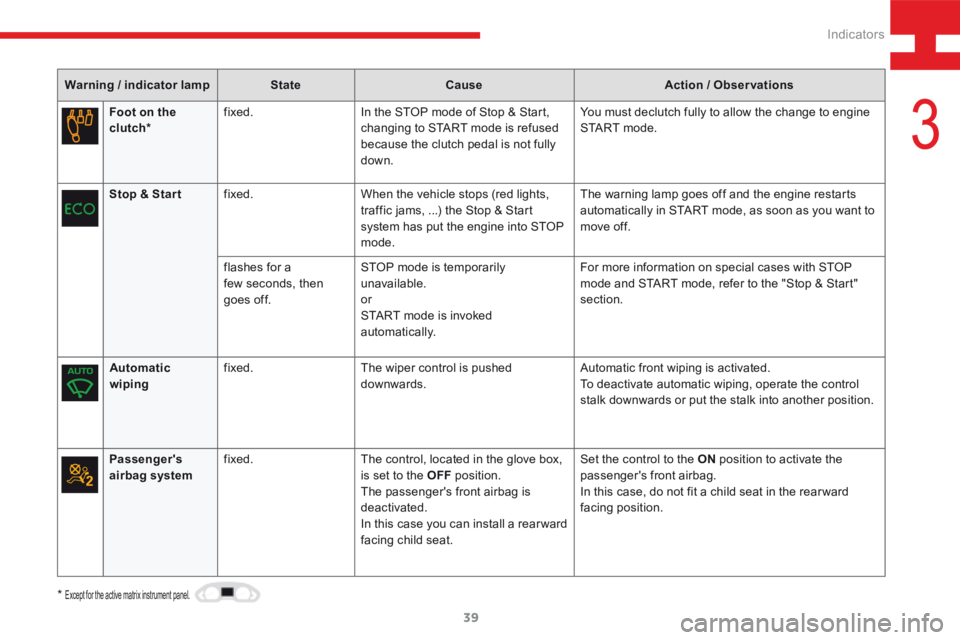
Passenger's
airbag system fixed.
The control, located in the glove box,
is set to the OFF position.
The passenger's front airbag is
deactivated.
In this case you can install a rear ward
facing child seat. Set the control to the ON
position to activate the
passenger's front airbag.
In this case, do not fit a child seat in the rear ward
facing position.
3
Indicators
Page 52 of 341
50
208_en_Chap03_Indicateurs_ed01-2015
Activate Park Assist.
Intermittent rear wiper. Demist - defrost the windscreen and
side windows. Demist - defrost the rear screen and
door mirrors. Heated seats control.Access to the settings menu.Start an emergency call.
Access to preset stations / Confirm.
Headlamp beam adjustment.
Deactivate parking sensors.
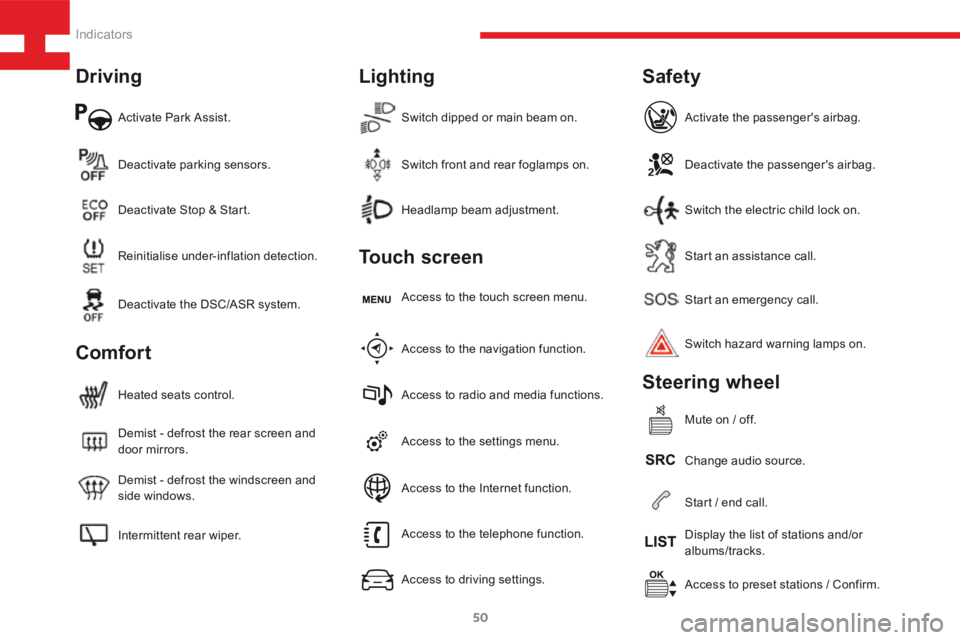
Access to the navigation function. Access to the touch screen menu.Deactivate the passenger's airbag.
Change audio source. Switch hazard warning lamps on. Activate the passenger's airbag.
Mute on / off.
Switch dipped or main beam on.
Reinitialise under-inflation detection. Deactivate Stop & Start.
Access to radio and media functions.Start an assistance call.
Display the list of stations and/or
albums/tracks.
Switch front and rear foglamps on.
Deactivate the DSC/ASR system.
Access to the telephone function.
Access to driving settings.Switch the electric child lock on.
Start / end call.
Access to the Internet function.
Driving
Comfort Lighting
Touch screen
Safety
Steering wheel
Indicators
Page 89 of 341
87
208_en_Chap04_confort_ed01-2015
General points
For maximum safety, please observe the
following recommendations:
- in accordance with European regulations,
all children under the age of 12 or less
than one and a half metres tall must
travel in approved child seats suited to
their weight , on seats fitted with a seat
belt or ISOFIX mountings*,
- statistically, the safest seats in your
vehicle for carr ying children are the
rear seats,
- a child weighing less than 9 kg must
travel in the rear ward facing position
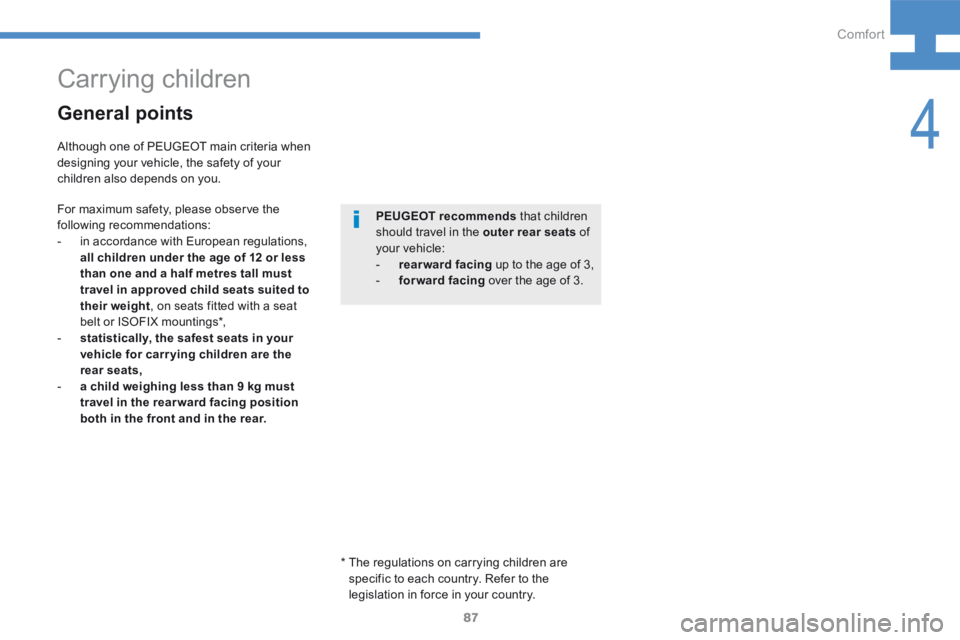
both in the front and in the rear. PEUGEOT recommends
that children
should travel in the outer rear seats of
your vehicle:
- rearward facing up to the age of 3,
- forward facing over the age of 3.
Although one of PEUGEOT main criteria when
designing your vehicle, the safety of your
children also depends on you.
* The regulations on carrying children are
specific to each country. Refer to the
legislation in force in your country.
Carrying children
4
Comfort
Page 90 of 341
88
208_en_Chap04_confort_ed01-2015
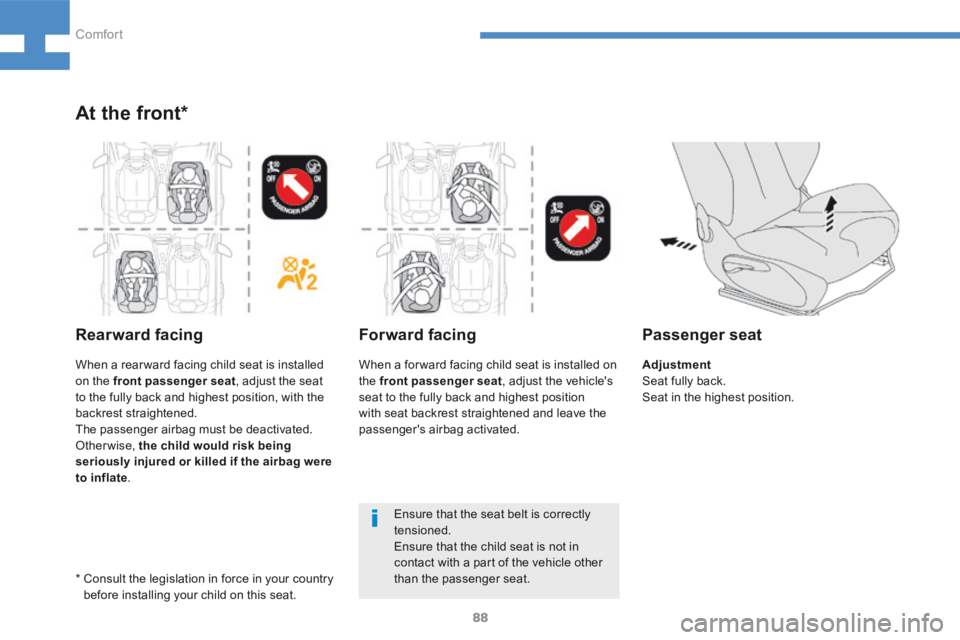
At the front*
Rearward facingForward facing
Ensure that the seat belt is correctly
tensioned.
Ensure that the child seat is not in
contact with a part of the vehicle other
than the passenger seat.
Passenger seat
When a rear ward facing child seat is installed
on the front passenger seat, adjust the seat
to the fully back and highest position, with the
backrest straightened.
The passenger airbag must be deactivated.
Otherwise, the child would risk being
seriously injured or killed if the airbag were
to inflate . When a for ward facing child seat is installed on
the front passenger seat
, adjust the vehicle's
seat to the fully back and highest position
with seat backrest straightened and leave the
passenger's airbag activated.
* Consult the legislation in force in your country
before installing your child on this seat. Adjustment
Seat fully back.
Seat in the highest position.
Comfort
Page 91 of 341
89
208_en_Chap04_confort_ed01-2015
Deactivating the passenger's
front airbag
Never install a rear ward facing child
restraint system on a seat protected by
an active front airbag. This could cause
the death of the child or serious injury.Passenger airbag OFF
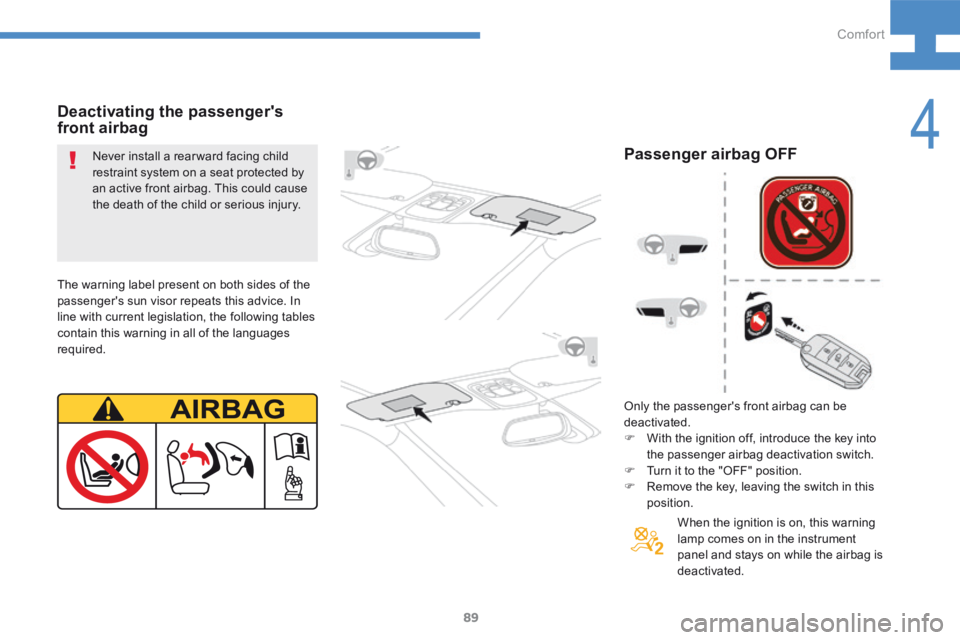
The warning label present on both sides of the
passenger's sun visor repeats this advice. In
line with current legislation, the following tables
contain this warning in all of the languages
required.Only the passenger's front airbag can be
deactivated.
F With the ignition off, introduce the key into
the passenger airbag deactivation switch.
F Turn it to the "OFF" position.
F Remove the key, leaving the switch in this
position.
When the ignition is on, this warning
lamp comes on in the instrument
panel and stays on while the airbag is
deactivated.
4
Comfort