Page 160 of 340
158
2008_en_Chap08_securite-enfants_ed01-2015
Electric child lock
Remote control system to prevent opening of the rear doors using their interior controls.
Switching on
F With the ignition on, press this button.
The indicator lamp in the button comes on,
accompanied by a message to confirm that the
child lock is on.
This indicator lamp remains on until the child
lock is switched off.
It is still possible to open the doors from the
outside and operate the rear electric windows
from the driver's control panel.
Switching off
F With the ignition on, press this button again.
The indicator lamp in the button goes off,
accompanied by a message to confirm that the
child lock is off.
This indicator lamp remains off while the child
lock is switched off.
Any other status of the indicator lamp
indicates a fault with the electric
child
lock.
Have it checked by a PEUGEOT dealer
or a qualified workshop.
This system is independent and in no
circumstances does it take the place of
the central locking control.
Check the status of the child lock each
time you switch on the ignition.
Always remove the key from the ignition
when leaving the vehicle, even for a
short time.
Manual child
lock
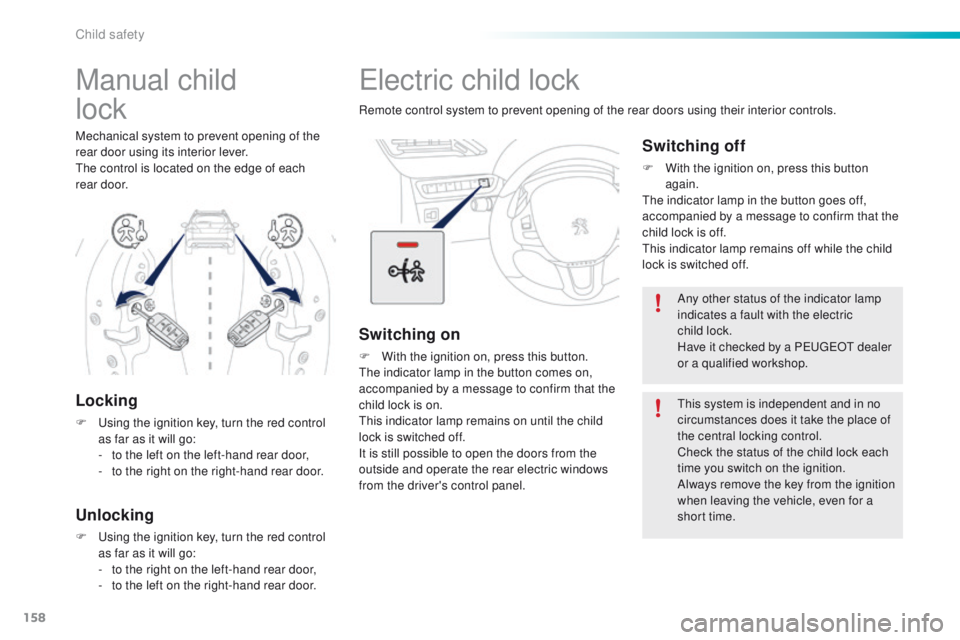
Locking
F Using the ignition key, turn the red control as far as it will go:
-
t
o the left on the left-hand rear door,
-
t
o the right on the right-hand rear door.
Unlocking
F Using the ignition key, turn the red control as far as it will go:
-
t
o the right on the left-hand rear door,
-
t
o the left on the right-hand rear door.
Mechanical system to prevent opening of the
rear door using its interior lever.
The control is located on the edge of each
rear
door.
Child safety
Page 174 of 340
172
2008_en_Chap09_info-pratiques_ed01-2015
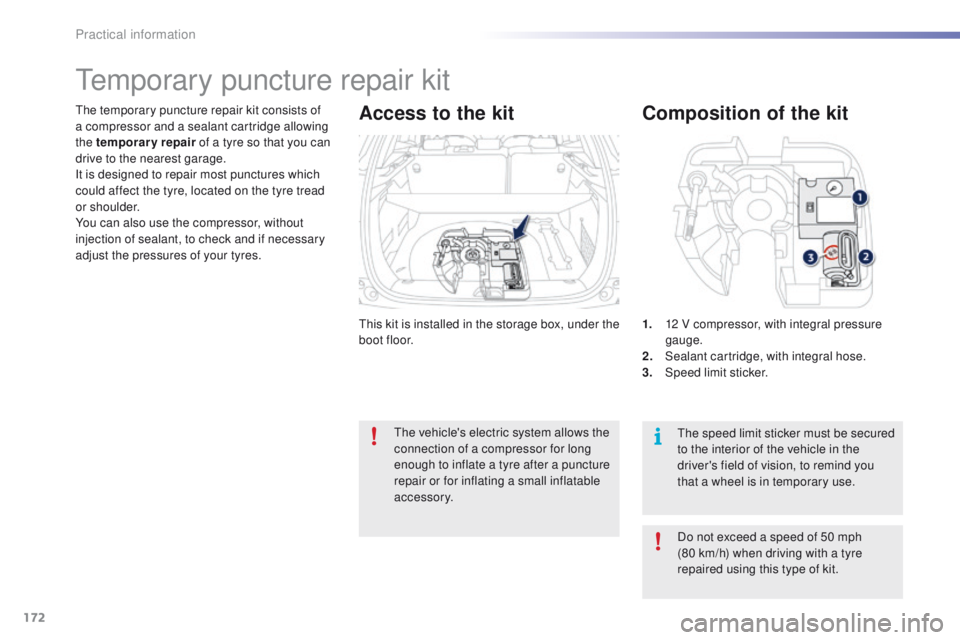
This kit is installed in the storage box, under the
boot floor.
The temporary puncture repair kit consists of
a compressor and a sealant cartridge allowing
the temporary repair
of a tyre so that you can
drive to the nearest garage.
It is designed to repair most punctures which
could affect the tyre, located on the tyre tread
or shoulder.
You can also use the compressor, without
injection of sealant, to check and if necessary
adjust the pressures of your tyres.
Temporary puncture repair kit
Access to the kit
Do not exceed a speed of 50 mph
(80 km/h) when driving with a tyre
repaired using this type of kit.
The vehicle's electric system allows the
connection of a compressor for long
enough to inflate a tyre after a puncture
repair or for inflating a small inflatable
accessory.
The speed limit sticker must be secured
to the interior of the vehicle in the
driver's field of vision, to remind you
that a wheel is in temporary use.
Composition of the kit
1. 12 V compressor, with integral pressure
gauge.
2.
S
ealant cartridge, with integral hose.
3.
Spe
ed limit sticker.
Practical information
Page 175 of 340
173
2008_en_Chap09_info-pratiques_ed01-2015
Repair procedure
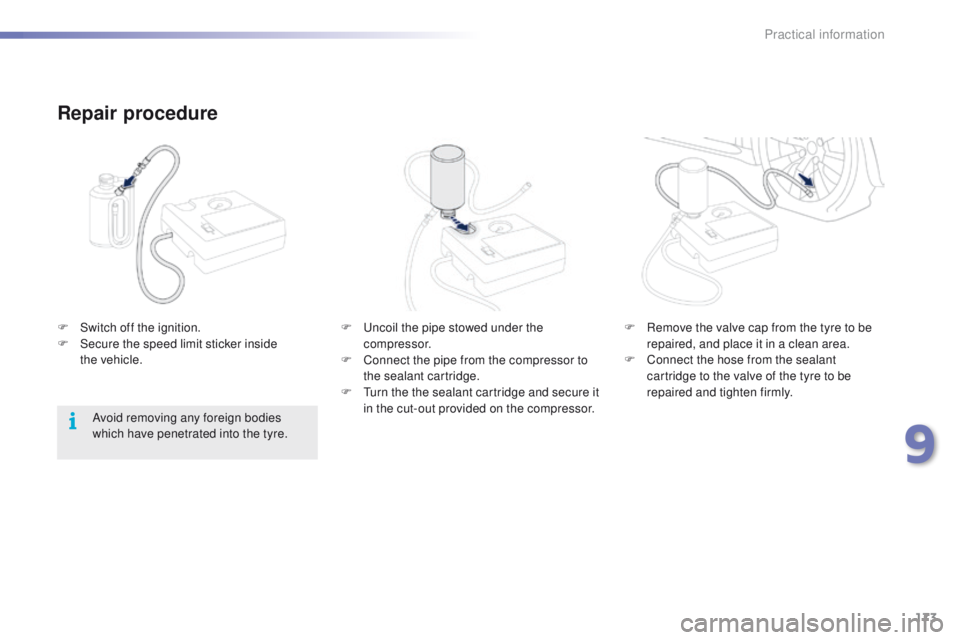
F Uncoil the pipe stowed under the compressor.
F
C
onnect the pipe from the compressor to
the sealant cartridge.
F
T
urn the the sealant cartridge and secure it
in the cut-out provided on the compressor. F
R emove the valve cap from the tyre to be
repaired, and place it in a clean area.
F
C
onnect the hose from the sealant
cartridge to the valve of the tyre to be
repaired and tighten firmly.
Avoid removing any foreign bodies
which have penetrated into the tyre.
F
S
witch off the ignition.
F
S
ecure the speed limit sticker inside
the
vehicle.
9
Practical information
Page 179 of 340
177
2008_en_Chap09_info-pratiques_ed01-2015
Changing a wheel
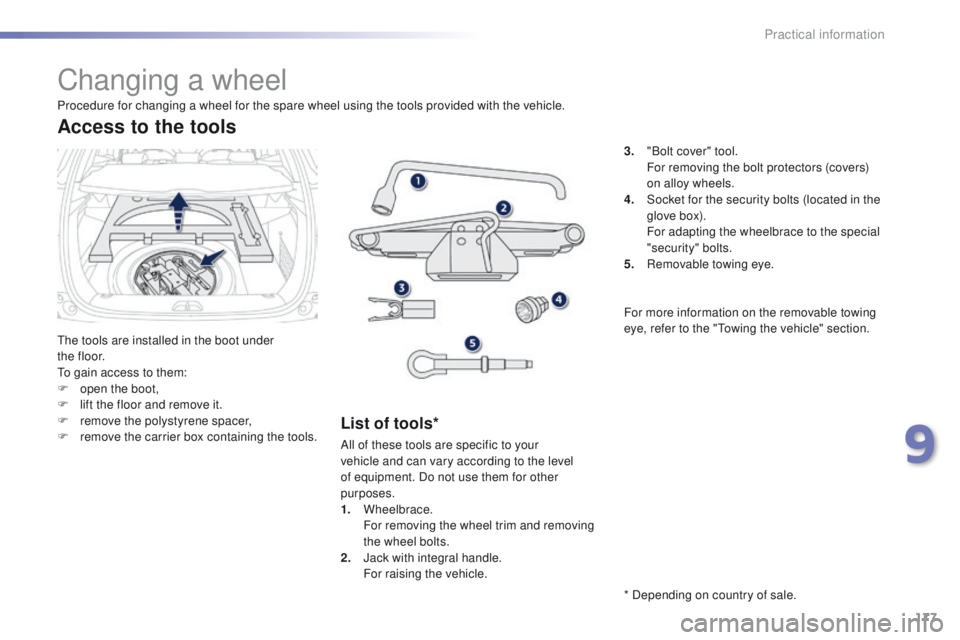
The tools are installed in the boot under
t h e f l o o r.
To gain access to them:
F
o
pen the boot,
F
l
ift the floor and remove it.
F
r
emove the polystyrene spacer,
F
r
emove the carrier box containing the tools.
Access to the tools
List of tools*
3. "Bolt cover" tool. F or removing the bolt protectors (covers)
on alloy wheels.
4.
S
ocket for the security bolts (located in the
glove box).
F
or adapting the wheelbrace to the special
"security" bolts.
5.
R
emovable towing eye.
Procedure for changing a wheel for the spare wheel using the tools provided with the vehicle.
All of these tools are specific to your
vehicle and can vary according to the level
of equipment. Do not use them for other
purposes.
1.
Wheelbrace.
F
or removing the wheel trim and removing
the wheel bolts.
2.
J
ack with integral handle.
F
or raising the vehicle. * Depending on country of sale. For more information on the removable towing
eye, refer to the "Towing the vehicle" section.
9
Practical information
Page 182 of 340
180
2008_en_Chap09_info-pratiques_ed01-2015
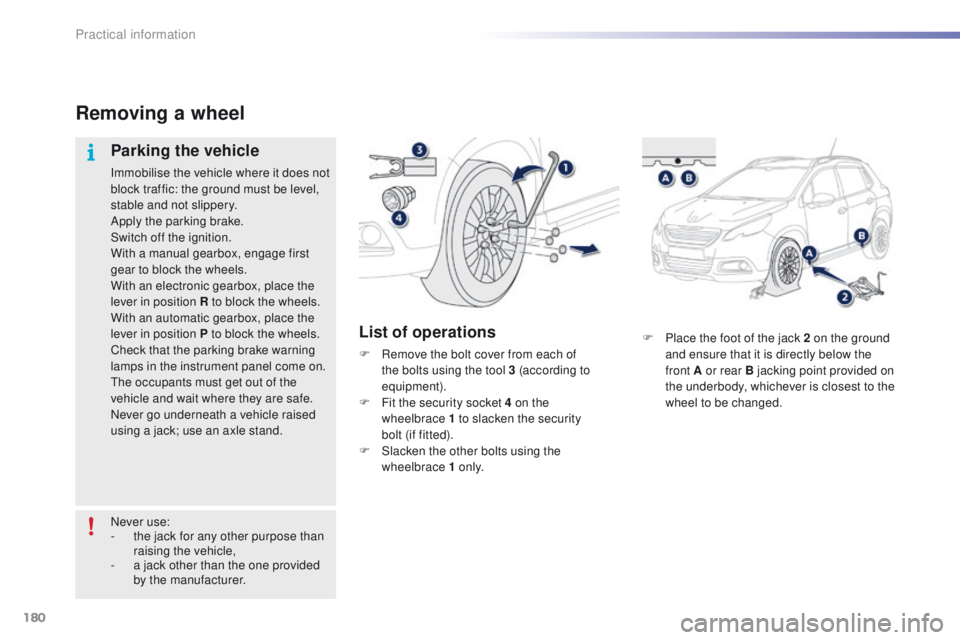
F Place the foot of the jack 2 on the ground and ensure that it is directly below the
front
A or rear B jacking point provided on
the underbody, whichever is closest to the
wheel to be changed.
Removing a wheel
Parking the vehicle
Immobilise the vehicle where it does not
block traffic: the ground must be level,
stable and not slippery.
Apply the parking brake.
Switch off the ignition.
With a manual gearbox, engage first
gear to block the wheels.
With an electronic gearbox, place the
lever in position R to block the wheels.
With an automatic gearbox, place the
lever in position P to block the wheels.
Check that the parking brake warning
lamps in the instrument panel come on.
The occupants must get out of the
vehicle and wait where they are safe.
Never go underneath a vehicle raised
using a jack; use an axle stand.
List of operations
F Remove the bolt cover from each of the bolts using the tool 3 (according to
equipment).
F
F
it the security socket 4 on the
wheelbrace
1 to slacken the security
bolt (if fitted).
F
S
lacken the other bolts using the
wheelbrace 1 o n l y.
Never use:
-
t
he jack for any other purpose than
raising the vehicle,
-
a j
ack other than the one provided
by the manufacturer.
Practical information
Page 184 of 340
182
2008_en_Chap09_info-pratiques_ed01-2015
Fitting a wheel
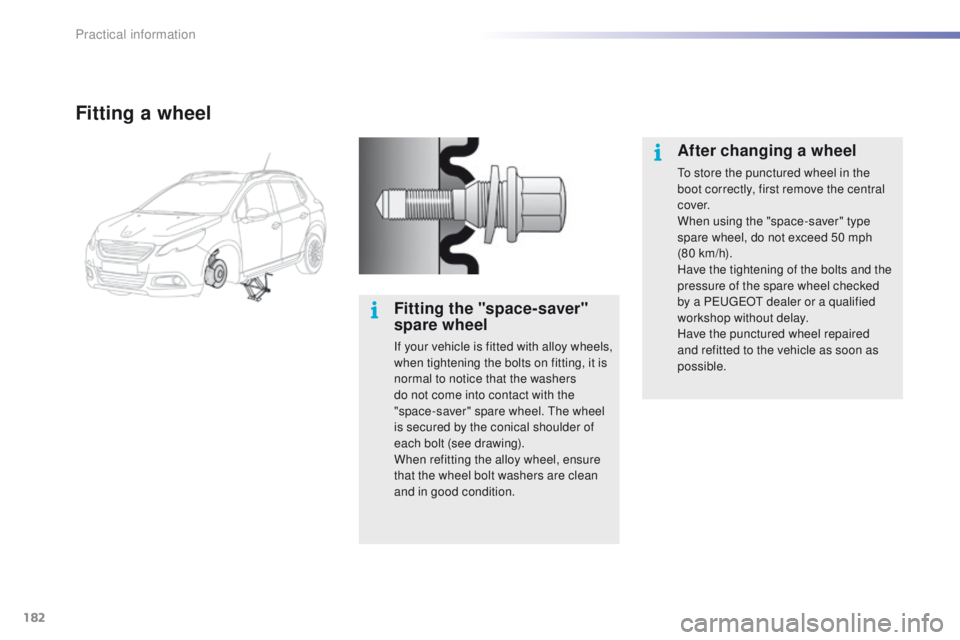
Fitting the "space-saver"
spare wheel
If your vehicle is fitted with alloy wheels,
when tightening the bolts on fitting, it is
normal to notice that the washers
do not come into contact with the
"space-saver" spare wheel. The wheel
is secured by the conical shoulder of
each bolt (see drawing).
When refitting the alloy wheel, ensure
that the wheel bolt washers are clean
and in good condition.
After changing a wheel
To store the punctured wheel in the
boot correctly, first remove the central
c ove r.
When using the "space-saver" type
spare wheel, do not exceed 50 mph
(80 km/h).
Have the tightening of the bolts and the
pressure of the spare wheel checked
by a PEUGEOT dealer or a qualified
workshop without delay.
Have the punctured wheel repaired
and refitted to the vehicle as soon as
possible.
Practical information
Page 185 of 340
183
2008_en_Chap09_info-pratiques_ed01-2015
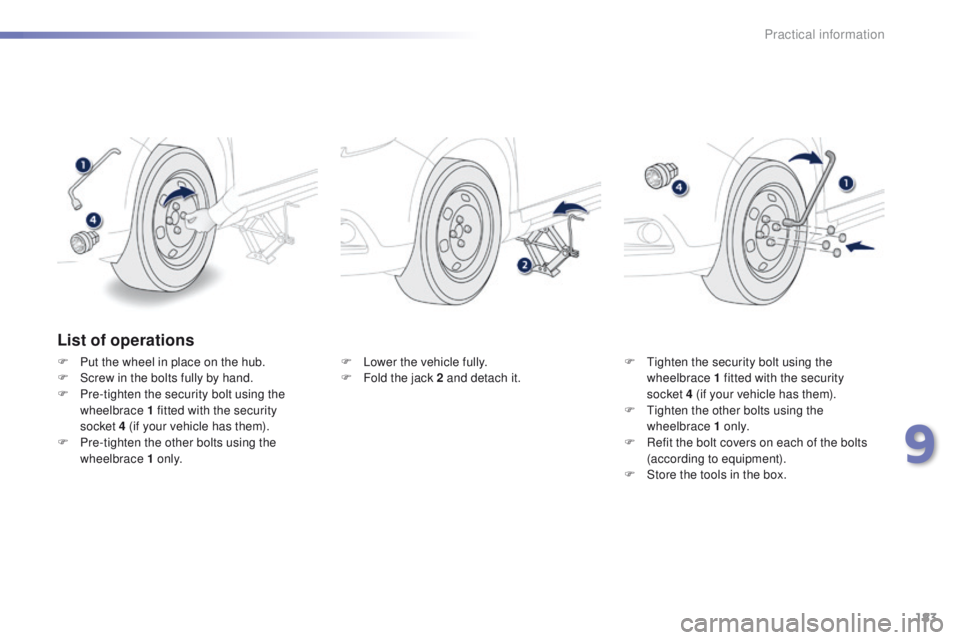
List of operations
F Put the wheel in place on the hub.
F S crew in the bolts fully by hand.
F
P
re-tighten the security bolt using the
wheelbrace 1 fitted with the security
socket
4 (if your vehicle has them).
F
P
re-tighten the other bolts using the
wheelbrace 1 o n l y. F
L ower the vehicle fully.
F F old the jack 2 and detach it.F
T ighten the security bolt using the
wheelbrace 1 fitted with the security
socket
4 (if your vehicle has them).
F
T
ighten the other bolts using the
wheelbrace 1 o n l y.
F
R
efit the bolt covers on each of the bolts
(according to equipment).
F
S
tore the tools in the box.
9
Practical information
Page 200 of 340
198
2008_en_Chap09_info-pratiques_ed01-2015
Battery
The presence of this label indicates
the use of a 12 V lead-acid battery with
special technology and specification, for
which the involvement of a PEUGEOT
dealer or qualified workshop is required
when replacing or disconnecting the
battery.
Failure to observe this recommendation
may cause premature wear of the
battery.
After refitting the battery, the Stop &
Start system will only be active after
several hours depending on the climatic
conditions and the state of charge of
the battery (up to about 8 hours).F
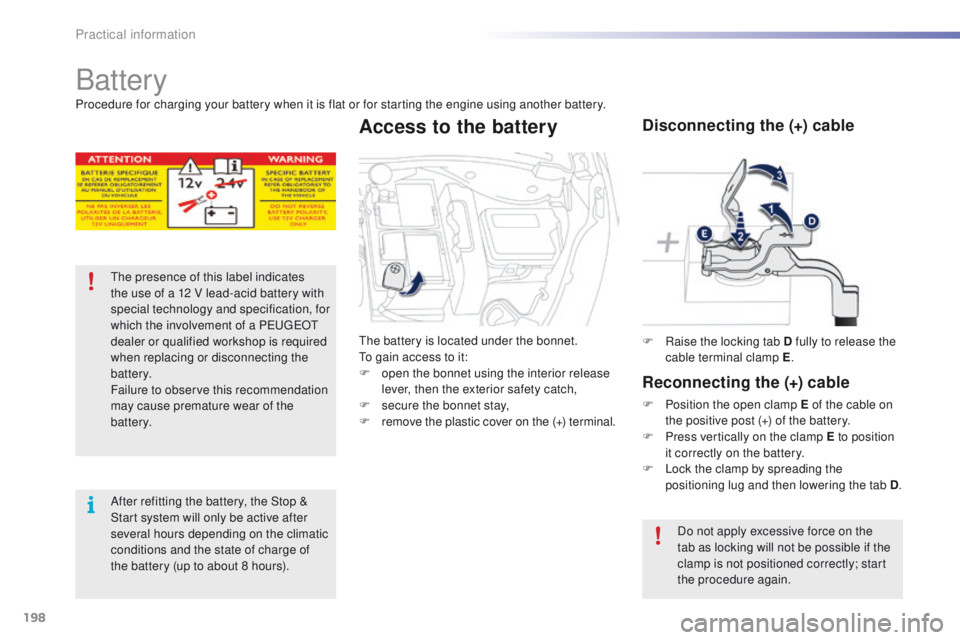
Ra
ise the locking tab D fully to release the
cable terminal clamp E .
Disconnecting the (+) cable
Reconnecting the (+) cable
F Position the open clamp E of the cable on
the positive post (+) of the battery.
F
P
ress vertically on the clamp E to position
it correctly on the battery.
F
L
ock the clamp by spreading the
positioning lug and then lowering the tab D .
Do not apply excessive force on the
tab as locking will not be possible if the
clamp is not positioned correctly; start
the procedure again.
Procedure for charging your battery when it is flat or for starting the engine using another battery.
The battery is located under the bonnet.
To gain access to it:
F
o
pen the bonnet using the interior release
lever, then the exterior safety catch,
F
s
ecure the bonnet stay,
F
r
emove the plastic cover on the (+) terminal.
Access to the battery
Practical information