2015 PEUGEOT 2008 display
[x] Cancel search: displayPage 87 of 340
85
2008_en_Chap05_conduite_ed01-2015
You must press the brake pedal firmly
while starting the engine.
Never select neutral N while the vehicle
is moving.
Only engage reverse gear R when the
vehicle is immobilised, with your foot on
the brake pedal.
In all cases, you must apply the parking
brake to immobilise the vehicle.
"Auto sequential" mode
In the automated mode, you can resume
control temporarily at any time using the
steering mounted control paddles.
The use of these paddles permits manual
selection of the gears in situations which
require a more rapid change-down than in
the automated mode (arrival at a roundabout,
leaving a car park with a steep gradient,
over taking...).
The gearbox engages the required gear if
the engine speed permits. AUTO remains
displayed on the instrument panel.
After a few moments, the gearbox resumes
automatic control of the gears.
Stopping the vehicle
Before switching off the engine, you can
change to position N to be in neutral.
In this case, you must apply the parking
brake to immobilise the vehicle.
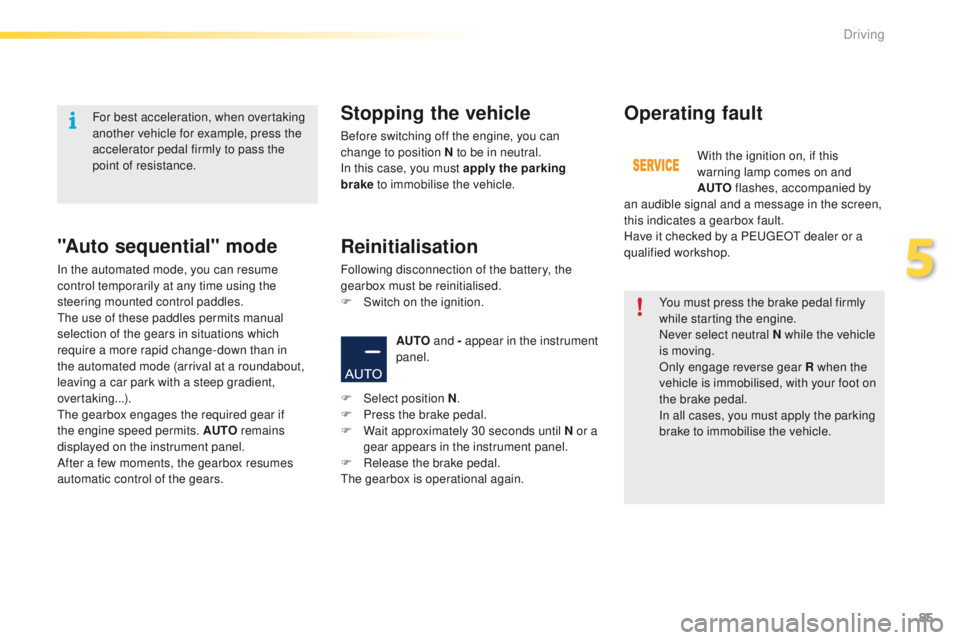
AUTO and - appear in the instrument
panel.
Operating fault
With the ignition on, if this
warning lamp comes on and
AUTO flashes, accompanied by
an audible signal and a message in the screen,
this indicates a gearbox fault.
Have it checked by a PEUGEOT dealer or a
qualified workshop.
For best acceleration, when overtaking
another vehicle for example, press the
accelerator pedal firmly to pass the
point of resistance.
F
Sel
ect position N .
F
P
ress the brake pedal.
F
W
ait approximately 30 seconds until N or a
gear appears in the instrument panel.
F
R
elease the brake pedal.
The gearbox is operational again.
Reinitialisation
Following disconnection of the battery, the
gearbox must be reinitialised.
F
S
witch on the ignition.
5
Driving
Page 89 of 340
87
2008_en_Chap05_conduite_ed01-2015
Engagement of reverse gear is
accompanied by an audible signal.If the engine does not start:
For optimum acceleration, for example
when overtaking another vehicle, press
the accelerator pedal firmly past the
point of resistance.
Display in the instrument panelMoving offAutomated mode
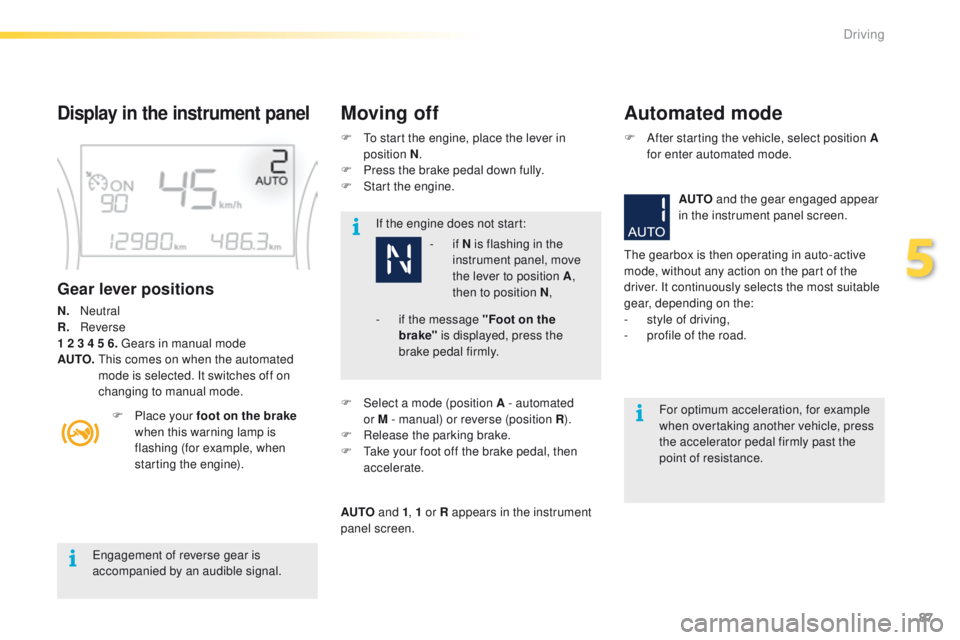
Gear lever positions
N. Neutral
R. R everse
1 2 3 4 5 6. Gears in manual mode
AUTO.
T
his comes on when the automated
mode is selected. It switches off on
changing to manual mode.
F
P
lace your foot on the brake
when this warning lamp is
flashing (for example, when
starting the engine). F
T
o start the engine, place the lever in
position N .
F
P
ress the brake pedal down fully.
F
S
tart the engine.
- if
N is flashing in the
instrument panel, move
the lever to position A ,
then to position N ,
F
Sel
ect a mode (position A - automated
or M - manual) or reverse (position R ).
F
R
elease the parking brake.
F
T
ake your foot off the brake pedal, then
accelerate.
AUTO and 1, 1 or R appears in the instrument
panel screen. F
A
fter starting the vehicle, select position A
for enter automated mode.
AUTO and the gear engaged appear
in the instrument panel screen.
The gearbox is then operating in auto-active
mode, without any action on the part of the
driver. It continuously selects the most suitable
gear, depending on the:
- s tyle of driving,
-
p
rofile of the road.
-
i f the message "Foot on the
brake" is displayed, press the
brake pedal firmly.
5
Driving
Page 90 of 340
88
2008_en_Chap05_conduite_ed01-2015
At very low speed, if reverse gear
is requested, this will only be taken
into account when the vehicle is
immobilised. A warning lamp appears in
the instrument panel screen.
Manual gear
changingManual mode
On sharp acceleration, the gearbox will
not change up unless the driver acts on
the gear lever or the steering mounted
paddles.
Never select neutral N while the vehicle
is moving.
Only engage reverse gear R when the
vehicle is immobilised with the brake
pedal pressed.
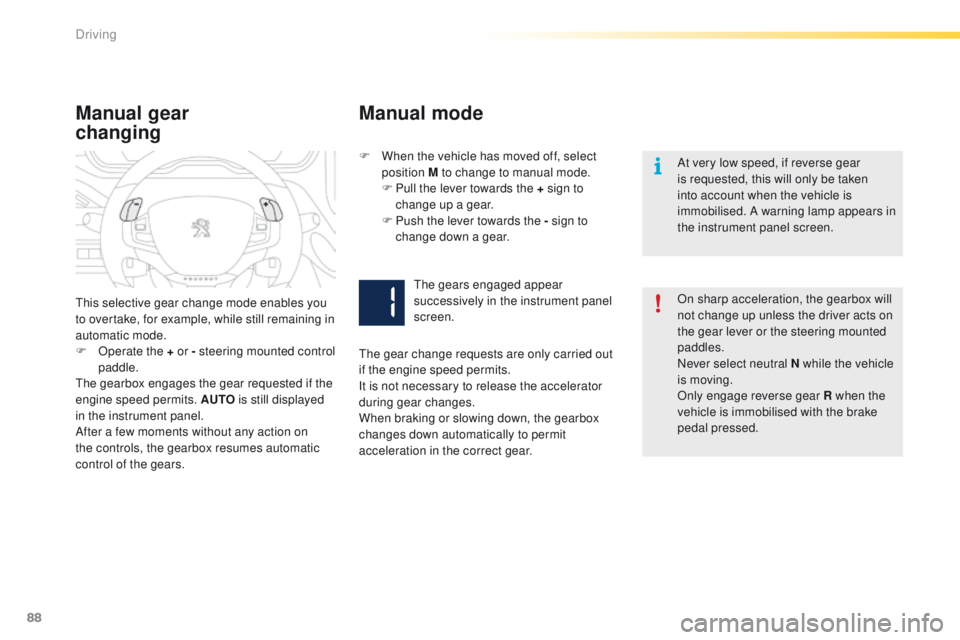
This selective gear change mode enables you
to overtake, for example, while still remaining in
automatic mode.
F
O
perate the + or - steering mounted control
paddle.
The gearbox engages the gear requested if the
engine speed permits. AUTO is still displayed
in the instrument panel.
After a few moments without any action on
the controls, the gearbox resumes automatic
control of the gears. F
W
hen the vehicle has moved off, select
position M to change to manual mode.
F
P
ull the lever towards the +
sign to
change up a gear.
F
P
ush the lever towards the - sign to
change down a gear.
The gears engaged appear
successively in the instrument panel
screen.
The gear change requests are only carried out
if the engine speed permits.
It is not necessary to release the accelerator
during gear changes.
When braking or slowing down, the gearbox
changes down automatically to permit
acceleration in the correct gear.
Driving
Page 92 of 340
90
2008_en_Chap05_conduite_ed01-2015
Four-speed automatic gearbox which offers a
choice between the comfort of fully automatic
operation, enhanced by sport and snow
programmes, or manual gear changing.
There are therefore four driving modes:
-
a
utomatic operation for electronic
management of the gears by the gearbox,
-
sp
ort programme for a more dynamic style
of driving,
-
s
now programme to improve driving when
traction is poor,
-
s
equential operation for manual changing
of the gears by the driver.
Automatic gearbox
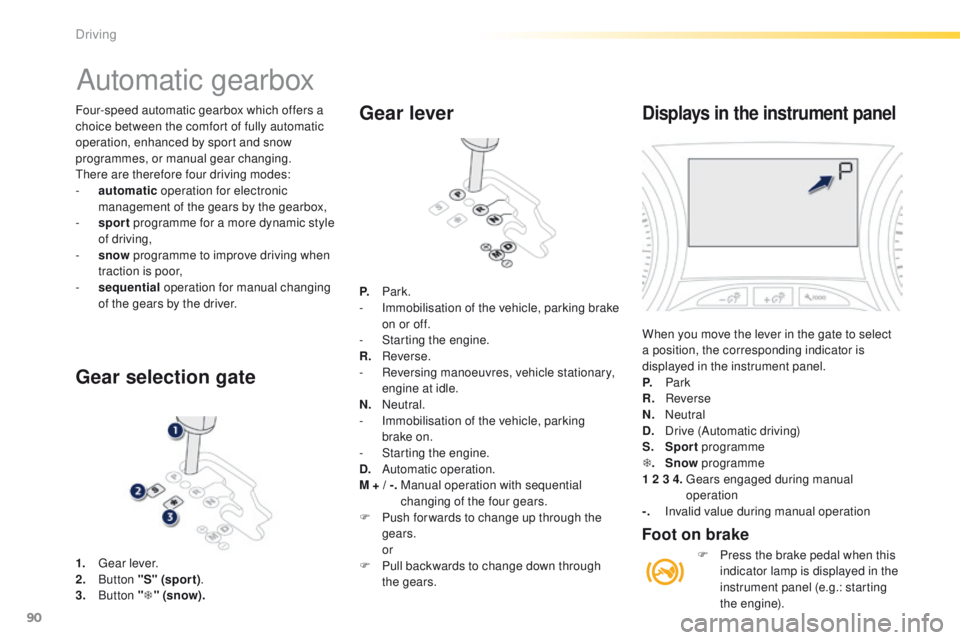
1. Gear lever.
2. B utton "S" (spor t) .
3.
Button "T " (snow).
Gear selection gate Gear lever
P.
Park.
- I mmobilisation of the vehicle, parking brake
on or off.
-
S
tarting the engine.
R.
R
everse.
-
R
eversing manoeuvres, vehicle stationary,
engine at idle.
N.
N
eutral.
-
I
mmobilisation of the vehicle, parking
brake on.
-
S
tarting the engine.
D.
A
utomatic operation.
M + / -.
M
anual operation with sequential
changing of the four gears.
F
P
ush for wards to change up through the
gears.
or
F
P
ull backwards to change down through
the gears.
Displays in the instrument panel
When you move the lever in the gate to select
a position, the corresponding indicator is
displayed in the instrument panel.
P.
Park
R.
Reverse
N.
N
eutral
D.
D
rive (Automatic driving)
S.
Sport programme
T .
Snow programme
1 2 3 4.
G
ears engaged during manual
operation
-.
I
nvalid value during manual operation
Foot on brake
F Press the brake pedal when this indicator lamp is displayed in the
instrument panel (e.g.: starting
the engine).
Driving
Page 93 of 340
91
2008_en_Chap05_conduite_ed01-2015
F Apply the parking brake.
F Sel ect position P or N .
F
S
tart the engine.
If this procedure is not followed, there is an
audible signal, accompanied by the display of
an warning message.
F
W
ith the engine running, press the brake
pedal.
F
R
elease the parking brake.
F
Sel
ect position R , D or M.
F
G
radually release the brake pedal.
The vehicle moves off immediately.
Moving off
When the engine is running at idle, with
the brakes released, if position R , D
or M is selected, the vehicle moves
even without the accelerator being
pressed.
When the engine is running, never
leave children in the vehicle without
supervision.
When carrying out maintenance with
the engine running, apply the parking
brake and select position P .
If position N is selected inadvertently
while driving, allow the engine to
return to idle then select position D to
accelerate.
If the ambient temperature is
below
-23°C, the engine should be left
at idle for four minutes, to ensure the
correct operation and life of the engine
and gearbox. Never select position N while the
vehicle is moving.
Never select positions P or R unless the
vehicle is completely stationary.
Automatic operation
F Select position D for automatic
changing
of the four gears.
The gearbox then operates in auto-adaptive
mode, without any intervention on the part
of the driver. It continuously selects the most
suitable gear according to the style of driving,
the profile of the road and the load in the
vehicle.
For maximum acceleration without touching the
gear lever, press the accelerator pedal down
fully (kick down). The gearbox changes down
automatically or maintains the gear selected
until the maximum engine speed is reached.
On braking, the gearbox changes down
automatically to provide efficient engine
braking.
If you release the accelerator sharply, the
gearbox will not change to a higher gear for
safety reasons.
5
Driving
Page 94 of 340
92
2008_en_Chap05_conduite_ed01-2015
Sport and snow programmes
Sport programme "S"
F Press button "S", after starting the engine.
The gearbox automatically favours a dynamic
style of driving.
S appears in the instrument panel.
Snow programme " T"
F Press button " T", after starting the
engine.
The gearbox adapts to driving on slippery
roads.
This programme improves starting and drive
when traction is poor.
T appears in the instrument panel.
These two special programmes supplement the
automatic operation in very specific conditions
of use.
Return to automatic
operation
Manual operation
F Select position M for sequential
changing
of the four gears.
F
P
ush the lever towards the + sign to
change up a gear.
F
P
ull the lever towards the - sign to change
down a gear.
It is only possible to change from one gear to
another if the vehicle speed and engine speed
permit; otherwise, the gearbox will operate
temporarily in automatic mode.
D disappears and the gears
engaged appear in succession in the
instrument panel.
If the engine speed is too low or too high, the
gear selected flashes for a few seconds, then
the actual gear engaged is displayed.
It is possible to change from position D
(automatic) to position M (manual) at any time.
When the vehicle is stationary or moving
very slowly, the gearbox selects gear M1
automatically.
The sport and snow programmes do not
operate in manual mode.
F
A
t any time, press the button selected
again to quit the programme engaged and
return to auto-adaptive mode.
Driving
Page 95 of 340
93
2008_en_Chap05_conduite_ed01-2015
There is a risk of damage to the
gearbox:
-
i
f you press the accelerator and
brake pedals at the same time,
-
i
f you force the movement of the
gear lever from the P position to
another position when the battery
is flat.
To reduce fuel consumption when at
a prolonged standstill with the engine
running (traffic jam...), put the gear lever
in the N position and apply the parking
brake.
Operating fault
When the ignition is on, the
lighting of this warning lamp,
accompanied by an audible signal and a
message in the multifunction screen, indicates
a gearbox fault.
In this case, the gearbox switches to back-up
mode and is locked in 3rd gear. You may feel
a substantial knock when changing from P
to R and from N to R . This will not cause any
damage to the gearbox.
Do not exceed 60 mph (100 km/h), local speed
restrictions permitting.
Contact a PEUGEOT dealer or a qualified
workshop as soon as possible.
If the lever is not in position P
, when the
driver's door is opened or approximately
45 seconds after the ignition is switched
off, a warning message appears in the
screen.
F
R
eturn the lever to position P ; the
message disappears.
When driving on flooded roads or when
crossing a ford, proceed at walking
pace.
Stopping the vehicle
This symbol is displayed if a gear
is not engaged correctly (selector
between two positions).
Invalid value during manual
operationBefore switching off the engine, you can
engage position P or N to place the gearbox in
neutral.
In both cases, apply the parking brake to
immobilise the vehicle.
5
Driving
Page 101 of 340
99
2008_en_Chap05_conduite_ed01-2015
Speed limiter
System which prevents the vehicle from
exceeding the speed programmed by the driver.
When the programmed speed limit is reached,
pressing the accelerator pedal in the normal
manner no longer has any effect.
The speed limiter is switched on manually: the
programmed speed must be at least 20 mph
(30 km/h).
The speed limiter is switched off by manual
operation of the control.
The programmed speed can be exceeded
temporarily by pressing the accelerator firmly.
To return to the programmed speed, simply
slow down to a speed below the programmed
speed.
The speed limiter cannot, in any circumstances,
replace the need to respect speed limits, nor can it
replace the need for vigilance on the part of the driver.
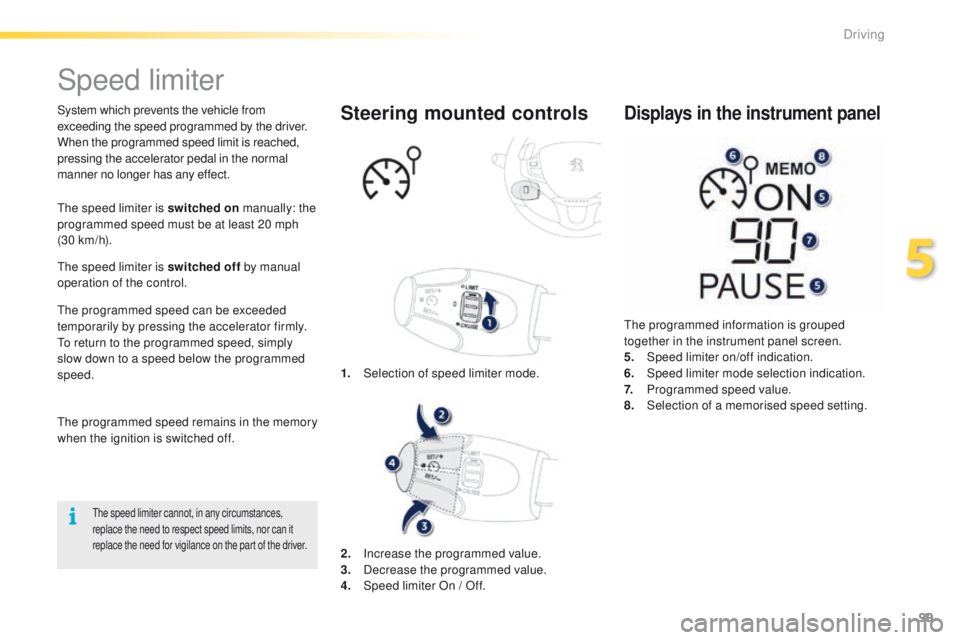
1. Selection of speed limiter mode.
Steering mounted controls
The programmed information is grouped
together in the instrument panel screen.
5.
Spe
ed limiter on/off indication.
6.
Spe
ed limiter mode selection indication.
7.
P
rogrammed speed value.
8.
Sel
ection of a memorised speed setting.
Displays in the instrument panel
The programmed speed remains in the memory
when the ignition is switched off.
2.
In
crease the programmed value.
3.
D
ecrease the programmed value.
4.
S
peed limiter On / Off.
5
Driving