2015 PEUGEOT 2008 air condition
[x] Cancel search: air conditionPage 67 of 340
65
2008_en_Chap03_confort_ed01-2015
Air conditioning On / Off
It enables you to:
- l ower the temperature, in summer,
-
i
ncrease the effectiveness of the demisting
in winter, above 3 °C.
Switching on
F Press the "A /C " button, the button's
indicator lamp comes on.
Switching off
F Press the "A /C " button again, the button's
indicator lamp goes off.
Switching off may affect comfort levels
(humidity, condensation). The air conditioning is designed to
operate effectively in all seasons,
with the windows closed.
The air conditioning does not operate
when the air flow adjustment control 2
is in position " 0".
To obtain cooled air more quickly, you can use
recirculation of interior air for a few moments.
Then return to fresh air intake.
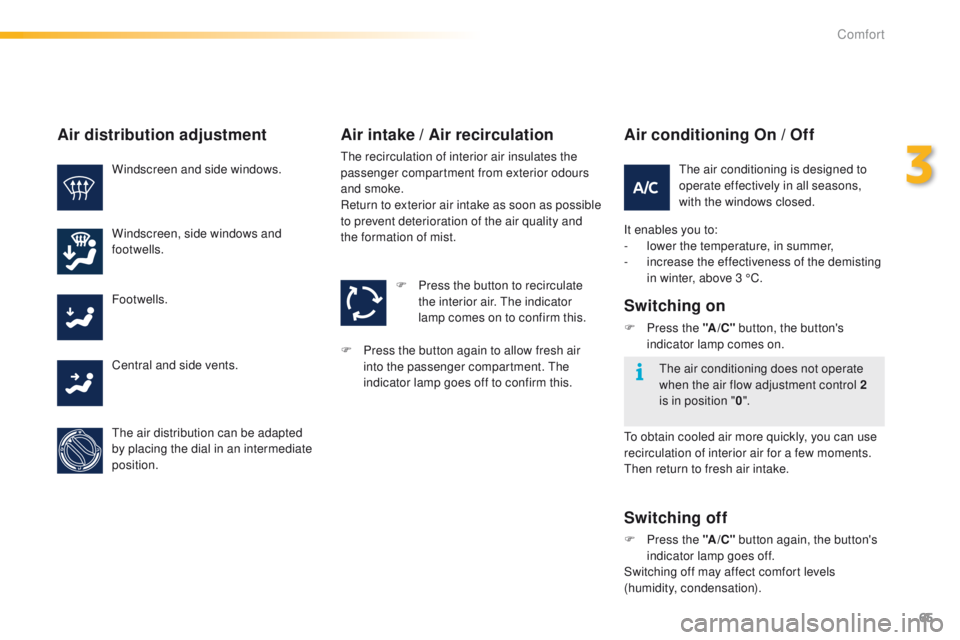
Air distribution adjustment
Windscreen and side windows.
Windscreen, side windows and
footwells.
Footwells.
Central and side vents.
The air distribution can be adapted
by placing the dial in an intermediate
position. F
P
ress the button to recirculate
the interior air. The indicator
lamp comes on to confirm this.
Air intake / Air recirculation
The recirculation of interior air insulates the
passenger compartment from exterior odours
and smoke.
Return to exterior air intake as soon as possible
to prevent deterioration of the air quality and
the formation of mist.
F
P
ress the button again to allow fresh air
into the passenger compartment. The
indicator lamp goes off to confirm this.
3
Comfort
Page 68 of 340
66
2008_en_Chap03_confort_ed01-2015
Dual-zone digital air conditioning
Automatic operation
Automatic comfort programme
Three modes are provided for the driver and for
the front passenger to select their desired level
of comfort in the passenger compartment.When the engine is cold, to prevent too
great a distribution of cold air, the air
flow will only reach its optimum level
gradually.
In cold weather, it favours the
distribution of warm air to the
windscreen, the side windows and the
footwells only.
Offers the best compromise between
a comfortable temperature and quiet
operation. Provides soft and quiet operation by
limiting air flow.
Provides strong and effective air flow.
F
P
ress the "AUTO" button
repeatedly. The indicator lamp
comes on at the first press; the
mode activated appears in the
digital air conditioning screen:
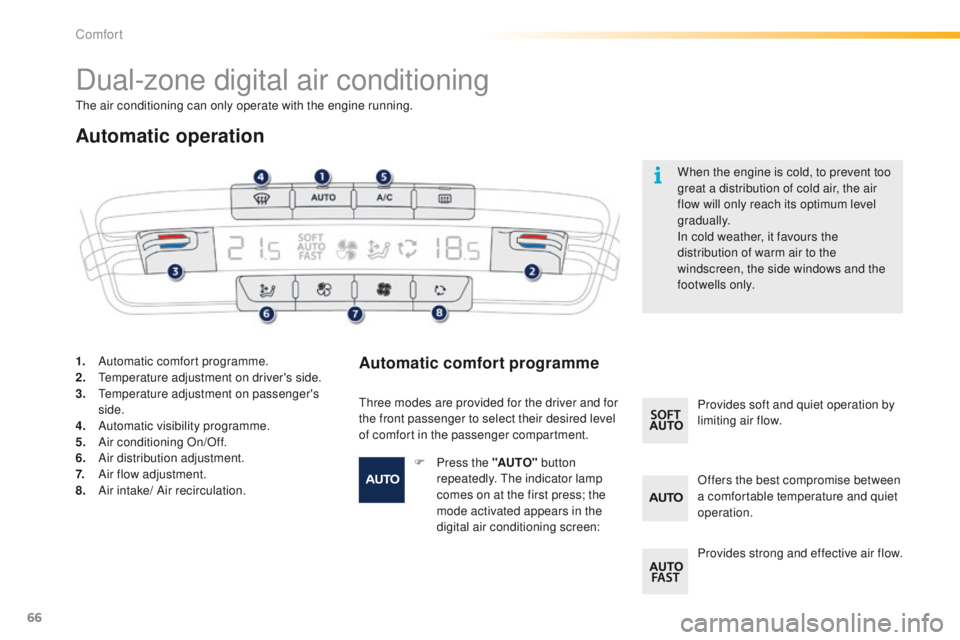
1.
A
utomatic comfort programme.
2.
T
emperature adjustment on driver's side.
3. T
emperature adjustment on passenger's
side.
4.
A
utomatic visibility programme.
5.
A
ir conditioning On/Off.
6.
A
ir distribution adjustment.
7.
A
ir flow adjustment.
8.
A
ir intake/ Air recirculation.
The air conditioning can only operate with the engine running.
Comfort
Page 69 of 340
67
2008_en_Chap03_confort_ed01-2015
A setting around 21 enables you to obtain an
optimum level of comfort. Depending on your
requirements, a setting between 18 and 24 is usual.
In addition, it is recommended that you avoid a left /
right setting difference of more than 3.
On entering the vehicle, if the interior
temperature is much colder or warmer
than the comfort value, there is no need
to alter the value displayed in order to
obtain the required level of comfort.
The system corrects the temperature
difference automatically and as quickly
as possible.
Automatic visibility
programme
For maximum cooling or heating of
the passenger compartment, you can
exceed the minimum value of 14 or the
maximum value of 28.
F
P
ush the switch 2 or 3 down
until
"LO" is displayed or up
until
"HI" is displayed.
See the "Front demisting-defrosting"
section.
Depending on your requirements, you can
make a different selection from that offered by
the system by changing a setting. The other
functions will still be controlled automatically.
Resuming manual control
The air conditioning is designed to
operate efficiently in all seasons, with
the windows closed.
Air conditioning On/Off
It allows you:
- i n summer, to lower the temperature,
-
i
n winter, above 3 °C, to improve demisting.
Switching on
F
P
ress the " A/C" button, the associated
indicator lamp comes on.
The air conditioning cannot operate when the
air flow is set to off.
Switching off
F
P
ress the "A /C " button again; the
associated indicator lamp goes off.
Switching off may cause some problems
(humidity, misting).
When you modify a setting, the indicator
lamp in the "AUTO"
button goes off.
F
P
ress the "AUTO" button again
to return to the automatic comfort
programme.
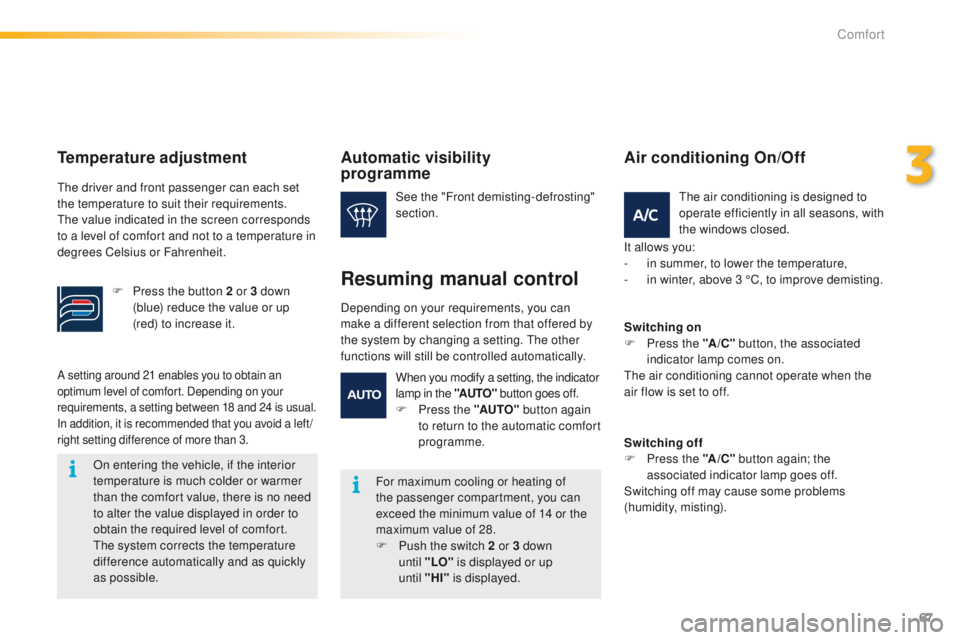
Temperature adjustment
The driver and front passenger can each set
the temperature to suit their requirements.
The value indicated in the screen corresponds
to a level of comfort and not to a temperature in
degrees Celsius or Fahrenheit.
F
P
ress the button 2 or 3 down
(blue) reduce the value or up
(red) to increase it.
3
Comfort
Page 70 of 340
68
2008_en_Chap03_confort_ed01-2015
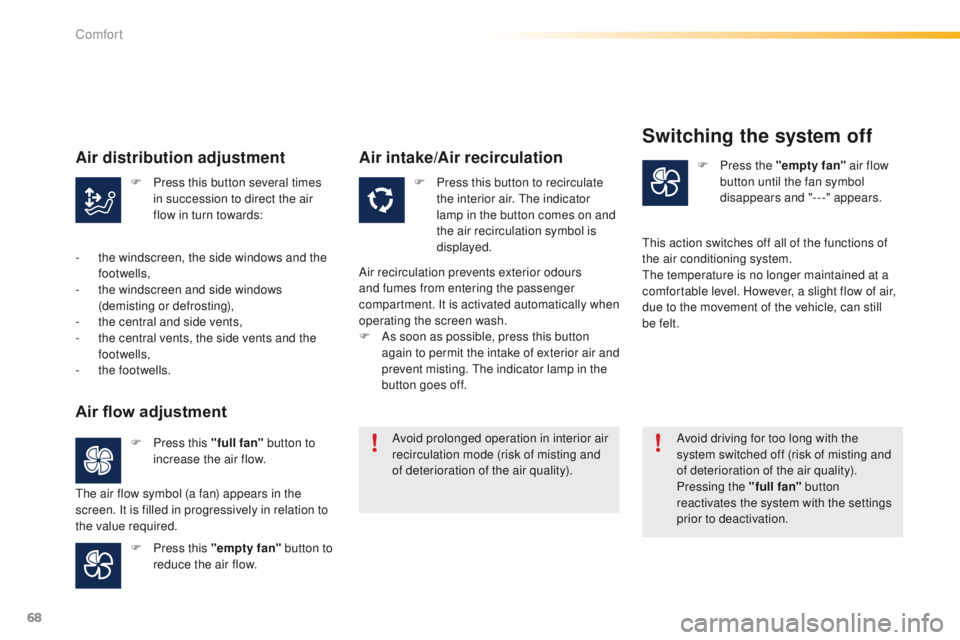
F Press this button several times in succession to direct the air
flow in turn towards: F
P ress this button to recirculate
the interior air. The indicator
lamp in the button comes on and
the air recirculation symbol is
displayed. F
P
ress the "empty fan"
air flow
button until the fan symbol
disappears and "---" appears.
F
P
ress this "full fan" button to
increase the air flow.
F
P
ress this "empty fan" button to
reduce the air flow. Avoid prolonged operation in interior air
recirculation mode (risk of misting and
of deterioration of the air quality).
Avoid driving for too long with the
system switched off (risk of misting and
of deterioration of the air quality).
Pressing the "full fan"
button
reactivates the system with the settings
prior to deactivation.
Air distribution adjustment
- the windscreen, the side windows and the footwells,
-
t
he windscreen and side windows
(demisting or defrosting),
-
t
he central and side vents,
-
t
he central vents, the side vents and the
footwells,
-
t
he footwells.
Air flow adjustment
The air flow symbol (a fan) appears in the
screen. It is filled in progressively in relation to
the value required.
Air intake/Air recirculation
Air recirculation prevents exterior odours
and fumes from entering the passenger
compartment. It is activated automatically when
operating the screen wash.
F
A
s soon as possible, press this button
again to permit the intake of exterior air and
prevent misting. The indicator lamp in the
button goes off.
Switching the system off
This action switches off all of the functions of
the air conditioning system.
The temperature is no longer maintained at a
comfortable level. However, a slight flow of air,
due to the movement of the vehicle, can still
be felt.
Comfort
Page 71 of 340
69
2008_en_Chap03_confort_ed01-2015
F Switch off the demisting/defrosting of the rear screen and door mirrors
as soon as appropriate, as lower
current consumption results in
reduced fuel consumption.
Front demist - defrost Rear screen
demist
-
defrost
The control button is located on the
air conditioning system control panel.
These markings on the control panel indicate the control positions for rapid demisting or
defrosting of the windscreen and side windows.With manual air
conditioning
Switching on
The rear screen demisting/defrosting can only
operate when the engine is running.
F
P
ress this button to demist /defrost the
rear screen and (depending on version)
the door mirrors. The indicator lamp
associated with the button comes on.
With Stop & Start, when demisting has
been activated, the STOP mode is not
available.
Switching off
The demisting/defrosting switches off automatically
to prevent an excessive consumption of current.
F
I
t is possible to stop the demisting/defrosting
operation before it is switched off automatically
by pressing the button again. The indicator
lamp associated with the button goes off.
With dual-zone digital air
conditioning
Automatic visibility
programme
F Select this programme to demist or defrost the windscreen and side windows as
quickly as possible.
The system automatically manages the air
conditioning, air flow and air intake, and
provides optimum distribution towards the
windscreen and side windows.
F
T
o stop the programme, press either the
"visibility" button again or "AUTO" , the
warning lamp on the button goes off and
the warning lamp in the "AUTO" button
comes on.
The system reverts to the previous settings.
F
P
ut the air flow, temperature and
distribution controls to the dedicated
marked position.
F
P
ress the "A /C " button for air conditioning;
the indicator lamp in the button comes on.
3
Comfort
Page 73 of 340
71
2008_en_Chap04_amenagements_ed01-2015
12 V accessory socket
F To connect a 12 V accessory (maximum power: 120 Watts), lift the cover and
connect a suitable adaptor.
Illuminated glove box
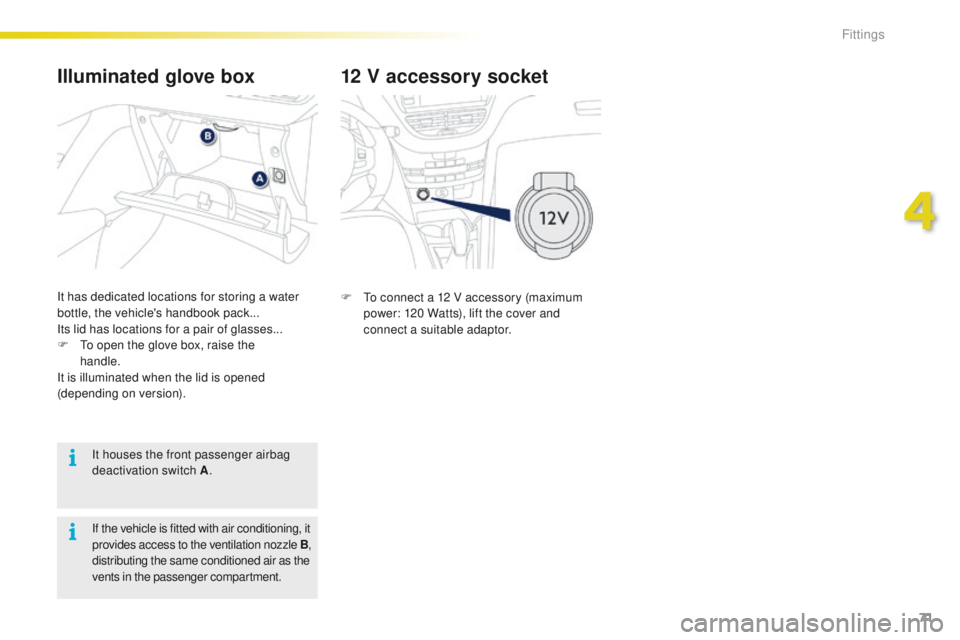
It has dedicated locations for storing a water
bottle, the vehicle's handbook pack...
Its lid has locations for a pair of glasses...
F
T
o open the glove box, raise the
handle.
It is illuminated when the lid is opened
(depending on version).
It houses the front passenger airbag
deactivation switch A .
If the vehicle is fitted with air conditioning, it
provides access to the ventilation nozzle
B,
distributing the same conditioned air as the
vents in the passenger compartment.
4
Fittings
Page 117 of 340
115
2008_en_Chap06_visibilite_ed01-2015
Daytime running lamps
Daytime lighting, compulsory in certain
countries, which comes on automatically when
the engine is started making the vehicle more
visible to other users.
LED lamps
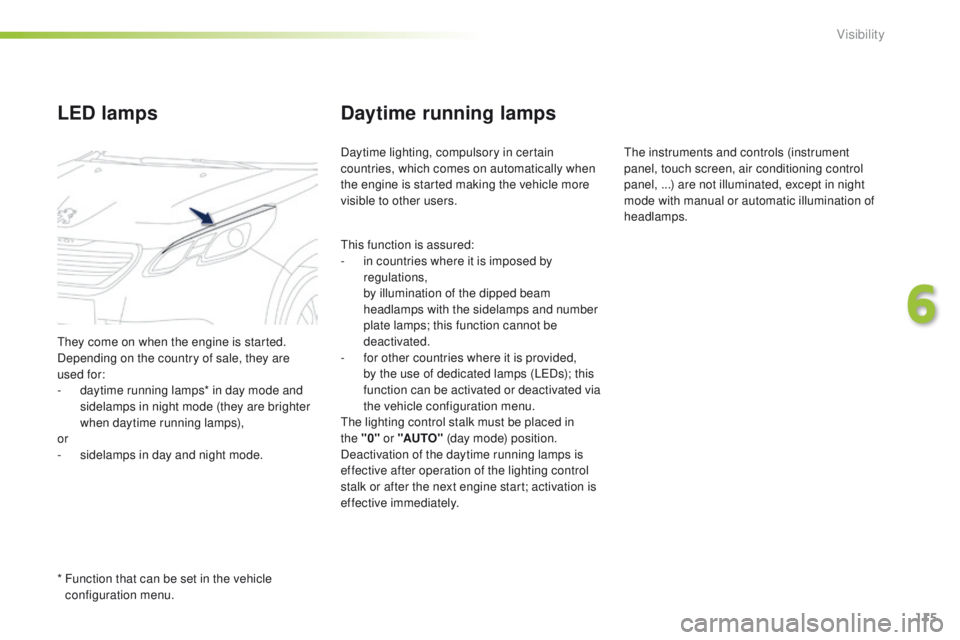
They come on when the engine is started.
Depending on the country of sale, they are
used for:
-
d
aytime running lamps* in day mode and
sidelamps in night mode (they are brighter
when daytime running lamps),
or
-
s
idelamps in day and night mode.
*
F
unction that can be set in the vehicle
configuration menu. This function is assured:
-
i
n countries where it is imposed by
regulations,
b
y illumination of the dipped beam
headlamps with the sidelamps and number
plate lamps; this function cannot be
deactivated.
- f or other countries where it is provided,
b
y the use of dedicated lamps (LEDs); this
function can be activated or deactivated via
the vehicle configuration menu.
The lighting control stalk must be placed in
the
"0"
or "AUTO" (day mode) position.
Deactivation of the daytime running lamps is
effective after operation of the lighting control
stalk or after the next engine start; activation is
effective immediately. The instruments and controls (instrument
panel, touch screen, air conditioning control
panel, ...) are not illuminated, except in night
mode with manual or automatic illumination of
headlamps.
6
Visibility
Page 132 of 340

130
2008_en_Chap07_securite_ed01-2015
The under-inflation detection system
does not replace the vigilance or the
responsibility of the driver.
This system does not avoid the need to
check the tyre pressures (including the
spare wheel) every month as well as
before a long journey.
Driving with under-inflated tyres impairs
road holding, extends braking distances
and causes premature tyre wear,
particularly under arduous condition
(high loading, high speed, long journey).The inflation pressures defined for
your vehicle can be found on the tyre
pressure label.
See the "Identification markings"
section.
Tyre pressures should be checked
when the tyres are "cold" (vehicle
stopped for 1 hour or after a journey of
less than 6 miles (10 km) at moderate
speeds).
Other wise (when hot), add 0.3 bar to
the pressures shown on the label.
Driving with under-inflated tyres
increases fuel consumption.
Tyre under-inflation detection
System which automatically checks the pressure of the tyres while driving.
The system monitors the pressures on the four
tyres, once the vehicle is moving.
It compares the information given by the four
wheel speed sensors with reference values,
which must be reinitialised ever y time the
tyre pressures are adjusted or a wheel
changed
.
The system triggers an alert as soon as it
detects a drop in the inflation pressure of one
or more tyres.
Safety