Page 167 of 271
165
108_en_Chap09_info-pratiques_ed01-2015
the batteries contain harmful substances
such as sulphuric acid and lead. th ey
must be disposed of in accordance
with regulations and must not, in any
circumstances, be discarded with household
waste.
ta
ke used remote control batteries and
vehicle batteries to a special collection point.Protect your eyes and face before
handling the battery.
All operations on the battery must be
carried out in a well ventilated area and
away from naked flames and sources
of sparks, so as to avoid the risk of
explosion or fire.
Do not try to charge a frozen battery;
the battery must first be thawed out to
avoid the risk of explosion. If the battery
has been frozen, before charging have
it checked by a P
e
uge
Ot
dealer or a
qualified workshop who will check that
the internal components have not been
damaged and the casing is not cracked,
which could cause a leak of toxic and
corrosive acid.
Do not reverse the polarity and use only
a 12 V charger.
Do not disconnect the terminals while
the engine is running.
Do not charge the batteries without
disconnecting the terminals first.
Wash your hands afterwards.
It is advisable to disconnect the battery
if the vehicle is to be left unused for
more than one month.Charging the battery using
a battery charger
F Disconnect the battery from the vehicle.
F
F ollow the instructions for use provided by
the manufacturer of the charger.
F
C
onnect the battery starting with the
positive terminal (+).
F
C
heck that the terminals and connectors
are clean. If they are covered with sulphate
(whitish or greenish deposit), remove them
and clean them.
Some functions are not available if the
battery is not sufficiently charged.
9
Practical information
Page 168 of 271
166
108_en_Chap09_info-pratiques_ed01-2015
electrical energy economy mode*
System which manages the duration of use of certain functions to conserve a sufficient level of
charge in the battery.
After the engine has stopped, you can still use functions such as the audio system, windscreen
wipers, dipped beam headlamps,
courtesy lamps, etc. for a maximum combined duration of
twenty
minutes.
th
is period may be greatly reduced if the battery is not fully charged. Let the engine run for the duration
specified to ensure that the battery
charge is sufficient.
Do not repeatedly and continuously
restart the engine in order to charge the
battery.
A flat battery prevents the engine from
starting.
Refer to the "Battery" section.
Switching to economy mode
Once this time has elapsed the active functions
are put on standby.
Exiting economy mode
these functions are reactivated automatically
next time the vehicle is driven.
to r
estore the use of these functions
immediately, start the engine and let it run for at
least 5 minutes.
Changing a wiper
blade
Removing the front wiper blade
F Raise the wiper arm.
F R emove the wiper blade, sliding it towards
the outside.
Fitting the front wiper blade
F Put the corresponding new wiper blade in place and fix it.
F
F
old down the wiper arm carefully.
to c
onserve the effectiveness of
the flat-blade type wiper blades, we
recommend that they are:
-
han
dled with care,
-
c
leaned regularly with soapy water,
-
n
ot used to hold a cardboard sheet
against the windscreen,
-
r
eplaced at the first signs of wear.
*
O
nly on vehicles with the "Keyless
e
n
try and
Starting" system.
Practical information
Page 175 of 271
173
108_en_Chap10_verifications_ed01-2015
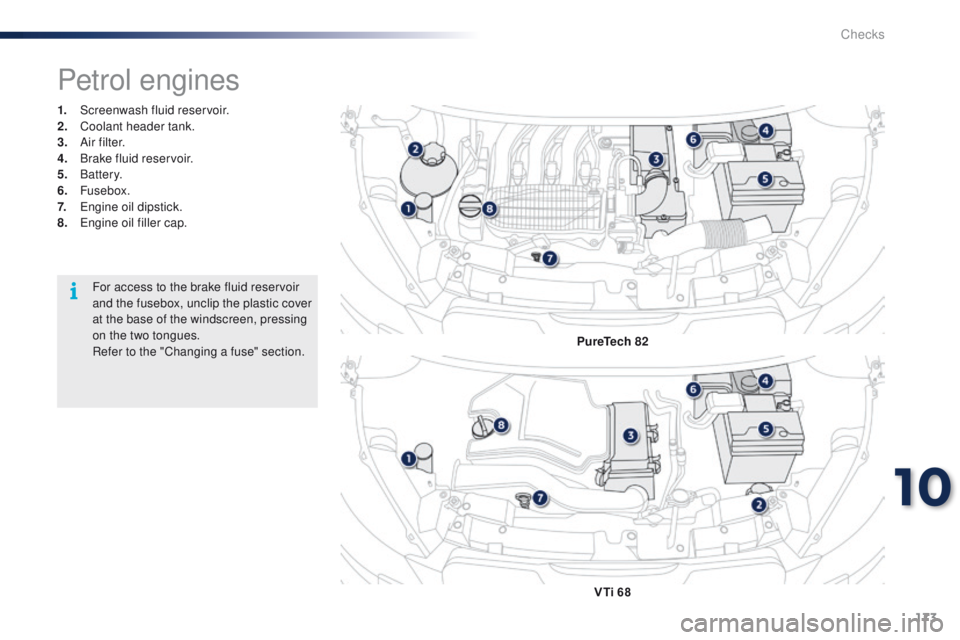
1. Screenwash fluid reservoir.
2. Coolant header tank.
3.
A
i r f i l t e r.
4.
B
rake fluid reservoir.
5.
Battery.
6.
Fusebox.
7.
e
n
gine oil dipstick.
8.
e
n
gine oil filler cap.
Petrol engines
PureTech 82
VTi 68
For access to the brake fluid reservoir
and the fusebox, unclip the plastic cover
at the base of the windscreen, pressing
on the two tongues.
Refer to the "Changing a fuse" section.
10
Checks
Page 179 of 271

177
108_en_Chap10_verifications_ed01-2015
Checks
12 V battery
the battery does not require any maintenance.
However, check that the terminals are clean
and correctly tightened, particularly in summer
and winter.Refer to the manufacturer's
service schedule for details of the
replacement intervals for these
components.
Air filter and passenger compartment filter
Replace the oil filter each time the
engine oil is changed.
Refer to the manufacturer's
service schedule for details of
the replacement interval for this
component.
Oil filter
unless otherwise indicated, check these components in accordance with the manufacturer's service schedule and according to your engine.
Other wise, have them checked by a PeugeOt dealer or a qualified workshop.
Depending on the environment (e.g. dusty
atmosphere) and the use of the vehicle
(e.g. city driving), replace them twice as often
if necessary .
A clogged passenger compartment filter may
have an adverse effect on the per formance
of the air conditioning system and generate
undesirable odours.
When carrying out work on the battery, refer
to the "12 V battery" section for details of the
precautions to be taken before disconnecting
the battery and following its reconnection.
Manual gearbox
the gearbox does not require any
maintenance (no oil change).
Refer to the manufacturer's service
schedule for the checking interval for
this component.
Clutch
the clutch is operated mechanically and
requires regular adjustment.
Refer to the manufacturer's service schedule
for information on when the adjustment should
be checked.
In the event of an operating fault
(difficulty moving off, for example),
contact a P
e
uge
Ot
dealer or a
qualified workshop.
10
Checks
Page 185 of 271
183
108_en_Chap12a_Autoradio-Toyota-tactile-1_ed01-2015
7-inch touch screen
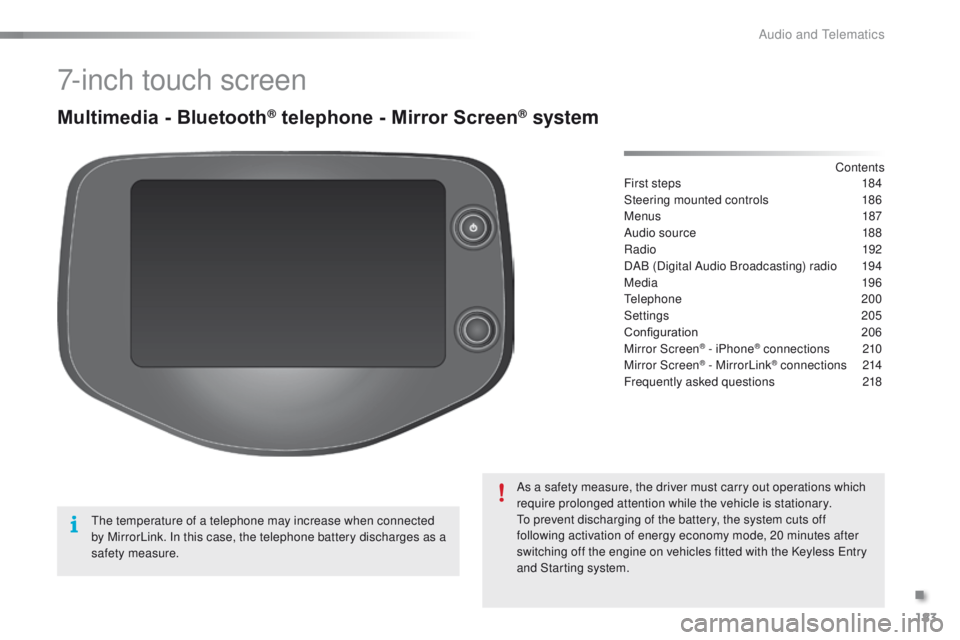
Multimedia - Bluetooth® telephone - Mirror Screen® system
First steps 184
Steering mounted controls
1
86
Menus
187
Audio source
1
88
Radio
192
DAB (Digital Audio Broadcasting) radio
1
94
Media
19 6
te
lephone
200
Settings
205
Configuration
20
6
Mirror Screen
® - iPhone® connections 210
Mirror Screen® - MirrorLink® connections 2 14
Frequently asked questions
2
18
As a safety measure, the driver must carry out operations which
require prolonged attention while the vehicle is stationary.
to p
revent discharging of the battery, the system cuts off
following activation of energy economy mode, 20 minutes after
switching off the engine on vehicles fitted with the Keyless
e
n
try
and Starting system. Contents
th
e temperature of a telephone may increase when connected
by MirrorLink. In this case, the telephone battery discharges as a
safety measure.
.
Audio and telematics
Page 223 of 271
221
108_en_Chap12a_Autoradio-Toyota-tactile-1_ed01-2015
Settings, configuration
QUESTIONANSWER SOLUTION
th
ere is a difference in
sound quality between the
different audio sources
(radio,
u
S
B...). For optimum sound quality, the audio settings (Volume,
t
r
eble,
Medium, Bass) can be adapted to the different sound sources,
which may result in audible differences when changing source
(radio,
u
S
B...). Check that the audio settings are adapted to
the sources listened to. It is advisable to select
automatic sound adjustment (Low, Medium,
High).
Check the quality and format of your recording.
With the engine off, the
system switches off after a
few minutes of use. When the engine is switched off, the system's operating time
depends on the battery charge.
th
e switch-off is normal: the system changes to economy mode
and switches off to preserve the state of charge of the vehicle's
battery. Start the vehicle's engine to increase the battery
charge.
.
Audio and telematics
Page 225 of 271
223
108_en_Chap12b_Autoradio-toyota-2_ed01-2015
Radio
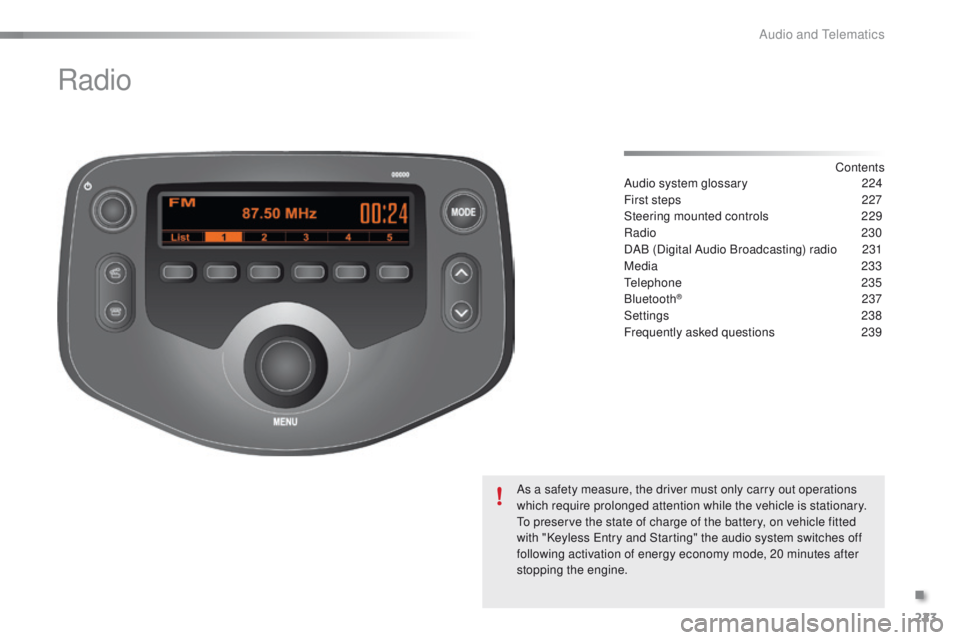
Contents
Audio system glossary
2 24
First steps
2
27
Steering mounted controls
2
29
Radio
230
DAB (Digital Audio Broadcasting) radio
2
31
Media
233
te
lephone
2
35
Bluetooth
® 237
Settings
2
38
Frequently asked questions
23
9
As a safety measure, the driver must only carry out operations
which require prolonged attention while the vehicle is stationary.
to p
reserve the state of charge of the battery, on vehicle fitted
with "Keyless
e
n
try and Starting" the audio system switches off
following activation of energy economy mode, 20 minutes after
stopping the engine.
.
Audio and telematics
Page 244 of 271
242
108_en_Chap12b_Autoradio-toyota-2_ed01-2015
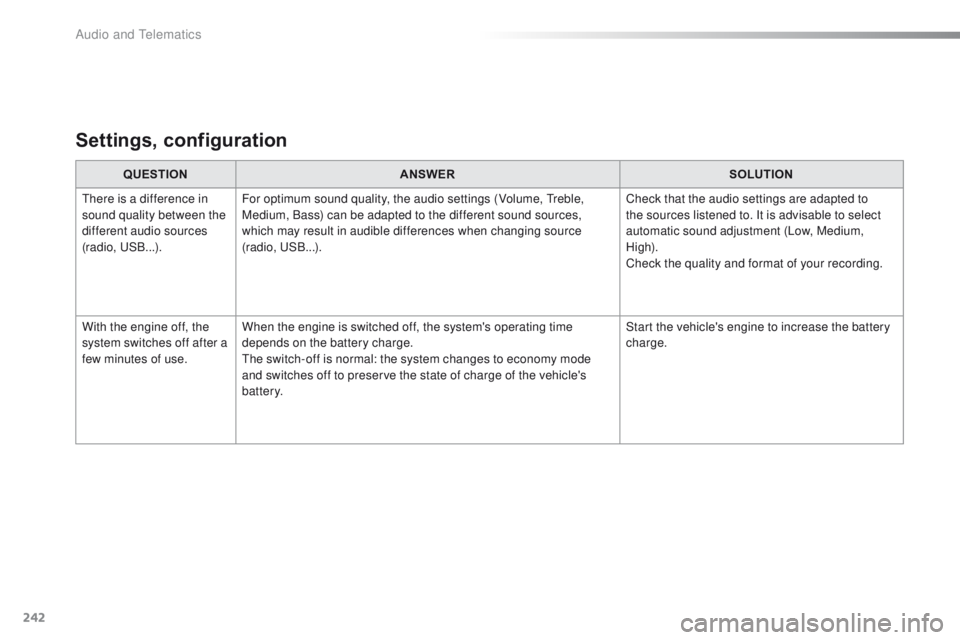
Settings, configuration
QUESTION ANSWER SOLUTION
th
ere is a difference in
sound quality between the
different audio sources
(radio,
u
S
B...). For optimum sound quality, the audio settings (Volume,
t
r
eble,
Medium, Bass) can be adapted to the different sound sources,
which may result in audible differences when changing source
(radio,
u
S
B...). Check that the audio settings are adapted to
the sources listened to. It is advisable to select
automatic sound adjustment (Low, Medium,
High).
Check the quality and format of your recording.
With the engine off, the
system switches off after a
few minutes of use. When the engine is switched off, the system's operating time
depends on the battery charge.
th
e switch-off is normal: the system changes to economy mode
and switches off to preserve the state of charge of the vehicle's
battery. Start the vehicle's engine to increase the battery
charge.
Audio and telematics