Page 23 of 457
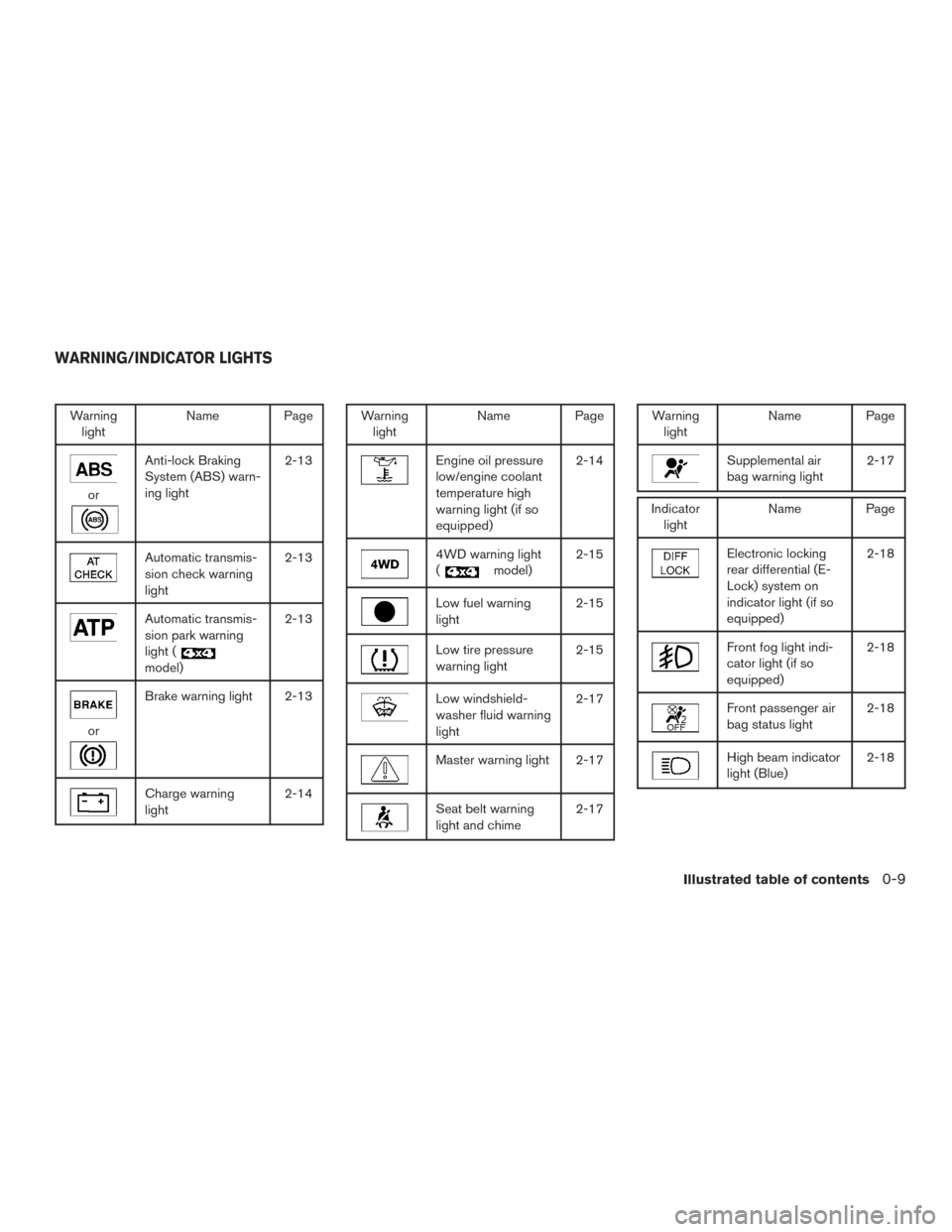
Warninglight Name Page
or
Anti-lock Braking
System (ABS) warn-
ing light 2-13
Automatic transmis-
sion check warning
light2-13
Automatic transmis-
sion park warning
light (
model)2-13
or
Brake warning light 2-13
Charge warning
light
2-14
Warning
light Name Page
Engine oil pressure
low/engine coolant
temperature high
warning light (if so
equipped) 2-14
4WD warning light
(
model)
2-15
Low fuel warning
light 2-15
Low tire pressure
warning light2-15
Low windshield-
washer fluid warning
light2-17
Master warning light 2-17
Seat belt warning
light and chime
2-17
Warning
light Name Page
Supplemental air
bag warning light 2-17
Indicator
light Name Page
Electronic locking
rear differential (E-
Lock) system on
indicator light (if so
equipped) 2-18
Front fog light indi-
cator light (if so
equipped)
2-18
Front passenger air
bag status light
2-18
High beam indicator
light (Blue)2-18
WARNING/INDICATOR LIGHTS
Illustrated table of contents0-9
Page 24 of 457
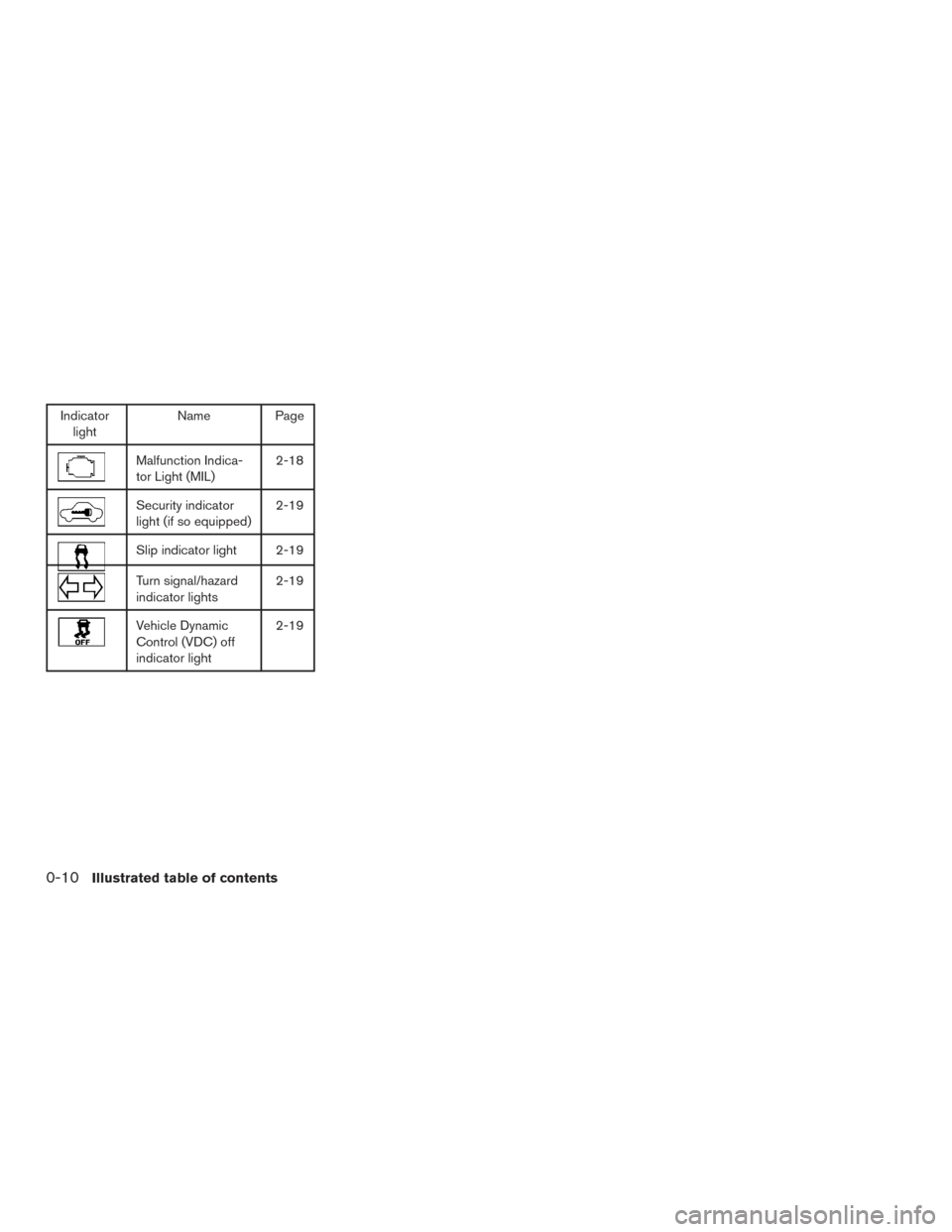
Indicatorlight Name Page
Malfunction Indica-
tor Light (MIL) 2-18
Security indicator
light (if so equipped)2-19
Slip indicator light 2-19
Turn signal/hazard
indicator lights2-19
Vehicle Dynamic
Control (VDC) off
indicator light2-19
0-10Illustrated table of contents
Page 26 of 457
1 Safety—Seats, seat belts and
supplemental restraint system
Seats............................................1-2
Front manual bench seat adjustment
(if so equipped) ................................1-3
Front power seat adjustment
(if so equipped) ................................1-4
Armrests (if so equipped) ........................1-5
Flexible seating .................................1-6
Head restraints/Headrests ..........................1-9
Adjustable head restraint/headrest
components .................................. 1-10
Non-adjustable head restraint/headrest
components .................................. 1-10
Remove ...................................... 1-11
Install ........................................ 1-11
Adjust ........................................ 1-12
Front-seat active head restraints ................1-13
Seat belts ....................................... 1-14Precautions on seat belt usage
..................1-14
Seat belt warning light ......................... 1-17
Pregnant women .............................. 1-17
Injured persons ................................ 1-17
Three-point type seat belt with retractor
(if so equipped) ............................... 1-17
Two-point type seat belt without retractor
(if so equipped) ............................... 1-21
Seat belt extenders ............................ 1-23
Seat belt maintenance ......................... 1-23
Child safety ...................................... 1-24
Infants ........................................ 1-24
Small children ................................. 1-25
Larger children ................................ 1-25
Child restraints ................................... 1-25
Precautions on child restraints ..................1-25
Page 27 of 457
LATCH (Lower Anchors and Tethers for
CHildren) System............................. 1-27
Rear-facing child restraint installation using
LATCH....................................... 1-30
Rear-facing child restraint installation using
the seat belts ................................. 1-32
Forward-facing child restraint installation
using LATCH .................................. 1-35
Forward-facing child restraint installation
using the seat belts — front passenger and
rear bench seat ............................... 1-39Forward-facing child restraint installation
using the seat belts — front bench center
position
...................................... 1-43
Booster seats ................................. 1-46
Supplemental restraint system (SRS) ...............1-50
Precautions on SRS ........................... 1-50
Supplemental air bag warning labels .............1-65
Supplemental air bag warning light ..............1-65
Page 42 of 457
WARNING
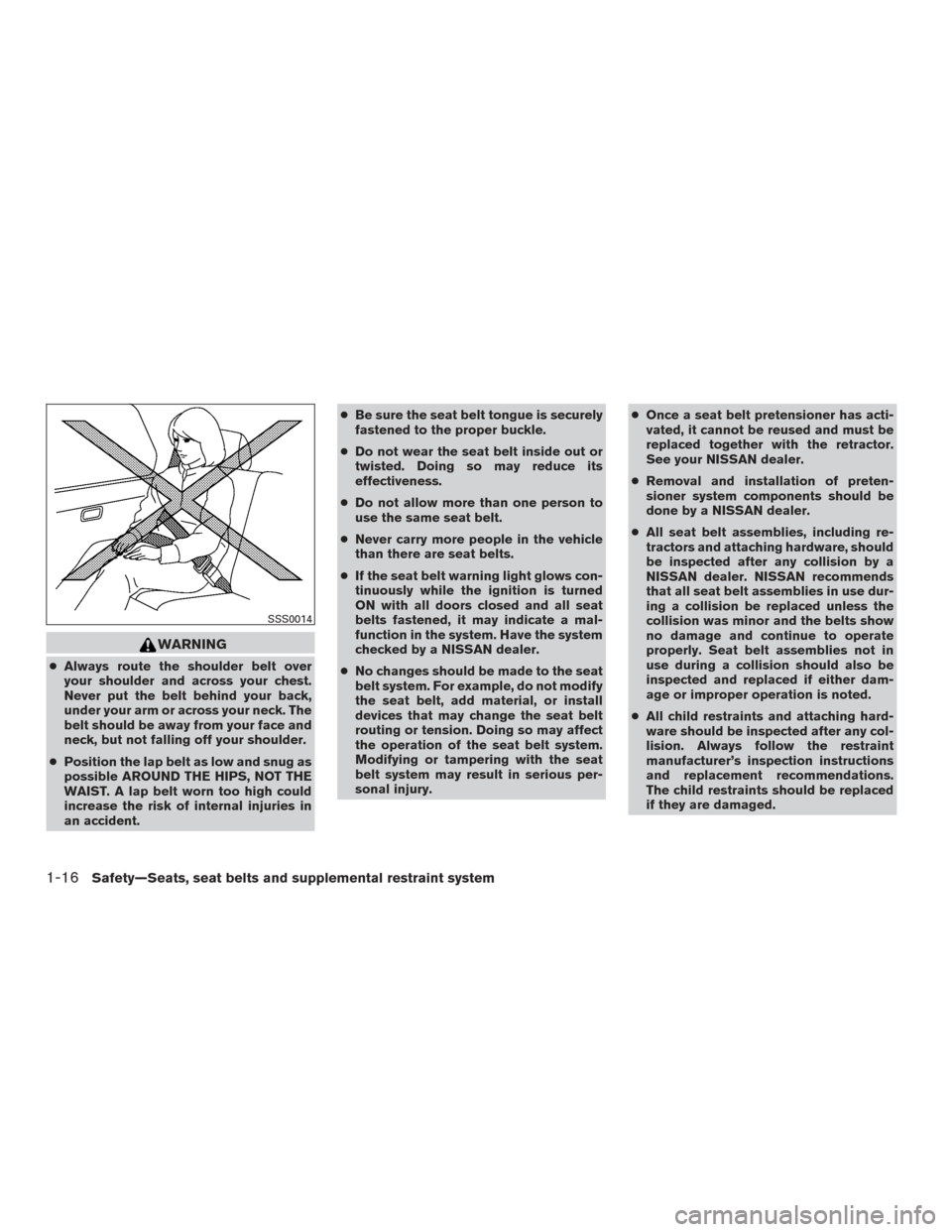
●Always route the shoulder belt over
your shoulder and across your chest.
Never put the belt behind your back,
under your arm or across your neck. The
belt should be away from your face and
neck, but not falling off your shoulder.
● Position the lap belt as low and snug as
possible AROUND THE HIPS, NOT THE
WAIST. A lap belt worn too high could
increase the risk of internal injuries in
an accident. ●
Be sure the seat belt tongue is securely
fastened to the proper buckle.
● Do not wear the seat belt inside out or
twisted. Doing so may reduce its
effectiveness.
● Do not allow more than one person to
use the same seat belt.
● Never carry more people in the vehicle
than there are seat belts.
● If the seat belt warning light glows con-
tinuously while the ignition is turned
ON with all doors closed and all seat
belts fastened, it may indicate a mal-
function in the system. Have the system
checked by a NISSAN dealer.
● No changes should be made to the seat
belt system. For example, do not modify
the seat belt, add material, or install
devices that may change the seat belt
routing or tension. Doing so may affect
the operation of the seat belt system.
Modifying or tampering with the seat
belt system may result in serious per-
sonal injury. ●
Once a seat belt pretensioner has acti-
vated, it cannot be reused and must be
replaced together with the retractor.
See your NISSAN dealer.
● Removal and installation of preten-
sioner system components should be
done by a NISSAN dealer.
● All seat belt assemblies, including re-
tractors and attaching hardware, should
be inspected after any collision by a
NISSAN dealer. NISSAN recommends
that all seat belt assemblies in use dur-
ing a collision be replaced unless the
collision was minor and the belts show
no damage and continue to operate
properly. Seat belt assemblies not in
use during a collision should also be
inspected and replaced if either dam-
age or improper operation is noted.
● All child restraints and attaching hard-
ware should be inspected after any col-
lision. Always follow the restraint
manufacturer’s inspection instructions
and replacement recommendations.
The child restraints should be replaced
if they are damaged.
SSS0014
1-16Safety—Seats, seat belts and supplemental restraint system
Page 43 of 457
SEAT BELT WARNING LIGHT
Both the driver’s and passenger’s front seats are
equipped with a seat belt warning light. The
warning light, located on the instrument panel,
will show the status of the driver and passenger
seat belt.
NOTE:
The front passenger seat belt warning light
will not light up if the seat is not occupied.
For additional information, refer to
“Warning/indicator lights and audible reminders”
in the “Instruments and controls” section of this
manual.
PREGNANT WOMEN
NISSAN recommends that pregnant women use
seat belts. The seat belt should be worn snug and
always position the lap belt as low as possible
around the hips, not the waist. Place the shoulder
belt over your shoulder and across your chest.
Never run the lap/shoulder belt over your ab-
dominal area. Contact your doctor for specific
recommendations.
INJURED PERSONS
NISSAN recommends that injured persons use
seat belts. Check with your doctor for specific
recommendations.
THREE-POINT TYPE SEAT BELT
WITH RETRACTOR (if so equipped)
WARNING
●Every person who drives or rides in this
vehicle should use a seat belt at all
times. ●
Do not ride in a moving vehicle when
the seatback is reclined. This can be
dangerous. The shoulder belt will not
be against your body. In an accident,
you could be thrown into it and receive
neck or other serious injuries. You
could also slide under the lap belt and
receive serious internal injuries.
● For the most effective protection when
the vehicle is in motion, the seat should
be upright. Always sit well back in the
seat with both feet on the floor and
adjust the seat belt properly.
● Do not allow children to play with the
seat belts. Most seating positions are
equipped with Automatic Locking Re-
tractor (ALR) mode seat belts. If the seat
belt becomes wrapped around a child’s
neck with the ALR mode activated, the
child can be seriously injured or killed if
the seat belt retracts and becomes
tight. This can occur even if the vehicle
is parked. Unbuckle the seat belt to
release the child. If the seat belt cannot
be unbuckled or is already unbuckled,
release the child by cutting the seat belt
with a suitable tool (such as a knife or
scissors) to release the seat belt.
LRS0786
Safety—Seats, seat belts and supplemental restraint system1-17
Page 45 of 457
The ELR mode allows the seat belt to extend and
retract to allow the driver and passengers some
freedom of movement in the seat. The ELR locks
the seat belt when the vehicle slows down rapidly
or during certain impacts.
The ALR mode (child restraint mode) locks the
seat belt for child restraint installation.
When the ALR mode is activated, the seat belt
cannot be extended again until the seat belt
tongue is detached from the buckle and fully
retracted. The seat belt returns to the ELR mode
after the seat belt fully retracts. For additional
information, refer to “Child restraints” in this sec-
tion.
The ALR mode should be used only for
child restraint installation. During normal
seat belt use by a passenger, the ALR mode
should not be activated. If it is activated it
may cause uncomfortable seat belt ten-
sion. It can also change the operation of
the front passenger air bag. For additional
information, refer to “Front passenger air
bag and status light” in this section.WARNING
When fastening the seat belts, be certain
that the seatbacks are completely secured
in the latched position. If they are not
completely secured, passengers may be
injured in an accident or sudden stop.
Unfastening the seat belts
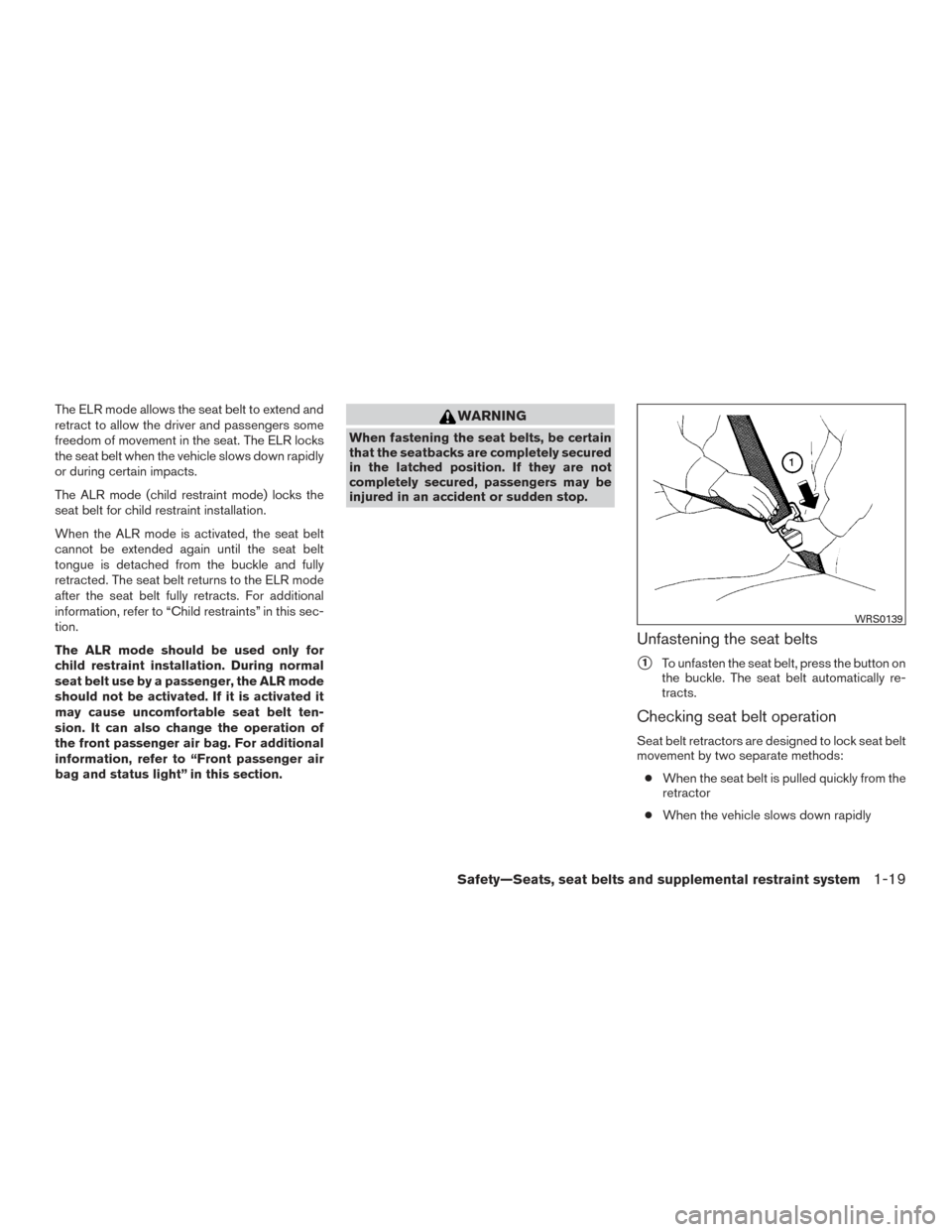
�1To unfasten the seat belt, press the button on
the buckle. The seat belt automatically re-
tracts.
Checking seat belt operation
Seat belt retractors are designed to lock seat belt
movement by two separate methods:
● When the seat belt is pulled quickly from the
retractor
● When the vehicle slows down rapidly
WRS0139
Safety—Seats, seat belts and supplemental restraint system1-19
Page 58 of 457
5. Check to make sure the child restraint isproperly secured prior to each use. If the
child restraint is loose, repeat steps 2
through 4.
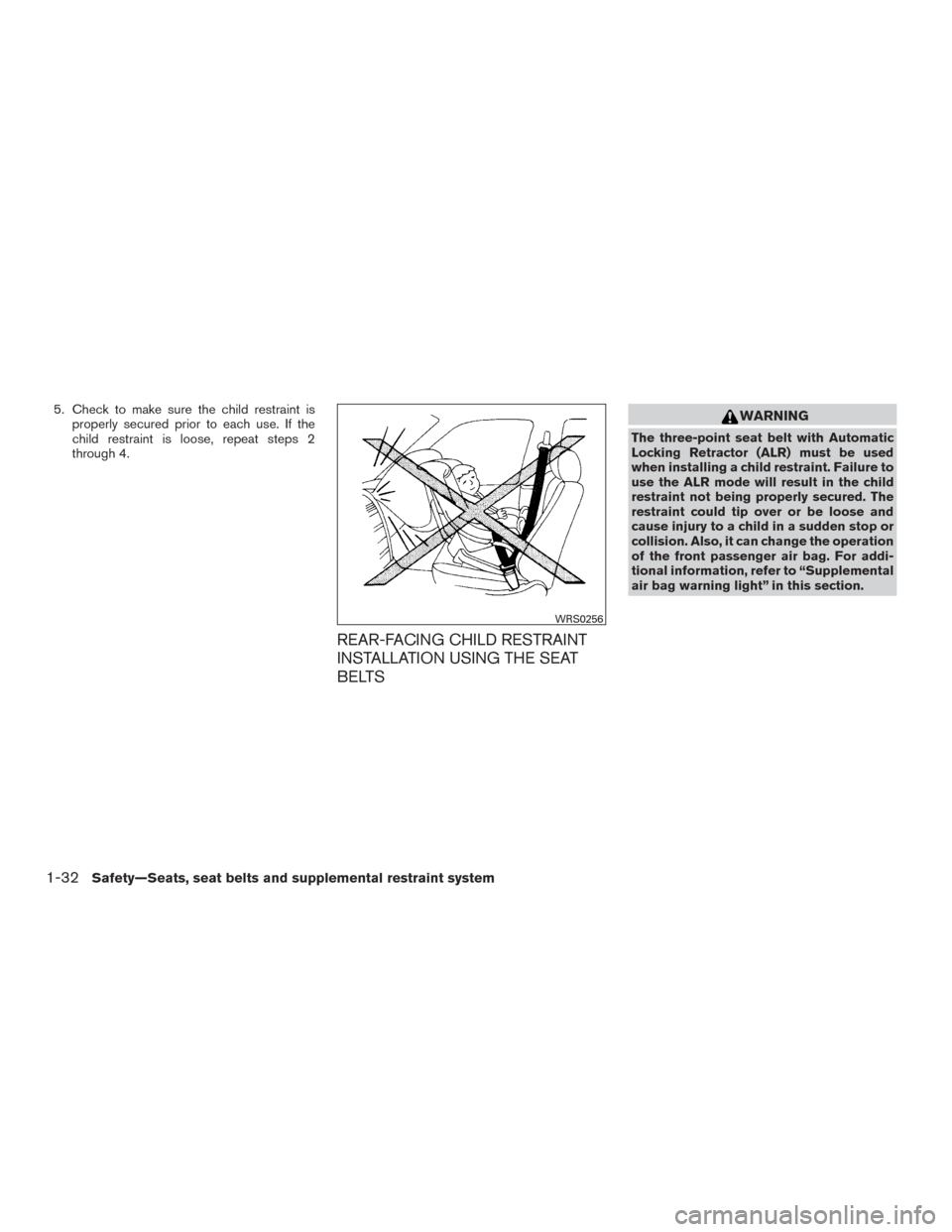
REAR-FACING CHILD RESTRAINT
INSTALLATION USING THE SEAT
BELTS
WARNING
The three-point seat belt with Automatic
Locking Retractor (ALR) must be used
when installing a child restraint. Failure to
use the ALR mode will result in the child
restraint not being properly secured. The
restraint could tip over or be loose and
cause injury to a child in a sudden stop or
collision. Also, it can change the operation
of the front passenger air bag. For addi-
tional information, refer to “Supplemental
air bag warning light” in this section.
WRS0256
1-32Safety—Seats, seat belts and supplemental restraint system