2015 NISSAN ROGUE SELECT weight
[x] Cancel search: weightPage 114 of 322
WARNING
.Drive extra carefully when the vehi-
cle is loaded at or near the cargo
carrying capacity, especially if the
significant portion of that load is
carried on the roof rack.
. Heavy loading of the roof rack has
the potential to affect the vehicle
stability and handling during sud-
den or unusual handling maneuvers.
. Roof rack load should be evenly
distributed.
. Do not exceed maximum roof rack
load weight capacity.
. Properly secure all cargo with ropes
or straps to help prevent it from
sliding or shifting. In a sudden stop
or collision, unsecured cargo could
cause personal injury.
CAUTION
Use care when placing or removing
items from the roof rack. If you cannot
comfortably lift the items onto the roof rack from the ground, use a ladder or
stool.
POWER WINDOWS
WARNING
.
Make sure that all passengers have
their hands, etc. inside the vehicle
while it is in motion and before
closing the windows. Use the win-
dow lock switch to prevent unex-
pected use of the power windows.
. Do not leave children unattended
inside the vehicle. They could un-
knowingly activate switches or con-
trols and become trapped in the
window. Unattended children could
become involved in serious acci-
dents.
The power windows operate when the ignition
switch is in the ON position, or for about 45
seconds after the ignition switch is turned to the
OFF position. If the driver’s or front passenger’s
door is opened during this period of about 45
seconds, power to the windows is canceled.
Instruments and controls2-39
WINDOWS
Page 270 of 322
If you have a flat tire, see “Flat tire” (P.6-2) .
TIRE PRESSURE
Tire Pressure Monitoring System (TPMS)
This vehicle is equipped with the Tire Pressure
Monitoring System (TPMS) . It monitors tire
pressure of all tires except the spare. When
the low tire pressure warning light is lit and the
CHECK TIRE PRESSURE warning appears on
the vehicle information display, one or more of
your tires is significantly under-inflated.
The TPMS will activate only when the vehicle is
driven at speeds above 16 MPH (25 km/h) .
Also, this system may not detect a sudden drop
in tire pressure (for example a flat tire while
driving) .
For more details, see “Low tire pressure warning
light” (P.2-12) , “Tire Pressure Monitoring Sys-
tem (TPMS)” (P.5-3) and “Tire Pressure Mon-
itoring System (TPMS)” (P.6-2) .
Tire inflation pressure
Check the pressure of the tires (including
the spare) often and always prior to long
distance trips. The recommended tire
pressure specifications are shown on the
Tire and Loading Information label under
the “Cold Tire Pressure” heading. The Tire
and Loading Information label is affixed tothe driver side center pillar. Tire pressures
should be checked regularly because:
.
Most tires naturally lose air over time.
. Tires can lose air suddenly when driven
over potholes or other objects or if the
vehicle strikes a curb while parking.
The tire pressures should be checked
when the tires are cold. The tires are
considered COLD after the vehicle has
been parked for 3 or more hours, or driven
less than 1 mile (1.6 km) at moderate
speeds.
Incorrect tire pressure, including un-
der inflation, may adversely affect tire
life and vehicle handling.
WARNING
. Improperly inflated tires can fail
suddenly and cause an accident.
. The Gross Vehicle Weight rating
(GVWR) is located on the F.M.V.
S.S. certification label. The ve-
hicle weight capacity is indi-
cated on the Tire and Loading
Information label. Do not load your vehicle beyond this capa-
city. Overloading your vehicle
may result in reduced tire life,
unsafe operating conditions due
to premature tire failure, or un-
favorable handling characteris-
tics and could also lead to a
serious accident. Loading be-
yond the specified capacity may
also result in failure of other
vehicle components.
. Before taking a long trip, or
whenever you heavily load your
vehicle, use a tire pressure
gauge to ensure that the tire
pressures are at the specified
level.
. For additional information re-
garding tires, refer to “Important
Tire Safety Information” in the
Warranty Information Booklet.
Maintenance and do-it-yourself8-29
WHEELS AND TIRES
Page 273 of 322
8-32Maintenance and do-it-yourself
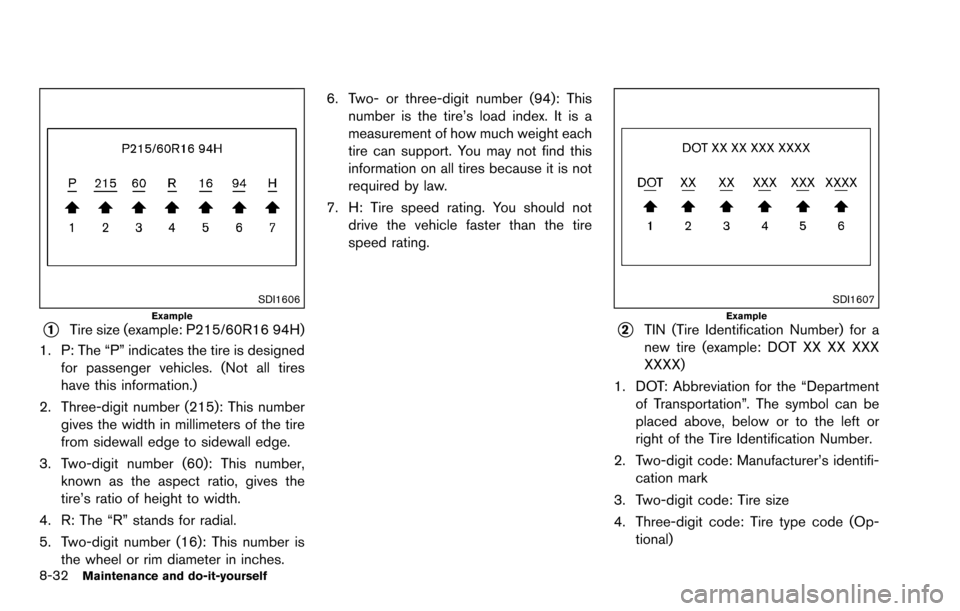
SDI1606Example*1Tire size (example: P215/60R16 94H)
1. P: The “P” indicates the tire is designedfor passenger vehicles. (Not all tires
have this information.)
2. Three-digit number (215): This number gives the width in millimeters of the tire
from sidewall edge to sidewall edge.
3. Two-digit number (60): This number, known as the aspect ratio, gives the
tire’s ratio of height to width.
4. R: The “R” stands for radial.
5. Two-digit number (16): This number is the wheel or rim diameter in inches. 6. Two- or three-digit number (94): This
number is the tire’s load index. It is a
measurement of how much weight each
tire can support. You may not find this
information on all tires because it is not
required by law.
7. H: Tire speed rating. You should not drive the vehicle faster than the tire
speed rating.
SDI1607Example*2TIN (Tire Identification Number) for a
new tire (example: DOT XX XX XXX
XXXX)
1. DOT: Abbreviation for the “Departmentof Transportation”. The symbol can be
placed above, below or to the left or
right of the Tire Identification Number.
2. Two-digit code: Manufacturer’s identifi- cation mark
3. Two-digit code: Tire size
4. Three-digit code: Tire type code (Op- tional)
Page 282 of 322
9 Technical and consumer information
Capacities and recommended fluids/lubricants ................ 9-2Fuel information ................................................................... 9-3
Engine oil and oil filter recommendation ....................... 9-5
Air conditioning system refrigerant and
lubricant recommendations ............................................... 9-6
Specifications ........................................................................\
..... 9-7
Engine ........................................................................\
............ 9-7
Wheels and tires ................................................................. 9-7
Dimensions and weights ................................................... 9-8
When traveling or registering your vehicle in
another country ........................................................................\
.. 9-8
Vehicle identification ................................................................. 9-8 Vehicle Identification Number (VIN) plate ..................... 9-8
Vehicle identification number (chassis number) .......... 9-9
Engine serial number .......................................................... 9-9
F.M.V.S.S. certification label ............................................. 9-9
Emission control information label ............................... 9-10
Tire and loading information label ................................ 9-10
Air conditioner specification label ................................ 9-10
Installing front license plate ................................................. 9-11 Vehicle loading information ................................................. 9-12
Terms ........................................................................\
......... 9-12
Vehicle load capacity .................................................... 9-13
Securing the load .......................................................... 9-14
Loading tips ..................................................................... 9-15
Measurement of weights .............................................. 9-15
Towing a trailer ....................................................................... 9-16 Maximum load limits ...................................................... 9-16
Maximum Gross Vehicle Weight (GVW)/maximum
Gross Axle Weight (GAW) ......................................... 9-18
Towing load/specification ............................................ 9-20
Towing safety .................................................................. 9-20
Flat towing ....................................................................... 9-24
Uniform tire quality grading ................................................. 9-25 Treadwear ........................................................................\
9-25
Traction AA, A, B and C .............................................. 9-25
Temperature A, B and C .............................................. 9-25
Emission control system warranty ..................................... 9-26
Reporting safety defects ..................................................... 9-26
Readiness for Inspection/Maintenance (I/M) test ......... 9-26
Event Data Recorders (EDR) ............................................. 9-27
Owner’s Manual/Service Manual order information ..... 9-28
Page 289 of 322
9-8Technical and consumer information
DIMENSIONS AND WEIGHTS
Overall length in (mm) 183.3 (4,655)*1183.9 (4,670)*2
Overall width in (mm) 70.9 (1,800)
Overall height in (mm) 65.3 (1,658) 66.3 (1,683)*3
Front tread in (mm) 60.6 (1,540)
Rear tread in (mm) 61.0 (1,550)
Wheelbase in (mm) 105.9 (2,690)
Gross Vehicle
Weight Rating
(GVWR) lb (kg)
See the F.M.V.S.S.
certification label on the
driver’s side center pil-
lar.
Gross Axle
Weight Rating
(GAWR)
Front lb (kg)
Rear lb (kg)
*1: Without front license plate bracket
*2: With front license plate bracket
*3: With roof rail
When planning to travel in another coun-
try, you should first find out if the fuel available is
suitable for your vehicle’s engine.
Using fuel with an octane rating that is too low
may cause engine damage. All gasoline vehicles
must be operated with unleaded gasoline.
Therefore, avoid taking your vehicle to areas
where appropriate fuel is not available.
When transferring the registration of your
vehicle to another country, state, province
or district, it may be necessary to modify the
vehicle to meet local laws and regulations.
The laws and regulations for motor vehicle
emission control and safety standards vary
according to the country, state, province or
district; therefore, vehicle specifications may
differ.
When any vehicle is to be taken into
another country, state, province or district
and registered, its modifications, transpor-
tation, and registration are the responsi-
bility of the user. NISSAN is not
responsible for any inconvenience that
may result.
STI0457
VEHICLE IDENTIFICATION NUMBER
(VIN) PLATE
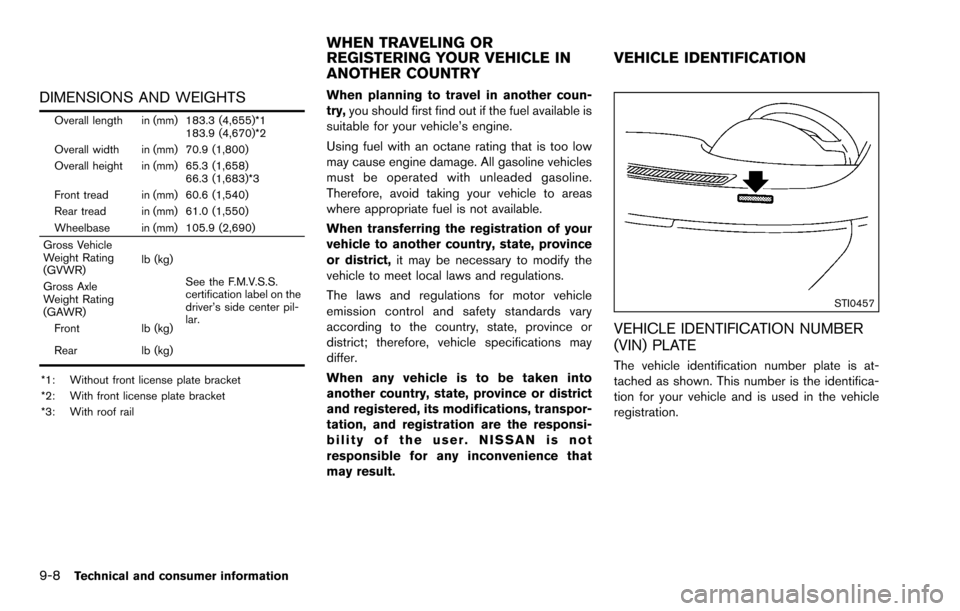
The vehicle identification number plate is at-
tached as shown. This number is the identifica-
tion for your vehicle and is used in the vehicle
registration.
WHEN TRAVELING OR
REGISTERING YOUR VEHICLE IN
ANOTHER COUNTRY VEHICLE IDENTIFICATION
Page 290 of 322
STI0553
VEHICLE IDENTIFICATION NUMBER
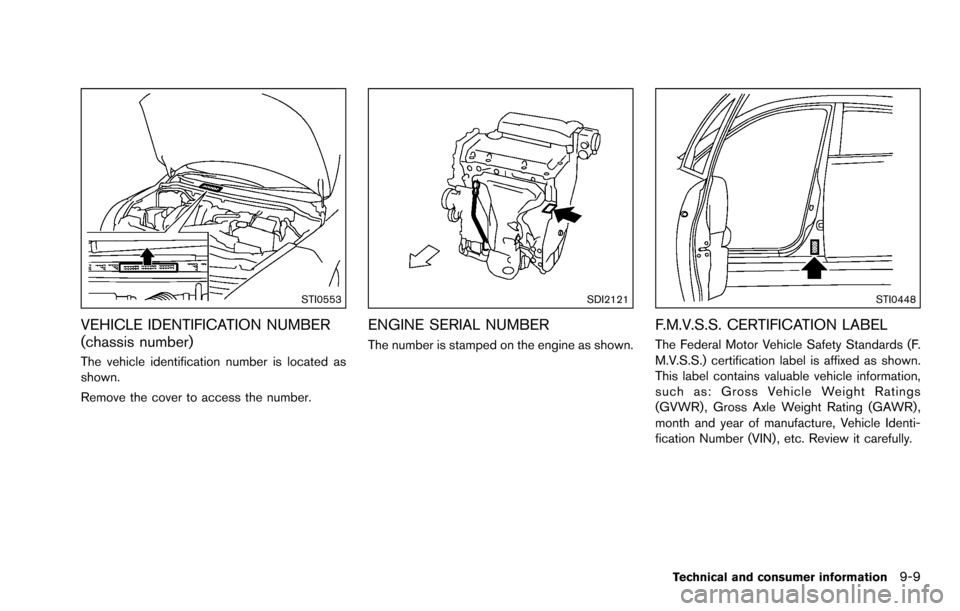
(chassis number)
The vehicle identification number is located as
shown.
Remove the cover to access the number.
SDI2121
ENGINE SERIAL NUMBER
The number is stamped on the engine as shown.
STI0448
F.M.V.S.S. CERTIFICATION LABEL
The Federal Motor Vehicle Safety Standards (F.
M.V.S.S.) certification label is affixed as shown.
This label contains valuable vehicle information,
such as: Gross Vehicle Weight Ratings
(GVWR) , Gross Axle Weight Rating (GAWR) ,
month and year of manufacture, Vehicle Identi-
fication Number (VIN) , etc. Review it carefully.
Technical and consumer information9-9
Page 293 of 322
9-12Technical and consumer information
the fascia.
8. Install the license plate bracket with screws.
9. Install the license plate with bolts that are no longer than 0.55 in (14 mm) .
WARNING
.It is extremely dangerous to ride
in a cargo area inside the vehi-
cle. In a collision, people riding
in these areas are more likely to
be seriously injured or killed.
. Do not allow people to ride in
any area of your vehicle that is
not equipped with seats and
seat belts.
. Be sure everyone in your vehicle
is in a seat and using a seat belt
properly.
TERMS
It is important to familiarize yourself with the
following terms before loading your vehicle:
.Curb Weight (actual weight of your
vehicle) - vehicle weight including:
standard and optional equipment,
fluids, emergency tools, and spare tire
assembly. This weight does notin-
clude passengers and cargo. .
GVW (Gross Vehicle Weight) - curb
weight plus the combined weight of
passengers and cargo.
. GVWR (Gross Vehicle Weight Rating)
- maximum total combined weight of the
unloaded vehicle, passengers, luggage,
hitch, trailer tongue load and any other
optional equipment. This information is
located on the F.M.V.S.S. label.
. GAWR (Gross Axle Weight Rating) -
maximum weight (load) limit specified
for the front or rear axle. This informa-
tion is located on the F.M.V.S.S. label.
. GCWR (Gross Combined Weight Rat-
ing) - The maximum total weight rating
of the vehicle, passengers, cargo, and
trailer.
. Vehicle Capacity Weight, Load limit,
Total load capacity - maximum total
weight limit specified of the load
(passengers and cargo) for the vehicle.
This is the maximum combined weight
of occupants and cargo that can be
loaded into the vehicle. If the vehicle is
used to tow a trailer, the trailer tongue
weight must be included as part of the
VEHICLE LOADING INFORMATION
Page 294 of 322
cargo load. This information is located
on the Tire and Loading Information
label.
. Cargo capacity - permissible weight of
cargo, the subtracted weight of occu-
pants from the load limit.
VEHICLE LOAD CAPACITY
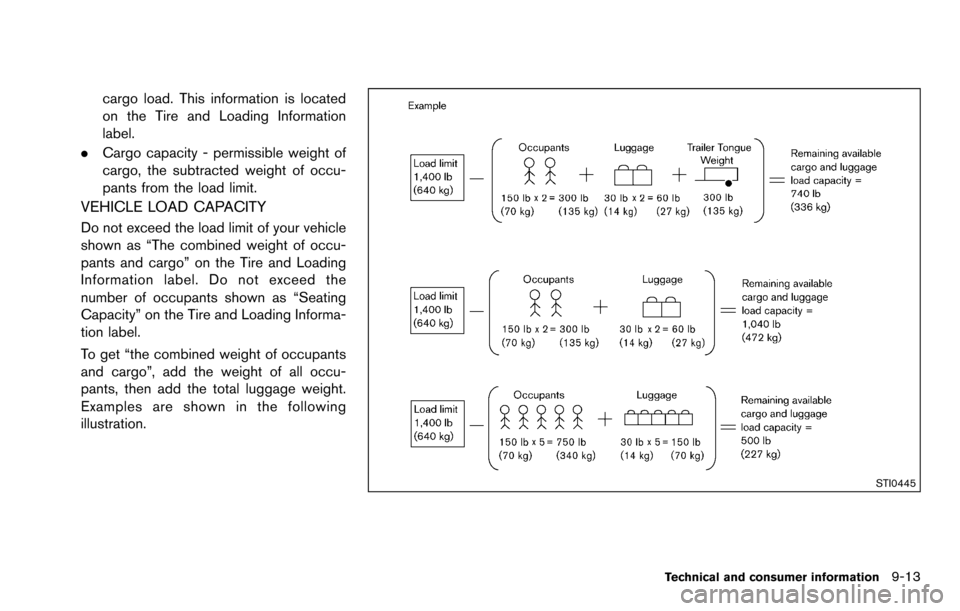
Do not exceed the load limit of your vehicle
shown as “The combined weight of occu-
pants and cargo” on the Tire and Loading
Information label. Do not exceed the
number of occupants shown as “Seating
Capacity” on the Tire and Loading Informa-
tion label.
To get “the combined weight of occupants
and cargo”, add the weight of all occu-
pants, then add the total luggage weight.
Examples are shown in the following
illustration.
STI0445
Technical and consumer information9-13