Page 364 of 524
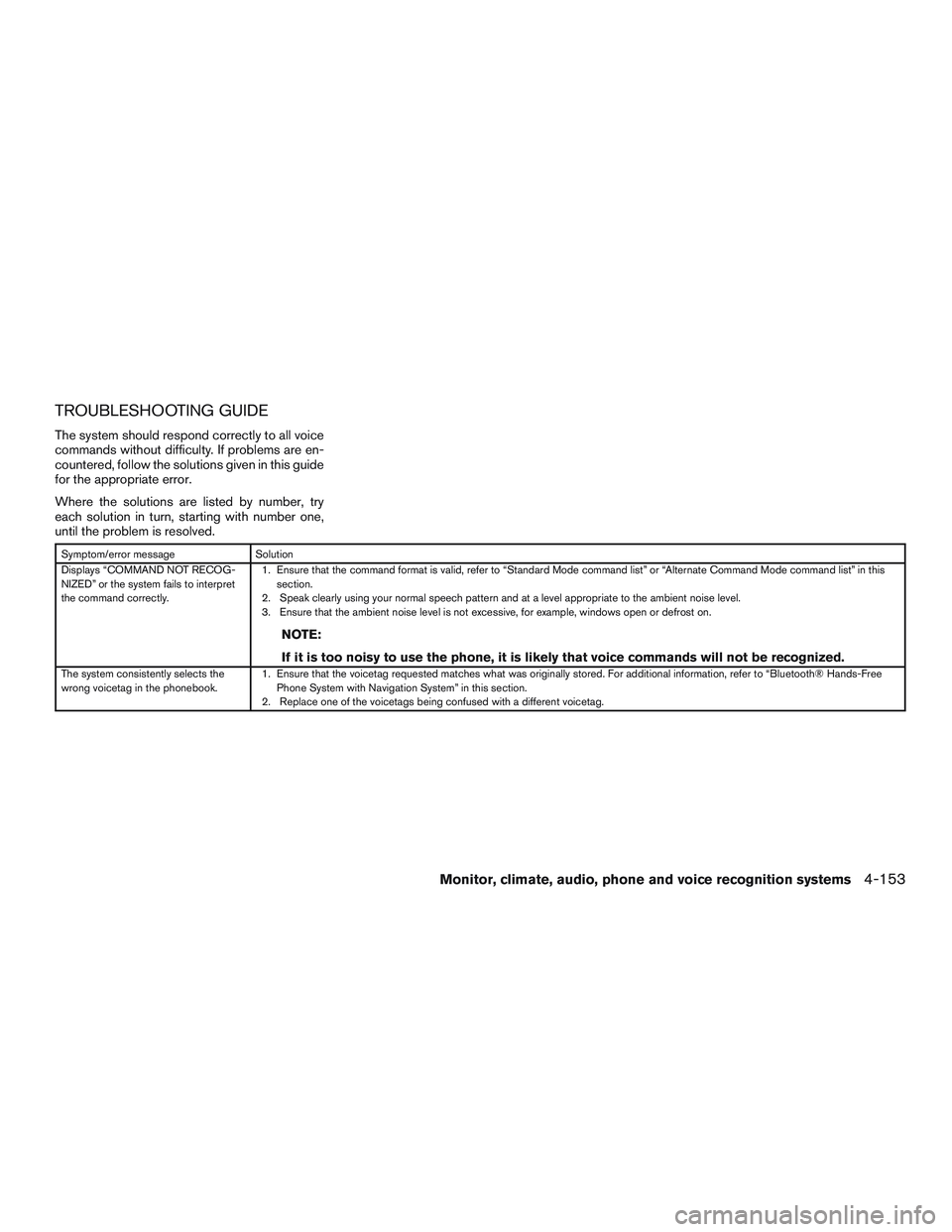
TROUBLESHOOTING GUIDE
The system should respond correctly to all voice
commands without difficulty. If problems are en-
countered, follow the solutions given in this guide
for the appropriate error.
Where the solutions are listed by number, try
each solution in turn, starting with number one,
until the problem is resolved.
Symptom/error message Solution
Displays “COMMAND NOT RECOG-
NIZED” or the system fails to interpret
the command correctly.1. Ensure that the command format is valid, refer to “Standard Mode command list” or “Alternate Command Mode command list” in this
section.
2. Speak clearly using your normal speech pattern and at a level appropriate to the ambient noise level.
3. Ensure that the ambient noise level is not excessive, for example, windows open or defrost on.
NOTE:
If it is too noisy to use the phone, it is likely that voice commands will not be recognized.
The system consistently selects the
wrong voicetag in the phonebook.1. Ensure that the voicetag requested matches what was originally stored. For additional information, refer to “Bluetooth® Hands-Free
Phone System with Navigation System” in this section.
2. Replace one of the voicetags being confused with a different voicetag.
Monitor, climate, audio, phone and voice recognition systems4-153
Page 399 of 524
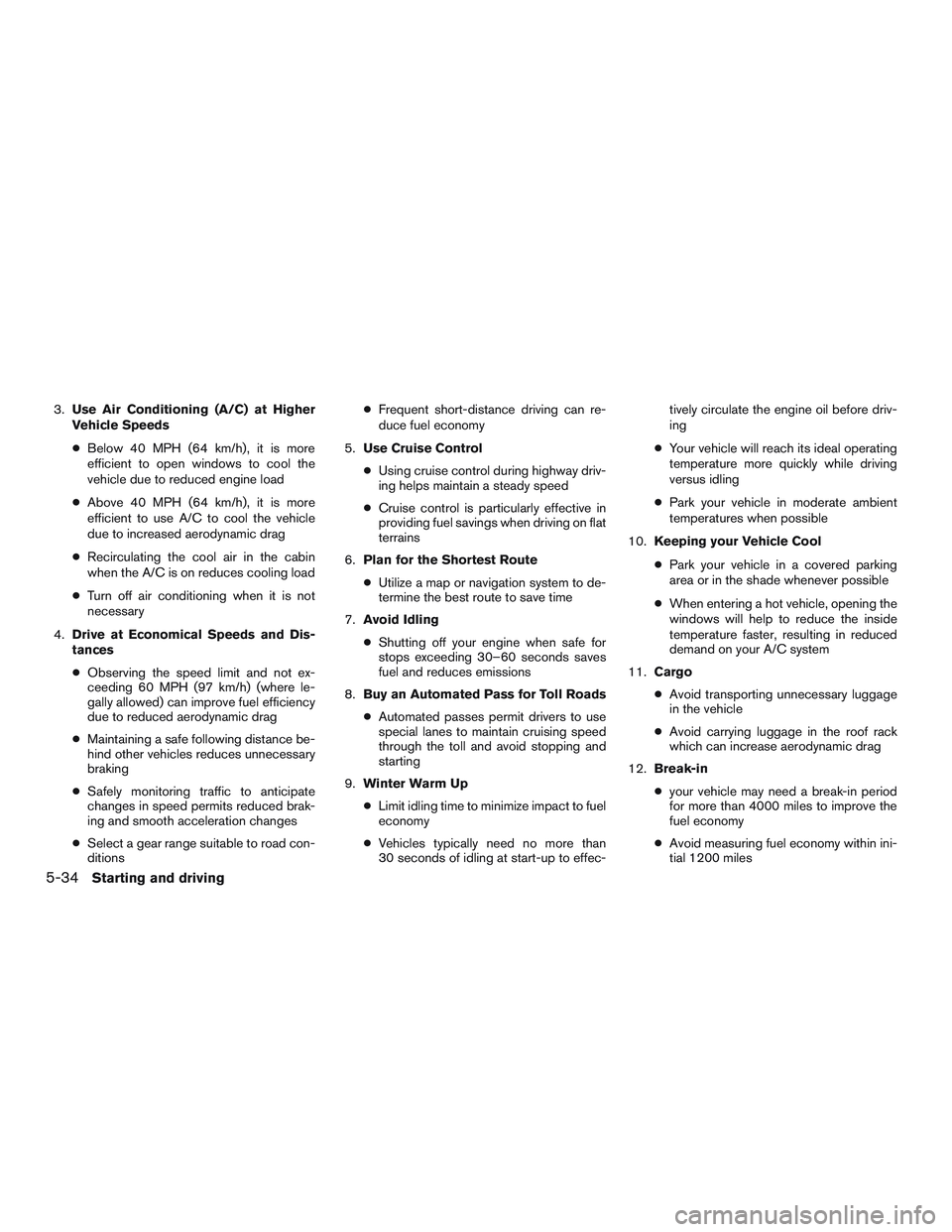
3.Use Air Conditioning (A/C) at Higher
Vehicle Speeds
●Below 40 MPH (64 km/h), it is more
efficient to open windows to cool the
vehicle due to reduced engine load
●Above 40 MPH (64 km/h), it is more
efficient to use A/C to cool the vehicle
due to increased aerodynamic drag
●Recirculating the cool air in the cabin
when the A/C is on reduces cooling load
●Turn off air conditioning when it is not
necessary
4.Drive at Economical Speeds and Dis-
tances
●Observing the speed limit and not ex-
ceeding 60 MPH (97 km/h) (where le-
gally allowed) can improve fuel efficiency
due to reduced aerodynamic drag
●Maintaining a safe following distance be-
hind other vehicles reduces unnecessary
braking
●Safely monitoring traffic to anticipate
changes in speed permits reduced brak-
ing and smooth acceleration changes
●Select a gear range suitable to road con-
ditions●Frequent short-distance driving can re-
duce fuel economy
5.Use Cruise Control
●Using cruise control during highway driv-
ing helps maintain a steady speed
●Cruise control is particularly effective in
providing fuel savings when driving on flat
terrains
6.Plan for the Shortest Route
●Utilize a map or navigation system to de-
termine the best route to save time
7.Avoid Idling
●Shutting off your engine when safe for
stops exceeding 30–60 seconds saves
fuel and reduces emissions
8.Buy an Automated Pass for Toll Roads
●Automated passes permit drivers to use
special lanes to maintain cruising speed
through the toll and avoid stopping and
starting
9.Winter Warm Up
●Limit idling time to minimize impact to fuel
economy
●Vehicles typically need no more than
30 seconds of idling at start-up to effec-tively circulate the engine oil before driv-
ing
●Your vehicle will reach its ideal operating
temperature more quickly while driving
versus idling
●Park your vehicle in moderate ambient
temperatures when possible
10.Keeping your Vehicle Cool
●Park your vehicle in a covered parking
area or in the shade whenever possible
●When entering a hot vehicle, opening the
windows will help to reduce the inside
temperature faster, resulting in reduced
demand on your A/C system
11.Cargo
●Avoid transporting unnecessary luggage
in the vehicle
●Avoid carrying luggage in the roof rack
which can increase aerodynamic drag
12.Break-in
●your vehicle may need a break-in period
for more than 4000 miles to improve the
fuel economy
●Avoid measuring fuel economy within ini-
tial 1200 miles
5-34Starting and driving
Page 517 of 524

Child restraints.......1-23,1-24,1-25,1-27
LATCH (Lower Anchors and Tethers for
CHildren) System..............1-27
Precautions on child
restraints.........1-25,1-32,1-39,1-44
Top tether strap anchor point locations . .1-30
Child restraint with top tether strap.......1-29
Child safety rear door lock............3-7
Chimes, audible reminders...........2-18
Cleaningexteriorandinterior...........7-2
Clock set/adjustment...........4-8,4-16
C.M.V.S.S. certification label..........9-11
Cold weather driving...............5-48
Compact disc (CD) player........4-67,4-74
Consolebox...................2-49
Continuously Variable Transmission (CVT) . . .5-15
Continuously Variable Transmission
(CVT) fluid..................8-13
Driving with Continuously Variable
Transmission (CVT).............5-15
Control panel buttons..............4-10
Brightness/contrast button......4-9,4-18
Enterbutton...............4-4,4-10
Without navigation system..........4-4
Controls
Audiocontrols(steeringwheel).......4-94
Heater and air conditioner controls.....4-43
Coolant
Capacities and recommended
fuel/lubricants.................9-2
Changing engine coolant...........8-8
Checking engine coolant level........8-8
Checking inverter coolant level.......8-10
Corrosionprotection ...............7-7
Cruisecontrol..................5-31
Cupholders...................2-51D
Daytime running light system (Canada only) . .2-39
Defroster switch
Rear window and outside mirror defroster
switch.....................2-36
Digital Versatile Disc (DVD) player.......4-76
Dimensionsandweights.............9-9
Dimmer switch for instrument panel......2-39
Display controls (see control panel buttons) . .4-4,
4-10
Door locks.....................3-5
Drive belt.....................8-17
Drive positioner, Automatic...........3-36
Driving
Cold weather driving.............5-48
Driving with Continuously Variable
Transmission (CVT).............5-15
Precautions when starting and driving....5-2
Dual head restraint DVD system........4-96
E
Economy - fuel..................5-35
Emission control information label.......9-11
Emission control system warranty.......9-29
Engine
Before starting the engine..........5-13
Block heater.................5-49
Capacities and recommended
fuel/lubricants.................9-2
Changingenginecoolant...........8-8
Changingengineoil.............8-11
Changing engine oil filter..........8-13Checking engine coolant level........8-8
Checking engine oil level..........8-10
Engine compartment check locations....8-6
Engine cooling system............8-7
Engineoil...................8-10
Engine oil and oil filter recommendation . . .9-6
Engine oil pressure warning light......2-12
Engine oil viscosity..............9-6
Engine serial number...........
.9-11
Engine specifications.............9-8
Starting the engine.............5-14
Enter button.................4-4,4-10
Event data recorders..............9-31
Exhaust gas (Carbon monoxide).........5-2
Extended storage switch............8-23
F
Flashers (See hazard warning flasher switch) . .6-2
Flat tire.......................6-3
Floor mat positioning aid.............7-6
Fluid
Brake fluid..................8-14
Capacities and recommended
fuel/lubricants.................9-2
Continuously Variable Transmission
(CVT) fluid..................8-13
Enginecoolant.................8-7
Engineoil...................8-10
Inverter coolant................8-9
Power steering fluid.............8-14
Windshield-washer fluid...........8-15
F.M.V.S.S. certification label...........9-11
Foglightswitch .................2-40
10-2