2015 NISSAN MURANO stop start
[x] Cancel search: stop startPage 335 of 424
5. Start the engine of the booster vehicle andlet it run for a few minutes.
6. Keep the engine speed of the booster ve- hicle at about 2,000 rpm and start the en-
gine of the vehicle being jump started.
CAUTION
Do not keep the starter motor engaged for
more than 10 seconds. If the engine does
not start right away, place the ignition
switch in the OFF position and wait 3 to
4 seconds before trying again.
7. After starting the engine, carefully discon- nect the negative cable and then the positive
cable.
CAUTION
●CVT models cannot be push-started or
tow-started. Attempting to do so may
cause transmission damage.
● Do not push start this vehicle. The 3-way
catalyst may be damaged.
WARNING
● Do not continue to drive if your vehicle
overheats. Doing so could cause engine
damage or a vehicle fire.
● To avoid the danger of being scalded,
never remove the radiator or coolant
reservoir cap while the engine is still
hot. When the radiator or coolant reser-
voir cap is removed, pressurized hot
water will spurt out, possibly causing
serious injury.
● Do not open the hood if steam is com-
ing out.
If your vehicle is overheating (indicated by an
extremely high temperature gauge reading and
the illumination of the engine oil pressure/engine
coolant temperature high indicator light) , or if you
feel a lack of engine power, detect abnormal
noise, etc. take the following steps: 1. Move the vehicle safely off the road, apply the parking brake and move the shift lever to
P (Park) .
Do not stop the engine.
2. Turn off the air conditioner. Open all the windows, move the heater or air conditioner
temperature control to maximum hot and fan
control to high speed.
PUSH STARTING IF YOUR VEHICLE OVERHEATS
6-12In case of emergency
Page 336 of 424
3. Get out of the vehicle. Look and listen forsteam or coolant escaping from the radiator
before opening the hood. If steam or coolant
is escaping, turn off the engine. Do not open
the hood further until no steam or coolant
can be seen.
4. Open the engine hood.
WARNING
If steam or water is coming from the en-
gine, stand clear to prevent getting
burned.
5. Visually check drive belts for damage or looseness. Also check if the cooling fan is
running. The radiator hoses and radiator
should not leak water. If coolant is leaking,
the water pump belt is missing or loose, or
the cooling fan does not run, stop the en-
gine.
WARNING
Be careful not to allow your hands, hair,
jewelry or clothing to come into contact
with, or get caught in, engine belts or the
engine cooling fan. The engine cooling fan
can start at any time. 6. After the engine cools down, check the cool-
ant level in the engine coolant reservoir tank
with the engine running. Add coolant to the
engine coolant reservoir tank if necessary.
Have your vehicle repaired at a NISSAN
dealer. When towing your vehicle, all jurisdictional and
local regulations for towing must be followed.
Incorrect towing equipment could damage your
vehicle. Towing instructions are available from a
NISSAN dealer. Local service operators are gen-
erally familiar with the applicable laws and proce-
dures for towing. To assure proper towing and to
prevent accidental damage to your vehicle,
NISSAN recommends having a service operator
tow your vehicle. It is advisable to have the ser-
vice operator carefully read the following precau-
tions:
WARNING
●
Never ride in a vehicle that is being
towed.
● Never get under your vehicle after it has
been lifted by a tow truck.
CAUTION
● When towing, make sure that the trans-
mission, axles, steering system and
powertrain are in working condition. If
any of these conditions apply, dollies or
a flatbed tow truck must be used.
● Always attach safety chains before
towing.
TOWING YOUR VEHICLE
In case of emergency6-13
Page 364 of 424
NOTE:
After installing a new air cleaner filter,
make sure the air cleaner cover is seated in
the housing and latch the clips.
WARNING
●Operating the engine with the air
cleaner removed can cause you or oth-
ers to be burned. The air cleaner not
only cleans the air, it stops the flame if
the engine backfires. If it isn’t there, and
the engine backfires, you could be
burned. Do not drive with the air cleaner
removed, and be careful when working
on the engine with the air cleaner
removed.
● Never pour fuel into the throttle body or
attempt to start the engine with the air
cleaner removed. Doing so could result
in serious injury.
IN-CABIN MICROFILTER
The in-cabin microfilter restricts the entry of air-
borne dust and pollen particles and reduces
some objectionable outside odors. The filter is
located behind the glove box. For additional in-
formation, refer to the “NISSAN Service and
Maintenance Guide” for change intervals.
If replacement is required, see your NISSAN
dealer.
CLEANING
If your windshield is not clear after using the
windshield-washer or if a wiper blade chatters
when running, wax or other material may be on
the blade or windshield.
Clean the outside of the windshield with a washer
solution or a mild detergent. Your windshield is
clean if beads do not form when rinsing with clear
water.
Clean each blade by wiping it with a cloth soaked
in a washer solution or a mild detergent. Then
rinse the blades with clear water. If your wind-
shield is still not clear after cleaning the blades
and using the wiper, replace the blades.
WARNING
Worn windshield wiper blades can dam-
age the windshield and impair driver
vision.
WINDSHIELD WIPER BLADES
Maintenance and do-it-yourself8-19
Page 408 of 424
Pre-towing tips
●Be certain your vehicle maintains a level
position when a loaded and/or unloaded
trailer is hitched. Do not drive the vehicle if it
has an abnormal nose-up or nose-down
condition; check for improper tongue load,
overload, worn suspension or other possible
causes of either condition.
● Always secure items in the trailer to prevent
load shift while driving.
● Keep the cargo load as low as possible in
the trailer to keep the trailer center of gravity
low.
● Load the trailer so approximately 60% of the
trailer load is in the front half and 40% is in
the back half. Also make sure the load is
balanced side to side.
● Check your hitch, trailer tire pressure, ve-
hicle tire pressure, trailer light operation, and
trailer wheel lug nuts every time you attach a
trailer to the vehicle.
● Be certain your rearview mirrors conform to
all federal, state or local regulations. If not,
install any mirrors required for towing before
driving the vehicle. ●
Determine the overall height of the vehicle
and trailer so the required clearance is
known.
Trailer towing tips
In order to gain skill and an understanding of the
vehicle’s behavior, you should practice turning,
stopping and backing up in an area which is free
from traffic. Steering stability and braking perfor-
mance will be somewhat different than under
normal driving conditions.
● Always secure items in the trailer to prevent
load shift while driving.
● Lock the trailer hitch coupler with a pin or
lock to prevent the coupler from inadver-
tently becoming unlatched.
● Avoid abrupt starts, acceleration or stops.
● Avoid sharp turns or lane changes.
● Always drive your vehicle at a moderate
speed.
● When backing up, hold the bottom of the
steering wheel with one hand. Move your
hand in the direction in which you want the
trailer to go. Make small corrections and
back up slowly. If possible, have someone
guide you when you are backing up. Always block the wheels on both vehicle and
trailer when parking. Parking on a slope is not
recommended; however, if you must do so:
CAUTION
If you move the shift lever to the P (Park)
position before blocking the wheels and
applying the parking brake, transmission
damage could occur.
1. Apply and hold the brake pedal.
2. Have someone place blocks on the downhill side of the vehicle and trailer wheels.
3. After the wheel blocks are in place, slowly release the brake pedal until the blocks ab-
sorb the vehicle load.
4. Apply the parking brake.
5. Shift the transmission into P (Park) .
6. Turn off the engine.
To drive away: 1. Start the vehicle.
2. Apply and hold the brake pedal.
3. Shift the transmission into gear.
4. Release the parking brake.
Technical and consumer information9-23
Page 416 of 424
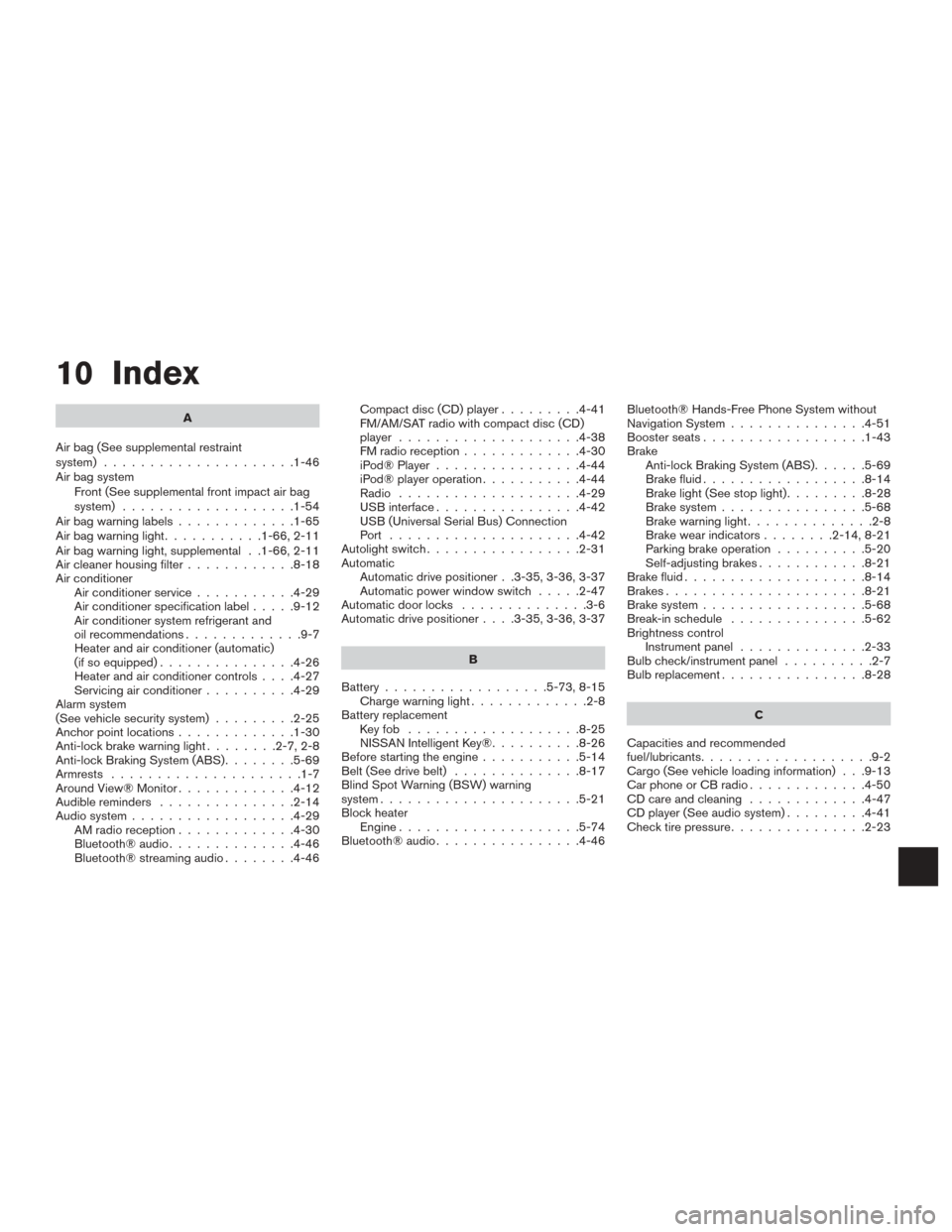
10 Index
A
Air bag (See supplemental restraint
system) .....................1-46
Air bag system Front (See supplemental front impact air bag
system) ...................1-54
Airbagwarninglabels.............1-65
Airbagwarninglight...........1-66,2-11
Air bag warning light, supplemental . .1-66, 2-11
Air cleaner housing filter ............8-18
Air conditioner Air conditioner service ...........4-29
Air conditioner specification label .....9-12
Air conditioner system refrigerant and
oil recommendations .............9-7
Heater and air conditioner (automatic)
(if so equipped) ...............4-26
Heater and air conditioner controls ....4-27
Servicing air conditioner ..........4-29
Alarm system
(See vehicle security system) .........2-25
Anchor point locations .............1-30
Anti-lock brake warning light ........2-7,2-8
Anti-lock Braking System (ABS) ........5-69
Armrests .....................1-7
Around View® Monitor .............4-12
Audible reminders ...............2-14
Audio system ..................4-29
AM radio reception .............4-30
Bluetooth®audio..............4-46
Bluetooth® streaming audio ........4-46Compact disc (CD) player
.........4-41
FM/AM/SAT radio with compact disc (CD)
player ....................4-38
FMradioreception.............4-30
iPod® Player ................4-44
iPod® player operation ...........4-44
Radio ....................4-29
USB interface ................4-42
USB (Universal Serial Bus) Connection
Port .....................4-42
Autolight switch .................2-31
Automatic Automatic drive positioner . .3-35, 3-36, 3-37
Automatic power window switch .....2-47
Automatic door locks ..............3-6
Automatic drive positioner ....3-35,3-36,3-37
B
Battery ..................5-73,8-15
Chargewarninglight.............2-8
Battery replacement Keyfob ...................8-25
NISSAN Intelligent Key® ..........8-26
Before starting the engine ...........5-14
Belt (See drive belt) ..............8-17
Blind Spot Warning (BSW) warning
system ......................5-21
Block heater Engine ....................5-74
Bluetooth®audio................4-46 Bluetooth® Hands-Free Phone System without
Navigation System
...............4-51
Boosterseats..................1-43
Brake Anti-lock Braking System (ABS) ......5-69
Brake fluid ..................8-14
Brakelight(Seestoplight).........8-28
Brake system ................5-68
Brakewarninglight..............2-8
Brakewearindicators........2-14,8-21
Parking brake operation ..........5-20
Self-adjusting brakes ............8-21
Brake fluid ....................8-14
Brakes ......................8-21
Brake system ..................5-68
Break-inschedule ...............5-62
Brightness control Instrument panel ..............2-33
Bulb check/instrument panel ..........2-7
Bulbreplacement................8-28
C
Capacities and recommended
fuel/lubricants ...................9-2
Cargo
(See vehicle loading information) . . .9-13
Car phone or CB radio .............4-50
CDcareandcleaning .............4-47
CD player (See audio system) .........4-41
Check tire pressure ...............2-23
Page 421 of 424
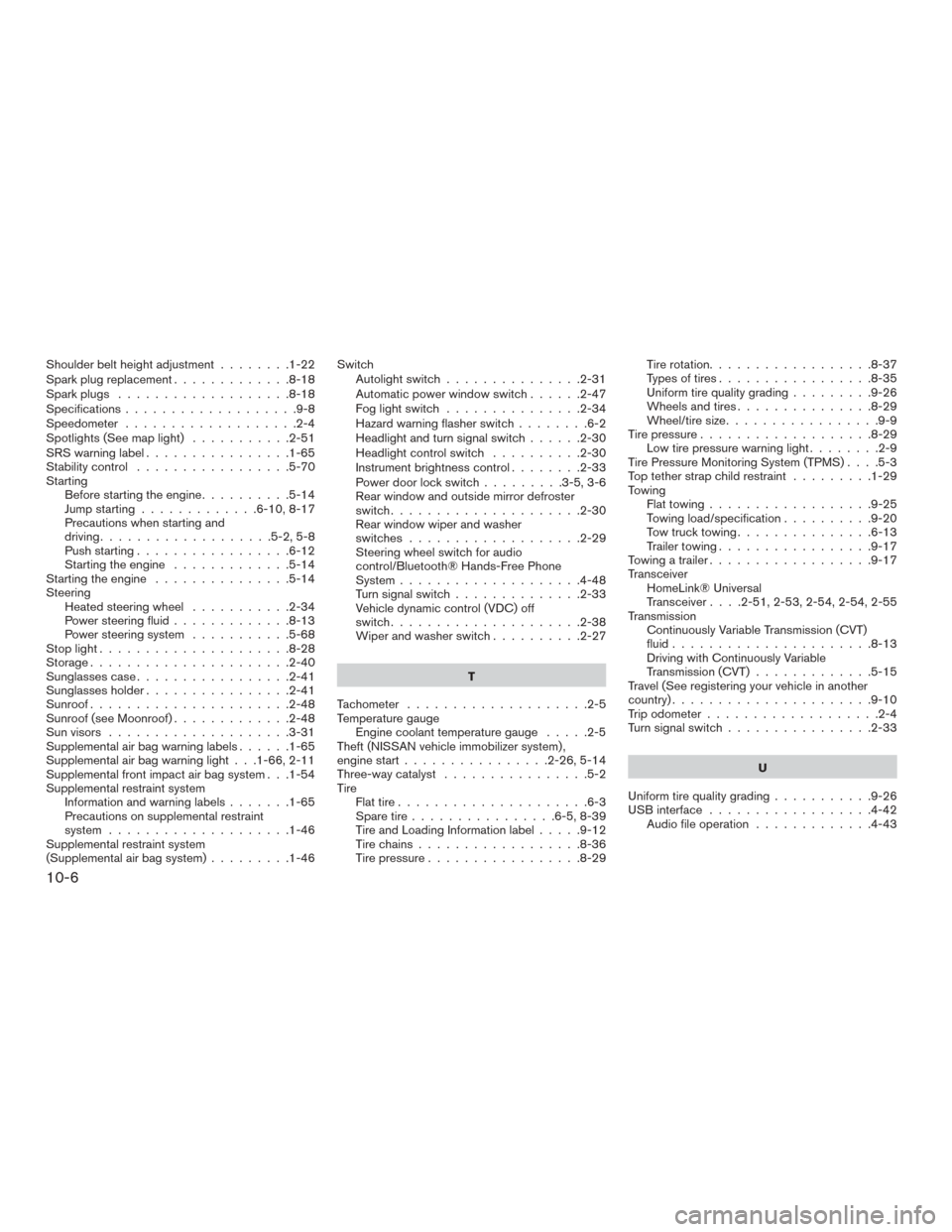
Shoulder belt height adjustment........1-22
Spark plug replacement .............8-18
Spark plugs ...................8-18
Specifications ...................9-8
Speedometer ...................2-4
Spotlights(Seemaplight) ...........2-51
SRS warning label ................1-65
Stability control .................5-70
Starting Before starting the engine ..........5-14
Jump starting .............6-10,8-17
Precautions when starting and
driving ...................5-2,5-8
Push starting .................6-12
Starting the engine .............5-14
Starting the engine ...............5-14
Steering Heated steering wheel ...........2-34
Power steering fluid .............8-13
Power steering system ...........5-68
Stoplight.....................8-28
Storage......................2-40
Sunglassescase.................2-41
Sunglassesholder................2-41
Sunroof......................2-48
Sunroof (see Moonroof) .............2-48
Sun visors ....................3-31
Supplemental air bag warning labels ......1-65
Supplemental air bag warning light . . .1-66, 2-11
Supplemental front impact air bag system . . .1-54
Supplemental restraint system Information and warning labels .......1-65
Precautions on supplemental restraint
system ....................1-46
Supplemental restraint system
(Supplemental air bag system) .........1-46Switch
Autolightswitch...............2-31
Automatic power window switch ......2-47
Foglightswitch ...............2-34
Hazard warning flasher switch ........6-2
Headlight and turn signal switch ......2-30
Headlight control switch ..........2-30
Instrument brightness control ........2-33
Power door lock switch .........3-5,3-6
Rear window and outside mirror defroster
switch.....................2-30
Rear window wiper and washer
switches...................2-29
Steering wheel switch for audio
control/Bluetooth® Hands-Free Phone
System ....................4-48
Turn signal switch ..............2-33
Vehicle dynamic control (VDC) off
switch.....................2-38
Wiperandwasherswitch..........2-27
T
Tachometer ....................2-5
Temperature gauge Engine coolant temperature gauge .....2-5
Theft (NISSAN vehicle immobilizer system) ,
engine start ................2-26,5-14
Three-way catalyst ................5-2
Tire Flat tire .....................6-3
Spare tire ................6-5,8-39
Tire and Loading Information label .....9-12
Tirechains..................8-36
Tire pressure .................8-29 Tire rotation..................8-37
Types of tires
.................8-35
Uniform tire quality grading .........9-26
Wheels and tires ...............8-29
Wheel/tire size .................9-9
Tirepressure...................8-29 Low tire pressure warning light ........2-9
Tire Pressure Monitoring System (TPMS) ....5-3
Top tether strap child restraint .........1-29
Towing Flattowing..................9-25
T
owing load/specification ..........9-20
Towtrucktowing...............6-13
Trailer towing .................9-17
Towing a trailer ..................9-17
Transceiver HomeLink® Universal
Transceiver ....2-51,2-53,2-54,2-54,2-55
Transmission Continuously Variable Transmission (CVT)
fluid......................8-13
Driving with Continuously Variable
Transmission (CVT) .............5-15
Travel (See registering your vehicle in another
country) ......................9-10
Trip odometer ...................2-4
Turn signal switch ................2-33
U
Uniform tire quality grading ...........9-26
USB interface ..................4-42
Audio file operation .............4-43
10-6