2015 NISSAN MURANO towing
[x] Cancel search: towingPage 336 of 424
3. Get out of the vehicle. Look and listen forsteam or coolant escaping from the radiator
before opening the hood. If steam or coolant
is escaping, turn off the engine. Do not open
the hood further until no steam or coolant
can be seen.
4. Open the engine hood.
WARNING
If steam or water is coming from the en-
gine, stand clear to prevent getting
burned.
5. Visually check drive belts for damage or looseness. Also check if the cooling fan is
running. The radiator hoses and radiator
should not leak water. If coolant is leaking,
the water pump belt is missing or loose, or
the cooling fan does not run, stop the en-
gine.
WARNING
Be careful not to allow your hands, hair,
jewelry or clothing to come into contact
with, or get caught in, engine belts or the
engine cooling fan. The engine cooling fan
can start at any time. 6. After the engine cools down, check the cool-
ant level in the engine coolant reservoir tank
with the engine running. Add coolant to the
engine coolant reservoir tank if necessary.
Have your vehicle repaired at a NISSAN
dealer. When towing your vehicle, all jurisdictional and
local regulations for towing must be followed.
Incorrect towing equipment could damage your
vehicle. Towing instructions are available from a
NISSAN dealer. Local service operators are gen-
erally familiar with the applicable laws and proce-
dures for towing. To assure proper towing and to
prevent accidental damage to your vehicle,
NISSAN recommends having a service operator
tow your vehicle. It is advisable to have the ser-
vice operator carefully read the following precau-
tions:
WARNING
●
Never ride in a vehicle that is being
towed.
● Never get under your vehicle after it has
been lifted by a tow truck.
CAUTION
● When towing, make sure that the trans-
mission, axles, steering system and
powertrain are in working condition. If
any of these conditions apply, dollies or
a flatbed tow truck must be used.
● Always attach safety chains before
towing.
TOWING YOUR VEHICLE
In case of emergency6-13
Page 337 of 424
For additional information about towing your front
wheel drive vehicle behind a recreational vehicle
(RV) , refer to “Flat towing for front wheel drive
vehicle” in the “Technical and Consumer Informa-
tion” section of this manual.
For additional information about towing your all-
wheel drive vehicle behind a recreational vehicle
(RV) , refer to “Flat towing for all-wheel drive
vehicle” in the “Technical and Consumer Informa-
tion” section of this manual.
TOWING RECOMMENDED BY
NISSAN
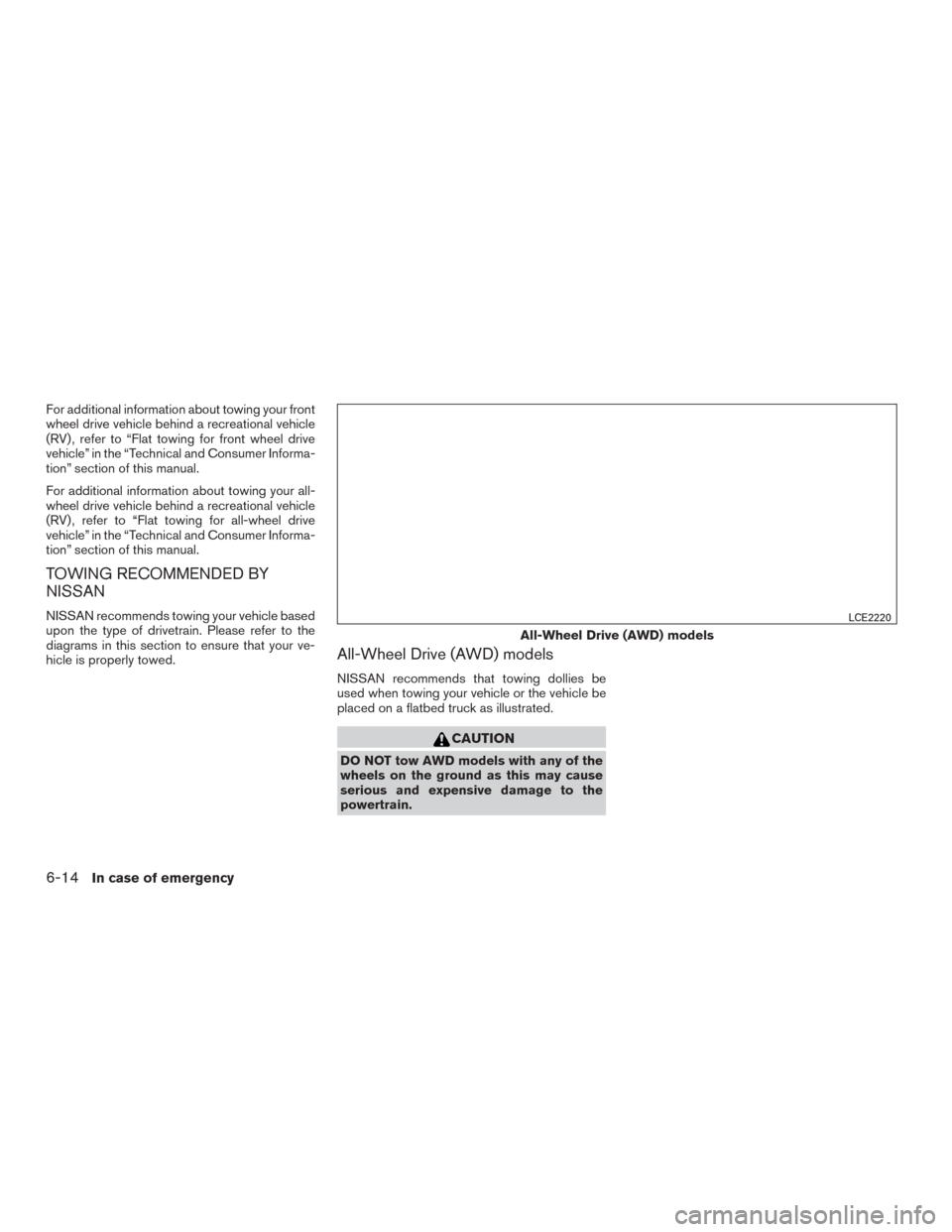
NISSAN recommends towing your vehicle based
upon the type of drivetrain. Please refer to the
diagrams in this section to ensure that your ve-
hicle is properly towed.
All-Wheel Drive (AWD) models
NISSAN recommends that towing dollies be
used when towing your vehicle or the vehicle be
placed on a flatbed truck as illustrated.
CAUTION
DO NOT tow AWD models with any of the
wheels on the ground as this may cause
serious and expensive damage to the
powertrain.
All-Wheel Drive (AWD) models
LCE2220
6-14In case of emergency
Page 338 of 424
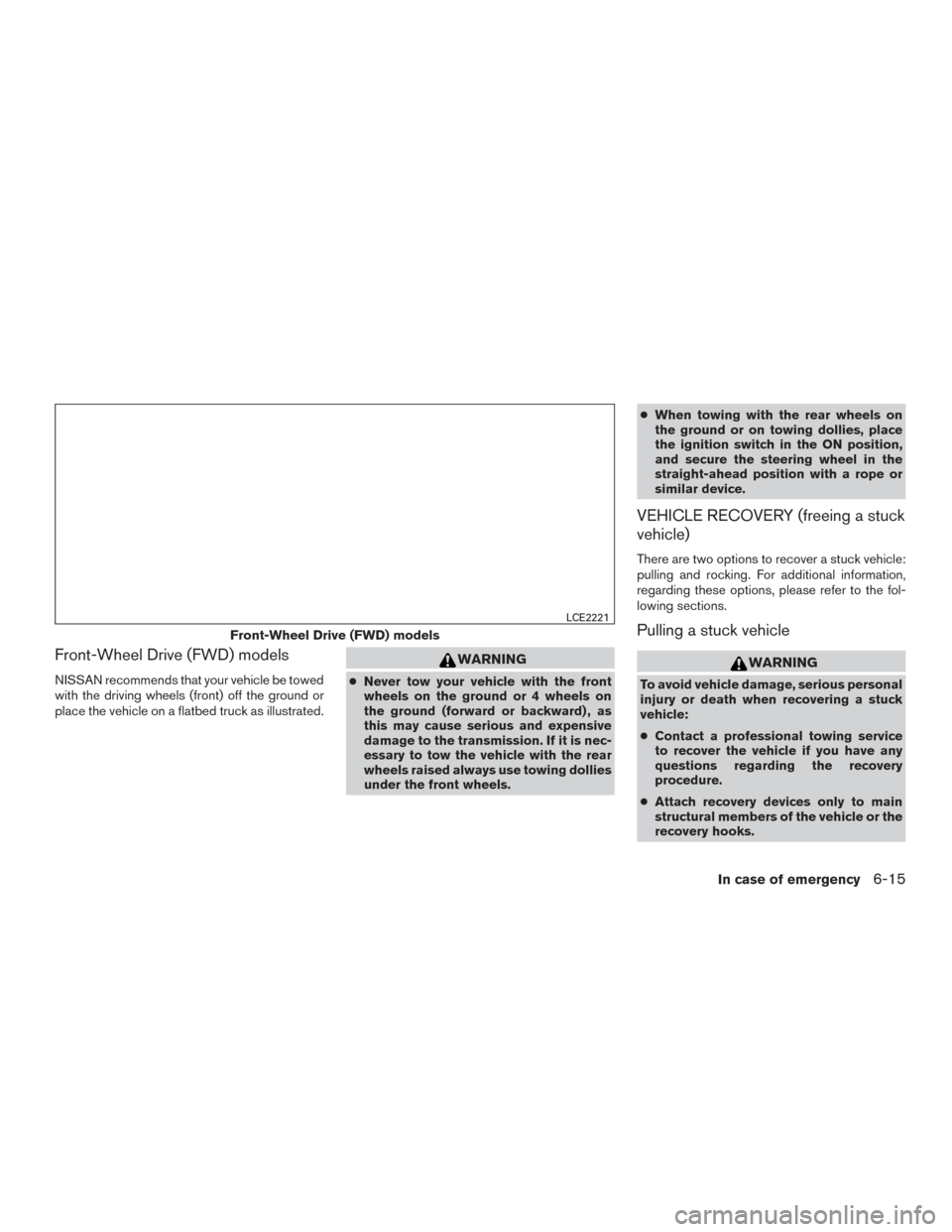
Front-Wheel Drive (FWD) models
NISSAN recommends that your vehicle be towed
with the driving wheels (front) off the ground or
place the vehicle on a flatbed truck as illustrated.
WARNING
●Never tow your vehicle with the front
wheels on the ground or 4 wheels on
the ground (forward or backward) , as
this may cause serious and expensive
damage to the transmission. If it is nec-
essary to tow the vehicle with the rear
wheels raised always use towing dollies
under the front wheels. ●
When towing with the rear wheels on
the ground or on towing dollies, place
the ignition switch in the ON position,
and secure the steering wheel in the
straight-ahead position with a rope or
similar device.
VEHICLE RECOVERY (freeing a stuck
vehicle)
There are two options to recover a stuck vehicle:
pulling and rocking. For additional information,
regarding these options, please refer to the fol-
lowing sections.
Pulling a stuck vehicle
WARNING
To avoid vehicle damage, serious personal
injury or death when recovering a stuck
vehicle:
● Contact a professional towing service
to recover the vehicle if you have any
questions regarding the recovery
procedure.
● Attach recovery devices only to main
structural members of the vehicle or the
recovery hooks.
Front-Wheel Drive (FWD) models
LCE2221
In case of emergency6-15
Page 339 of 424
●Do not use the vehicle tie-downs to tow
or free a stuck vehicle.
● Only use devices specifically designed
for vehicle recovery and follow the
manufacturer’s instructions.
● Always pull the recovery device straight
out from the front of the vehicle. Never
pull at an angle.
● Route recovery devices so they do not
touch any part of the vehicle except the
attachment point.
If your vehicle is stuck in sand, snow, mud, etc.,
use a tow strap or other device designed specifi-
cally for vehicle recovery. Always follow the
manufacturer’s instructions for the recovery de-
vice.
Do not use the tie-down hooks for towing or
vehicle recovery.Rocking a stuck vehicle
WARNING
● Stand clear of a stuck vehicle.
● Do not spin your tires at high speed.
This could cause them to explode and
result in serious injury. Parts of your
vehicle could also overheat and be
damaged.
If your vehicle is stuck in sand, snow, mud, etc.,
use the following procedure: 1. Turn off the Vehicle Dynamic Control (VDC) system.
2. Make sure the area in front and behind the vehicle is clear of obstructions.
3. Turn the steering wheel right and left to clear an area around the front tires.
4. Slowly rock the vehicle forward and back- ward.
● Shift back and forth between R (Reverse)
and D (Drive) . ●
Apply the accelerator as little as possible
to maintain the rocking motion.
● Release the accelerator pedal before
shifting between R and D.
● Do not spin the tires above 35 mph
(55 km/h).
5. If the vehicle cannot be freed after a few tries, contact a professional towing service
to remove the vehicle.
6-16In case of emergency
Page 386 of 424
9 Technical and consumer information
Recommended fluids/lubricants and capacities.......9-2
Recommended fuel .............................9-4
Engine oil and oil filter recommendations ..........9-6
Air conditioner system refrigerant and oil
recommendations ..............................9-7
Specifications .....................................9-8
Engine ........................................9-8
Wheels and tires ...............................9-9
Dimensions and weights ........................9-9
When traveling or registering your vehicle in
another country .................................. 9-10
Vehicle identification .............................. 9-10
Vehicle identification number (VIN) plate .........9-10
Vehicle identification number
(chassis number) .............................. 9-10
Engine serial number ........................... 9-11
F.M.V.S.S./C.M.V.S.S. certification label ..........9-11
Emission control information label ...............9-11
Tire and loading information label ................9-12
Air conditioner specification label ................9-12
Installing front license plate ........................9-12Vehicle loading information
........................9-13
Terms ........................................ 9-13
Vehicle load capacity .......................... 9-14
Securing the load .............................. 9-15
Loading tips .................................. 9-16
Measurement of weights .......................9-16
Towing a trailer ................................... 9-17
Maximum load limits ........................... 9-17
Towing load/specification .......................9-20
Towing safety ................................. 9-20
Flat towing for All–Wheel drive vehicle
(if so equipped) ............................... 9-25
Flat towing for front wheel drive vehicle
(if so equipped) ............................... 9-25
Uniform tire quality grading ........................9-26
Emission control system warranty ..................9-27
Reporting safety defects .......................... 9-27
Readiness for inspection/maintenance (I/M) test .....9-28
Event Data Recorders (EDR) .......................9-29
Owner’s
Manual/Service Manual order information . . . 9-29
Page 392 of 424
Your engine was filled with a high-quality engine
oil when it was built. You do not have to change
the oil before the first recommended change
interval. Oil and filter change intervals depend
upon how you use your vehicle.
Operation under the following conditions may
require more frequent oil and filter changes:● repeated short distance driving at cold out-
side temperatures
● driving in dusty conditions
● extensive idling
● towing a trailer
● stop and go commuting
For additional information, refer to the “NISSAN
Service and Maintenance Guide” for the mainte-
nance schedule.
AIR CONDITIONER SYSTEM
REFRIGERANT AND OIL
RECOMMENDATIONS
The air conditioner system in your NISSAN
vehicle must be charged with the refriger-
ant HFC-134a (R-134a) and NISSAN A/C
system oil Type ND-OIL8 or the exact
equivalents.
CAUTION
The use of any other refrigerant or oil will
cause severe damage to the air condition-
ing system and will require the replace-
ment of all air conditioner system
components.
The refrigerant HFC-134a (R-134a) in your
NISSAN vehicle does not harm the earth’s ozone
layer. Although this refrigerant does not affect the
earth’s atmosphere, certain government regula-
tions require the recovery and recycling of any
refrigerant during automotive air conditioner sys-
tem service. A NISSAN dealer has the trained
technicians and equipment needed to recover
and recycle your air conditioner system refriger-
ant.
Contact a NISSAN dealer when servicing your air
conditioner system.
Technical and consumer information9-7
Page 400 of 424
Steps for determining correct load
limit
1. Locate the statement “The combinedweight of occupants and cargo
should never exceed XXX lbs or XXX
kg” on your vehicle’s placard.
2. Determine the combined weight of the driver and passengers that will be
riding in your vehicle.
3. Subtract the combined weight of the driver and passengers from XXX lbs
or XXX kg.
4. The resulting figure equals the avail- able amount of cargo and luggage
load capacity. For example, if the
XXX amount equals 1,400 lbs. and
there will be five 150 lb. passengers
in your vehicle, the amount of avail-
able cargo and luggage load capac-
ity is 650 lbs. (1,400-750 (5 X 150)
= 650 lbs) or (640-340 (5 X 70) =
300 kg.) 5. Determine the combined weight of
luggage and cargo being loaded on
the vehicle. That weight may not
safely exceed the available cargo and
luggage load capacity calculated in
step 4.
6. If your vehicle will be towing a trailer, load from your trailer will be trans-
ferred to your vehicle. Consult this
manual to determine how this re-
duces the available cargo and lug-
gage load capacity of your vehicle.
Before driving a loaded vehicle, confirm
that you do not exceed the Gross Vehicle
Weight Rating (GVWR) or the Gross Axle
Weight Rating (GAWR) for your vehicle.
For additional information, refer to “Mea-
surement of weights” in this section.
Also check tires for proper inflation pres-
sures. For additional information, refer to
the “Tire and loading information label” in
this section.
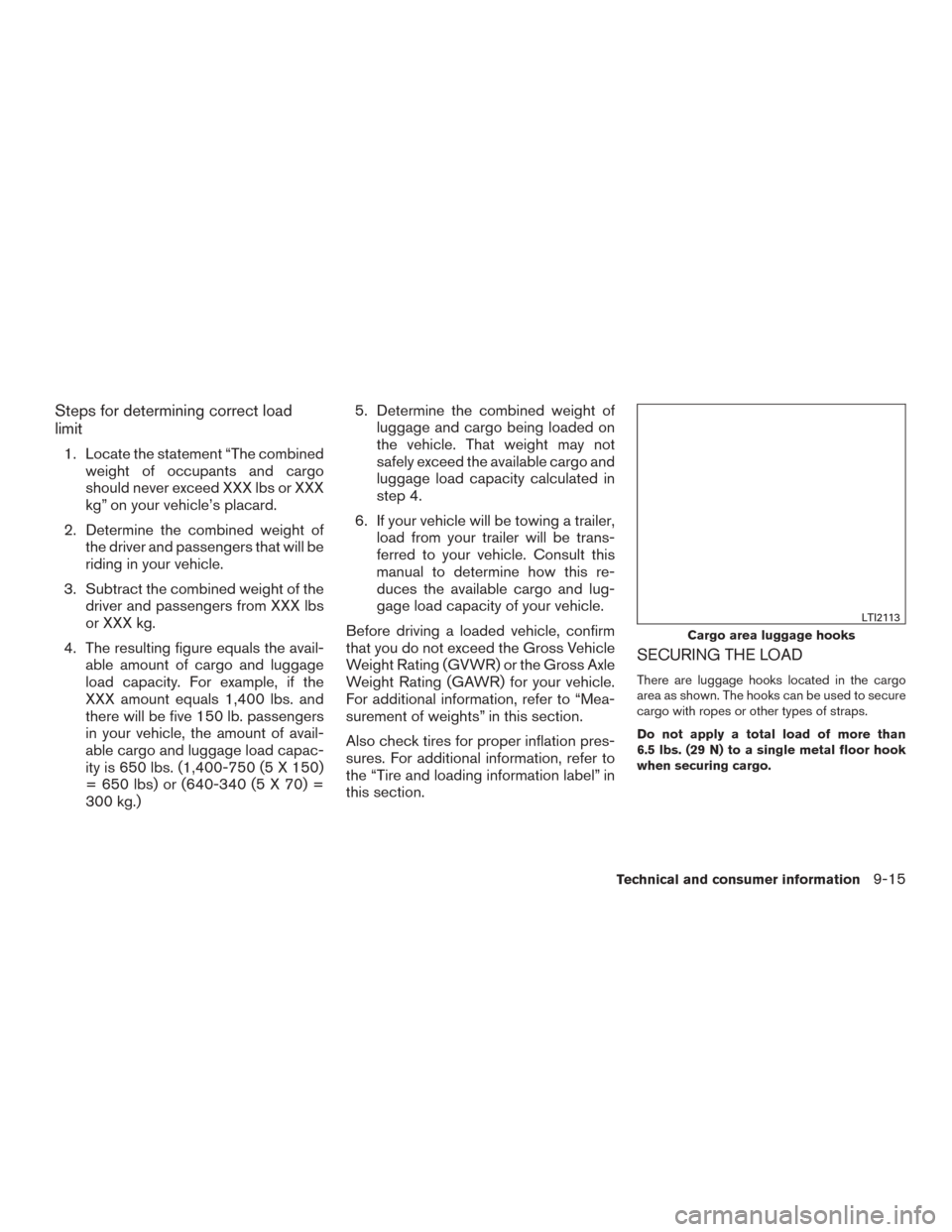
SECURING THE LOAD
There are luggage hooks located in the cargo
area as shown. The hooks can be used to secure
cargo with ropes or other types of straps.
Do not apply a total load of more than
6.5 lbs. (29 N) to a single metal floor hook
when securing cargo.
Cargo area luggage hooks
LTI2113
Technical and consumer information9-15
Page 402 of 424
WARNING
Overloading or improper loading of a
trailer and its cargo can adversely affect
vehicle handling, braking and perfor-
mance and may lead to accidents.
CAUTION
●Do not tow a trailer or haul a heavy load
for the first 500 miles (805 km) . Your
engine, axle or other parts could be
damaged.
● For the first 500 miles (805 km) that you
tow a trailer, do not drive over 50 mph
(80 km/h) and do not make starts at full
throttle. This helps the engine and other
parts of your vehicle wear in at the
heavier loads.
Your new vehicle was designed to be used pri-
marily to carry passengers and cargo. Remember
that towing a trailer places additional loads on
your vehicle’s engine, drive train, steering, brak-
ing and other systems.
A NISSAN Towing Guide (U.S. only) is available
on the website at www.nissanusa.com. This
guide includes information on trailer towing ca-
pability and the special equipment required for
proper towing.
MAXIMUM LOAD LIMITS
Maximum trailer loads
Never allow the total trailer load to exceed the
value specified in the “Towing
Load/Specification” chart found in this section.
The total trailer load equals trailer weight plus its
cargo weight.
The maximum Gross Combined Weight Rating
(GCWR) should not exceed the value specified
in the following Towing Load/Specification Chart.
The Gross Combined Weight Rating (GCWR)
equals the combined weight of the towing vehicle
(including passengers and cargo) plus the total
trailer load. Towing loads greater than these or
using improper towing equipment could ad-
versely affect vehicle handling, braking and per-
formance.
The ability of your vehicle to tow a trailer is not
only related to the maximum trailer loads, but also
the places you plan to tow. Tow weights appro-
priate for level highway driving may have to be
reduced for low traction situations (for example,
on slippery boat ramps) .
LTI2105
TOWING A TRAILER
Technical and consumer information9-17