Page 327 of 412
(Park) position. If this occurs, place suit-
able blocks at both the front and back of
a wheel to prevent the vehicle from mov-
ing. Failure to block a wheel may allow
the vehicle to move unexpectedly which
may result in serious personal injury or
death.
To place the vehicle in the READY position so the
vehicle can be driven, charge the Li-ion battery
until the driving range on the instrument panel
changes from “---” to a numeric distance. Do not attempt to start the system by pushing the
vehicle.
CAUTION
An EV (Electric Vehicle) cannot be push-
started or tow-started. Attempting to do
so may cause traction motor damage. When towing your vehicle, all State (Provincial in
Canada) and local regulations for towing must be
followed. Incorrect towing equipment could dam-
age your vehicle. Towing instructions are avail-
able from a NISSAN certified LEAF dealer. Local
service operators are familiar with the applicable
laws and procedures for towing. To assure
proper towing and to prevent accidental damage
to your vehicle, NISSAN recommends that you
have a service operator tow your vehicle. It is
advisable to have the service operator carefully
read the following precautions.
WARNING
• Never ride in a vehicle that is being towed.
• Never get under your vehicle after it has been lifted by a tow truck.
CAUTION
• When towing, make sure that the ax- les, steering system and power train
are in working condition. If any unit is
damaged, dollies must be used.
• Always attach safety chains before towing.
PUSH STARTING TOWING YOUR VEHICLE
6-12In case of emergency
Page 328 of 412
For information about towing your vehicle behind
a recreational vehicle (RV) , see “Flat towing” in
the “Technical and consumer information”
section.
TOWING RECOMMENDED BY
NISSAN
NISSAN recommends that your vehicle be towed
with the driving (front) wheels off the ground or
that the vehicle be placed on a flatbed truck as
illustrated.
CAUTION
• Never tow with the front wheels on the ground or four wheels on the ground
(forward or backward) , as this may
cause serious and expensive damage
to the motor. • When towing this vehicle with the rear
wheels on the ground (if you do not
use towing dollies): Always release
the parking brake.
NOTE:
If your vehicle cannot be moved because
the vehicle can not to be shifted to the N
(Neutral) position, please refer to the LEAF
Roadside Assistance Guide which is lo-
cated at www.NISSANUSA.com. If your ve-
hicle cannot be moved because the parking
brake cannot be released, see “Parking
brake” in the “Starting and driving” section.
In case of emergency6-13
Page 329 of 412
VEHICLE RECOVERY (FREEING
STUCK VEHICLE)
WARNING
• Stand clear of a stuck vehicle.
• Do not spin your tires at high speed. This could cause them to explode,
which could result in serious injury.
Parts of the vehicle could also over-
heat and be damaged.
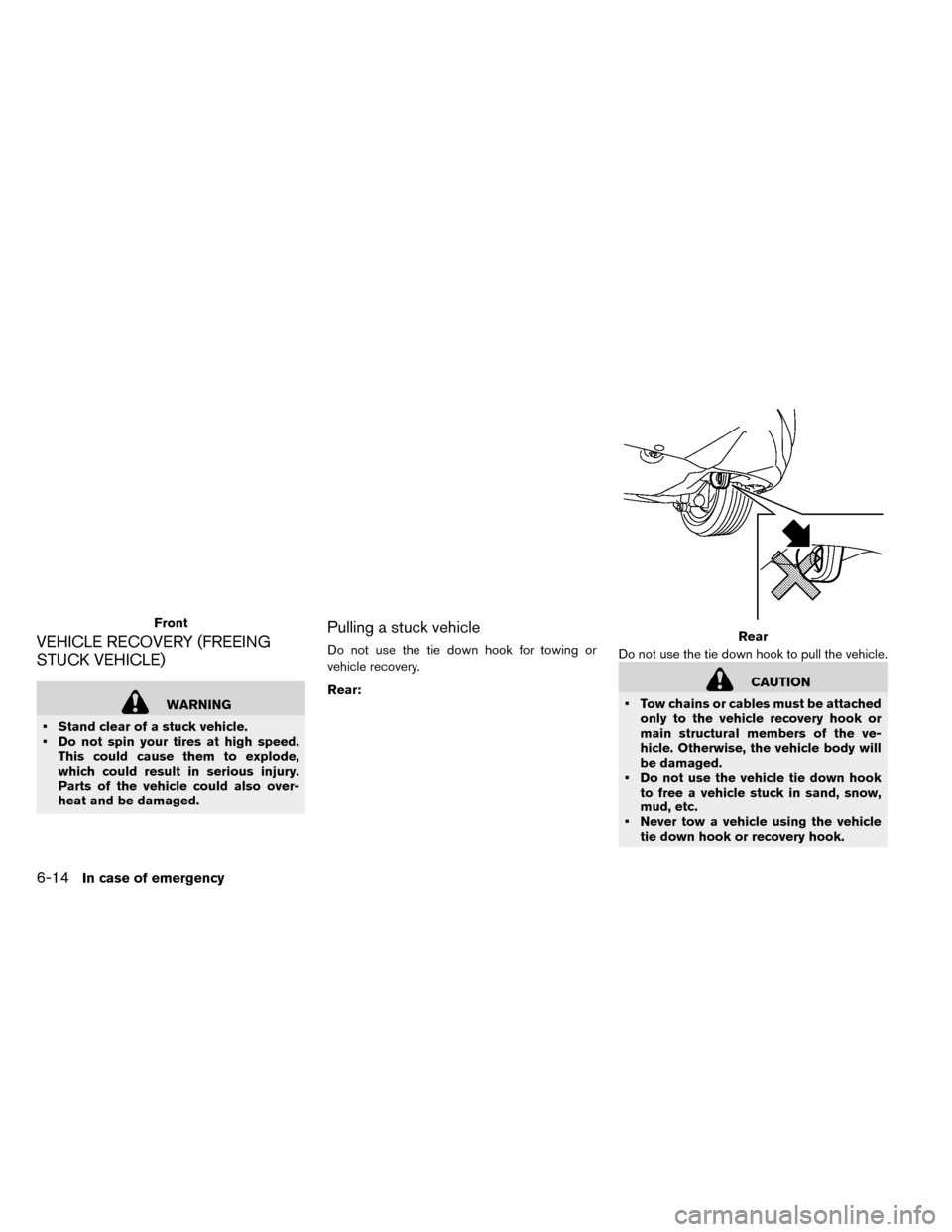
Pulling a stuck vehicle
Do not use the tie down hook for towing or
vehicle recovery.
Rear: Do not use the tie down hook to pull the vehicle.
CAUTION
• Tow chains or cables must be attached only to the vehicle recovery hook or
main structural members of the ve-
hicle. Otherwise, the vehicle body will
be damaged.
• Do not use the vehicle tie down hook to free a vehicle stuck in sand, snow,
mud, etc.
• Never tow a vehicle using the vehicle tie down hook or recovery hook.
FrontRear
6-14In case of emergency
Page 330 of 412
• Always pull the cable straight out fromthe front of the vehicle. Never pull on
the vehicle at an angle.
• Pulling devices should be routed so they do not touch any part of the sus-
pension, steering, brake or cooling
systems.
• Pulling devices such as ropes or can- vas straps are not recommended for
use in vehicle towing or recovery.
Rocking a stuck vehicle
If the vehicle is stuck in sand, snow, mud, etc., try
to free it by following the procedure below.
1. Turn off the Vehicle Dynamic Control (VDC)
system.
2. Make sure the area in front and behind the vehicle is clear of obstructions.
3. Turn the steering wheel left and right to clear an area around the front tires.
4. Slowly rock the vehicle forward and backward.
• Shift back and forth between the R (Reverse) and D (Drive) positions.
• Apply the accelerator as little as possible to maintain the rocking motion. • Release the accelerator pedal before shifting
between R (Reverse) and D (Drive) .
• Do not spin the tires above 35 MPH (55 km/h) .
5. If the vehicle cannot be freed after a few tries, contact a professional towing service to re-
move the vehicle.
In case of emergency6-15
Page 335 of 412
CHROME PARTS
Clean chrome parts regularly with a non- abrasive
chrome polish to maintain the finish.
TIRE DRESSING
NISSAN does not recommend the use of tire
dressings. Tire manufacturers apply a coating to
the tires to help reduce discoloration of the rub-
ber. If a tire dressing is applied to the tires, it may
react with the coating and form a compound. This
compound may come off the tire while driving and
stain the vehicle paint.
If you choose to use a tire dressing, take the
following precautions:
• Use a water-based tire dressing. The coating onthe tire dissolves more easily with an oil-based
tire dressing.
• Apply a light coat of tire dressing to help prevent it from entering the tire tread/grooves (where it
would be difficult to remove) .
• Wipe off excess tire dressing using a dry towel. Make sure the tire dressing is completely re-
moved from the tire tread/grooves.
• Allow the tire dressing to dry as recommended by the tire dressing manufacturer. Occasionally remove loose dust from the interior
trim, plastic parts and seats using a vacuum
cleaner or soft bristled brush. Wipe the vinyl and
leather surfaces with a clean, soft cloth damp-
ened in mild soap solution, then wipe clean with a
dry soft cloth.
Regular care and cleaning is required in order to
maintain the appearance of the leather.
Before using any fabric protector, read the manu-
facturer’s recommendations. Some fabric pro-
tectors contain chemicals that may stain or
bleach the seat material.
Use a cloth dampened only with water to clean
the meter and gauge lens.
WARNING
Do not use water or acidic cleaners (hot
steam cleaners) on the seat. This can
damage the seat or occupant classifica-
tion sensor. This can also affect the op-
eration of the air bag system and result in
serious personal injury.
CAUTION
• Never use benzine, thinner, or any similar material. • Small dirt particles can be abrasive
and damaging to the leather surfaces
and should be removed promptly. Do
not use saddle soap, car waxes, pol-
ishes, oils, cleaning fluids, solvents,
detergents or ammonia-based clean-
ers as they may damage the leather’s
natural finish.
• Never use fabric protectors unless rec- ommended by the manufacturer.
• Do not use glass or plastic cleaner on meter or gauge lens covers. It may
damage the lens cover.
AIR FRESHENERS
Most air fresheners use a solvent that could affect
the vehicle interior. If you use an air freshener,
take the following precautions:
• Hanging-type air fresheners can cause perma-
nent discoloration when they contact vehicle
interior surfaces. Place the air freshener in a
location that allows it to hang free and not
contact an interior surface.
• Liquid-type air fresheners typically clip on the vents. These products can cause immediate
damage and discoloration when spilled on inte-
rior surfaces.
CLEANING INTERIOR
7-4Appearance and care
Page 364 of 412
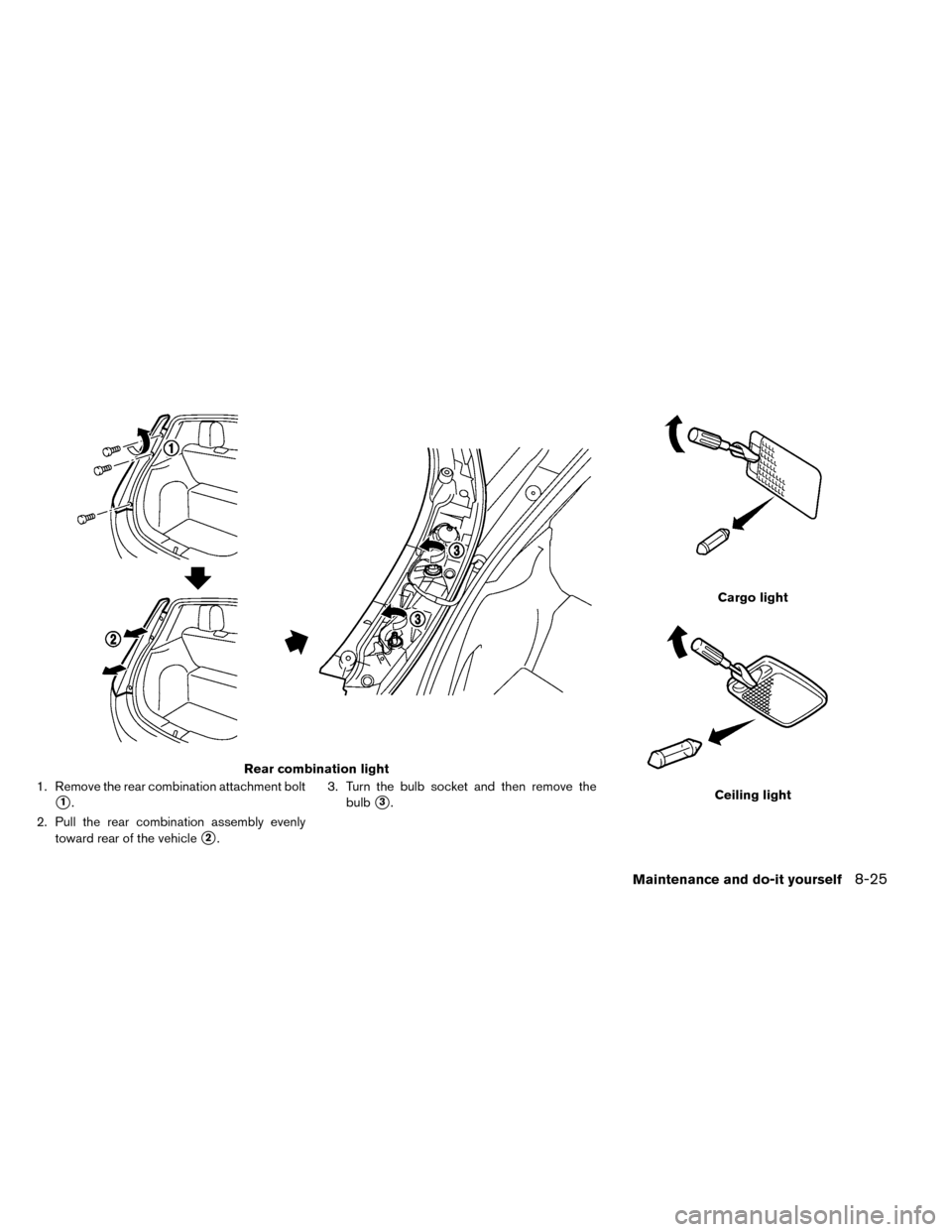
1. Remove the rear combination attachment bolt
�1.
2. Pull the rear combination assembly evenly toward rear of the vehicle
�2. 3. Turn the bulb socket and then remove the
bulb
�3.
Rear combination light
Cargo light
Ceiling light
Maintenance and do-it yourself8-25
Page 374 of 412
EMERGENCY TIRE PUNCTURE
REPAIR KIT
The emergency tire puncture repair kit (Emer-
gency Tire Sealant) is supplied with the vehicle
instead of a spare tire. It can be used to tempo-
rarily repair minor tire punctures.
If possible, have the vehicle towed to a facility that
can repair or replace the flat tire. Using the emer-
gency tire puncture repair kit may cause a mal-
function of the tire pressure sensor and cause the
low tire pressure warning light to illuminate.
See “Flat tire” in the “In case of emergency”
section for more details.
Maintenance and do-it yourself8-35
Page 376 of 412
9 Technical and consumer information
Recommended fluids/lubricants and capacities.....9-2
Air conditioning system refrigerant and lubricant
recommendations .................... .9-3
Specifications ........................ .9-4
Charging system .................... .9-4
Motor ........................... .9-5
Wheels and tires .................... .9-5
Dimensions and weights ................ .9-6
When traveling or registering your vehicle in another
country ............................ .9-6
Vehicle identification .................... .9-7
Vehicle Identification Number (VIN) plate .......9-7
Vehicle identification number (chassis number). . . .9-7
Traction motor serial number ..............9-7
F.M.V.S.S./C.M.V.S.S certification label ........9-8
Emission control information label ...........9-8
Tire and Loading Information label ...........9-8
Air conditioner specification label ............9-9
Installing front license plate .................9-9Vehicle loading information
.................9-10
Terms .......................... .9-10
Vehicle load capacity ................. .9-11
Securing the load ................... .9-12
Loading tips ...................... .9-12
Measurement of weights ................9-13
Towing a trailer ....................... .9-14
Flat towing ......................... .9-14
Uniform tire quality grading .................9-14
Treadwear ....................... .9-14
Traction AA, A, B and C ................9-14
Temperature A, B and C ................9-15
Reporting safety defects ................. .9-15
Telematics overview .................... .9-16
Event Data Recorder (EDR) ................9-18
Owner’s Manual/Service Manual order information. . .9-19
Charging information ................... .9-20
Cold tire pressures .................... .9-22