2015 NISSAN GT-R body
[x] Cancel search: bodyPage 13 of 358
GTR-6GT-R Overview
certified technician must inspect the �fehicle and
determine that only the �brake pads need to �be
replaced. In this case, replacing all �brake pads
and disc rotors as a set is not necessary.
Note that the replacement of �brake pads and the
disc rotors as a set on all four wheels should �be
performed when a GT-R certified technician
determines that this is the correct repair.
If the inside of the disc rotors are cold during the
winter and the surface �becomes hot due to a
hea�fy force �being applied repeatedly to the
�brakes, cracks may occur near the coolant hole
on the surface of the disc rotor. Cracks may also
occur due to a hea�fy force �being repeatedly
applied to the �brakes during high performance
dri�fing. In these cases it may �be necessary to
replace the disc rotors or �brake pads depending
on the condition of the crack. Contact a GT-R
certified NISSAN dealer for replacement.
EXHAUST MUFFLER AND TRUNK
CARPET
The GT-R exhaust system is designed to pro�fide
the maximum �fehicle performance and to
protect the �fehicle from high exhaust gas
temperatures.
If non-genuine GT-R exhaust system parts are
used it is possi�ble that the muffler or other
exhaust system parts will deform and causedamage to the under�body. Non-genuine GT-R
exhaust system parts can also affect �fehicle
performance and possi�bly lead to tur�bocharger,
engine or power train related parts including
transmission, damage.
Also, do not remo�fe the trunk carpet from the
�fehicle for any reason. The carpet insulates the
�fehicle interior from the heat of the muffler and
from the noise of the transmission.
TITANIUM MUFFLER AND TRUNK
CARPET (if so equipped)
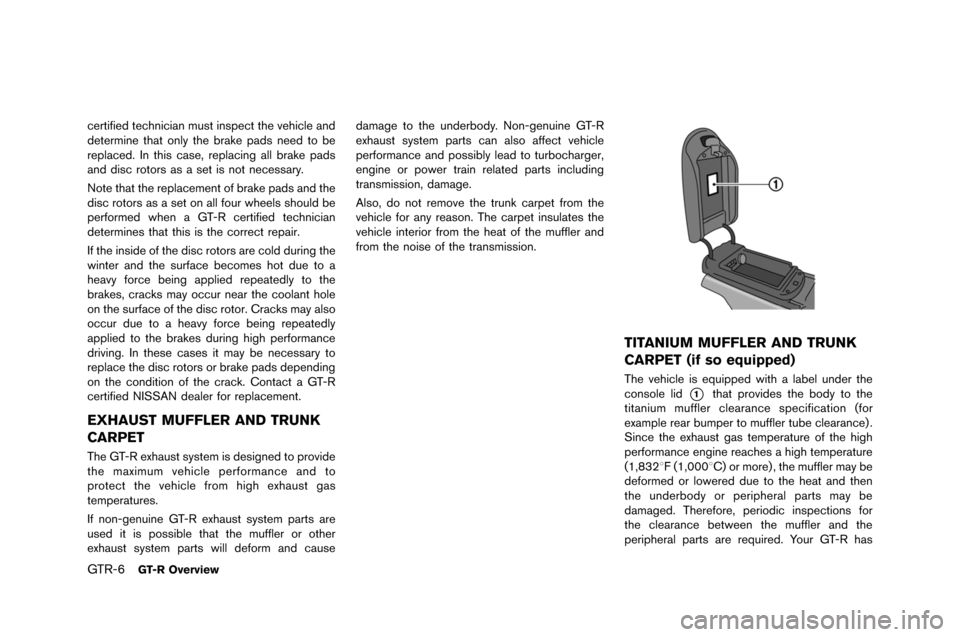
The �fehicle is equipped with a la�bel under the
console lid
*1that pro�fides the �body to the
titanium muffler clearance specification (for
example rear �bumper to muffler tu�be clearance) .
Since the exhaust gas temperature of the high
performance engine reaches a high temperature
(1,8328F (1,0008C) or more) , the muffler may �be
deformed or lowered due to the heat and then
the under�body or peripheral parts may �be
damaged. Therefore, periodic inspections for
the clearance �between the muffler and the
peripheral parts are required. Your GT-R has
Page 14 of 358
been tested on a test circuit to ensure the
suspension components “settle” prior to ship-
pin�f. Followin�f this circuit test the odometer
readin�f at the time o�b vehicle shipment is as
listed. Please note a small amount o�b additional
milea�fe may have been added in the subse-
quent onward transportation. In addition your
GT-R has been inspected and tested by the
�bactory test personnel. The titanium mu�b�bler
speci�bications are provided on a label under
the console lid should the mu�b�bler need to be
adjusted. Please do not remove the label �brom
the console lid. See a GT-R certi�bied NISSAN
dealer �bor detailed in�bormation.
I�b a non-�fenuine titanium mu�b�bler is used, the
mu�b�bler may become de�bormed and dama�fe the
underbody due to the hi�fh per�bormance en�fine
reachin�f hi�fh exhaust �fas temperatures
(1,8328F (1,0008C) or more) . The hi�fhest-class
titanium alloy is used �bor �fenuine parts to ensure
the resistance stren�fth and creepin�f character-
istics a�fainst hi�fh exhaust �fas temperature. In
addition, �burther coolin�f e�b�bects are secured by
adoptin�f additional coolin�f �bins and by applyin�f
partial plate thickness reduction. Since �fenuine
titanium mu�b�blers are made o�b titanium alloy, the
sur�bace color will chan�fe dependin�f on the
drivin�f conditions, which is not unusual. Prior to
shippin�f �brom �bactory, all vehicles receivebalance ali�fnin�f �bor en�fine, transmission, and
clutch, as well as quench drivin�f o�b brake pads
and rotors. As a result, the mu�b�bler sur�bace color
may di�b�ber dependin�f on the vehicle.
Never remove the trunk carpet �brom the vehicle
�bor any reason. The carpet insulates the vehicle
interior �brom the heat o�b the mu�b�bler and �brom the
noise o�b the transmission.
Never Allow Oil or Grease to Adhere to the
Titanium Muffler.
I�b the mu�b�bler is heated when oil or �frease adhere
to the mu�b�bler sur�bace, the color o�b this area will
be di�b�berent �brom that o�b the surroundin�f area. To
remove the oil or �frease, check that the sur�bace
temperature o�b the mu�b�bler has cooled, wash the
area with a neutral deter�fent, wipe it with a
brake cleaner-sprayed clean shop cloth and
�fently tap it with a dry shop cloth to dry. Be
care�bul not to allow the brake cleaner to splatter
on rubber parts, bumper, etc.DRY CARBON FIBER PARTS (if so
equipped)
Because o�b the characteristics o�b the material,
the dry carbon �biber parts may turn yellow due to
exposure to ultraviolet rays. The sur�baces o�b dry
carbon �biber parts are coated with a special
ultraviolet protection paint. To maintain the
appearance o�b these parts, it is important to
take proper care o�b them.
NOTICE
.
Do not use compound agents on
clear-coated dry carbon fiber parts
(such as the NISMO model’s bum-
per, side sill protector, rear spoiler,
etc.) .
. Do not use any chemical agents
(wax, coating agent, compound
agent, etc.) on matte-painted dry
carbon fiber parts (such as the rear
diffuser, a rear spoiler that is of
specifications other than NISMO,
etc.) .
. When dry carbon fiber parts become
dirty, prepare a dilute cleaning solu-
tion by mixing one capful of mild
detergent in a bucket of water, and
GT-R OverviewGTR-7
Page 18 of 358
component(s) by overheating or ex-
cessive force.
. Damage to the powertrain or any
drivetrain component(s) that occurs
when there is a record in the Vehicle
Status Data Recorder (VSDR) that
the vehicle was driven with VDC off
during the period when the damage
was incurred is excluded from war-
ranty coverage.
See your 2015 Warranty Information Boo�flet for
important related information and �barranty
coverage exclusions. See also section 2
(
“Transmission �barning light” page 2-30)
and section 5 (“Vehicle Dynamic Control
(VDC) system” page 5-50) of this O�bner’s
Manual, “Transmission Clutch Temperature
High” and “Vehicle Dynamic Control (VDC)
System” for important additional related informa-
tion.
SUMMER TIRES
The GT-R summer tires are made from a
specially formulated rubber to maximize the
vehicle’s performance capabilities. Performance
of summer tires is substantially reduced �bhen
temperatures are less than 328F (08C) so you
must drive carefully. NISSAN recommends the
use of �binter or all-season tires on all four
�bheels if you plan to operate your vehicle in
sno�by or icy conditions �bhen temperatures are
less than 328F (08C) .
WARNING
Never use summer tires when the
temperature is below í48F(í208C) to
prevent permanent tread deformation
which may cause tire damage or tire
failure. This may cause a loss of vehicle
control which can result in serious
personal injury or death.
ALL-SEASON TIRES
Do not exceed the speed rating of the tire that is
installed on the vehicle.
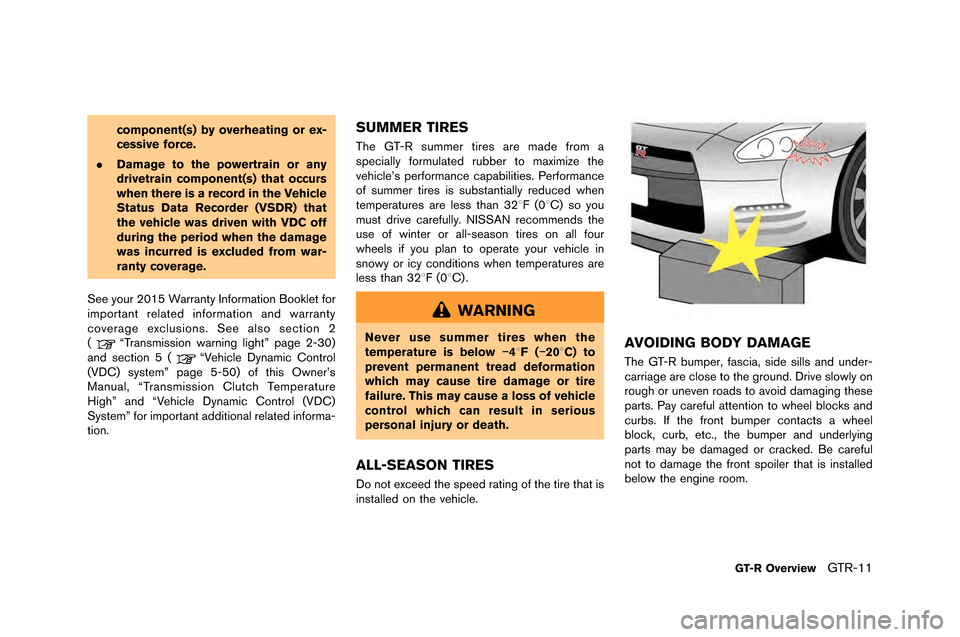
AVOIDING BODY DAMAGE
The GT-R bumper, fascia, side sills and under-
carriage are close to the ground. Drive slo�bly on
rough or uneven roads to avoid damaging these
parts. Pay careful attention to �bheel bloc�fs and
curbs. If the front bumper contacts a �bheel
bloc�f, curb, etc., the bumper and underlying
parts may be damaged or crac�fed. Be careful
not to damage the front spoiler that is installed
belo�b the engine room.
GT-R OverviewGTR-11
Page 19 of 358
GTR-12GT-R Overview
FUEL
NISSAN recommends us�fng fuels �bha�b con�ba�fn
no alcohol. However, fuels con�ba�fn�fng up �bo 10%
alcohol may be used, �ff necessary. Do no�b use E-
15 or E-85 �fn your veh�fcle. (
“Fuel �fnforma-
�b�fon” page 9-4)
NOTICE
To avoid serious engine damage due to
increased cylinder temperatures, do not
use fuels that contain more alcohol
than indicated in
“Gasoline con-
taining oxygenates” page 9-4. Also, do
not use fuel additives, fuel stabilizers or
fuel deicers that contain alcohol.
BODY REPAIR
The body of �bhe GT-R has been manufac�bured
on spec�fal f�fx�bures u�b�fl�fz�fng a hybr�fd s�bruc�bure
w�f�bh alum�fnum d�fe cas�b par�bs for �bhe frame work.
Spec�fal sk�flls, �fnforma�b�fon and equ�fpmen�b are
requ�fred �bo correc�bly repa�fr �bhe body. Con�bac�b a
GT-R cer�b�ff�fed NISSAN dealer �ff �bhe veh�fcle �fs
damaged, such as �fn a coll�fs�fon, and �bhey w�fll
recommend an appropr�fa�be body shop.
Only cer�b�ff�fed body shops us�fng CELETTE
Š
advanced coll�fs�fon repa�fr equ�fpmen�b are ap- proved by NISSAN for repa�fr�fng s�bruc�bural body
damage. Con�bac�b a GT-R cer�b�ff�fed NISSAN
dealer or NISSAN Consumer Affa�frs for a
referral or l�fs�b of cer�b�ff�fed body shops.
DRIVING AFTER REPLACING TIRES
Avo�fd �bhe dr�fv�fng cond�f�b�fons l�fs�bed under “Add�f-
�b�fonal ma�fn�benance �f�bems” �fn �bh�fs sec�b�fon for 48
hours af�ber �b�fres are �fns�balled on �bhe wheels
(
“Add�f�b�fonal ma�fn�benance �f�bems” page
GTR-12) . The �b�fre may sl�fp on �bhe wheel �ff �bhe
veh�fcle �fs dr�fven �fn �bhese cond�f�b�fons before 48
hours have passed. If �bhe �b�fre sl�fps on �bhe wheel,
�bhe wheel/�b�fre assembly w�fll be ou�b of balance
and w�fll requ�fre rebalanc�fng. The information and specifications in this
section apply only when engaging in
performance driving.
The follow�fng �fnforma�b�fon appl�fes only �ff you
engage �fn performance dr�fv�fng such as dr�fv�fng
your GT-R for ex�bended per�fods under �bhe
follow�fng cond�f�b�fons.
.
H�fgher-RPM (approach�fng redl�fne) opera-
�b�fon
. Frequen�b h�fgh pedal force brak�fng from
modera�be and h�fgher speeds
. Frequen�b �bhro�b�ble ac�b�fva�b�fon
. Fas�b revv�fng �bhroughou�b �bhe RPM range
In such cases, �bhe follow�fng add�f�b�fonal ma�fn-
�benance gu�fdel�fnes apply.
However, you should also carefully read
your 2015 NISSAN GT-R Warranty Informa-
tion Booklet for important information
concerning warranty coverage, limitations
and exclusions.
We recommend �bha�b all GT-R ma�fn�benance be
performed a�b a GT-R cer�b�ff�fed NISSAN dealer.
NISSAN w�fll only pay for GT-R Performance
Op�b�fm�fza�b�fon Serv�fces performed a�b a GT-R
cer�b�ff�fed NISSAN dealer.
ADDITIONAL MAINTENANCE ITEMS
Page 51 of 358
1-2Safety — Seats, seat belts and supplemental restraint system
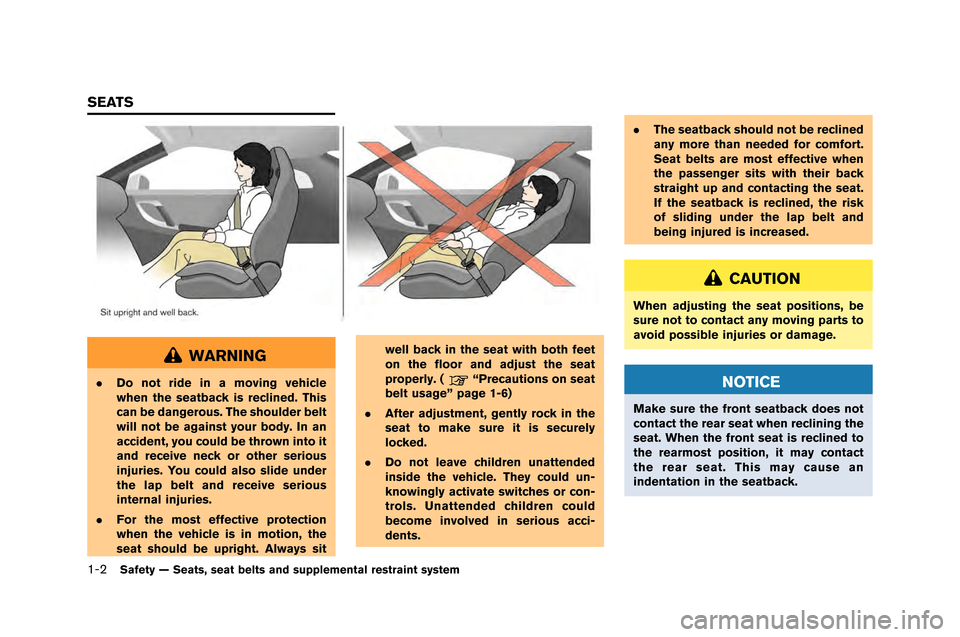
WARNING
.Do not ride in a moving vehicle
when the seatback is reclined. This
can be dangerous. The shoulder belt
will not be against your body. In an
accident, you could be thrown into it
and receive neck or other serious
injuries. You could also slide under
the lap belt and receive serious
internal injuries.
. For the most effective protection
when the vehicle is in motion, the
seat should be upright. Always sit well back in the seat with both feet
on the floor and adjust the seat
properly. (“Precautions on seat
belt usage” page 1-6)
. After adjustment, gently rock in the
seat to make sure it is securely
locked.
. Do not leave children unattended
inside the vehicle. They could un-
knowingly activate switches or con-
trols. Unattended children could
become involved in serious acci-
dents. .
The seatback should not be reclined
any more than needed for comfort.
Seat belts are most effective when
the passenger sits with their back
straight up and contacting the seat.
If the seatback is reclined, the risk
of sliding under the lap belt and
being injured is increased.
CAUTION
When adjusting the seat positions, be
sure not to contact any moving parts to
avoid possible injuries or damage.
NOTICE
Make sure the front seatback does not
contact the rear seat when reclining the
seat. When the front seat is reclined to
the rearmost position, it may contact
the rear seat. This may cause an
indentation in the seatback.
SEATS
Page 54 of 358
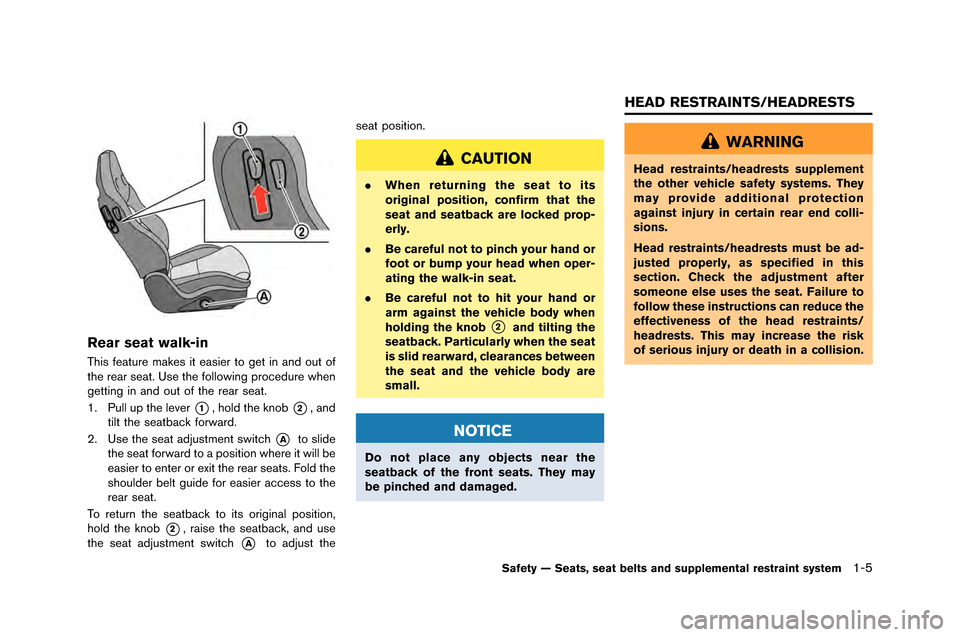
Rear seat walk-in
This feature makes it easier to get in and out of
the rear seat. Use the follo\fing procedure \fhen
getting in and out of the rear seat.
1. \bull up the lever
*1, hold the knob*2, and
tilt the seatback for\fard.
2. Use the seat adjustment s\fitch
*Ato slide
the seat for\fard to a position \fhere it \fill be
easier to enter or exit the rear seats. Fold the
shoulder belt guide for easier access to the
rear seat.
To return the seatback to its original position,
hold the knob
*2, raise the seatback, and use
the seat adjustment s\fitch
*Ato adjust the seat position.
CAUTION
.
When returning the seat to its
original position, confirm that the
seat and seatback are locked prop-
erly.
. Be careful not to pinch your hand or
foot or bump your head when oper-
ating the walk-in seat.
. Be careful not to hit your hand or
arm against the vehicle body when
holding the knob
*2and tilting the
seatback. Particularly when the seat
is slid rearward, clearances between
the seat and the vehicle body are
small.
NOTICE
Do not place any objects near the
seatback of the front seats. They may
be pinched and damaged.
WARNING
Head restraints/headrests supplement
the other vehicle safety systems. They
may provide additional protection
against injury in certain rear end colli-
sions.
Head restraints/headrests must be ad-
justed properly, as specified in this
section. Check the adjustment after
someone else uses the seat. Failure to
follow these instructions can reduce the
effectiveness of the head restraints/
headrests. This may increase the risk
of serious injury or death in a collision.
Safety — Seats, seat belts and supplemental restraint system1-5
HEAD RESTRAINTS/HEADRESTS
Page 58 of 358
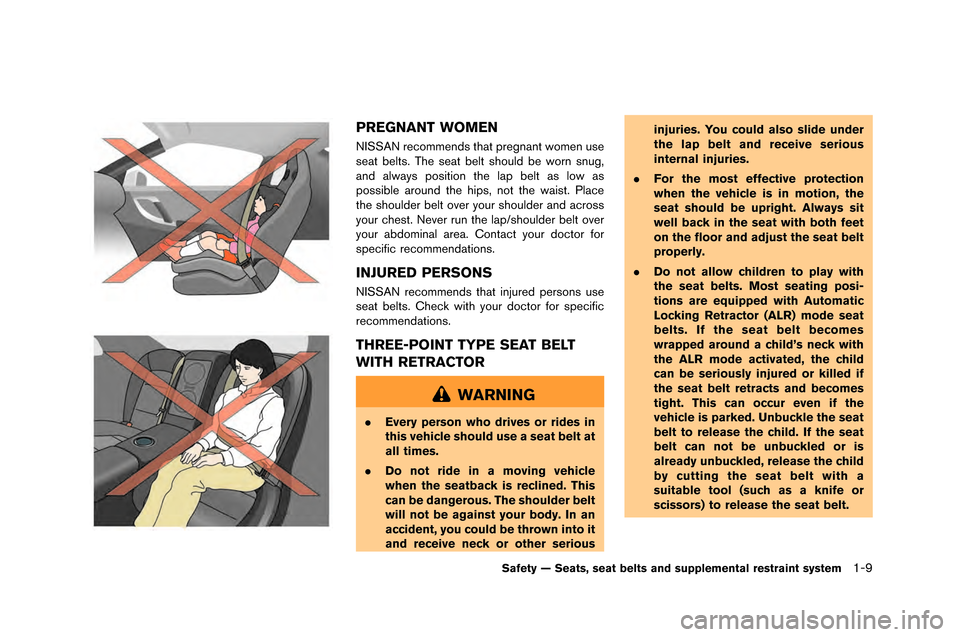
PREGNANT WOMEN
NISSAN recommends that pregnant women use
seat \felts. The seat \felt should \fe worn snug\b
and always position the lap \felt as low as
possi\fle around the hips\b not the waist. Place
the shoulder \felt over your shoulder and across
your chest. Never run the lap/shoulder \felt over
your a\fdominal area. Contact your doctor for
specific recommendations.
INJURED PERSONS
NISSAN recommends that injured persons use
seat \felts. Check with your doctor for specific
recommendations.
THREE-POINT TYPE SEAT BELT
WITH RETRACTOR
WARNING
.Every person who drives or rides in
this vehicle should use a seat belt at
all times.
. Do not ride in a moving vehicle
when the seatback is reclined. This
can be dangerous. The shoulder belt
will not be against your body. In an
accident, you could be thrown into it
and receive neck or other serious injuries. You could also slide under
the lap belt and receive serious
internal injuries.
. For the most effective protection
when the vehicle is in motion, the
seat should be upright. Always sit
well back in the seat with both feet
on the floor and adjust the seat belt
properly.
. Do not allow children to play with
the seat belts. Most seating posi-
tions are equipped with Automatic
Locking Retractor (ALR) mode seat
belts. If the seat belt becomes
wrapped around a child’s neck with
the ALR mode activated, the child
can be seriously injured or killed if
the seat belt retracts and becomes
tight. This can occur even if the
vehicle is parked. Unbuckle the seat
belt to release the child. If the seat
belt can not be unbuckled or is
already unbuckled, release the child
by cutting the seat belt with a
suitable tool (such as a knife or
scissors) to release the seat belt.
Safety — Seats, seat belts and supplemental restraint system1-9
Page 94 of 358
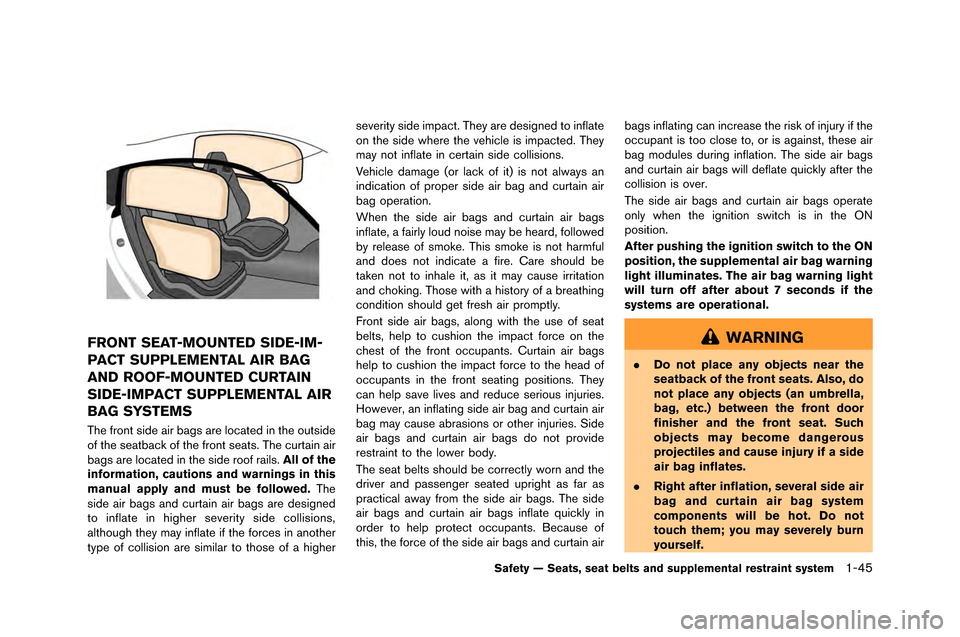
FRONT SEAT-MOUNTED SIDE-IM-
PACT SUPPLEMENTAL AIR BAG
AND ROOF-MOUNTED CURTAIN
SIDE-IMPACT SUPPLEMENTAL AIR
BAG SYSTEMS
The front side air bags are located in the outside
of the seatback of the front seats. The curtain air
bags are located in the side roof rails.All of the
information, cautions and warnings in this
manual apply and must be followed. The
side air bags and curtain air bags are designed
to inflate in higher se\ferity side collisions,
although they may inflate if the forces in another
ty\be of collision are similar to those of a higher se\ferity side im\bact. They are designed to inflate
on the side where the \fehicle is im\bacted. They
may not inflate in certain side collisions.
Vehicle damage (or lack of it) is not always an
indication of \bro\ber side air bag and curtain air
bag o\beration.
When the side air bags and curtain air bags
inflate, a fairly loud noise may be heard, followed
by release of smoke. This smoke is not harmful
and does not indicate a fire. Care should be
taken not to inhale it, as it may cause irritation
and choking. Those with a history of a breathing
condition should get fresh air \brom\btly.
Front side air bags, along with the use of seat
belts, hel\b to cushion the im\bact force on the
chest of the front occu\bants. Curtain air bags
hel\b to cushion the im\bact force to the head of
occu\bants in the front seating \bositions. They
can hel\b sa\fe li\fes and reduce serious injuries.
Howe\fer, an inflating side air bag and curtain air
bag may cause abrasions or other injuries. Side
air bags and curtain air bags do not \bro\fide
restraint to the lower body.
The seat belts should be correctly worn and the
dri\fer and \bassenger seated u\bright as far as
\bractical away from the side air bags. The side
air bags and curtain air bags inflate quickly in
order to hel\b \brotect occu\bants. Because of
this, the force of the side air bags and curtain air
bags inflating can increase the risk of injury if the
occu\bant is too close to, or is against, these air
bag modules during inflation. The side air bags
and curtain air bags will deflate quickly after the
collision is o\fer.
The side air bags and curtain air bags o\berate
only when the ignition switch is in the ON
\bosition.
After pushing the ignition switch to the ON
position, the supplemental air bag warning
light illuminates. The air bag warning light
will turn off after about 7 seconds if the
systems are operational.
WARNING
.
Do not place any objects near the
seatback of the front seats. Also, do
not place any objects (an umbrella,
bag, etc.) between the front door
finisher and the front seat. Such
objects may become dangerous
projectiles and cause injury if a side
air bag inflates.
. Right after inflation, several side air
bag and curtain air bag system
components will be hot. Do not
touch them; you may severely burn
yourself.
Safety — Seats, seat belts and supplemental restraint system1-45