Page 88 of 466
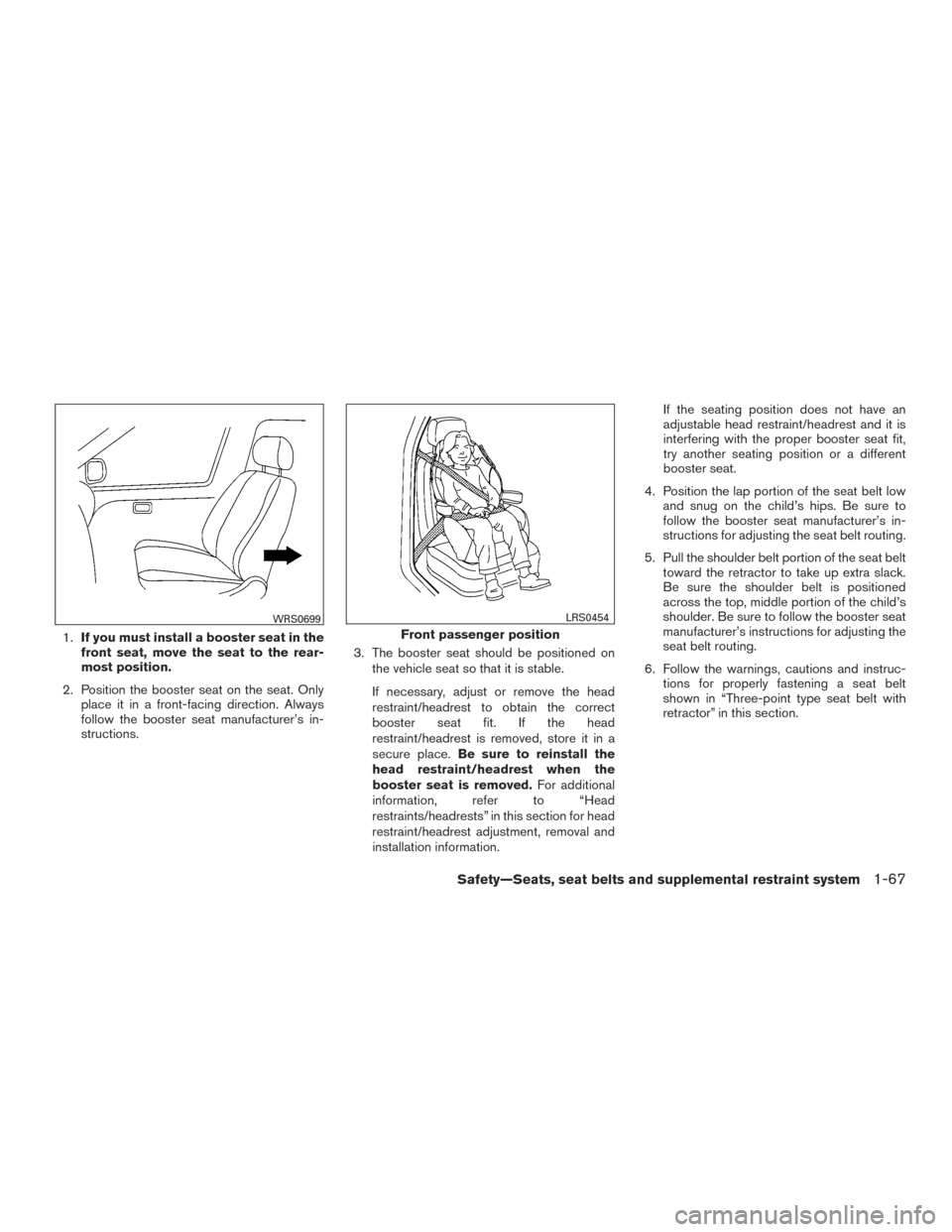
1.If you must install a booster seat in the
front seat, move the seat to the rear-
most position.
2. Position the booster seat on the seat. Only place it in a front-facing direction. Always
follow the booster seat manufacturer’s in-
structions. 3. The booster seat should be positioned on
the vehicle seat so that it is stable.
If necessary, adjust or remove the head
restraint/headrest to obtain the correct
booster seat fit. If the head
restraint/headrest is removed, store it in a
secure place. Be sure to reinstall the
head restraint/headrest when the
booster seat is removed. For additional
information, refer to “Head
restraints/headrests” in this section for head
restraint/headrest adjustment, removal and
installation information. If the seating position does not have an
adjustable head restraint/headrest and it is
interfering with the proper booster seat fit,
try another seating position or a different
booster seat.
4. Position the lap portion of the seat belt low and snug on the child’s hips. Be sure to
follow the booster seat manufacturer’s in-
structions for adjusting the seat belt routing.
5. Pull the shoulder belt portion of the seat belt toward the retractor to take up extra slack.
Be sure the shoulder belt is positioned
across the top, middle portion of the child’s
shoulder. Be sure to follow the booster seat
manufacturer’s instructions for adjusting the
seat belt routing.
6. Follow the warnings, cautions and instruc- tions for properly fastening a seat belt
shown in “Three-point type seat belt with
retractor” in this section.
WRS0699
Front passenger position
LRS0454
Safety—Seats, seat belts and supplemental restraint system1-67
Page 89 of 466
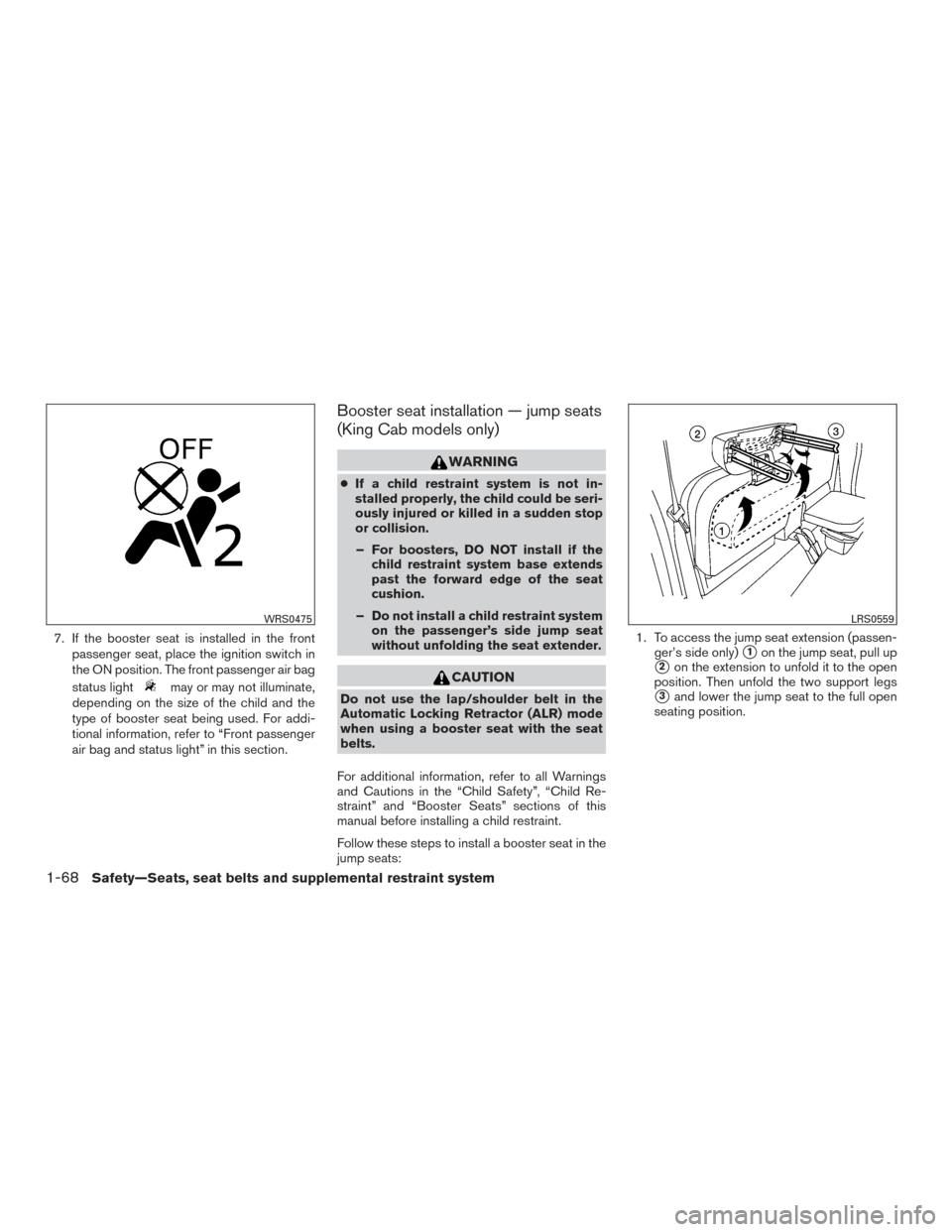
7. If the booster seat is installed in the frontpassenger seat, place the ignition switch in
the ON position. The front passenger air bag
status light
may or may not illuminate,
depending on the size of the child and the
type of booster seat being used. For addi-
tional information, refer to “Front passenger
air bag and status light” in this section.
Booster seat installation — jump seats
(King Cab models only)
WARNING
● If a child restraint system is not in-
stalled properly, the child could be seri-
ously injured or killed in a sudden stop
or collision.
– For boosters, DO NOT install if the child restraint system base extends
past the forward edge of the seat
cushion.
– Do not install a child restraint system on the passenger’s side jump seat
without unfolding the seat extender.
CAUTION
Do not use the lap/shoulder belt in the
Automatic Locking Retractor (ALR) mode
when using a booster seat with the seat
belts.
For additional information, refer to all Warnings
and Cautions in the “Child Safety”, “Child Re-
straint” and “Booster Seats” sections of this
manual before installing a child restraint.
Follow these steps to install a booster seat in the
jump seats: 1. To access the jump seat extension (passen-
ger’s side only)
�1on the jump seat, pull up
�2on the extension to unfold it to the open
position. Then unfold the two support legs
�3and lower the jump seat to the full open
seating position.
WRS0475LRS0559
1-68Safety—Seats, seat belts and supplemental restraint system
Page 90 of 466
2. Position the booster seat on the seat. Onlyplace it in a front-facing direction. Always
follow the booster seat manufacturer’s in-
structions.
3. The booster seat should be positioned on the vehicle seat so that it is stable.
If necessary, adjust or remove the head
restraint/headrest to obtain the correct
booster seat fit. If the head
restraint/headrest is removed, store it in a
secure place. Be sure to reinstall the
head restraint/headrest when the
booster seat is removed. For additional
information, refer to “head restraint/headrest” in this section for head
restraint/headrest adjustment, removal and
installation information.
If the seating position does not have an
adjustable head restraint/headrest and it is
interfering with the proper booster seat fit,
try another seating position or a different
booster seat.
4. Position the lap portion of the seat belt low and snug on the child’s hips. Be sure to
follow the booster seat manufacturer’s in-
structions for adjusting the seat belt routing. 5. Pull the shoulder belt portion of the seat belt
toward the retractor to take up extra slack.
Be sure the shoulder belt is positioned
across the top, middle portion of the child’s
shoulder. Be sure to follow the booster seat
manufacturer’s instructions for adjusting the
seat belt routing.
6. Follow the warnings, cautions and instruc- tions for properly fastening a seat belt
shown in “Three-point type seat belt with
retractor” in this section.
LRS2502LRS0539
Safety—Seats, seat belts and supplemental restraint system1-69
Page 93 of 466
WARNING
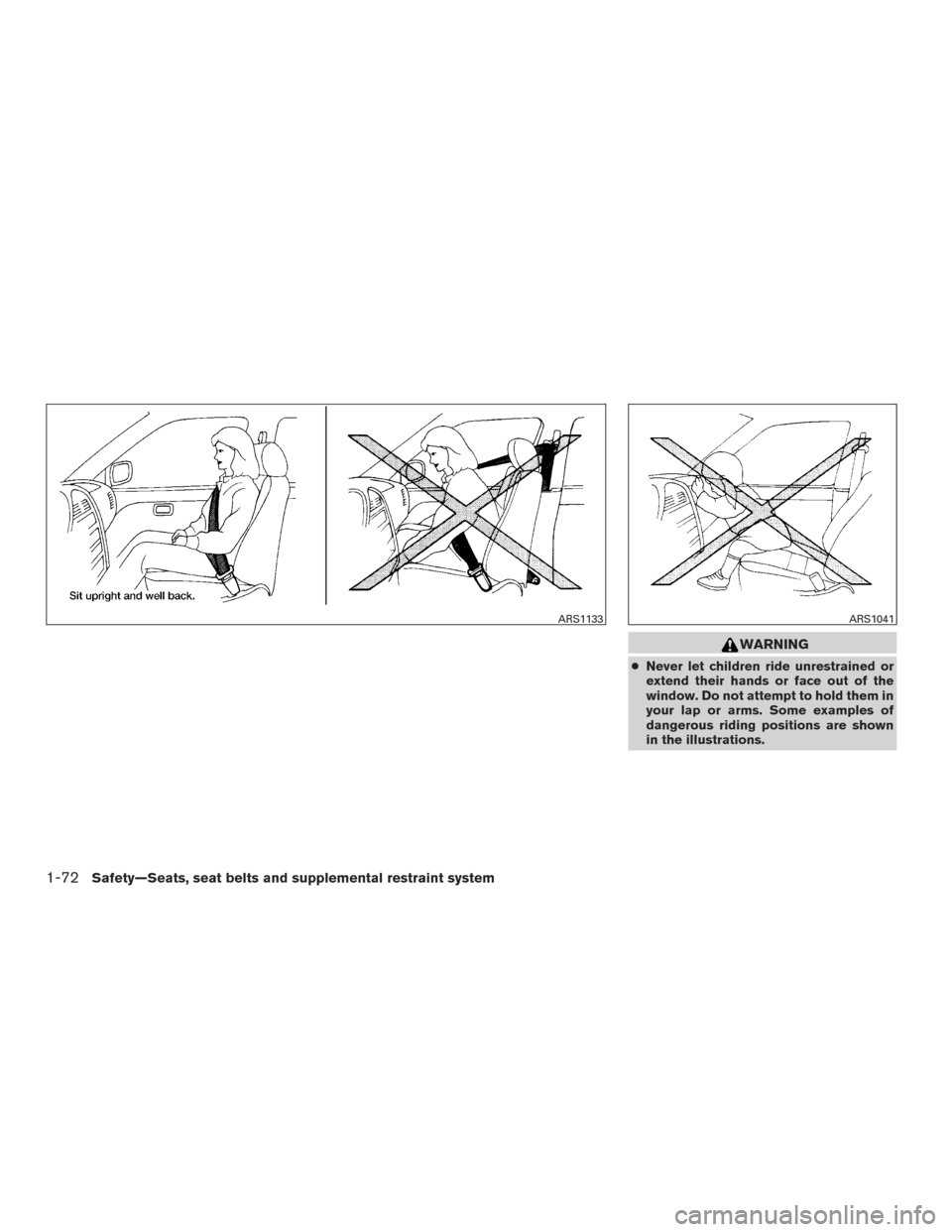
●Never let children ride unrestrained or
extend their hands or face out of the
window. Do not attempt to hold them in
your lap or arms. Some examples of
dangerous riding positions are shown
in the illustrations.
ARS1133ARS1041
1-72Safety—Seats, seat belts and supplemental restraint system
Page 94 of 466
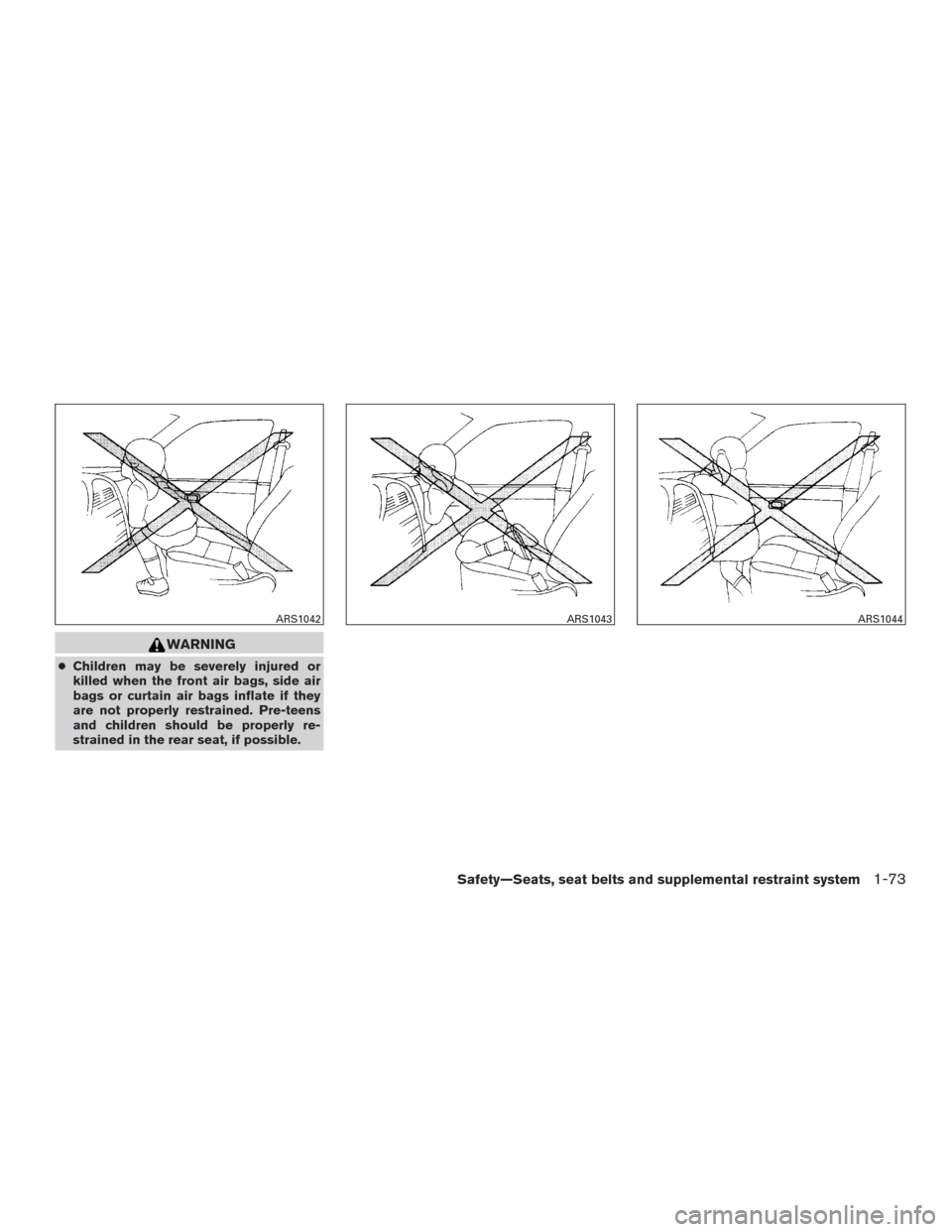
WARNING
●Children may be severely injured or
killed when the front air bags, side air
bags or curtain air bags inflate if they
are not properly restrained. Pre-teens
and children should be properly re-
strained in the rear seat, if possible.
ARS1042ARS1043ARS1044
Safety—Seats, seat belts and supplemental restraint system1-73
Page 95 of 466
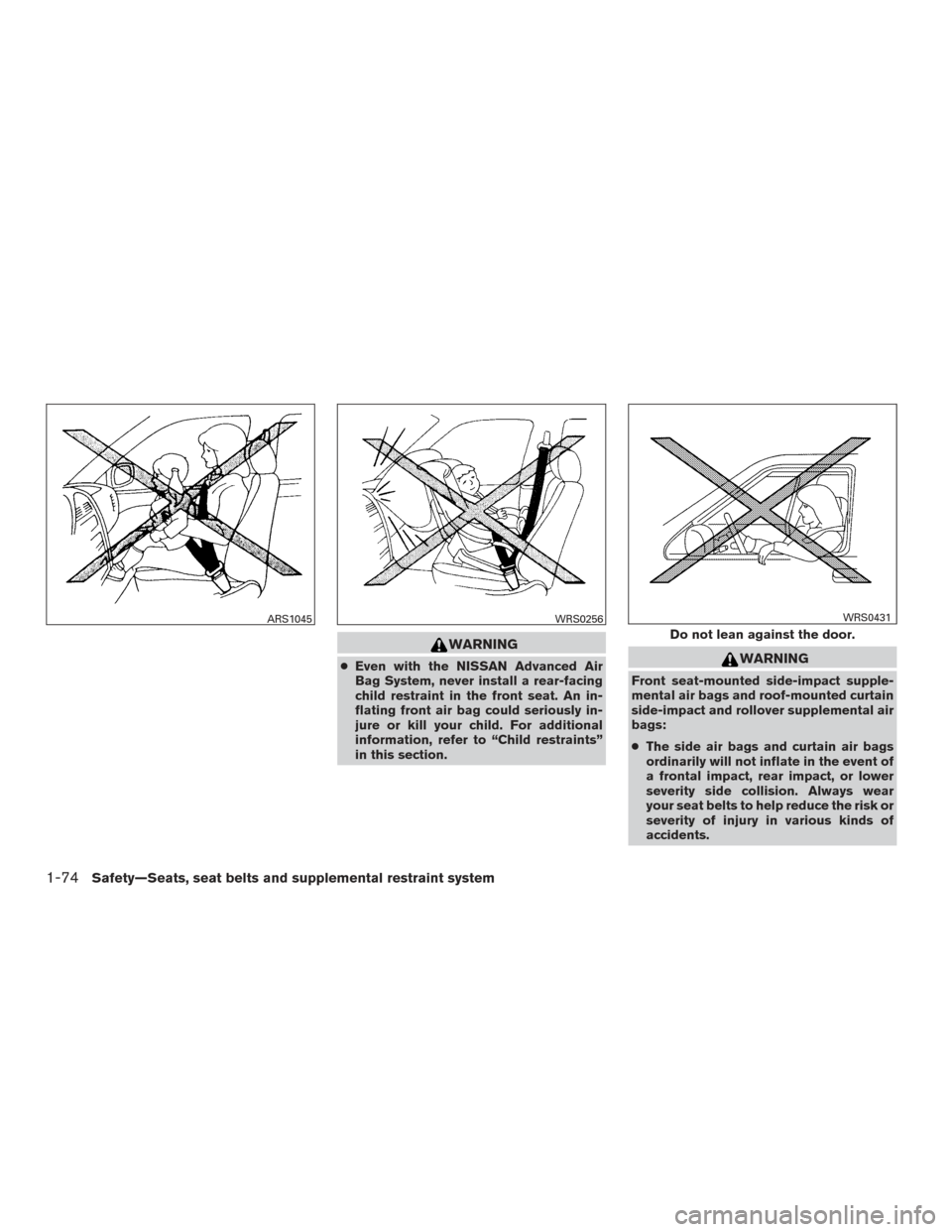
WARNING
●Even with the NISSAN Advanced Air
Bag System, never install a rear-facing
child restraint in the front seat. An in-
flating front air bag could seriously in-
jure or kill your child. For additional
information, refer to “Child restraints”
in this section.WARNING
Front seat-mounted side-impact supple-
mental air bags and roof-mounted curtain
side-impact and rollover supplemental air
bags:
● The side air bags and curtain air bags
ordinarily will not inflate in the event of
a frontal impact, rear impact, or lower
severity side collision. Always wear
your seat belts to help reduce the risk or
severity of injury in various kinds of
accidents.
ARS1045WRS0256
Do not lean against the door.
WRS0431
1-74Safety—Seats, seat belts and supplemental restraint system
Page 97 of 466
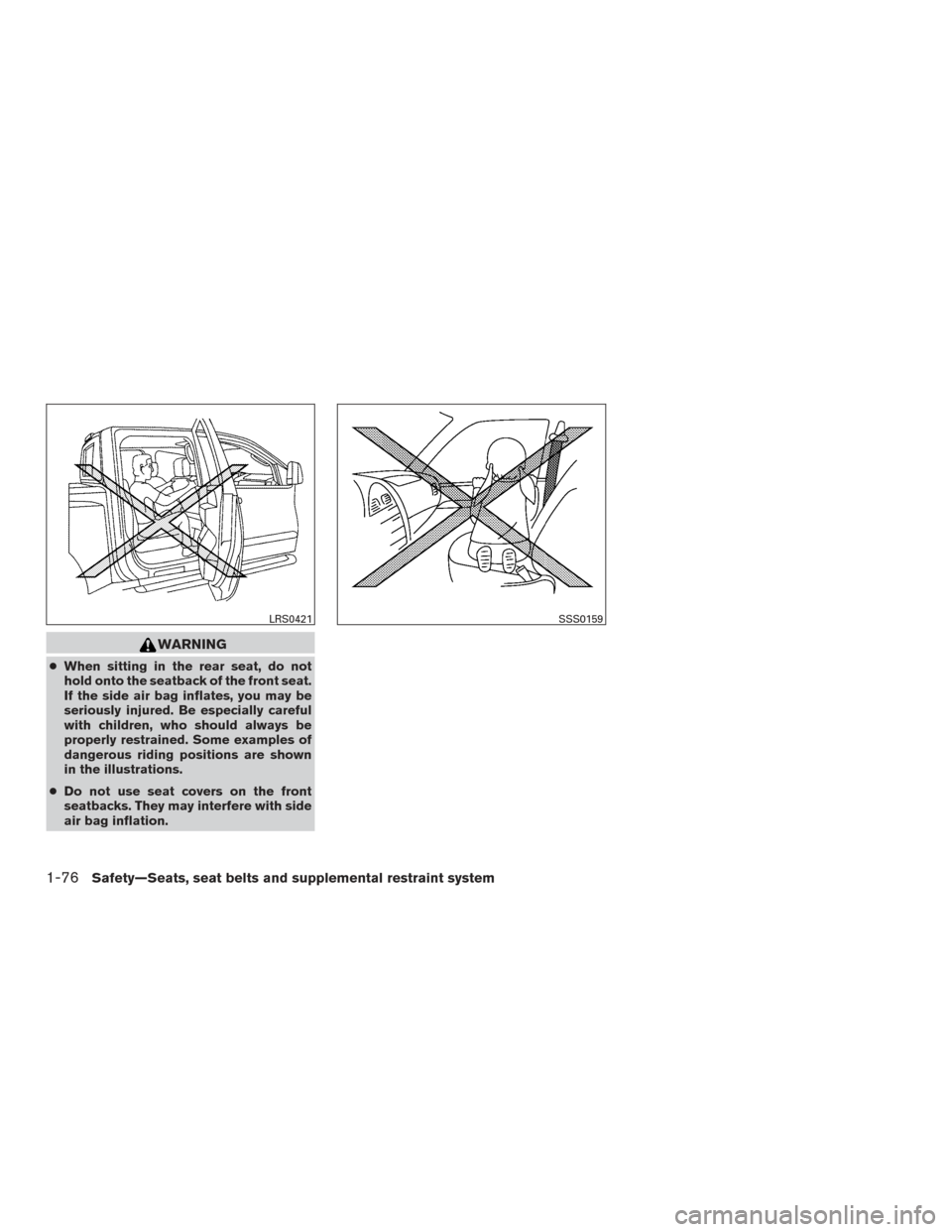
WARNING
●When sitting in the rear seat, do not
hold onto the seatback of the front seat.
If the side air bag inflates, you may be
seriously injured. Be especially careful
with children, who should always be
properly restrained. Some examples of
dangerous riding positions are shown
in the illustrations.
● Do not use seat covers on the front
seatbacks. They may interfere with side
air bag inflation.
LRS0421SSS0159
1-76Safety—Seats, seat belts and supplemental restraint system
Page 100 of 466
Front passenger air bag and status light
WARNING
The front passenger air bag is designed to
automatically turn OFF under some condi-
tions. Read this section carefully to learn
how it operates. Proper use of the seat,
seat belt and child restraints is necessary
for most effective protection. Failure to
follow all instructions in this manual con-
cerning the use of seats, seat belts and
child restraints can increase the risk or
severity of injury in an accident.Status light
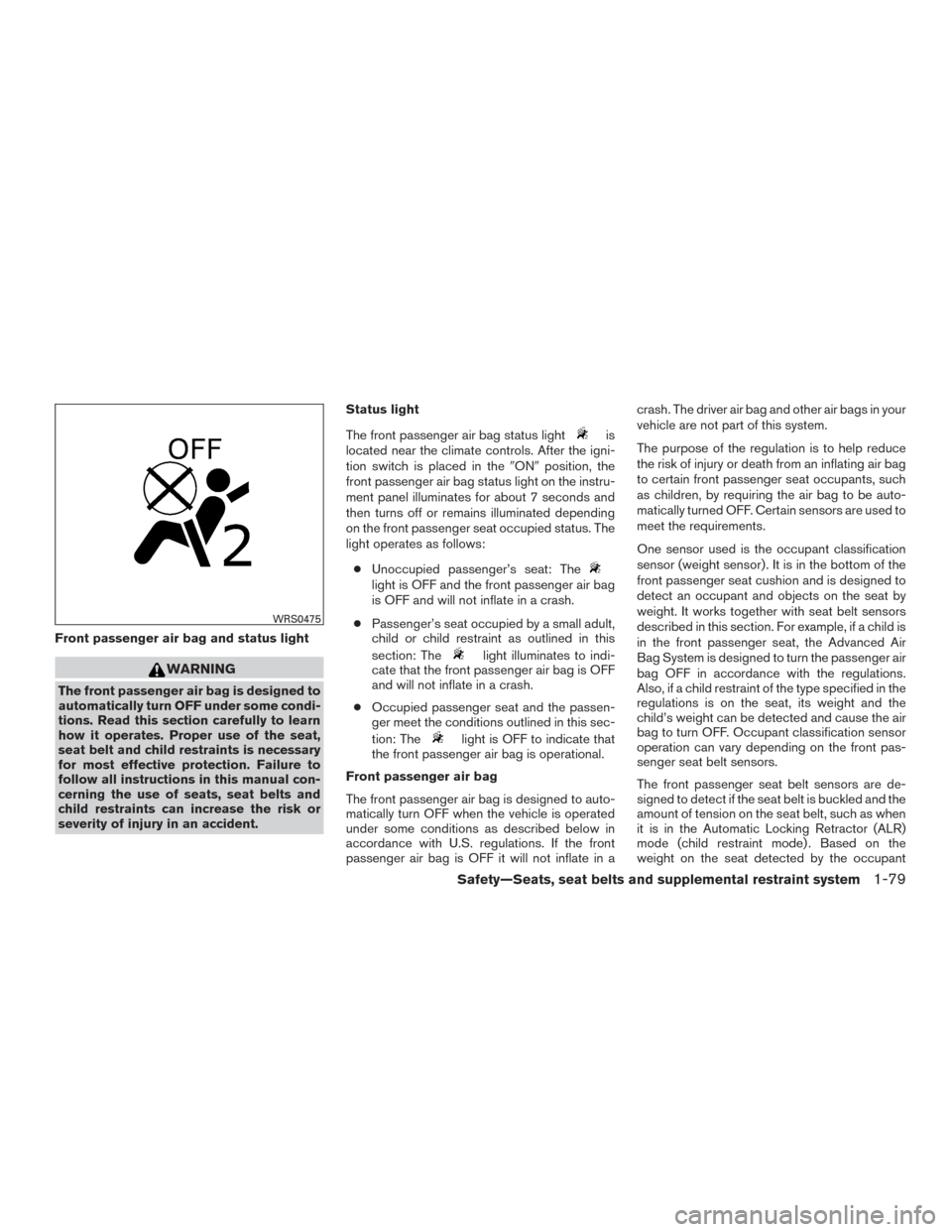
The front passenger air bag status light
is
located near the climate controls. After the igni-
tion switch is placed in the �ON�position, the
front passenger air bag status light on the instru-
ment panel illuminates for about 7 seconds and
then turns off or remains illuminated depending
on the front passenger seat occupied status. The
light operates as follows:
● Unoccupied passenger’s seat: The
light is OFF and the front passenger air bag
is OFF and will not inflate in a crash.
● Passenger’s seat occupied by a small adult,
child or child restraint as outlined in this
section: The
light illuminates to indi-
cate that the front passenger air bag is OFF
and will not inflate in a crash.
● Occupied passenger seat and the passen-
ger meet the conditions outlined in this sec-
tion: The
light is OFF to indicate that
the front passenger air bag is operational.
Front passenger air bag
The front passenger air bag is designed to auto-
matically turn OFF when the vehicle is operated
under some conditions as described below in
accordance with U.S. regulations. If the front
passenger air bag is OFF it will not inflate in a crash. The driver air bag and other air bags in your
vehicle are not part of this system.
The purpose of the regulation is to help reduce
the risk of injury or death from an inflating air bag
to certain front passenger seat occupants, such
as children, by requiring the air bag to be auto-
matically turned OFF. Certain sensors are used to
meet the requirements.
One sensor used is the occupant classification
sensor (weight sensor) . It is in the bottom of the
front passenger seat cushion and is designed to
detect an occupant and objects on the seat by
weight. It works together with seat belt sensors
described in this section. For example, if a child is
in the front passenger seat, the Advanced Air
Bag System is designed to turn the passenger air
bag OFF in accordance with the regulations.
Also, if a child restraint of the type specified in the
regulations is on the seat, its weight and the
child’s weight can be detected and cause the air
bag to turn OFF. Occupant classification sensor
operation can vary depending on the front pas-
senger seat belt sensors.
The front passenger seat belt sensors are de-
signed to detect if the seat belt is buckled and the
amount of tension on the seat belt, such as when
it is in the Automatic Locking Retractor (ALR)
mode (child restraint mode) . Based on the
weight on the seat detected by the occupant
WRS0475
Safety—Seats, seat belts and supplemental restraint system1-79