Page 10 of 466
0 Illustrated table of contents
Air bags, seat belts and child restraints..............0-2
Exterior front ......................................0-3
Exterior rear .......................................0-4
Passenger compartment ...........................0-5 Instrument panel
...................................0-6
Engine compartment check locations . . ..............0-8
Warning/indicator lights ........................... 0-10
Page 11 of 466
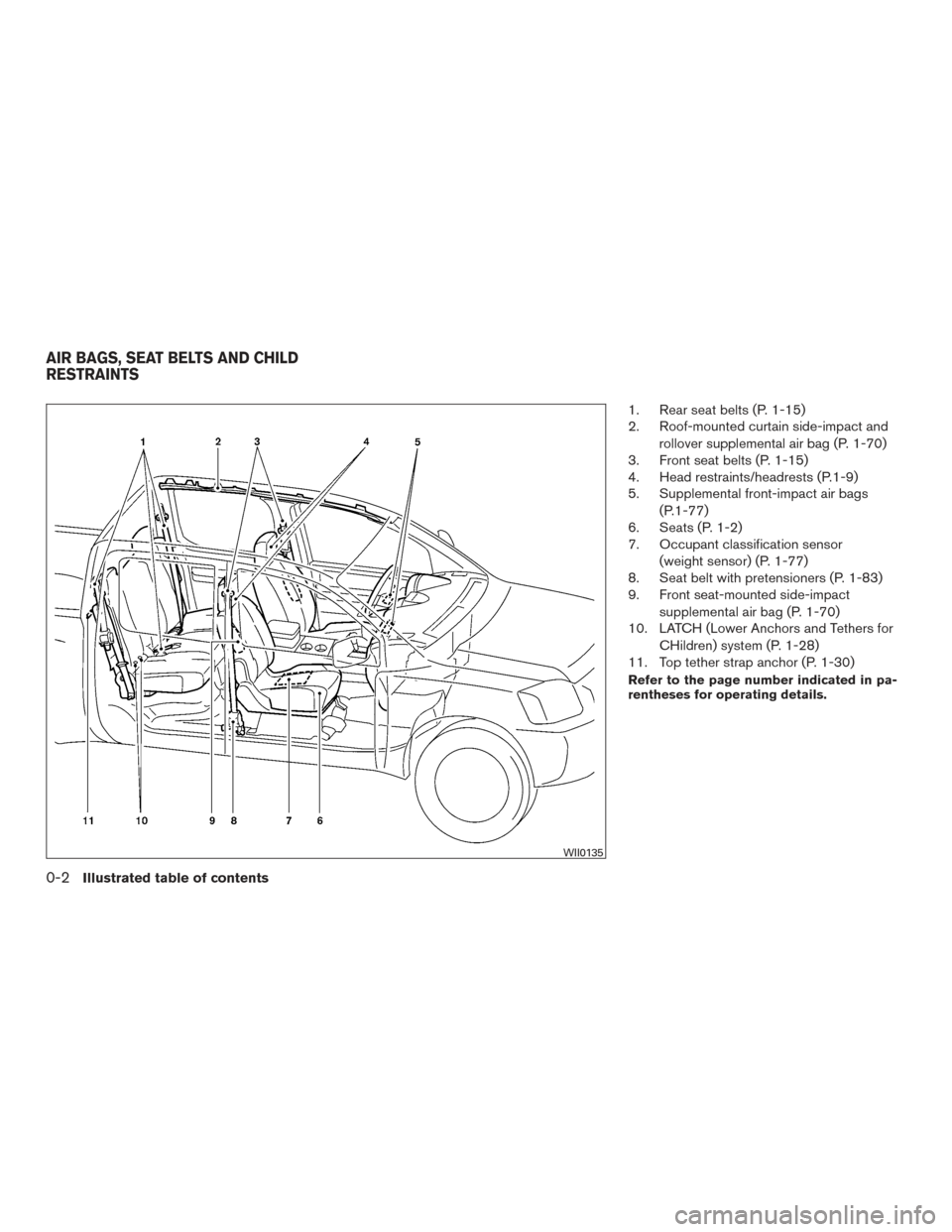
1. Rear seat belts (P. 1-15)
2. Roof-mounted curtain side-impact androllover supplemental air bag (P. 1-70)
3. Front seat belts (P. 1-15)
4. Head restraints/headrests (P.1-9)
5. Supplemental front-impact air bags
(P.1-77)
6. Seats (P. 1-2)
7. Occupant classification sensor
(weight sensor) (P. 1-77)
8. Seat belt with pretensioners (P. 1-83)
9. Front seat-mounted side-impact
supplemental air bag (P. 1-70)
10. LATCH (Lower Anchors and Tethers for
CHildren) system (P. 1-28)
11. Top tether strap anchor (P. 1-30)
Refer to the page number indicated in pa-
rentheses for operating details.
WII0135
AIR BAGS, SEAT BELTS AND CHILD
RESTRAINTS
0-2Illustrated table of contents
Page 15 of 466
1. Vents (P. 4-15)
2. Headlight/fog light (if so equipped)/turnsignal switch (P. 2-28)
3. Steering wheel switch for audio control
(if so equipped)/Bluetooth® Hands-
Free Phone System (if so equipped)
(P. 4-69, P. 4-67, P. 4-67)
4. Driver supplemental air bag/horn
(P. 1-70, P. 2-33)
5. Meters, gauges and warning/indicator
lights (P. 2-3, 2-14)
6. Cruise control main/set switches
(if so equipped) (P. 5-21)
7. Windshield wiper/washer switch
(P. 2-27)
8. Storage (P. 2-39)
9. Audio system (P. 4-34)
10. Front passenger supplemental air bag
(P. 1-70)
11. Upper and lower glove box (P. 2-42)
12. Passenger air bag status light (P. 1-79)
13. Power outlet (P. 2-38)
14. Power outlet (P. 2-38)
LIC2471
INSTRUMENT PANEL
0-6Illustrated table of contents
Page 19 of 466
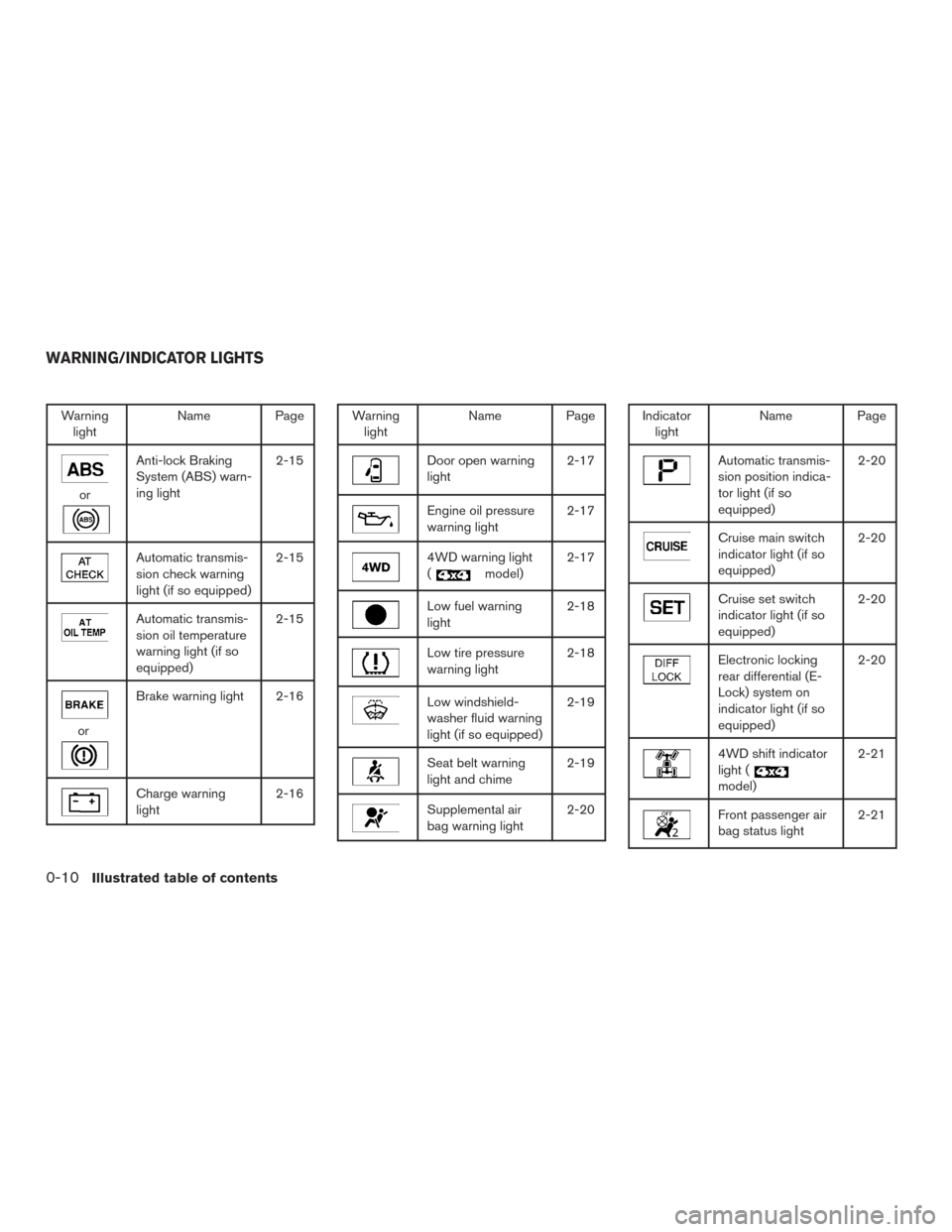
Warninglight Name Page
or
Anti-lock Braking
System (ABS) warn-
ing light 2-15
Automatic transmis-
sion check warning
light (if so equipped)2-15
Automatic transmis-
sion oil temperature
warning light (if so
equipped)2-15
or
Brake warning light 2-16
Charge warning
light
2-16
Warning
light Name Page
Door open warning
light 2-17
Engine oil pressure
warning light2-17
4WD warning light
(
model)2-17
Low fuel warning
light 2-18
Low tire pressure
warning light2-18
Low windshield-
washer fluid warning
light (if so equipped)2-19
Seat belt warning
light and chime
2-19
Supplemental air
bag warning light2-20
Indicator
light Name Page
Automatic transmis-
sion position indica-
tor light (if so
equipped) 2-20
Cruise main switch
indicator light (if so
equipped)
2-20
Cruise set switch
indicator light (if so
equipped)2-20
Electronic locking
rear differential (E-
Lock) system on
indicator light (if so
equipped)2-20
4WD shift indicator
light (
model)
2-21
Front passenger air
bag status light
2-21
WARNING/INDICATOR LIGHTS
0-10Illustrated table of contents
Page 22 of 466
Forward-facing child restraint installation
using the seat belts — front passenger and
rear bench seat (Crew Cab models only).........1-54
Forward-facing child restraint installation
using the seat belts — front passenger and
jump seats (King Cab models only) ..............1-58 Booster seats
................................. 1-65
Supplemental restraint system (SRS) ...............1-70
Precautions on SRS ........................... 1-70
Supplemental air bag warning labels .............1-84
Supplemental air bag warning light ..............1-85
Page 36 of 466
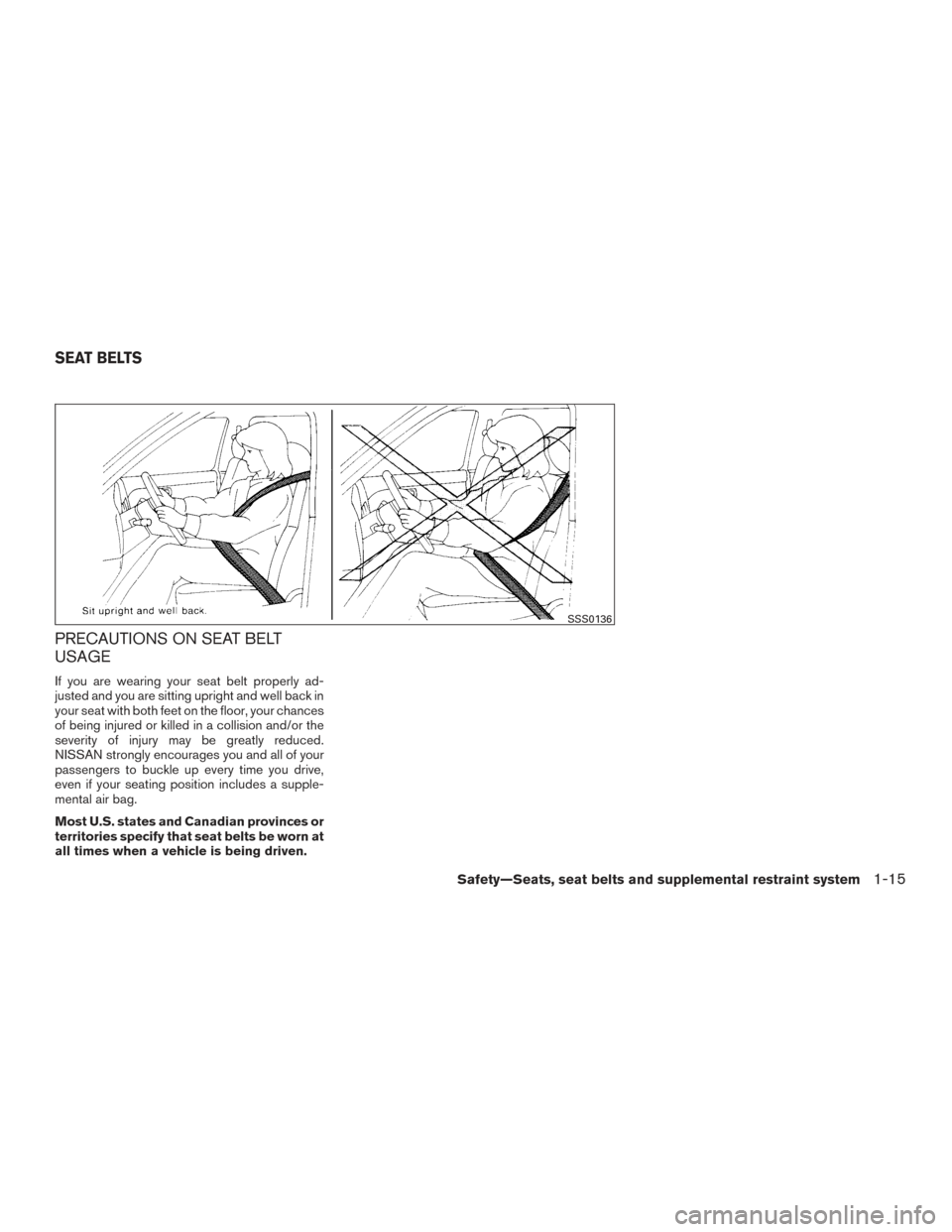
PRECAUTIONS ON SEAT BELT
USAGE
If you are wearing your seat belt properly ad-
justed and you are sitting upright and well back in
your seat with both feet on the floor, your chances
of being injured or killed in a collision and/or the
severity of injury may be greatly reduced.
NISSAN strongly encourages you and all of your
passengers to buckle up every time you drive,
even if your seating position includes a supple-
mental air bag.
Most U.S. states and Canadian provinces or
territories specify that seat belts be worn at
all times when a vehicle is being driven.
SSS0136
SEAT BELTS
Safety—Seats, seat belts and supplemental restraint system1-15
Page 41 of 466
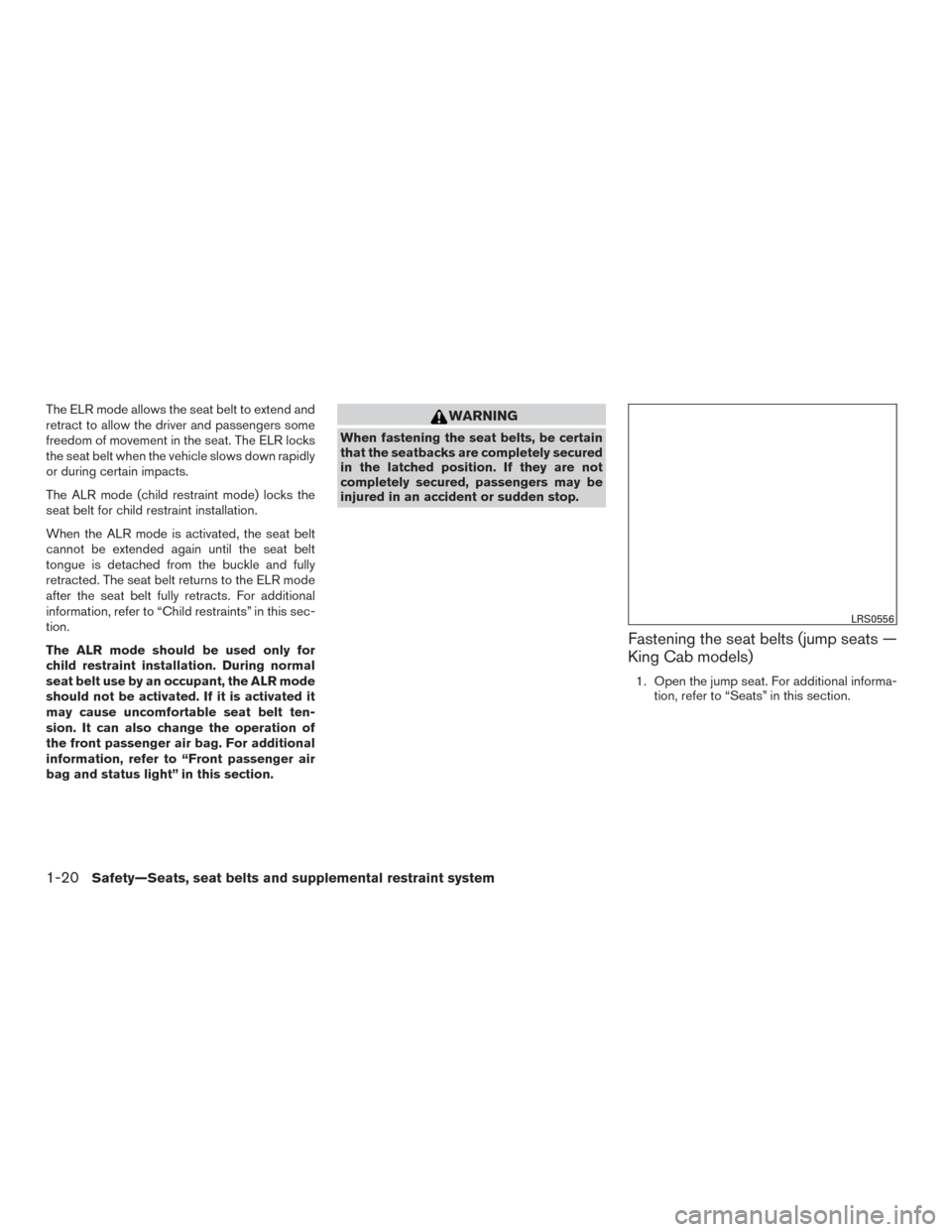
The ELR mode allows the seat belt to extend and
retract to allow the driver and passengers some
freedom of movement in the seat. The ELR locks
the seat belt when the vehicle slows down rapidly
or during certain impacts.
The ALR mode (child restraint mode) locks the
seat belt for child restraint installation.
When the ALR mode is activated, the seat belt
cannot be extended again until the seat belt
tongue is detached from the buckle and fully
retracted. The seat belt returns to the ELR mode
after the seat belt fully retracts. For additional
information, refer to “Child restraints” in this sec-
tion.
The ALR mode should be used only for
child restraint installation. During normal
seat belt use by an occupant, the ALR mode
should not be activated. If it is activated it
may cause uncomfortable seat belt ten-
sion. It can also change the operation of
the front passenger air bag. For additional
information, refer to “Front passenger air
bag and status light” in this section.WARNING
When fastening the seat belts, be certain
that the seatbacks are completely secured
in the latched position. If they are not
completely secured, passengers may be
injured in an accident or sudden stop.
Fastening the seat belts (jump seats —
King Cab models)
1. Open the jump seat. For additional informa-tion, refer to “Seats” in this section.
LRS0556
1-20Safety—Seats, seat belts and supplemental restraint system
Page 42 of 466
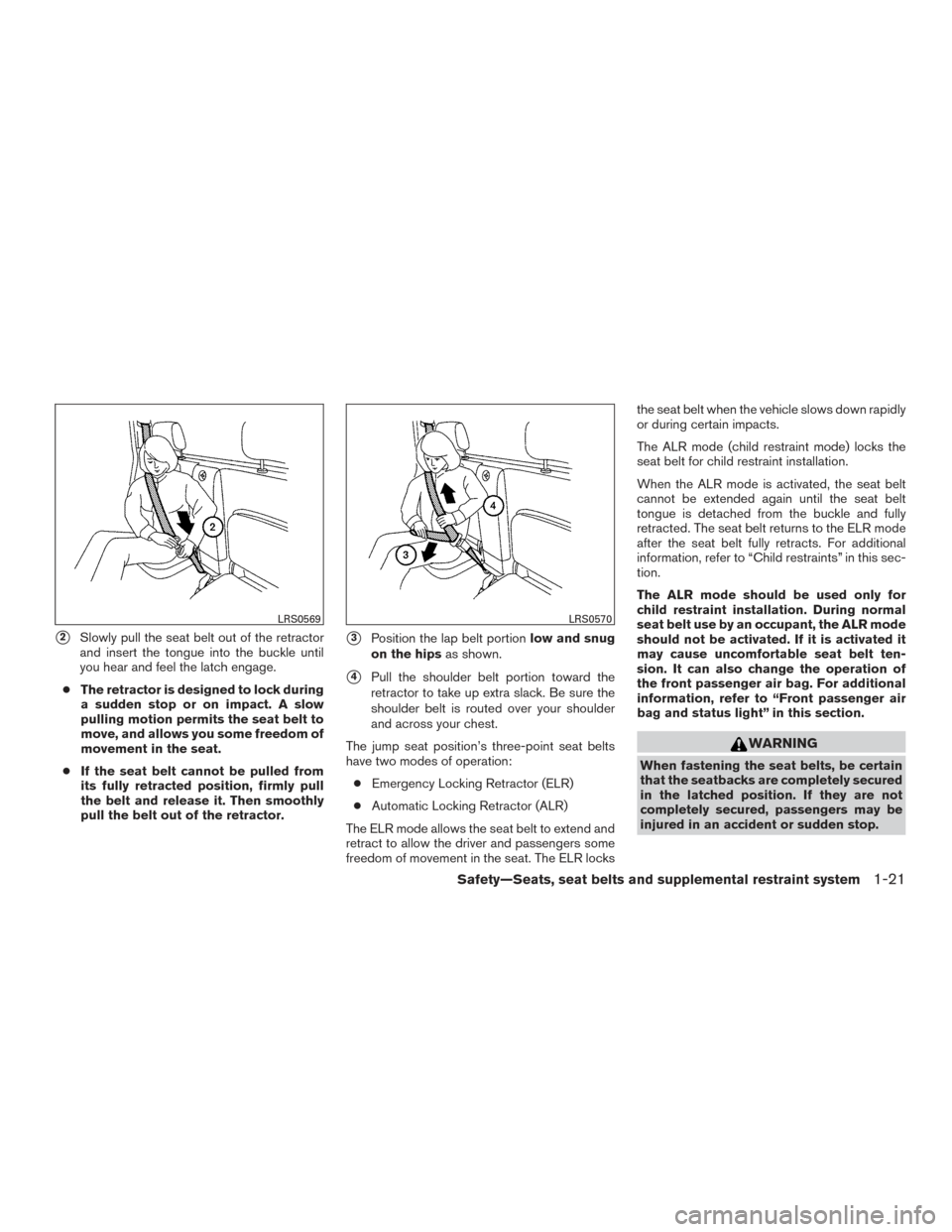
�2Slowly pull the seat belt out of the retractor
and insert the tongue into the buckle until
you hear and feel the latch engage.
● The retractor is designed to lock during
a sudden stop or on impact. A slow
pulling motion permits the seat belt to
move, and allows you some freedom of
movement in the seat.
● If the seat belt cannot be pulled from
its fully retracted position, firmly pull
the belt and release it. Then smoothly
pull the belt out of the retractor.�3Position the lap belt portion low and snug
on the hips as shown.
�4Pull the shoulder belt portion toward the
retractor to take up extra slack. Be sure the
shoulder belt is routed over your shoulder
and across your chest.
The jump seat position’s three-point seat belts
have two modes of operation: ● Emergency Locking Retractor (ELR)
● Automatic Locking Retractor (ALR)
The ELR mode allows the seat belt to extend and
retract to allow the driver and passengers some
freedom of movement in the seat. The ELR locks the seat belt when the vehicle slows down rapidly
or during certain impacts.
The ALR mode (child restraint mode) locks the
seat belt for child restraint installation.
When the ALR mode is activated, the seat belt
cannot be extended again until the seat belt
tongue is detached from the buckle and fully
retracted. The seat belt returns to the ELR mode
after the seat belt fully retracts. For additional
information, refer to “Child restraints” in this sec-
tion.
The ALR mode should be used only for
child restraint installation. During normal
seat belt use by an occupant, the ALR mode
should not be activated. If it is activated it
may cause uncomfortable seat belt ten-
sion. It can also change the operation of
the front passenger air bag. For additional
information, refer to “Front passenger air
bag and status light” in this section.
WARNING
When fastening the seat belts, be certain
that the seatbacks are completely secured
in the latched position. If they are not
completely secured, passengers may be
injured in an accident or sudden stop.
LRS0569LRS0570
Safety—Seats, seat belts and supplemental restraint system1-21