Page 23 of 510
WARNING
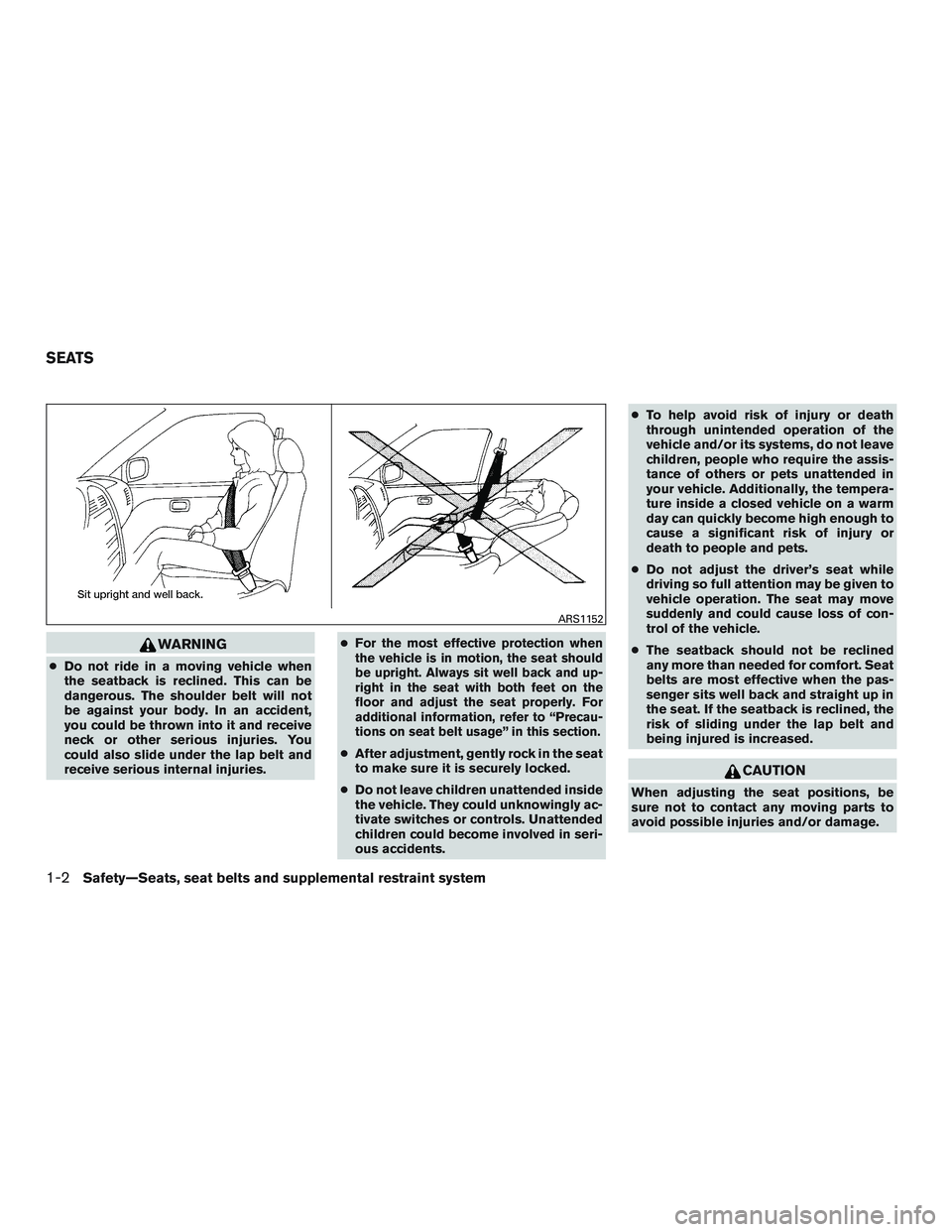
●Do not ride in a moving vehicle when
the seatback is reclined. This can be
dangerous. The shoulder belt will not
be against your body. In an accident,
you could be thrown into it and receive
neck or other serious injuries. You
could also slide under the lap belt and
receive serious internal injuries. ●
For the most effective protection when
the vehicle is in motion, the seat should
be upright. Always sit well back and up-
right in the seat with both feet on the
floor and adjust the seat properly. For
additional information, refer to “Precau-
tions on seat belt usage” in this section.
● After adjustment, gently rock in the seat
to make sure it is securely locked.
● Do not leave children unattended inside
the vehicle. They could unknowingly ac-
tivate switches or controls. Unattended
children could become involved in seri-
ous accidents. ●
To help avoid risk of injury or death
through unintended operation of the
vehicle and/or its systems, do not leave
children, people who require the assis-
tance of others or pets unattended in
your vehicle. Additionally, the tempera-
ture inside a closed vehicle on a warm
day can quickly become high enough to
cause a significant risk of injury or
death to people and pets.
● Do not adjust the driver’s seat while
driving so full attention may be given to
vehicle operation. The seat may move
suddenly and could cause loss of con-
trol of the vehicle.
● The seatback should not be reclined
any more than needed for comfort. Seat
belts are most effective when the pas-
senger sits well back and straight up in
the seat. If the seatback is reclined, the
risk of sliding under the lap belt and
being injured is increased.
Page 35 of 510
WARNING
Head restraints/headrests supplement
the other vehicle safety systems. They may
provide additional protection against in-
jury in certain rear end collisions. Adjust-
able head restraints/headrests must be
adjusted properly, as specified in this sec-
tion. Check the adjustment after someone
else uses the seat. Do not attach anything
to the head restraint/headrest stalks or
remove the head restraint/headrest. Do
not use the seat if the head
restraint/headrest has been removed. If
the head restraint/headrest was removed,
reinstall and properly adjust the head
restraint/headrest before an occupant
uses the seating position. Failure to fol-
low these instructions can reduce the ef-
fectiveness of the head
restraints/headrests. This may increase
the risk of serious injury or death in a
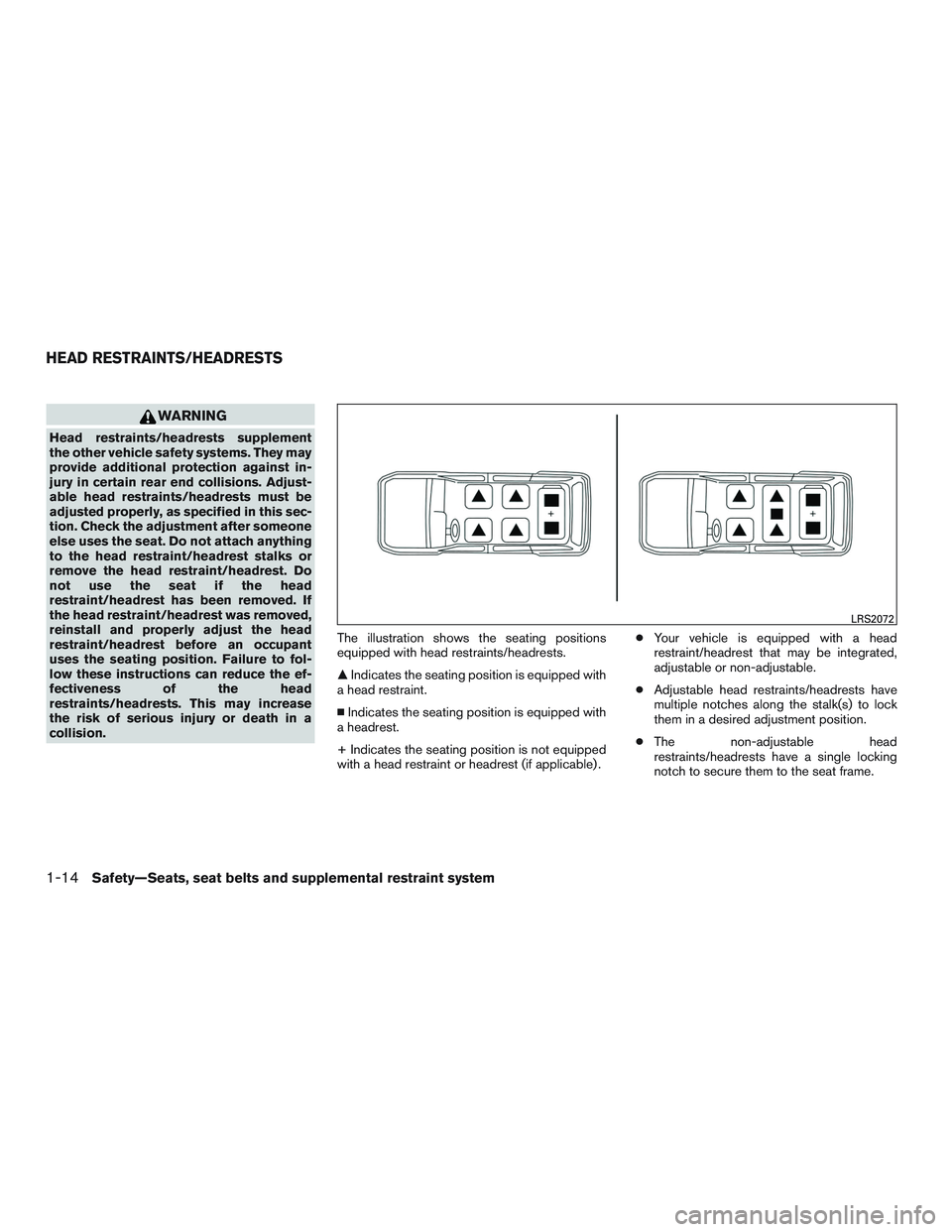
collision.The illustration shows the seating positions
equipped with head restraints/headrests.
�
Indicates the seating position is equipped with
a head restraint.
� Indicates the seating position is equipped with
a headrest.
+ Indicates the seating position is not equipped
with a head restraint or headrest (if applicable) . ●
Your vehicle is equipped with a head
restraint/headrest that may be integrated,
adjustable or non-adjustable.
● Adjustable head restraints/headrests have
multiple notches along the stalk(s) to lock
them in a desired adjustment position.
● The non-adjustable head
restraints/headrests have a single locking
notch to secure them to the seat frame.
Page 37 of 510
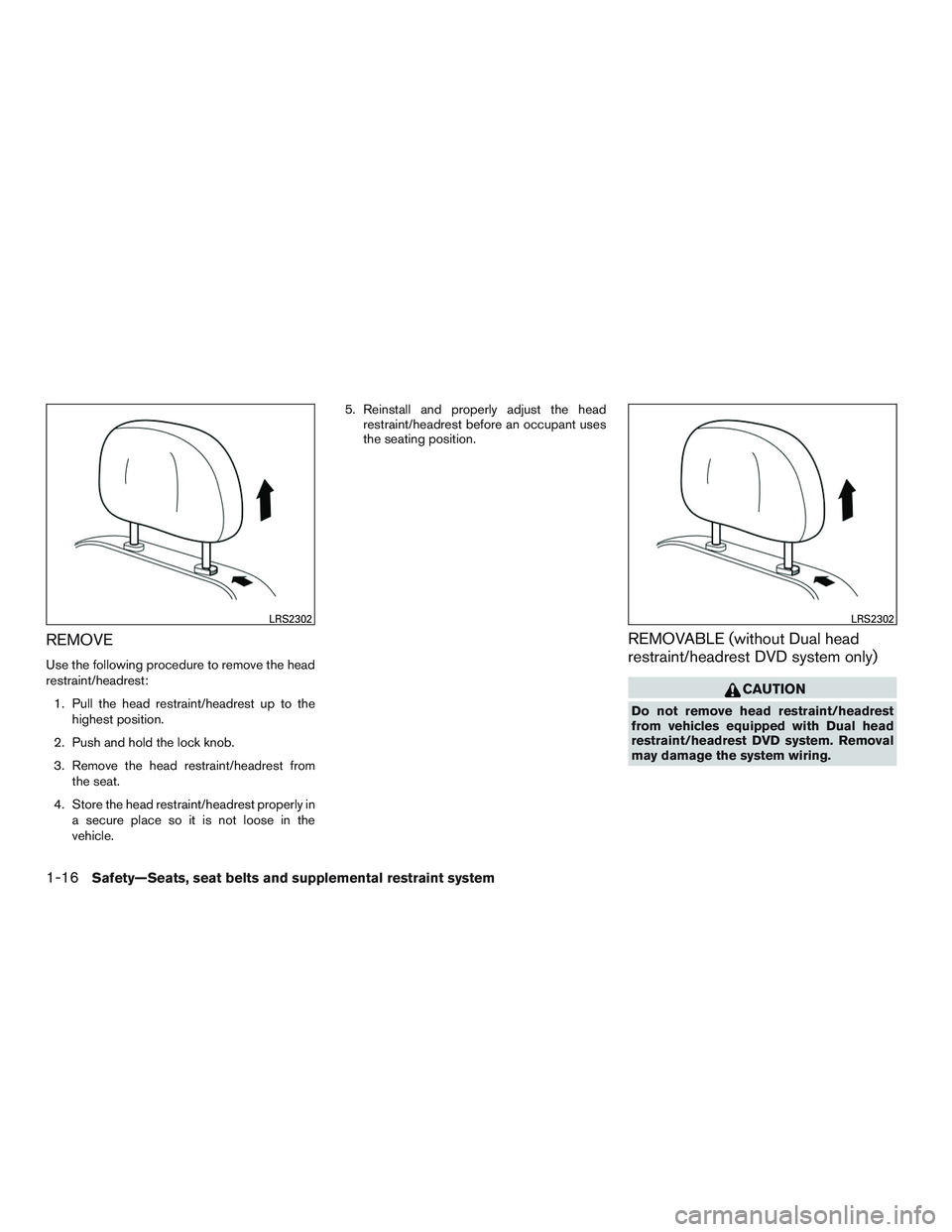
REMOVE
Use the following procedure to remove the head
restraint/headrest:1. Pull the head restraint/headrest up to the highest position.
2. Push and hold the lock knob.
3. Remove the head restraint/headrest from the seat.
4. Store the head restraint/headrest properly in a secure place so it is not loose in the
vehicle. 5. Reinstall and properly adjust the head
restraint/headrest before an occupant uses
the seating position.
REMOVABLE (without Dual head
restraint/headrest DVD system only)
Page 46 of 510
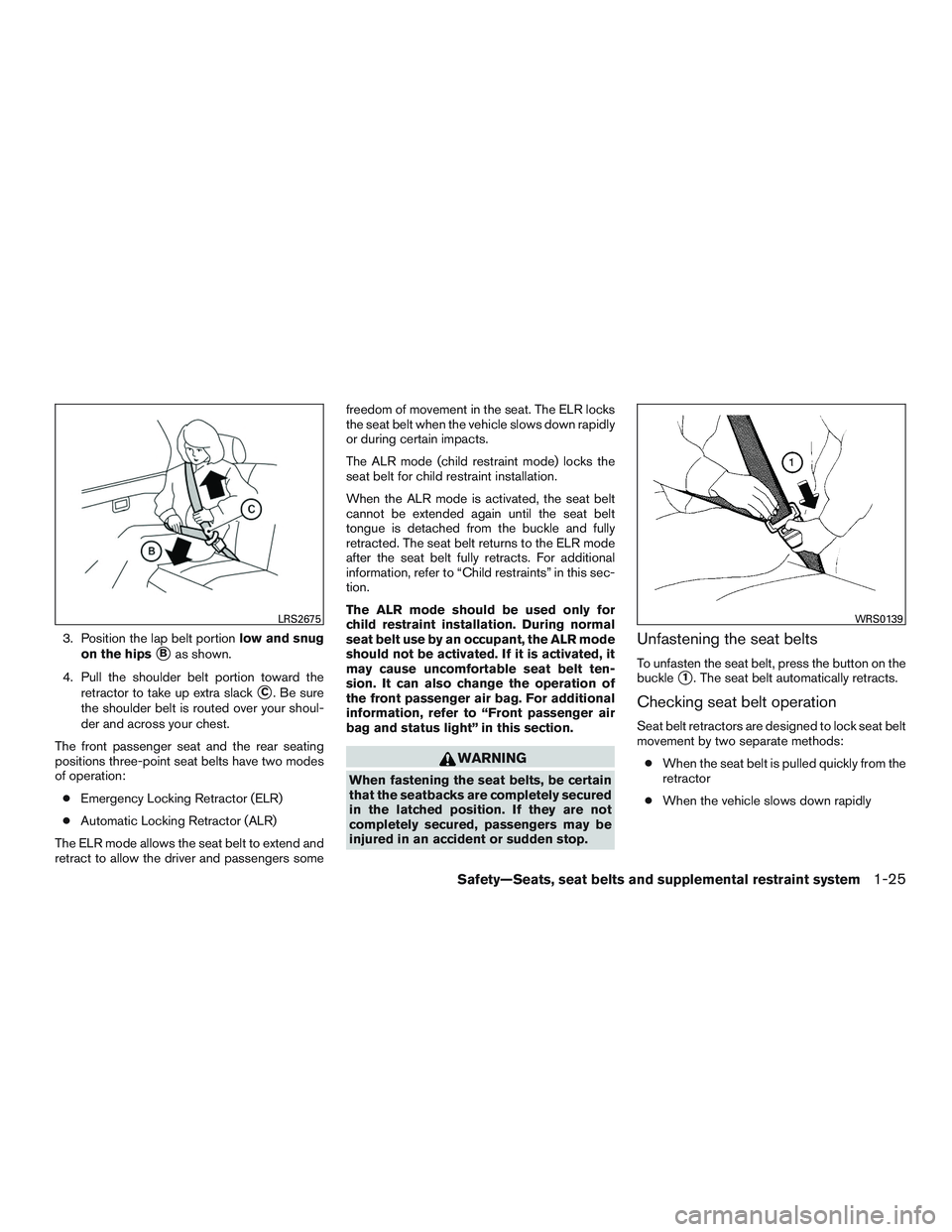
3. Position the lap belt portionlow and snug
on the hips
�Bas shown.
4. Pull the shoulder belt portion toward the retractor to take up extra slack
�C. Be sure
the shoulder belt is routed over your shoul-
der and across your chest.
The front passenger seat and the rear seating
positions three-point seat belts have two modes
of operation: ● Emergency Locking Retractor (ELR)
● Automatic Locking Retractor (ALR)
The ELR mode allows the seat belt to extend and
retract to allow the driver and passengers some freedom of movement in the seat. The ELR locks
the seat belt when the vehicle slows down rapidly
or during certain impacts.
The ALR mode (child restraint mode) locks the
seat belt for child restraint installation.
When the ALR mode is activated, the seat belt
cannot be extended again until the seat belt
tongue is detached from the buckle and fully
retracted. The seat belt returns to the ELR mode
after the seat belt fully retracts. For additional
information, refer to “Child restraints” in this sec-
tion.
The ALR mode should be used only for
child restraint installation. During normal
seat belt use by an occupant, the ALR mode
should not be activated. If it is activated, it
may cause uncomfortable seat belt ten-
sion. It can also change the operation of
the front passenger air bag. For additional
information, refer to “Front passenger air
bag and status light” in this section.
Page 47 of 510
To increase your confidence in the seat belts,
check the operation as follows:● Grasp the shoulder belt and pull forward
quickly. The retractor should lock and re-
strict further belt movement.
If the retractor does not lock during this check,
get the system checked. It is recommended you
visit a NISSAN dealer for this service, or to learn
more about seat belt operation.
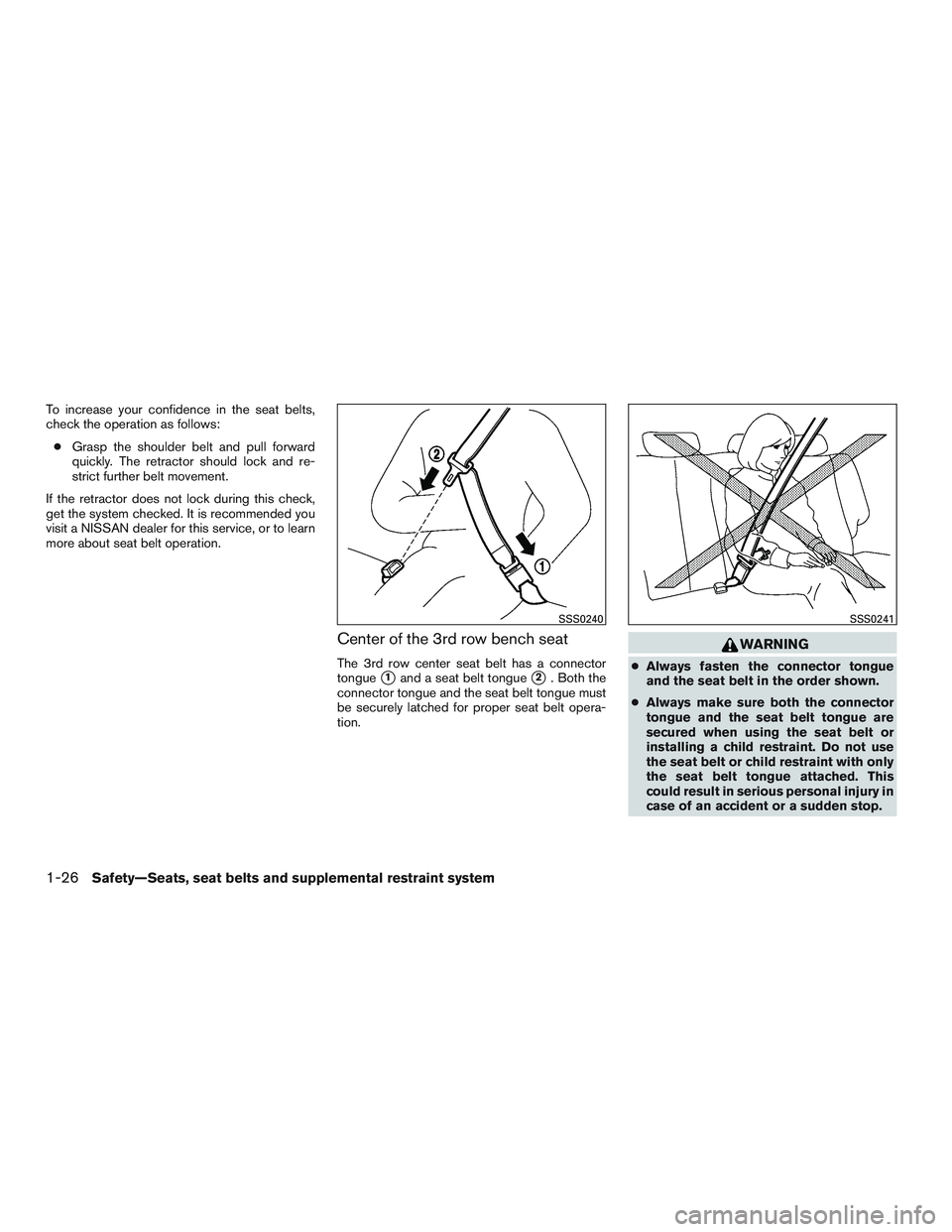
Center of the 3rd row bench seat
The 3rd row center seat belt has a connector
tongue
�1and a seat belt tongue�2. Both the
connector tongue and the seat belt tongue must
be securely latched for proper seat belt opera-
tion.
Page 50 of 510
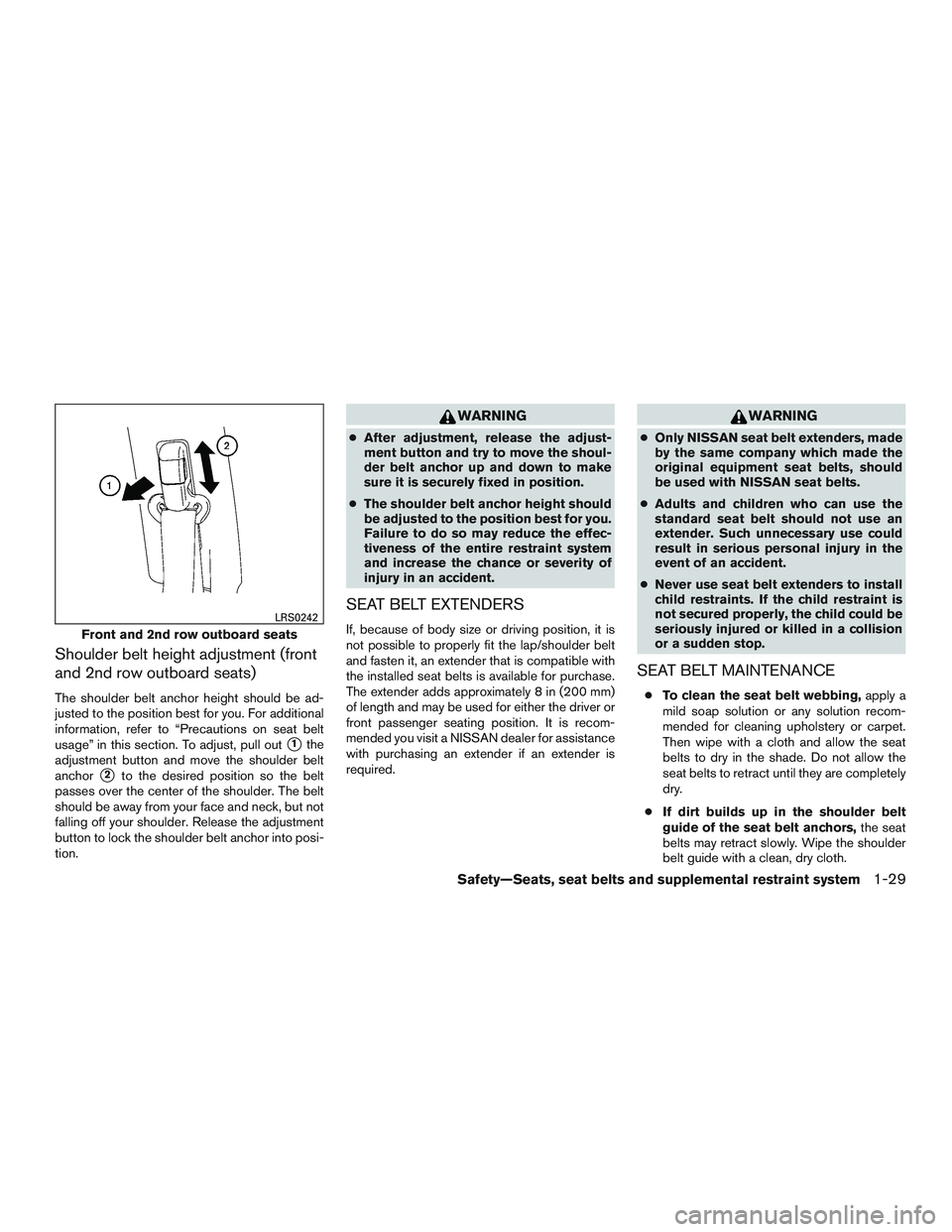
Shoulder belt height adjustment (front
and 2nd row outboard seats)
The shoulder belt anchor height should be ad-
justed to the position best for you. For additional
information, refer to “Precautions on seat belt
usage” in this section. To adjust, pull out
�1the
adjustment button and move the shoulder belt
anchor
�2to the desired position so the belt
passes over the center of the shoulder. The belt
should be away from your face and neck, but not
falling off your shoulder. Release the adjustment
button to lock the shoulder belt anchor into posi-
tion.
Page 109 of 510
●The warning light may come on when
the ignition switch is ON and the shift
lever is placed in the P position while
shifting the transfer case between 4H
and 4LO. Shift the 4WD shift switch to
the 2WD, AUTO, 4H, or 4LO position
again to turn off the ATP warning light
when the warning light comes on. Be-
fore shifting the 4WD switch into the
4LO position or out of 4LO in the 4H
position, move the shift lever into the N
position. Shift the shift lever into the P
position and make sure that the 4WD
shift indicator light is ON and the ATP
warning light is OFF.
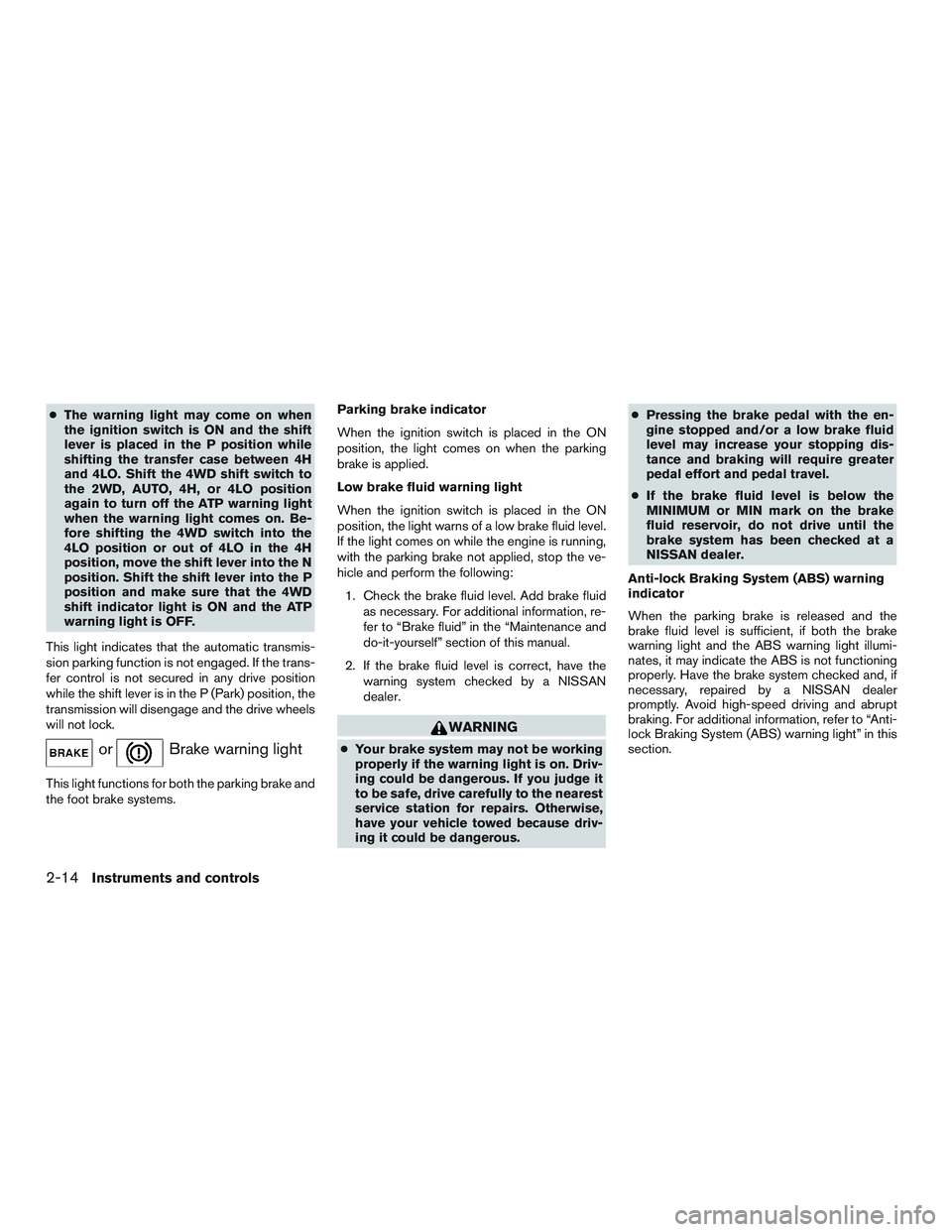
This light indicates that the automatic transmis-
sion parking function is not engaged. If the trans-
fer control is not secured in any drive position
while the shift lever is in the P (Park) position, the
transmission will disengage and the drive wheels
will not lock.
Page 128 of 510
CAUTION
●Do not operate the washer continuously
for more than 30 seconds.
● Do not operate the washer if the
windshield-washer reservoir is empty.
● Do not fill the windshield-washer reser-
voir with washer fluid concentrates at
full strength. So methyl alcohol based
windshield-washer fluid concentrates
may permanently stain the grille if
spilled with filling the windshield-
washer fluid reservoir.
● Pre-mix windshield-washer fluid con-
centrates with water to the manufactur-
er’s recommended levels before pour-
ing the fluid into the windshield-washer
reservoir. Do not use the windshield-
washer reservoir to mix the windshield-
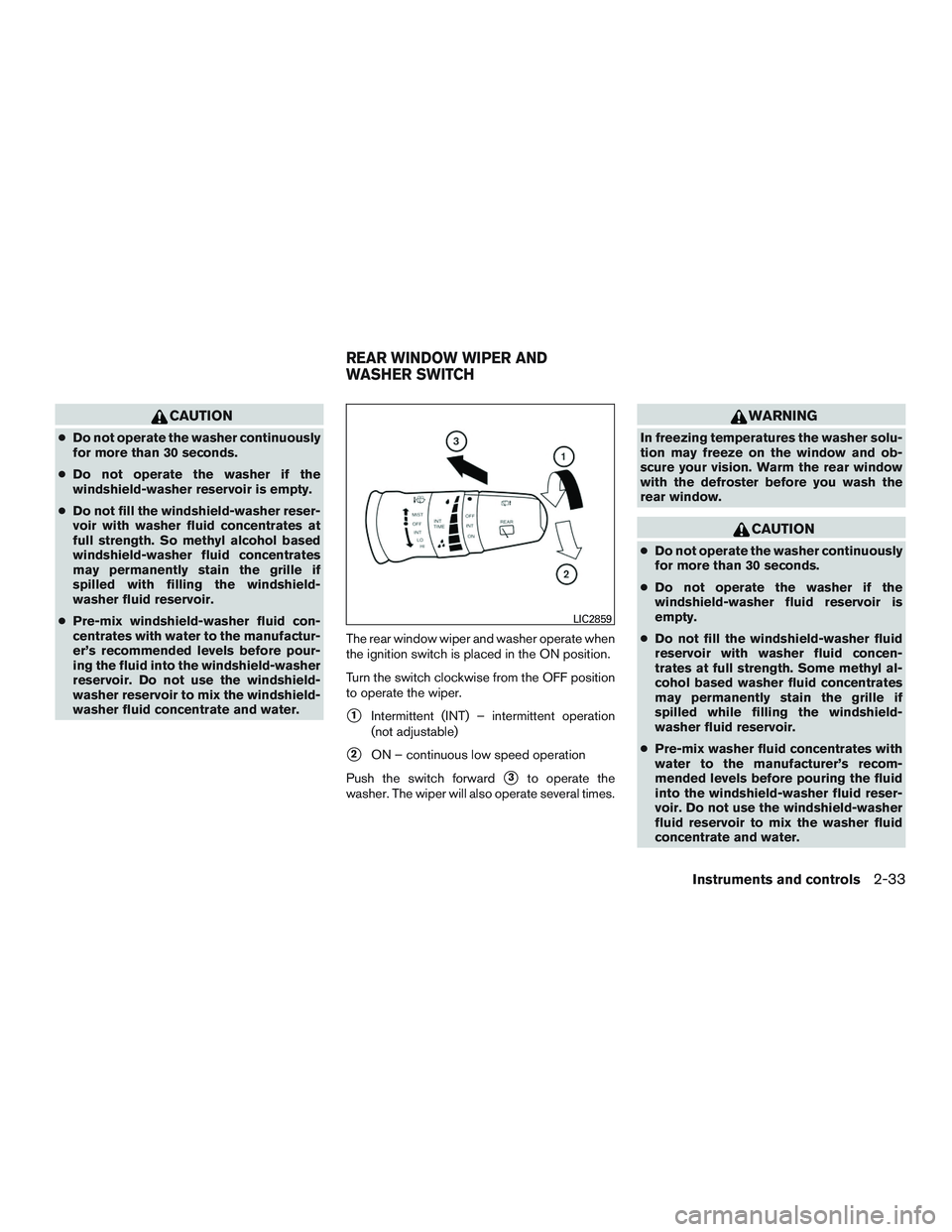
washer fluid concentrate and water. The rear window wiper and washer operate when
the ignition switch is placed in the ON position.
Turn the switch clockwise from the OFF position
to operate the wiper.
�1Intermittent (INT) – intermittent operation
(not adjustable)
�2ON – continuous low speed operation
Push the switch forward
�3to operate the
washer. The wiper will also operate several times.