Page 393 of 441
1. Disconnect the negative battery cable.
2. Remove the fasteners
�A; carefully pull back
the front fender protector.
3. Rotate the bulb
�Bcounterclockwise and
pull out to remove.
Reverse steps to install.
PARK/TURN SIGNAL LIGHTS
Replacing the park/turn signal bulb
LDI2144
Maintenance and do-it-yourself8-31
Page 395 of 441
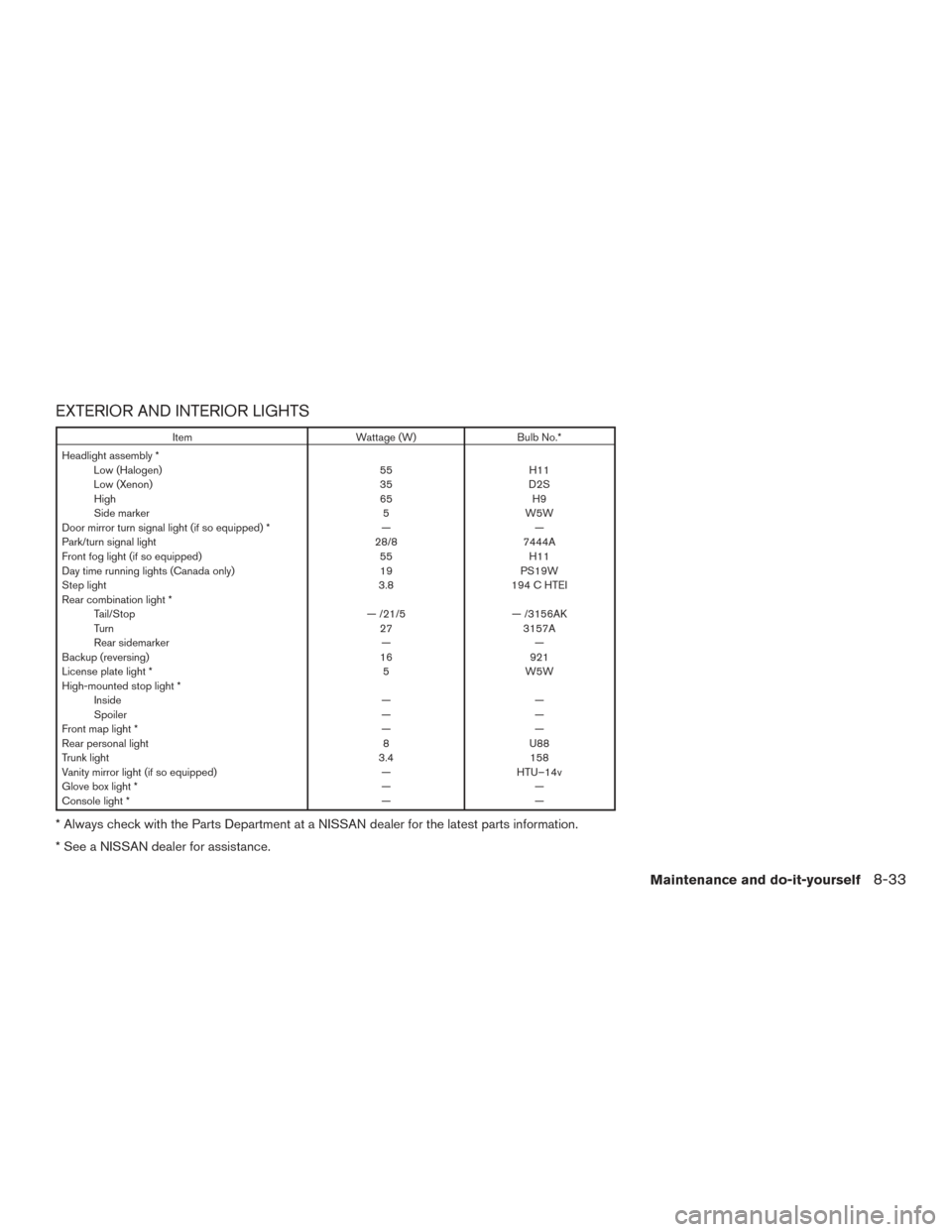
EXTERIOR AND INTERIOR LIGHTS
ItemWattage (W)Bulb No.*
Headlight assembly * Low (Halogen) 55H11
Low (Xenon) 35D2S
High 65H9
Side marker 5W5W
Door mirror turn signal light (if so equipped) * ——
Park/turn signal light 28/87444A
Front fog light (if so equipped) 55H11
Day time running lights (Canada only) 19PS19W
Step light 3.8194 C HTEI
Rear combination light * Tail/Stop — /21/5— /3156AK
Turn 273157A
Rear sidemarker ——
Backup (reversing) 16921
License plate light * 5W5W
High-mounted stop light * Inside ——
Spoiler ——
Front map light * ——
Rear personal light 8U88
Trunk light 3.4158
Vanity mirror light (if so equipped) —HTU–14v
Glove box light * ——
Console light * ——
* Always check with the Parts Department at a NISSAN dealer for the latest parts information.
* See a NISSAN dealer for assistance.
Maintenance and do-it-yourself8-33
Page 396 of 441
1. Front map light
2. Headlamp assembly
3. Park/Turn signal light
4. Fog light (if so equipped)/Day timerunning light (Canada only)
5. Step light
6. Door mirror turn signal light
(if so equipped)
7. Personal light
8. High-mount stoplight
9. Trunk light
10. Spoiler-mount stop light
11. Rear combination light
12. License plate light
LDI2100
8-34Maintenance and do-it-yourself
Page 397 of 441
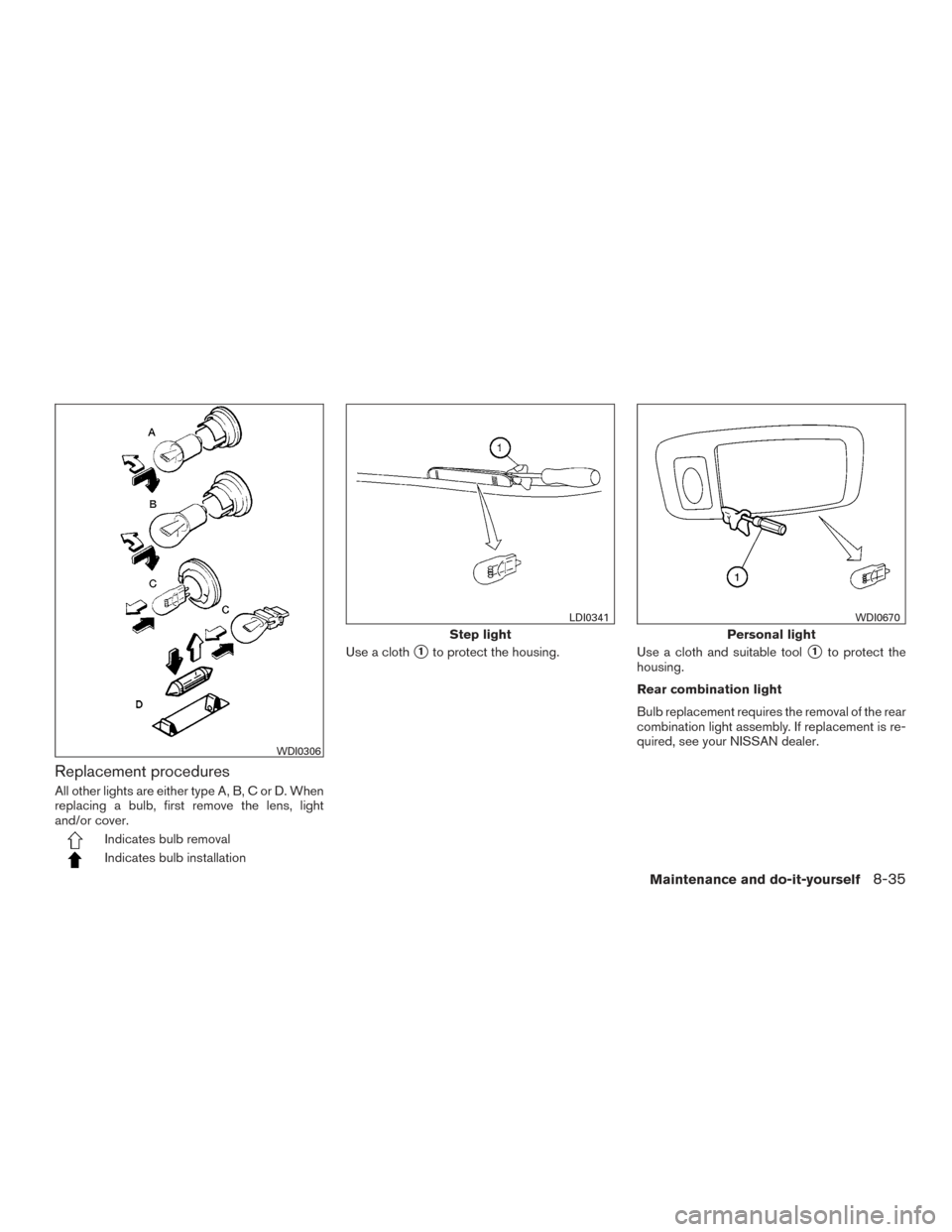
Replacement procedures
All other lights are either type A, B, C or D. When
replacing a bulb, first remove the lens, light
and/or cover.
Indicates bulb removal
Indicates bulb installationUse a cloth
�1to protect the housing.
Use a cloth and suitable tool�1to protect the
housing.
Rear combination light
Bulb replacement requires the removal of the rear
combination light assembly. If replacement is re-
quired, see your NISSAN dealer.
WDI0306
Step light
LDI0341
Personal light
WDI0670
Maintenance and do-it-yourself8-35
Page 398 of 441

If you have a flat tire, refer “Flat tire” in the “In
case of emergency” section of this manual.
TIRE PRESSURE
Tire Pressure Monitoring System (TPMS)
WARNING
Radio waves could adversely affect
electric medical equipment. Those
who use a pacemaker should con-
tact the electric medical equipment
manufacturer for the possible influ-
ences before use.
This vehicle is equipped with the Tire
Pressure Monitoring System (TPMS) . It
monitors tire pressure of all tires except
the spare. When the low tire pressure
warning light is lit and the “Tire Pressure
Low - Add Air” warning appears in the
vehicle information display, one or more of
your tires is significantly under-inflated.
The TPMS will activate only when the
vehicle is driven at speeds above 16 MPH
(25 km/h). Also, this system may not de-
tect a sudden drop in tire pressure (for
example a flat tire while driving) . For additional information, refer to “Low
tire pressure warning light” in the “Instru-
ments and controls” section, “Tire Pres-
sure Monitoring System (TPMS)” in the
“Starting and driving” section, and “Flat
tire” in the “In case of emergency” section
of this manual.
Tire inflation pressure
Check the tire pressures (including the
spare) often and always prior to long dis-
tance trips. The recommended tire pres-
sure specifications are shown on the
F.M.V.S.S./C.M.V.S.S. certification label
or the Tire and Loading Information label
under the
�Cold Tire Pressure� heading.
The Tire and Loading Information label is
affixed to the driver side center pillar. Tire
pressures should be checked regularly
because:
● Most tires naturally lose air over time.
● Tires can lose air suddenly when
driven over potholes or other objects
or if the vehicle strikes a curb while
parking.
Trunk light
LDI2135
WHEELS AND TIRES
8-36Maintenance and do-it-yourself
Page 408 of 441
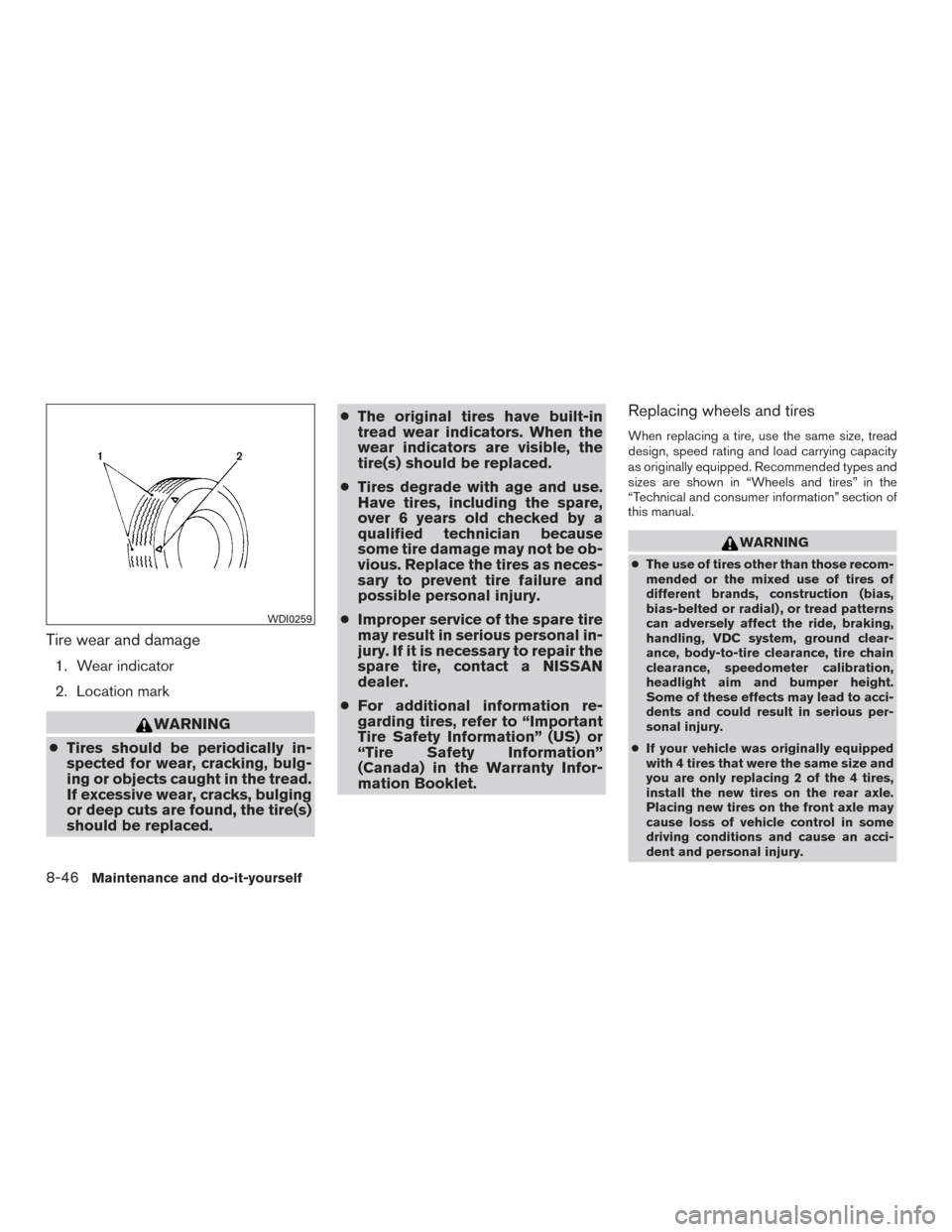
Tire wear and damage
1. Wear indicator
2. Location mark
WARNING
● Tires should be periodically in-
spected for wear, cracking, bulg-
ing or objects caught in the tread.
If excessive wear, cracks, bulging
or deep cuts are found, the tire(s)
should be replaced. ●
The original tires have built-in
tread wear indicators. When the
wear indicators are visible, the
tire(s) should be replaced.
● Tires degrade with age and use.
Have tires, including the spare,
over 6 years old checked by a
qualified technician because
some tire damage may not be ob-
vious. Replace the tires as neces-
sary to prevent tire failure and
possible personal injury.
● Improper service of the spare tire
may result in serious personal in-
jury. If it is necessary to repair the
spare tire, contact a NISSAN
dealer.
● For additional information re-
garding tires, refer to “Important
Tire Safety Information” (US) or
“Tire Safety Information”
(Canada) in the Warranty Infor-
mation Booklet.
Replacing wheels and tires
When replacing a tire, use the same size, tread
design, speed rating and load carrying capacity
as originally equipped. Recommended types and
sizes are shown in “Wheels and tires” in the
“Technical and consumer information” section of
this manual.
WARNING
●The use of tires other than those recom-
mended or the mixed use of tires of
different brands, construction (bias,
bias-belted or radial) , or tread patterns
can adversely affect the ride, braking,
handling, VDC system, ground clear-
ance, body-to-tire clearance, tire chain
clearance, speedometer calibration,
headlight aim and bumper height.
Some of these effects may lead to acci-
dents and could result in serious per-
sonal injury.
● If your vehicle was originally equipped
with 4 tires that were the same size and
you are only replacing 2 of the 4 tires,
install the new tires on the rear axle.
Placing new tires on the front axle may
cause loss of vehicle control in some
driving conditions and cause an acci-
dent and personal injury.
WDI0259
8-46Maintenance and do-it-yourself
Page 409 of 441
●If the wheels are changed for any rea-
son, always replace with wheels which
have the same off-set dimension.
Wheels of a different off-set could
cause premature tire wear, degrade ve-
hicle handling characteristics, affect the
VDC system and/or interference with
the brake discs/drums. Such interfer-
ence can lead to decreased braking ef-
ficiency and/or early brake pad/shoe
wear. Refer to “Wheels and tires” in the
“Technical and consumer information”
section of this manual for wheel off-set
dimensions.
● When a spare tire is mounted or a wheel
is replaced, the TPMS will not function
and the low tire pressure warning light
will flash for approximately 1 minute.
The light will remain on after 1 minute.
Contact your NISSAN dealer as soon as
possible for tire replacement and/or
system resetting.
● Replacing tires with those not originally
specified by NISSAN could affect the
proper operation of the TPMS. ●
Do not install a damaged or deformed
wheel or tire even if it has been re-
paired. Such wheels or tires could have
structural damage and could fail with-
out warning.
● The use of retread tires is not
recommended.
● For additional information regarding
tires, refer to “Important Tire Safety In-
formation” (US) or “Tire Safety Informa-
tion” (Canada) in the Warranty Informa-
tion Booklet.
Wheel balance
Unbalanced wheels may affect vehicle handling
and tire life. Even with regular use, wheels can get
out of balance. Therefore, they should be bal-
anced as required.
Wheel balance service should be per-
formed with the wheels off the vehicle.
Spin balancing the wheels on the vehicle
could lead to mechanical damage.
● For additional information regarding
tires, refer to “Important Tire Safety
Information” (US) or “Tire Safety Infor-
mation” (Canada) in the Warranty In-
formation Booklet.
Care of wheels
●Wash the wheels when washing the vehicle
to maintain their appearance.
● Clean the inner side of the wheels when the
wheel is changed or the underside of the
vehicle is washed.
● Do not use abrasive cleaners when washing
the wheels.
● Inspect wheel rims regularly for dents or
corrosion. Such damage may cause loss of
pressure or poor seal at the tire bead.
● NISSAN recommends waxing the road
wheels to protect against road salt in areas
where it is used during winter.
Maintenance and do-it-yourself8-47
Page 412 of 441
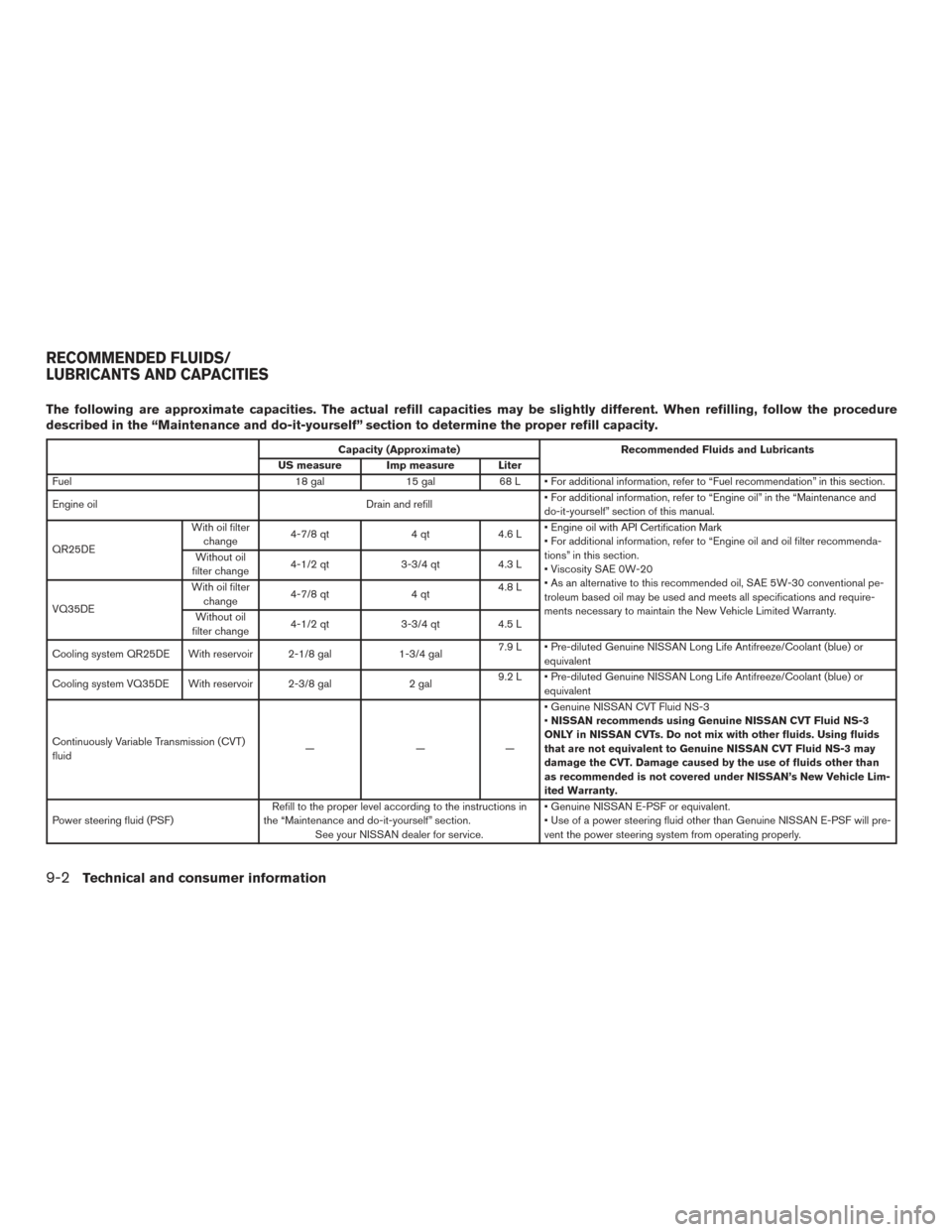
The following are approximate capacities. The actual refill capacities may be slightly different. When refilling, follow the procedure
described in the “Maintenance and do-it-yourself” section to determine the proper refill capacity.
Capacity (Approximate)Recommended Fluids and Lubricants
US measure Imp measure Liter
Fuel 18 gal15 gal68 L • For additional information, refer to “Fuel recommendation” in this section.
Engine oil Drain and refill• For additional information, refer to “Engine oil” in the “Maintenance and
do-it-yourself” section of this manual.
QR25DE With oil filter
change 4-7/8 qt
4 qt4.6 L• Engine oil with API Certification Mark
• For additional information, refer to “Engine oil and oil filter recommenda-
tions” in this section.
• Viscosity SAE 0W-20
• As an alternative to this recommended oil, SAE 5W-30 conventional pe-
troleum based oil may be used and meets all specifications and require-
ments necessary to maintain the New Vehicle Limited Warranty.
Without oil
filter change 4-1/2 qt
3-3/4 qt4.3 L
VQ35DE With oil filter
change 4-7/8 qt
4 qt4.8 L
Without oil
filter change 4-1/2 qt
3-3/4 qt4.5 L
Cooling system QR25DE With reservoir 2-1/8 gal 1-3/4 gal7.9 L • Pre-diluted Genuine NISSAN Long Life Antifreeze/Coolant (blue) or
equivalent
Cooling system VQ35DE With reservoir 2-3/8 gal 2 gal9.2 L • Pre-diluted Genuine NISSAN Long Life Antifreeze/Coolant (blue) or
equivalent
Continuously Variable Transmission (CVT)
fluid ———• Genuine NISSAN CVT Fluid NS-3
•
NISSAN recommends using Genuine NISSAN CVT Fluid NS-3
ONLY in NISSAN CVTs. Do not mix with other fluids. Using fluids
that are not equivalent to Genuine NISSAN CVT Fluid NS-3 may
damage the CVT. Damage caused by the use of fluids other than
as recommended is not covered under NISSAN’s New Vehicle Lim-
ited Warranty.
Power steering fluid (PSF) Refill to the proper level according to the instructions in
the “Maintenance and do-it-yourself” section. See your NISSAN dealer for service. • Genuine NISSAN E-PSF or equivalent.
• Use of a power steering fluid other than Genuine NISSAN E-PSF will pre-
vent the power steering system from operating properly.
RECOMMENDED FLUIDS/
LUBRICANTS AND CAPACITIES
9-2Technical and consumer information