Page 3 of 384
Instruments and controls 1-1
1
Overview
N00100202560
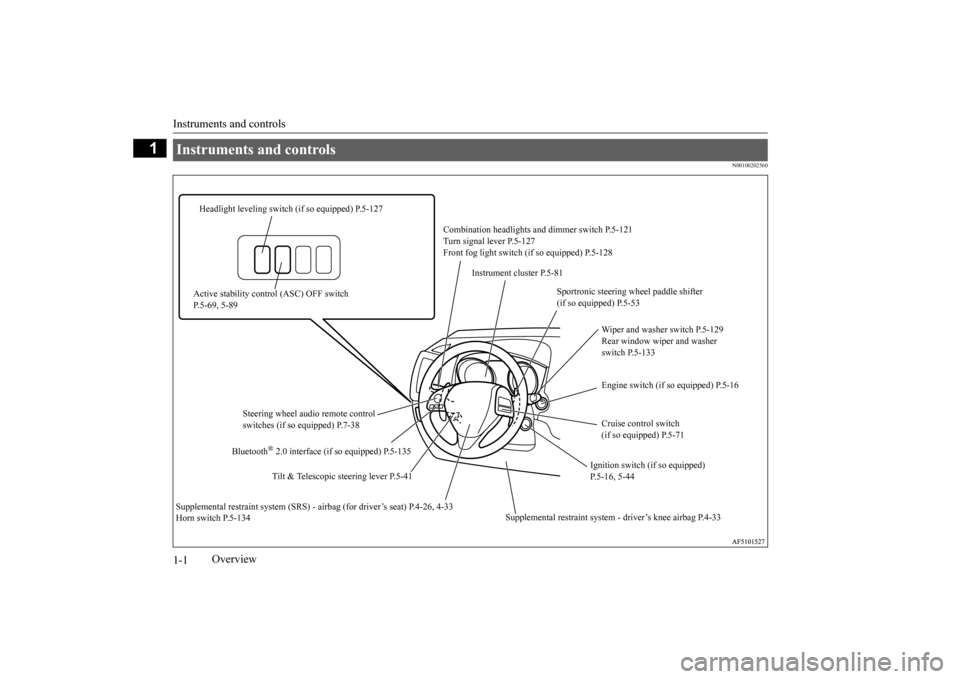
Instruments and controls
Combination headlights
and dimmer switch P.5-121
Turn signal lever P.5-127 Front fog light switch (if so equipped) P.5-128
Headlight leveling switch (if so equipped) P.5-127
Instrument cluster P.5-81
Active stability control (ASC) OFF switch P.5-69, 5-89
Sportronic steering wheel paddle shifter (if so equipped) P.5-53
Wiper and washer switch P.5-129 Rear window wiper and washer switch P.5-133 Engine switch (if so equipped) P.5-16
Steering wheel audio remote control switches (if so equipped) P.7-38
Cruise control switch (if so equipped) P.5-71
Tilt & Telescopic steering lever P.5-41
Ignition switch (if so equipped) P.5-16, 5-44
Bluetooth
® 2.0 interface (if so
equipped) P.5-135
Supplemental restraint system
- driver’s knee airbag P.4-33
Supplemental restraint system (SRS) - ai
rbag (for driver’s seat) P.4-26, 4-33
Horn switch P.5-134BK0206700US.bo
ok 1 ページ 2014年3月25日 火曜日 午後4時42分
Page 4 of 384
Instruments and controls
Overview 1-2
1
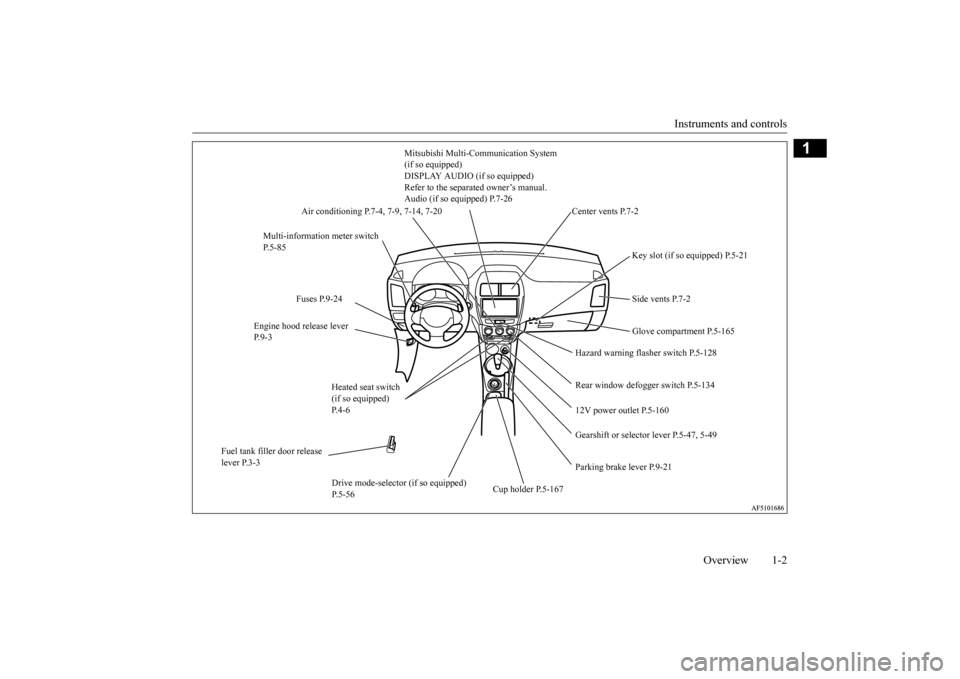
Mitsubishi Multi-Communication System (if so equipped) DISPLAY AUDIO (if so equipped) Refer to the separated owner’s manual.Audio (if so equipped) P.7-26
Multi-information meter switch P.5-85
Key slot (if so equipped) P.5-21 Side vents P.7-2
Fuses P.9-24
Engine hood release lever P.9-3
Glove compartment P.5-165
Hazard warning flasher switch P.5-128 Rear window defogger switch P.5-134
Air conditioning P.7-4, 7-9, 7-14, 7-20
12V power outlet P.5-160 Gearshift or selector
lever P.5-47, 5-49
Fuel tank filler door release lever P.3-3
Parking brake lever P.9-21
Drive mode-selector (if so equipped) P.5-56
Cup holder P.5-167
Center vents P.7-2
Heated seat switch (if so equipped) P. 4 - 6
BK0206700US.bo
ok 2 ページ 2014年3月25日 火曜日 午後4時42分
Page 6 of 384
Interior
Overview 1-4
1
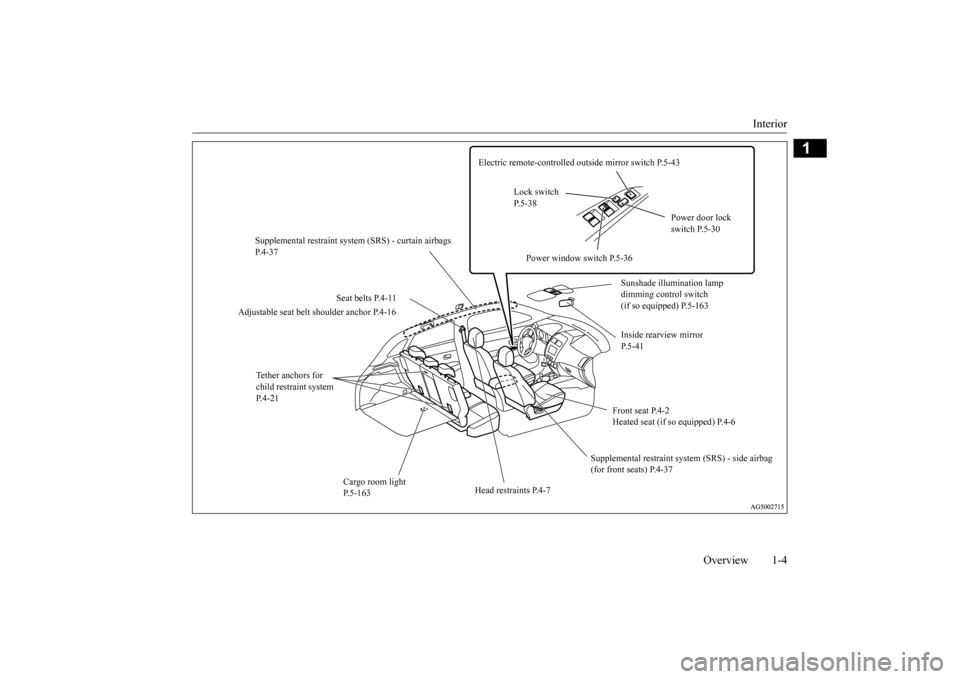
Electric remote-controlled outside mirror switch P.5-43
Lock switch P.5-38
Power door lock switch P.5-30
Supplemental restraint system (SRS) - curtain airbags P.4-37
Power window switch P.5-36
Sunshade illumination lamp dimming control switch (if so equipped) P.5-163
Seat belts P.4-11
Adjustable seat belt shoulder anchor P.4-16
Inside rearview mirror P.5-41
Tether anchors for child restraint system P.4-21
Front seat P.4-2 Heated seat (if so equipped) P.4-6
Supplemental restraint system (SRS) - side airbag (for front seats) P.4-37
Cargo room light P.5-163
Head restraints P.4-7
BK0206700US.bo
ok 4 ページ 2014年3月25日 火曜日 午後4時42分
Page 8 of 384
Outside
Overview 1-6
1
N00100602447
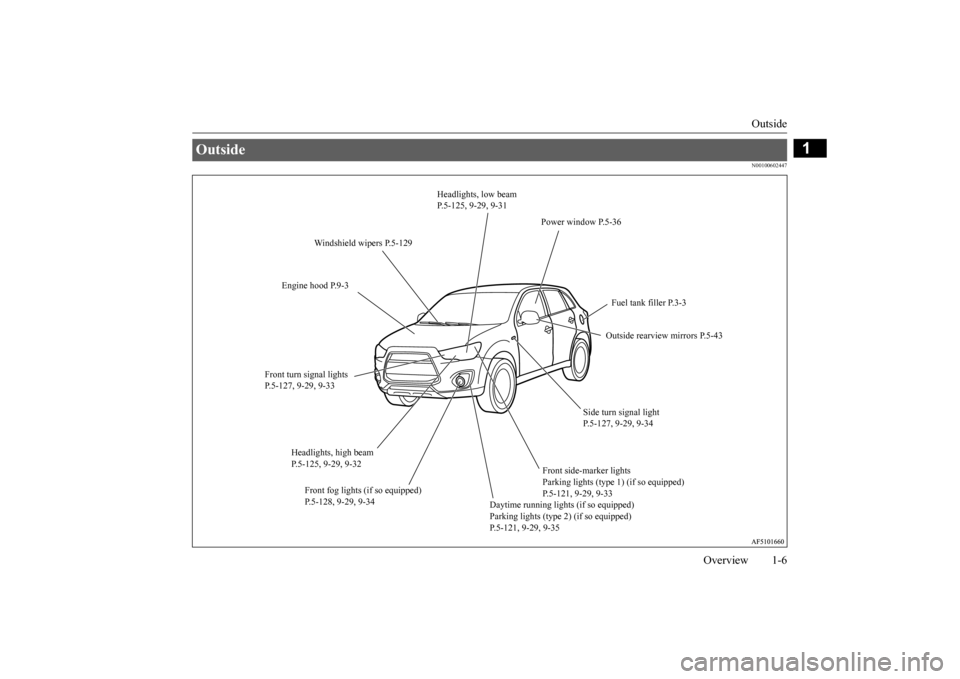
Outside
Power window P.5-36
Windshield wipers P.5-129
Engine hood P.9-3
Fuel tank filler P.3-3 Outside rearview mirrors P.5-43
Front turn signal lights P.5-127, 9-29, 9-33
Side turn signal light P.5-127, 9-29, 9-34
Headlights, high beam P.5-125, 9-29, 9-32
Front side-marker lights Parking lights (type 1) (if so equipped)P.5-121, 9-29, 9-33
Front fog lights (if so equipped) P.5-128, 9-29, 9-34
Headlights, low beam P.5-125, 9-29, 9-31
Daytime running lights (if so equipped) Parking lights (type 2)
(if so equipped)
P.5-121, 9-29, 9-35
BK0206700US.bo
ok 6 ページ 2014年3月25日 火曜日 午後4時42分
Page 9 of 384
Outside 1-7 Overview
1
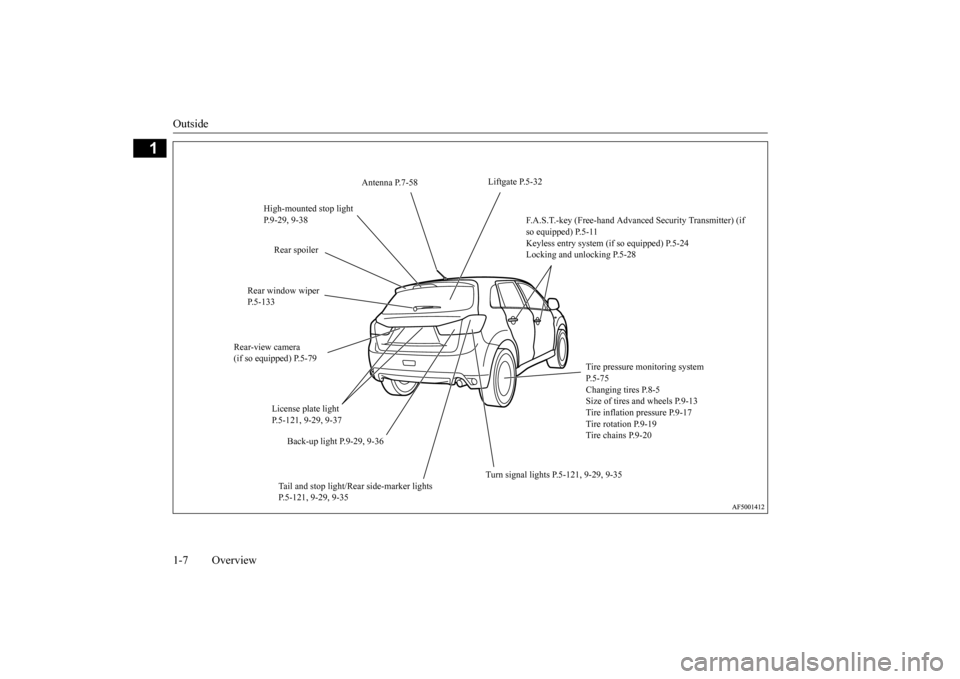
Liftgate P.5-32
Antenna P.7-58
High-mounted stop light P.9-29, 9-38
F.A.S.T.-key (Free-hand Advanced Security Transmitter) (if so equipped) P.5-11 Keyless entry system (if so equipped) P.5-24Locking and unlocking P.5-28
Rear spoiler
Rear window wiper P.5-133
Rear-view camera (if so equipped) P.5-79
Tire pressure monitoring system P.5-75Changing tires P.8-5 Size of tires and wheels P.9-13 Tire inflation pressure P.9-17 Tire rotation P.9-19 Tire chains P.9-20
License plate light P.5-121, 9-29, 9-37
Back-up light P.9-29, 9-36
Turn signal lights P.5-121, 9-29, 9-35
Tail and stop light/Rear side-marker lights P.5-121, 9-29, 9-35
BK0206700US.bo
ok 7 ページ 2014年3月25日 火曜日 午後4時42分
Page 13 of 384
If this problem occurs... 2-4 Quick index
2
Cannot shift the selector lever from the “P” (PARK) position. (for vehicles with continuously variable transmission (CVT))
Shift the selector lever while pressing the brake pedal. Check that the ignition switch or the operation mode is in ON.
P. 5-49
The windows are fogged up.
1. Set the mode selection dial to the “ ” or “ ” position. 2. Turn on the blower.
P. 7-8, 7-13, 7-19, 7-24
The engine does not start. The lights do not come on.The lights are dim. The horn does not honk. The horn sound is weak.
Have the battery checked. Recharge or replace as needed.
P. 8-2, P. 9-12
Problem
Do this
Ref. Page
BK0206700US.bo
ok 4 ページ 2014年3月25日 火曜日 午後4時42分
Page 19 of 384
Filling the fuel tank 3-4 General information
3
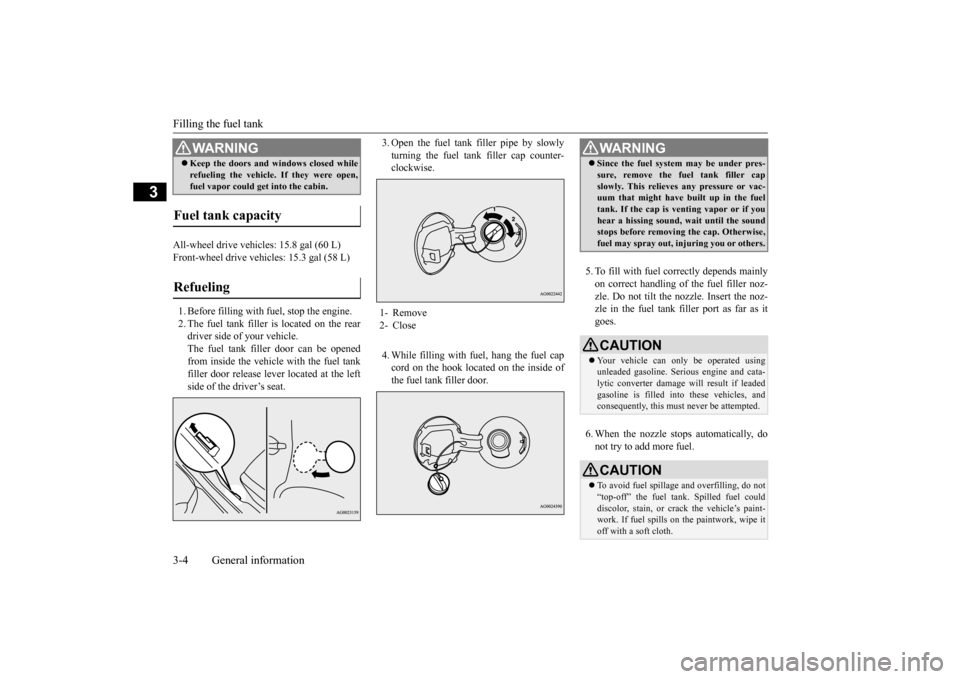
All-wheel drive vehicles: 15.8 gal (60 L) Front-wheel drive vehicles: 15.3 gal (58 L) 1. Before filling with fuel, stop the engine. 2. The fuel tank filler is located on the rear driver side of your vehicle. The fuel tank filler door can be openedfrom inside the vehicle with the fuel tank filler door release le
ver located at the left
side of the driver’s seat.
3. Open the fuel tank filler pipe by slowly turning the fuel tank filler cap counter- clockwise. 4. While filling with fuel, hang the fuel cap cord on the hook located on the inside of the fuel tank filler door.
5. To fill with fuel correctly depends mainly on correct handling of the fuel filler noz-zle. Do not tilt the nozzle. Insert the noz- zle in the fuel tank filler port as far as it goes. 6. When the nozzle stops automatically, do not try to add more fuel.
Keep the doors and windows closed while refueling the vehicle. If they were open, fuel vapor could get into the cabin.
Fuel tank capacity Refueling
WA R N I N G
1- Remove 2- Close
WA R N I N G Since the fuel system may be under pres- sure, remove the fuel tank filler cap slowly. This relieves any pressure or vac- uum that might have built up in the fuel tank. If the cap is venting vapor or if youhear a hissing sound, wait until the sound stops before removing the cap. Otherwise, fuel may spray out, injuring you or others.CAUTION Your vehicle can only be operated using unleaded gasoline. Serious engine and cata-lytic converter damage will result if leaded gasoline is filled into these vehicles, and consequently, this must never be attempted.CAUTION To avoid fuel spillage
and overfilling, do not
“top-off” the fuel tank. Spilled fuel could discolor, stain, or crack the vehicle’s paint- work. If fuel spills on the paintwork, wipe itoff with a soft cloth.
BK0206700US.bo
ok 4 ページ 2014年3月25日 火曜日 午後4時42分
Page 48 of 384
Supplemental Restraint System (SRS) - airbag
Seat and restraint systems 4-27
4
side windows in both side impact and roll- over type accidents. The SRS airbags are NOT
a substitute for use
of the seat belts. For maximum protection in all types of accidents, seat belts mustALWAYS be worn by everyone who drives or rides in this vehicle (with infants and small children in an appropriate child restraint sys-tem in the rear seat, and older children buck- led in the rear seat). Refer to “Child restraint systems” on page 4-18.
WA R N I N G IT IS VERY IMPORTANT TO ALWAYS WEAR YOUR SEAT BELT PROPERLYEVEN WITH AN AIRBAG.• Seat belts help keep the driver and pas-sengers properly positioned. This reduces the risk of injury in all collisions, and reduces the risk of serious injuries ordeath when the airbags inflate. During sudden braking just before a col- lision, an unrestrained or improperlyrestrained driver or passengers can move forward into direct contact with, or within close proximity to, the airbag when it begins to inflate. The beginning stage of airbag inflation isthe most forceful and can cause serious injuries or death if the occupant comes in contact with the airbag at this time.
• Seat belts reduce the risk of injury in rear impact collisions, and in lower- speed frontal collisions because the air- bags are not designed to inflate in those situations.• Seat belts reduce the risk of beingthrown from your vehicle in a collision orrollover.
IT IS VERY IMPORTANT TO BE PROP- ERLY SEATED.• A driver or front passenger sitting tooclose to the steering wheel or instrument panel during airbag deployment can be seriously injured or killed.• Airbags inflate very quickly and withgreat force. If the driver and front pas-senger are not properly seated and restrained, the airbag may not provide the proper protection, and can causeserious injuries or de
ath when it inflates.
• To reduce the risk to the driver of serious injury or death due to a deploying driver’s airbag, always properly wear your seat belt and adjust the driver’s seatas far back as possible, maintaining a position that still allows the driver to have good control of the steering wheel, brake, accelerator, and other vehicle con- trols.WA R N I N G
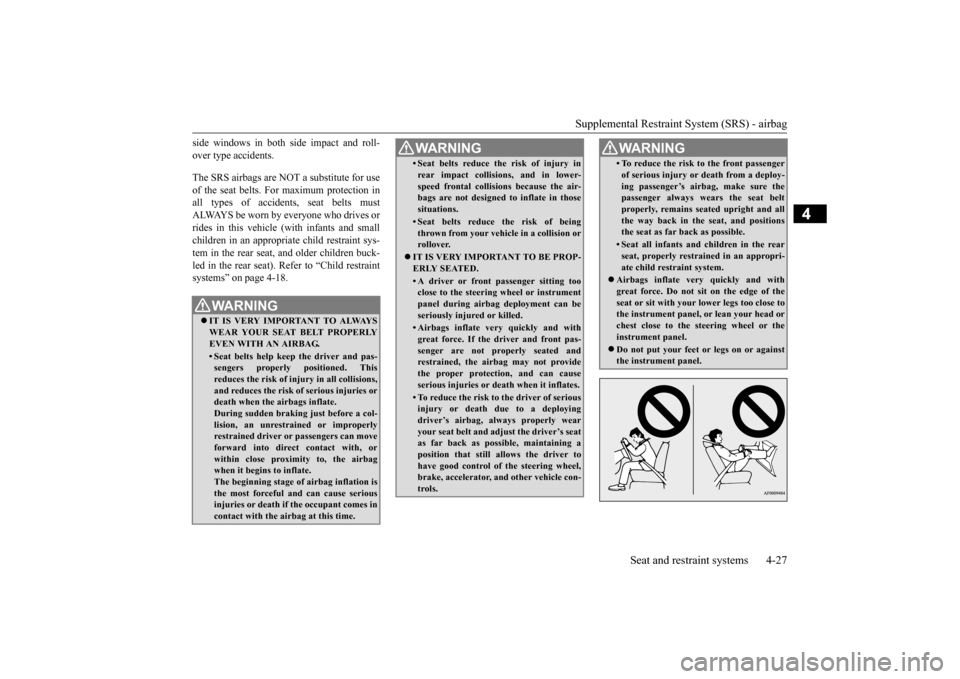
• To reduce the risk to the front passenger of serious injury or death from a deploy- ing passenger’s airbag, make sure the passenger always wears the seat belt properly, remains seated upright and allthe way back in the seat, and positions the seat as far back as possible.• Seat all infants and children in the rearseat, properly restrained in an appropri- ate child restraint system.
Airbags inflate very quickly and with great force. Do not sit on the edge of theseat or sit with your lower legs too close to the instrument panel, or lean your head or chest close to the steering wheel or theinstrument panel. Do not put your feet or legs on or against the instrument panel.WA R N I N G
BK0206700US.bo
ok 27 ページ 2014年3月25日 火曜日 午後4時42分