2015 MITSUBISHI OUTLANDER SPORT automatic transmission
[x] Cancel search: automatic transmissionPage 79 of 384
Free-hand Advanced Security Transmitte
r (F.A.S.T.-key) (if so equipped)
5-16 Features and controls
5
N00513500075
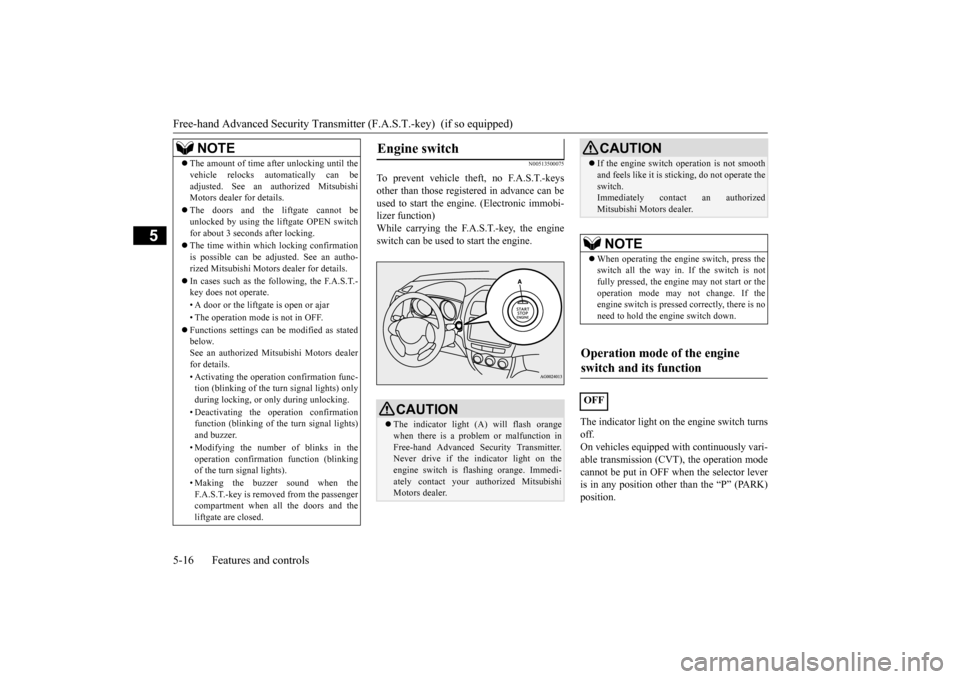
To prevent vehicle theft, no F.A.S.T.-keys other than those registered in advance can beused to start the engine. (Electronic immobi- lizer function) While carrying the F.A.S.T.-key, the engineswitch can be used to start the engine.
The indicator light on the engine switch turns off.On vehicles equipped with continuously vari- able transmission (CVT), the operation mode cannot be put in OFF when the selector leveris in any position other than the “P” (PARK) position.
The amount of time after unlocking until the vehicle relocks automatically can be adjusted. See an authorized Mitsubishi Motors dealer for details. The doors and the liftgate cannot be unlocked by using the liftgate OPEN switch for about 3 seconds after locking. The time within which locking confirmation is possible can be adjusted. See an autho-rized Mitsubishi Motors dealer for details. In cases such as the following, the F.A.S.T.- key does not operate. • A door or the liftgate is open or ajar• The operation mode is not in OFF. Functions settings can be modified as stated below. See an authorized Mitsubishi Motors dealerfor details. • Activating the operation confirmation func- tion (blinking of the turn signal lights) only during locking, or only during unlocking. • Deactivating the operation confirmation function (blinking of the turn signal lights) and buzzer. • Modifying the number of blinks in the operation confirmation function (blinking of the turn signal lights). • Making the buzzer sound when the F.A.S.T.-key is removed from the passenger compartment when all the doors and theliftgate are closed.NOTE
Engine switch
CAUTION The indicator light (A) will flash orange when there is a problem or malfunction in Free-hand Advanced Security Transmitter. Never drive if the indicator light on theengine switch is flashing orange. Immedi- ately contact your authorized Mitsubishi Motors dealer.
If the engine switch operation is not smooth and feels like it is sticking, do not operate the switch. Immediately contact an authorized Mitsubishi Motors dealer.NOTE
When operating the engine switch, press the switch all the way in. If the switch is not fully pressed, the engine may not start or the operation mode may not change. If theengine switch is pressed correctly, there is no need to hold the en
gine switch down.
Operation mode of the engine switch and its function
OFF
CAUTION
BK0206700US.bo
ok 16 ページ 2014年3月25日 火曜日 午後4時42分
Page 80 of 384
Free-hand Advanced Security Transmitt
er (F.A.S.T.-key) (if so equipped)
Features and controls 5-17
5
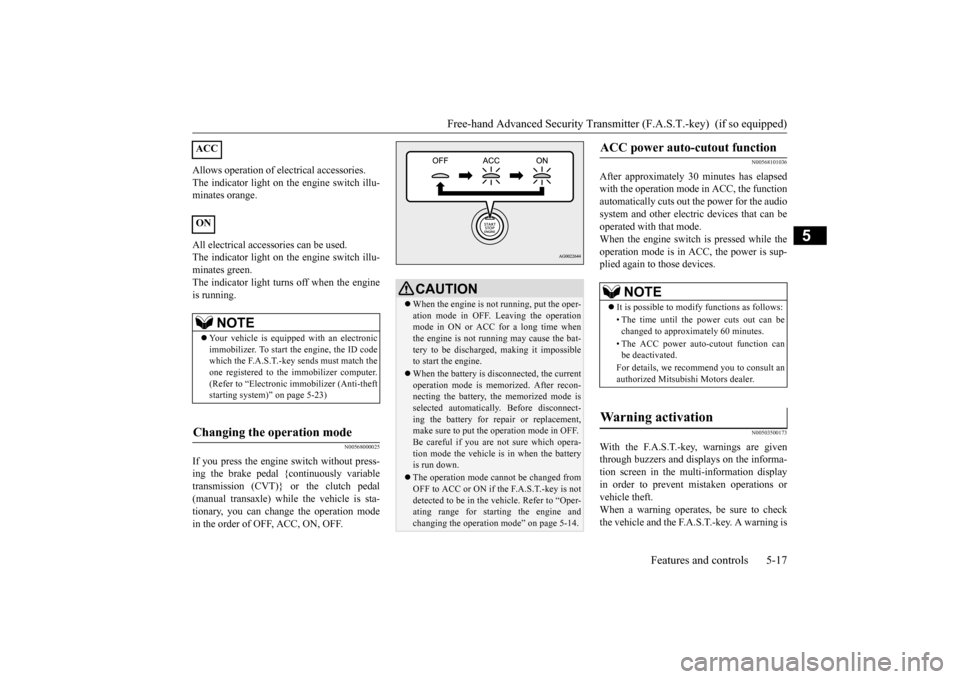
Allows operation of electrical accessories. The indicator light on the engine switch illu- minates orange. All electrical accessories can be used. The indicator light on the engine switch illu-minates green.The indicator light turn
s off when the engine
is running.
N00568000025
If you press the engine switch without press- ing the brake pedal {continuously variabletransmission (CVT)} or the clutch pedal (manual transaxle) while the vehicle is sta- tionary, you can change the operation modein the order of OFF, ACC, ON, OFF.
N00568101036
After approximately 30 minutes has elapsedwith the operation mode in ACC, the functionautomatically cuts out the power for the audio system and other electri
c devices that can be
operated with that mode.When the engine switch is pressed while the operation mode is in ACC, the power is sup- plied again to those devices.
N00503500173
With the F.A.S.T.-key, warnings are given through buzzers and displays on the informa- tion screen in the multi-information displayin order to prevent mistaken operations or vehicle theft. When a warning operates, be sure to checkthe vehicle and the F.A.S.T.-key. A warning is
ACC ON
NOTE
Your vehicle is equipped with an electronic immobilizer. To start the engine, the ID codewhich the F.A.S.T.-key sends must match the one registered to the immobilizer computer. (Refer to “Electronic immobilizer (Anti-theftstarting system)” on page 5-23)
Changing the operation mode
CAUTION When the engine is not running, put the oper- ation mode in OFF. Leaving the operation mode in ON or ACC for a long time whenthe engine is not running may cause the bat- tery to be discharged, making it impossible to start the engine. When the battery is disconnected, the current operation mode is memorized. After recon-necting the battery, the memorized mode is selected automatically. Before disconnect- ing the battery for repair or replacement,make sure to put the operation mode in OFF. Be careful if you are not sure which opera- tion mode the vehicle is in when the batteryis run down. The operation mode cannot be changed from OFF to ACC or ON if the F.A.S.T.-key is not detected to be in the vehicle. Refer to “Oper- ating range for starting the engine andchanging the operation mode” on page 5-14.
ACC power auto-cutout function
NOTE
It is possible to modify functions as follows: • The time until the power cuts out can be changed to approximately 60 minutes. • The ACC power auto-cutout function can be deactivated. For details, we recommend you to consult an authorized Mitsubishi Motors dealer.
Warning activation
BK0206700US.bo
ok 17 ページ 2014年3月25日 火曜日 午後4時42分
Page 83 of 384
Free-hand Advanced Security Transmitte
r (F.A.S.T.-key) (if so equipped)
5-20 Features and controls
5
Your vehicle is equipped with an electroni- cally controlled fuel injection system. This is a system that automatically controls fuel injection. There is usually no need to depressthe accelerator pedal when starting the engine. To prevent battery drain, wait a few secondsbetween attempts to restart the engine. 1. Make sure all occupants are properly seated with seat belts fastened. 2. Make sure the parking brake is applied.3. Press and hold the brake pedal down with your right foot.
4. Press and hold the clutch pedal all the way down (manual transaxle). 5. On vehicles equipped with manual trans- axle, place the gearshift lever in the “N”(Neutral) position. On vehicles equipped with continuously variable transmission (CVT), make surethe selector lever is in the “P” (PARK) position. 6. Press the engine switch. 7. Confirm that all warning lights and warn- ing displays are functioning properly.
After several attempts, you may experience that the engine still does not start. 1. Make sure that all electric devices, such as lights, air conditioning blower and rear window defogger, are turned off.2. While depressing the brake pedal {contin- uously variable transmission (CVT)} or the clutch pedal (manual transaxle), pressthe accelerator pedal halfway and hold itthere, then crank the engine. Release the accelerator pedal, immediately after the engine starts.3. If the engine still will not start, the engine could be flooded with too much gasoline. While depressing the brake pedal (CVT)or the clutch pedal (manual transaxle), push the accelerator pedal all the way down and hold it there, then press theengine switch to crank the engine. If the engine does not start after 5 to 6 seconds, push the engine switch to stop crankingthe engine, and release the accelerator pedal. Put the operation mode in OFF.
WA R N I N G Never run the engine in a closed or poorly ventilated area any longer than is needed to move your vehicle out of the area. Car- bon monoxide gas, which is odorless and extremely poisonous, could build up andcause serious injury or death.CAUTION Do not push-start the vehicle.Do not run the engine
at high rpms or drive
at high speeds until the engine has had a chance to warm up.
Starting the engine
NOTE
On vehicles equipped with continuously variable transmission (CVT), the engine can only be started when the selector lever is inthe “P” (PARK) or “N” (NEUTRAL) posi- tion. For safety reasons, the engine should bestarted when the selector lever is in the “P” (PARK) position in which the driving wheels lock.NOTE
Minor noises may be heard on engine start- up. These will disappear as the engine warmsup.
When the engine is hard to start
BK0206700US.bo
ok 20 ページ 2014年3月25日 火曜日 午後4時42分
Page 103 of 384
Parking brake 5-40 Features and controls
5
To stop the moving sunshade, press the switch (1), (2) or (3). If a hand or head is trapped in the closing sunshade opening, the safety mechanism will cause the sunshade to re-open automatically. The opened sunshade will become opera-tional again after a few seconds.
N00511400373
To park the vehicle, first bring it to a com-plete stop, fully engage the parking brake, and then move the gearshift lever to 1st (on a
uphill) or “R” (Reverse) (on a downhill) posi- tion for vehicles equipped with a manual transaxle, set the selector lever to “P” (PARK) position for vehicles equipped with acontinuously variable transmission (CVT).
When parking on a hill, set the parking brake, and turn the front wheels toward the curb on adownhill, or away from the curb on an uphill.
Safety mechanism
NOTE
The safety mechanism can be activated if the driving conditions or other circumstances cause the sunshade to be subjected to a phys-ical shock similar to that caused by a trapped hand or head.CAUTION Do not deliberately trap your hands or head in order to activate the safety mechanism. Personal injury and malfunction of the sun- shade could result.
Parking brake
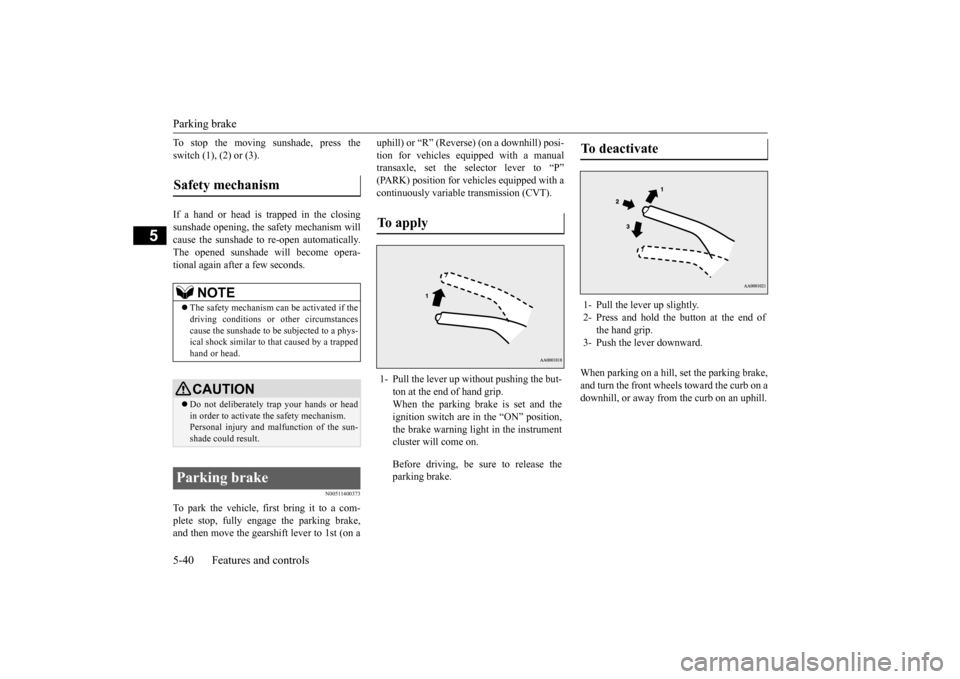
To apply 1- Pull the lever up without pushing the but-
ton at the end of hand grip. When the parking brake is set and the ignition switch are in the “ON” position,the brake warning light in the instrument cluster will come on. Before driving, be sure to release the parking brake.
To deactivate 1- Pull the lever up slightly.2- Press and hold the button at the end of
the hand grip.
3- Push the lever downward.
BK0206700US.bo
ok 40 ページ 2014年3月25日 火曜日 午後4時42分
Page 109 of 384
Starting the engine 5-46 Features and controls
5
Do not operate the starter motor continu- ously for longer than
15 seconds as this
could run the battery down or damage thestarter motor. If the engine does not start, turn the ignition switch back to the “OFF” position, wait a few seconds, and then tryagain. Trying repeatedly with the engine or starter motor still turning will damage the starter mechanism. If the engine will not start because the bat- tery is weak or discharged, refer to “Jump-starting the engine” (on page 8-2) for instructions. A longer warm up period will only con- sume extra fuel. The
engine is warmed up
enough for driving when the bar graph ofengine coolant temperature display starts to move. Refer to “Interrupt display screen (With ignition switch or operationmode in ON)” on page 5-93.
This model is equipped with an electronically controlled fuel injection system. This is a sys-tem that automatically controls fuel injection. There is usually no need to depress the accel- erator pedal when starting the engine.The starter should not be run for more than 15 seconds at a time. To prevent battery drain, wait a few secondsbetween attempts to restart the engine. 1. Make sure all occupants are properly seated with seat belts fastened. 2. Insert the ignition key.3. Make sure the parking brake is applied. 4. Press and hold the brake pedal down with your right foot.5. Press and hold the clutch pedal all the way down (manual transaxle).
6. On vehicles equipped with manual trans- axle, place the gearshift lever in the “N” (Neutral) position. On vehicles equipped with continuouslyvariable transmission (CVT), make sure the selector lever is in the “P” (PARK) position. 7. Turn the ignition switch to the “ON” posi- tion and make certain that all warning lights are functioning properly beforestarting the engine. 8. Turn the ignition switch to the “START” position without pressing the acceleratorpedal. Release the key when the engine starts.
Tips for starting
WA R N I N G Never run the engine in a closed or poorly ventilated area any longer than is needed to move your vehicle out of the area. Car-bon monoxide gas, which is odorless and extremely poisonous, could build up and cause serious injury or death.
CAUTION Do not push-start the vehicle.Do not run the engine
at high rpms or drive
at high speeds until the engine has had a chance to warm up. Release the ignition switch as soon as the engine starts. Otherwise, the starter motorwill be damaged.
Starting the engine
NOTE
On vehicles equipped with CVT, the starter will not operate unless the selector lever is in the “P” (PARK) or “N” (NEUTRAL) posi- tion.For safety reasons, start the engine in the “P” (PARK) position so that the wheels are locked.NOTE
Minor noises may be heard on engine start- up. These will disappear as the engine warms up.
BK0206700US.bo
ok 46 ページ 2014年3月25日 火曜日 午後4時42分
Page 110 of 384
Manual transaxle (if so equipped)
Features and controls 5-47
5
After several attempts, you may experience that the engine still does not start. 1. Make sure that all electric devices, such as lights, air conditioning blower and rear window defogger, are turned off. 2. While depressing the brake pedal {contin-uously variable transmission (CVT)} orthe clutch pedal (manual transaxle), press the accelerator pedal halfway and hold it there, then crank the engine. Release theaccelerator pedal, immediately after the engine starts.
3. If the engine still will not start, the engine could be flooded with too much gasoline. While depressing the brake pedal (CVT) or the clutch pedal (manual transaxle),push the accelerator pedal all the way down and hold it there, then crank the engine for 5 to 6 seconds. Return the igni-tion switch to the “OFF” position and release the accelerator pedal. Wait a few seconds, and then crank the engine againfor 5 to 6 seconds while depressing thebrake pedal (CVT) or the clutch pedal (manual transaxle), but do not push the accelerator pedal. Release the ignition keyif the engine starts. If the engine fails to start, repeat these procedures. If the engine still will not start, contact yourlocal Mitsubishi Motors dealer or a repair facility of your choice for assistance.
When the ambient temperature is -22 °F (-30 °C) or lower, it may not be possible to start from a standstill even with the selector leverin the “D” (DRIVE) or “R” (REVERSE) position.
This occurs because the transaxle has not warmed up sufficiently; it does not indicate a problem. If this occurs, place the selector lever in the “P” (PARK) position and let theengine idle for at least 10 minutes. The transaxle will warm up, and you will be able to start normally.Do not leave the vehicle during warm-up operation.
N00512701152
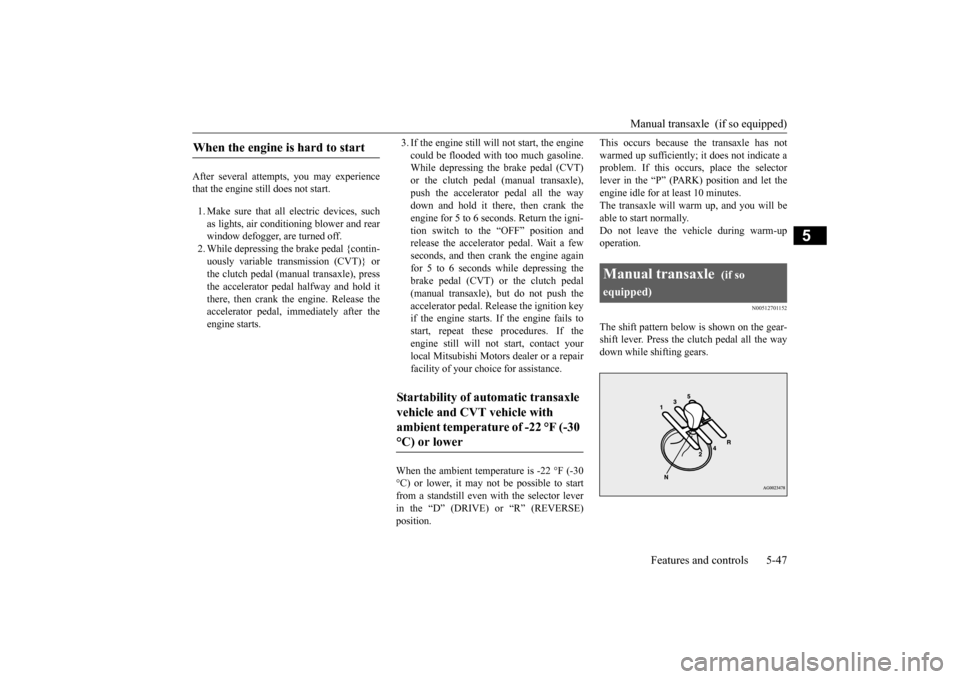
The shift pattern below is shown on the gear-shift lever. Press the clutch pedal all the way down while shifting gears.
When the engine is hard to start
Startability of automatic transaxle vehicle and CVT vehicle with ambient temperature of -22 °F (-30 °C) or lower
Manual transaxle
(if so
equipped)
BK0206700US.bo
ok 47 ページ 2014年3月25日 火曜日 午後4時42分
Page 112 of 384
Continuously variable transmission (CVT) (if so equipped)
Features and controls 5-49
5
N00513000096
It is recommended that you downshift to a lower gear when needed to maintain thedesired speed, according to the table. Avoid downshifting at too high a speed. The engine may suffer damage.To maintain a safe speed and prolong brake life, shift down to 2nd or 1st when descend- ing a steep hill.Downshifting is also important to avoid “lug-ging” the engine at too low a speed, such as when turning a corner or when driving up a steep hill.
N00513100228
Do not use the gearshift lever as a han- drest. This can result in premature wear ofthe transaxle shift forks.
The table above shows the maximum rec- ommended driving speed for in each gear. Do not drive near or at these speeds for prolonged periods of time.
N00560200047
The CVT will automatically and continuouslychange its gear ratio depending on road anddriving conditions. This helps achieve smooth driving and excellent fuel efficiency. Also you can manually shift up and shiftdown the transmission. Refer to “Sports
mode” on page 5-53. The transmission prevents unnecessary upshifts even when the accelerator pedal isreleased and ensures smooth driving. According to the condi
tions, the transmission
will automatically shift to a lower gear ratioto achieve stronger engine braking. This may help reduce your need to use the service brake.
N00560300048
As an additional safe
ty precaution, models
equipped with a continuously variable trans-mission have a shift-lock device that holds the selector lever in the “P” (PARK) position. To move the selector lever from the “P”(PARK) position to another position, follow the steps below. 1. Press and hold the brake pedal down.
Downshifting
Recommended downshifting speed
Downshifting speed
Shift point
Under 20 mph (32 km/h)
Shift down from cur- rent gear to 2nd gear.
20 to 30 mph (32 to
48 km/h)
Shift down from cur- rent gear to 3rd gear.
Driving precautions
Maximum possible driving speed
Shift points
Maximum possible driving
speed
1st gear
28 mph (45 km/h)
2nd gear
59 mph (95 km/h)
3rd gear
86 mph (140 km/h)
4th gear
111 mph (180 km/h)
Continuously variable transmission (CVT)
(if so
equipped)
DRIVING UPHILL
DRIVING DOWNHILL
Selector lever operation
BK0206700US.bo
ok 49 ページ 2014年3月25日 火曜日 午後4時42分
Page 117 of 384
Continuously variable transmis
sion (CVT) (if so equipped)
5-54 Features and controls
5
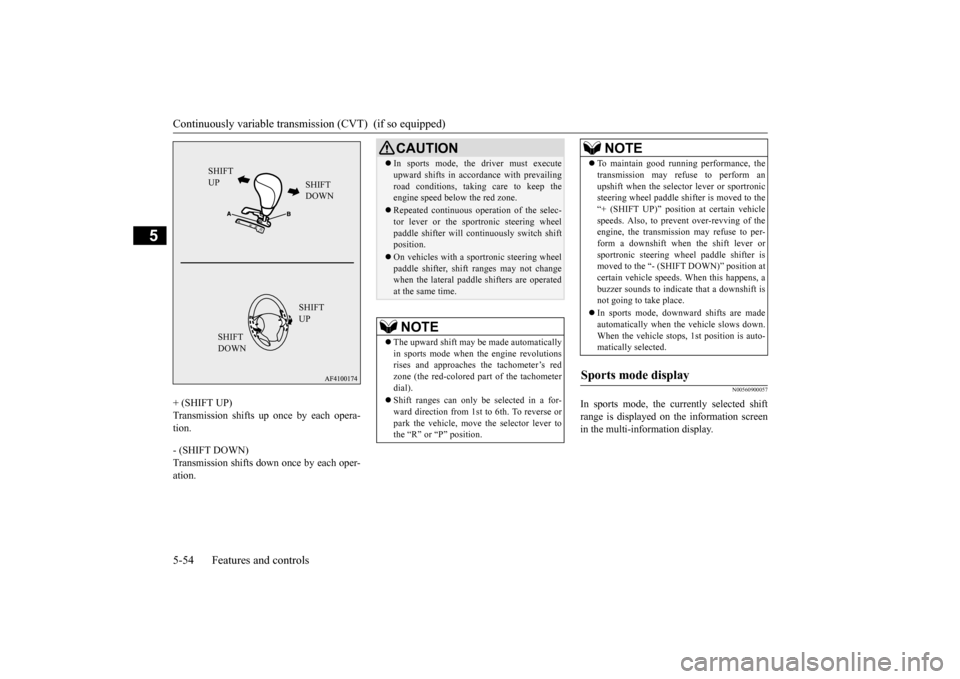
+ (SHIFT UP) Transmission shifts up once by each opera- tion. - (SHIFT DOWN) Transmission shifts down once by each oper-ation.
N00560900057
In sports mode, the currently selected shift range is displayed on the information screen in the multi-information display.
SHIFT UP
SHIFT DOWN SHIFT UP
SHIFT DOWN
CAUTION In sports mode, the driver must execute upward shifts in accordance with prevailing road conditions, taking care to keep the engine speed below the red zone. Repeated continuous operation of the selec- tor lever or the sportronic steering wheel paddle shifter will continuously switch shiftposition. On vehicles with a sportronic steering wheel paddle shifter, shift ranges may not change when the lateral paddle shifters are operated at the same time.NOTE
The upward shift may be made automatically in sports mode when the engine revolutions rises and approaches the tachometer’s redzone (the red-colored part of the tachometer dial). Shift ranges can only be selected in a for- ward direction from 1st to 6th. To reverse or park the vehicle, move the selector lever tothe “R” or “P” position.
To maintain good running performance, the transmission may refuse to perform an upshift when the selector lever or sportronic steering wheel paddle shifter is moved to the “+ (SHIFT UP)” position at certain vehiclespeeds. Also, to prevent over-revving of the engine, the transmission may refuse to per- form a downshift when the shift lever orsportronic steering wheel paddle shifter is moved to the “- (SHIFT DOWN)” position at certain vehicle speeds. When this happens, abuzzer sounds to indicate that a downshift is not going to take place. In sports mode, downward shifts are made automatically when the vehicle slows down. When the vehicle stops, 1st position is auto-matically selected.
Sports mode display
NOTE
BK0206700US.bo
ok 54 ページ 2014年3月25日 火曜日 午後4時42分