Page 316 of 384
![MITSUBISHI OUTLANDER SPORT 2015 3.G Owners Manual How to change a tire
For emergencies 8-9
8
7. [Vehicle with the tapered nuts] Install the wheel nuts with their tapered ends facing inward, then tighten by hand until the wheel is no longer loose. [V](/manual-img/19/7548/w960_7548-315.png "MITSUBISHI OUTLANDER SPORT 2015 3.G Owners Manual How to change a tire
For emergencies 8-9
8
7. [Vehicle with the tapered nuts] Install the wheel nuts with their tapered ends facing inward, then tighten by hand until the wheel is no longer loose. [V")
How to change a tire
For emergencies 8-9
8
7. [Vehicle with the tapered nuts] Install the wheel nuts with their tapered ends facing inward, then tighten by hand until the wheel is no longer loose. [Vehicle with the flange nuts] • Aluminium wheelTemporarily tighten the wheel nuts until their flange section comes in contact with the wheel and it is no longer loose.
• Steel wheel Install the wheel nuts with their tapered ends facing inward, then tighten by hand until the wheel is no longer loose.
WA R N I N G Mount the spare wheel with the valve stem (I) facing outward. If you cannot see the valve stem (I), you have installed the wheel backwards. Operating the vehicle with the spare wheelinstalled backwards can cause vehicle damage and result in an accident.
CAUTION Never apply oil to either the wheel bolts or the nuts or they will tighten too much.NOTE
Flange nuts can be temporarily used on the compact spare or steel wheel, but returnthem to the original wheel and tire as soon as possible. If all 4 wheels are changed to steel wheels, use tapered nuts.
BK0206700US.bo
ok 9 ページ 2014年3月25日 火曜日 午後4時42分
Page 317 of 384

How to change a tire 8-10 For emergencies
8
8. Lower the vehicle slowly until the tire touches the ground, by rotating the wheel nut wrench counterclockwise. 9. Tighten the nuts in the order shown in the illustration until each nut has been tight- ened to the torque listed here.65 to 80 ft-lb (88 to 108 N•m)
10. Lower the jack all the way and remove it. 11. Check the tire inflation pressure. The rec-
ommended tire pressure for your vehicle is listed on the tire and loading informa-tion placard attached to the driver’s doorsill as shown in the illustration. Refer to “Tire inflation pressures” on page 9-17.
N00850000162
Reverse the removing procedure when stor- ing the flat tire or spare tire, jack, bar and wheel nut wrench. Refer to “To remove the spare tire” on page8-7 and “Jack and tools” on page 8-5.
CAUTION Never use your foot or a pipe extension to apply added force to the wheel nut wrench when tightening the wheel nuts. If you do so, you can over-tighten the wheel nuts and damage the wheel, wheel nuts and hub bolts.
CAUTION Driving with an improperly inflated tire can cause an accident. If
you have no choice but
to drive with an under-inflated tire, keep your speed down and avoid sudden steering or braking, if possible
. Inflate the tire to the
correct pressure as soon as possible. Refer to “Tire inflation pressures” on page 9-17. After changing the tire and driving the vehi- cle about 620 miles (1,000 km), retighten the wheel nuts to make sure that they have notcome loose. If the steering wheel vibrates when driving after changing the tire, have the tire checked for balance at an authorized Mitsubishi Motors dealer or a repair facility of yourchoice. Do not mix one type of tire with another or use a different size from the one listed. This would cause early wear and poor handling.
To store the flat tire or spare tire, jack, bar and wheel nut wrench
BK0206700US.bo
ok 10 ページ 2014年3月25日 火曜日 午後4時42分
Page 340 of 384
Tires
Vehicle care and maintenance 9-17
9
under controlled conditions on speci- fied government test surfaces of asphalt and concrete. A tire marked C may have poor traction perfor- mance. The temperature grades are A (the highest), B and C, representing the tire’s resistance to the generation ofheat and its ability to dissipate heat when tested under controlled condi- tions on a specified indoor laboratorytest wheel. Sustained high tempera- ture can cause the material of the tire to degenerate and reduce tire life, andexcessive temperature can lead to sudden tire failure. The grade C cor- responds to a level of performancewhich all passenger car tires must meet under the Federal Motor Vehi- cle Safety Standard No. 109. Grades B and A represent higher levels of performance on the laboratory testwheel than the minimum required by law.
N00939301955
Proper tire inflation pressure is essential for the safe and satisfactory operation of yourvehicle. The wrong tire pressure will cause problems in three major areas: Safety Too little pressure increases flexing in thetire and can cause tire failure. Too muchpressure can cause a tire to lose its ability to cushion shock. Objects on the road and potholes could then cause tire damage thatmay result in tire failure. Economy The wrong tire pressure can cause unevenwear patterns in the tire tread. These abnormal wear patterns will reduce the tread life, and the tire will have to bereplaced sooner. Too little pressure also makes it harder for the tire to roll, and this uses up more fuel. Ride comfort and vehicle stability The superior riding experience built into your vehicle partly depends on the correcttire pressure. Too much pressure gives an uncomfortable and jarring ride. Too little pressure feels as if your vehicle is slow torespond. Unequal tire pressures can make steering your vehicle uneven and unpredictable.
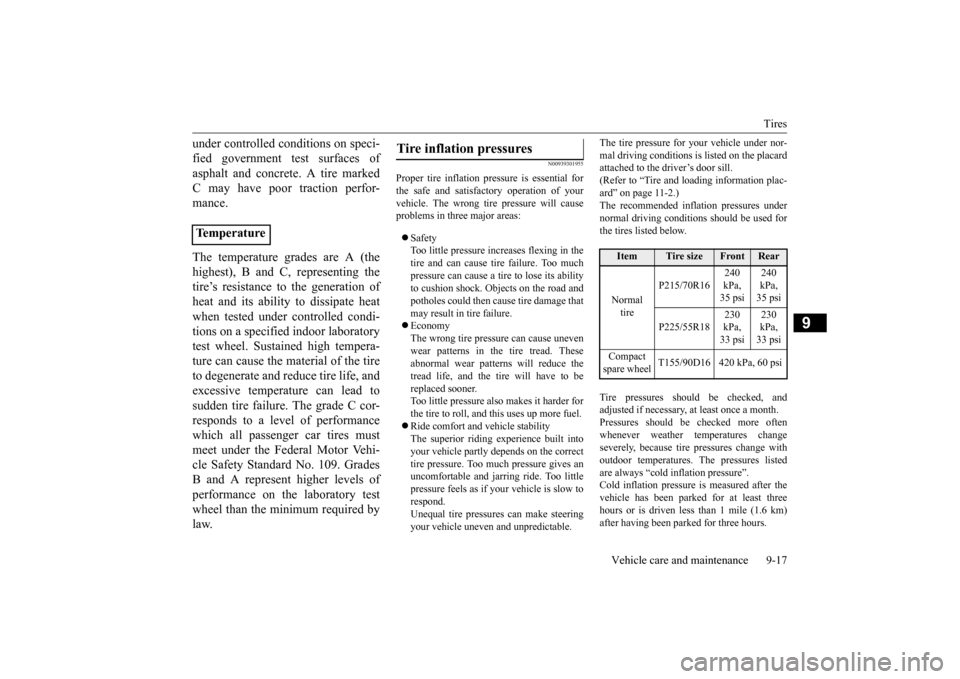
The tire pressure for your vehicle under nor- mal driving conditions is listed on the placard attached to the driver’s door sill. (Refer to “Tire and loading information plac-ard” on page 11-2.) The recommended infl
ation pressures under
normal driving conditions should be used forthe tires listed below. Tire pressures should be checked, and adjusted if necessary, at least once a month. Pressures should be checked more oftenwhenever weather temperatures change severely, because tire pressures change with outdoor temperatures. The pressures listedare always “cold inflation pressure”. Cold inflation pressure is measured after the vehicle has been parked for at least threehours or is driven less than 1 mile (1.6 km) after having been parked for three hours.
Temperature
Tire inflation pressures
Item
Tire size
Front
Rear
Normal tire
P215/70R16
240 kPa, 35 psi
240 kPa, 35 psi
P225/55R18
230 kPa, 33 psi
230 kPa, 33 psi
Compact spare wheel
T155/90D16 420 kPa, 60 psi
BK0206700US.bo
ok 17 ページ 2014年3月25日 火曜日 午後4時42分
Page 342 of 384
Tires
Vehicle care and maintenance 9-19
9
When the bands appear next to one another in two or more places, replace your tires.
N00939901531
To even out the wear on your tires and makethem last longer, Mitsubishi Motors Corpora- tion recommends that you rotate your tires at the mileage listed in the “WARRANTY ANDMAINTENANCE MANUAL”. However, the timing for tire rotation may vary according to your vehicle condition,road surface conditions, and your own per- sonal driving habits. Any time you notice unusual wear, rotate your tires as soon as pos-sible. When rotating tires, check for uneven wear, damage, and wheel alignment. Abnormal wear is usually caused by a wrong tire pres-sure, wheels that are not aligned properly, wheels that are out-of-balance, or severe braking.Check with an authorized Mitsubishi Motors dealer or a repair facility of your choice to find out the reason for uneven tread wear.
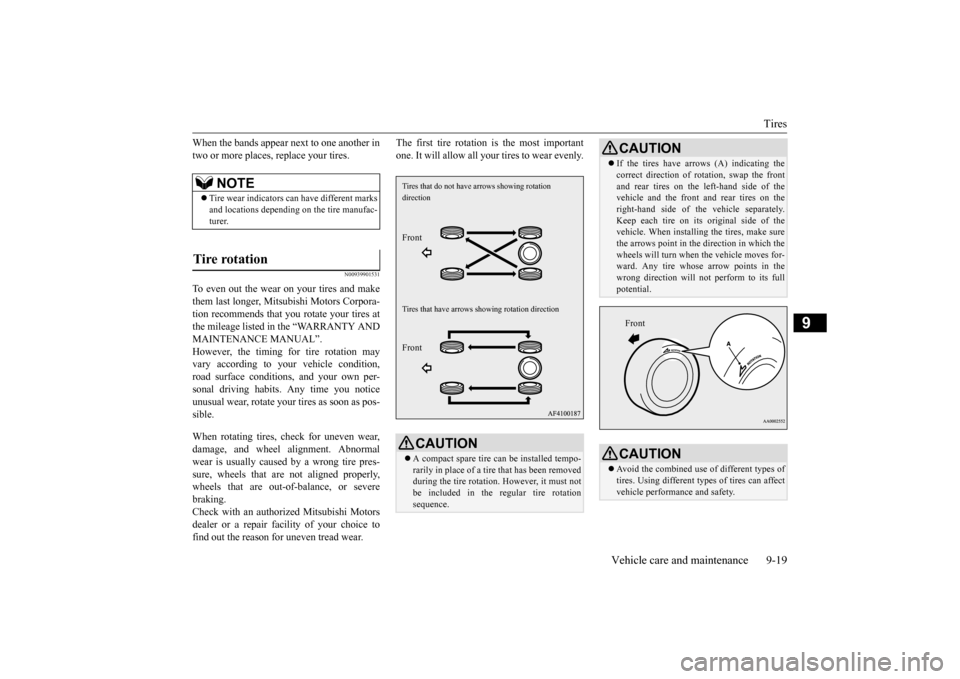
The first tire rotation is the most important one. It will allow all your tires to wear evenly.
NOTE
Tire wear indicators can have different marks and locations depending on the tire manufac- turer.
Tire rotation
CAUTION A compact spare tire can be installed tempo- rarily in place of a tire that has been removed during the tire rotation. However, it must not be included in the regular tire rotationsequence.Tires that do not have
arrows showing rotation
directionFrontTires that have arrows
showing rotation direction
Front
If the tires have arrows (A) indicating the correct direction of rotation, swap the front and rear tires on the left-hand side of the vehicle and the front and rear tires on the right-hand side of the vehicle separately.Keep each tire on its original side of the vehicle. When installing the tires, make sure the arrows point in the
direction in which the
wheels will turn when the vehicle moves for- ward. Any tire whose arrow points in the wrong direction will not perform to its fullpotential.CAUTION Avoid the combined use of different types of tires. Using different types of tires can affect vehicle performance and safety.CAUTIONFront
BK0206700US.bo
ok 19 ページ 2014年3月25日 火曜日 午後4時42分