2015 MITSUBISHI OUTLANDER service
[x] Cancel search: servicePage 389 of 446
Engine coolant 9-8 Vehicle care and maintenance
9
ters require that the filter can withstand a pressure of 256 psi (1.8 MPa). A MitsubishiMotors Genuine oil filter
is the best replace-
ment filter. Follow the installation instructions printed onthe filter.
N00937801594
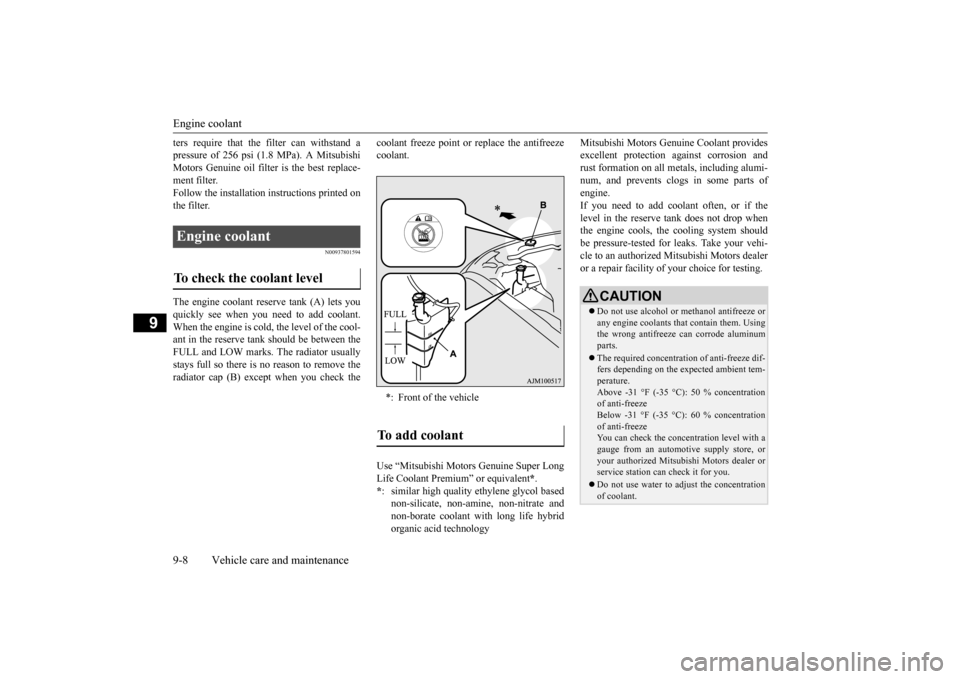
The engine coolant reserve tank (A) lets youquickly see when you need to add coolant. When the engine is cold, the level of the cool- ant in the reserve tank should be between theFULL and LOW marks. The radiator usually stays full so there is no reason to remove the radiator cap (B) except when you check the
coolant freeze point or
replace the antifreeze
coolant.
Mitsubishi Motors Genui
ne Coolant provides
excellent protection against corrosion andrust formation on all metals, including alumi- num, and prevents clogs in some parts of engine.If you need to add coolant often, or if the level in the reserve tank does not drop when the engine cools, the cooling system shouldbe pressure-tested for le
aks. Take your vehi-
cle to an authorized Mitsubishi Motors dealer or a repair facility of
your choice for testing.
Engine coolant To check the coolant level
*: Front of the vehicleTo add coolant Use “Mitsubishi Motors Genuine Super Long Life Coolant Premium” or equivalent
*.
* : similar high quality et
hylene glycol based
non-silicate, non-amine, non-nitrate andnon-borate coolant with long life hybrid organic acid technology
CAUTION Do not use alcohol or methanol antifreeze or any engine coolants th
at contain them. Using
the wrong antifreeze can corrode aluminum parts. The required concentrati
on of anti-freeze dif-
fers depending on the
expected ambient tem-
perature. Above -31 °F (-35 °C): 50 % concentration of anti-freezeBelow -31 °F (-35 °C): 60 % concentration of anti-freeze You can check the concentration level with agauge from an automotive supply store, or your authorized Mitsubi
shi Motors dealer or
service station can check it for you. Do not use water to adjust the concentration of coolant.
BK0211800US.book 8 ページ 2014年3月12日 水曜日 午後2時42分
Page 391 of 446
Automatic transaxle fl
uid (if so equipped)
9-10 Vehicle care and maintenance
9
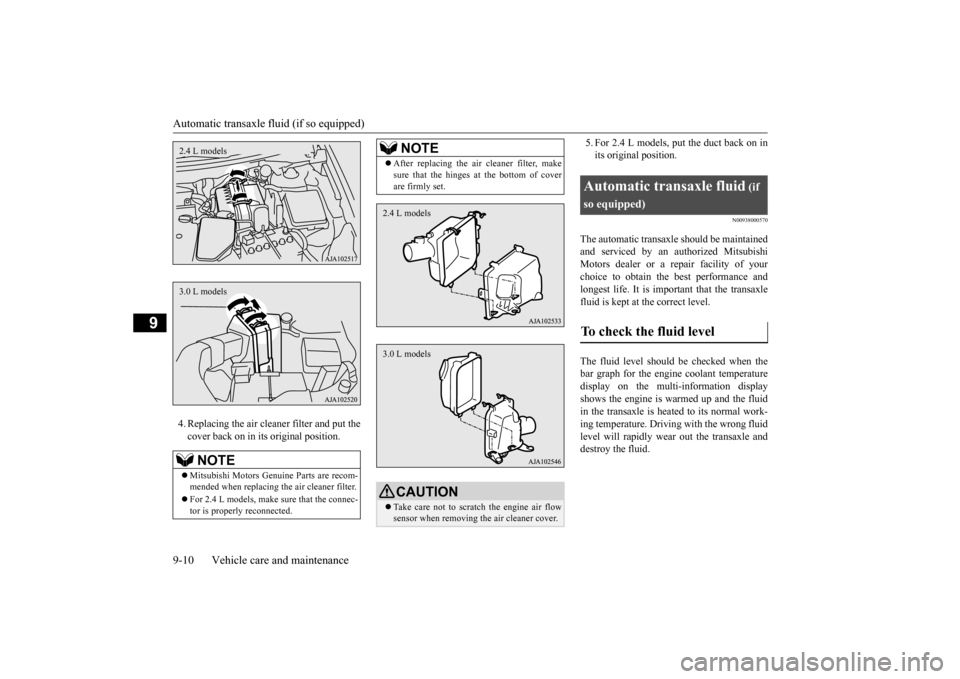
4. Replacing the air clea
ner filter and put the
cover back on in its original position.
5. For 2.4 L models, put the duct back on in its original position.
N00938000570
The automatic transaxle should be maintainedand serviced by an au
thorized Mitsubishi
Motors dealer or a repair facility of your choice to obtain the best performance and longest life. It is impor
tant that the transaxle
fluid is kept at the correct level. The fluid level should be checked when the bar graph for the engine coolant temperaturedisplay on the multi-information display shows the engine is wa
rmed up and the fluid
in the transaxle is heated to its normal work-ing temperature. Driving with the wrong fluid level will rapidly wear
out the transaxle and
destroy the fluid.
NOTE
Mitsubishi Motors Genui
ne Parts are recom-
mended when replacing th
e air cleaner filter.
For 2.4 L models, make sure that the connec- tor is properl
y reconnected.
2.4 L models3.0 L models
After replacing the air cleaner filter, make sure that the hinges at the bottom of coverare firmly set.CAUTION Take care not to scratc
h the engine air flow
sensor when removing
the air cleaner cover.
NOTE
2.4 L models3.0 L models
Automatic transaxle fluid
(if
so equipped)To check the fluid level
BK0211800US.book 10 ページ 2014年3月12日 水曜日 午後2時42分
Page 392 of 446
Continuously variable transmission (CVT) fluid (if so equipped)
Vehicle care and maintenance 9-11
9
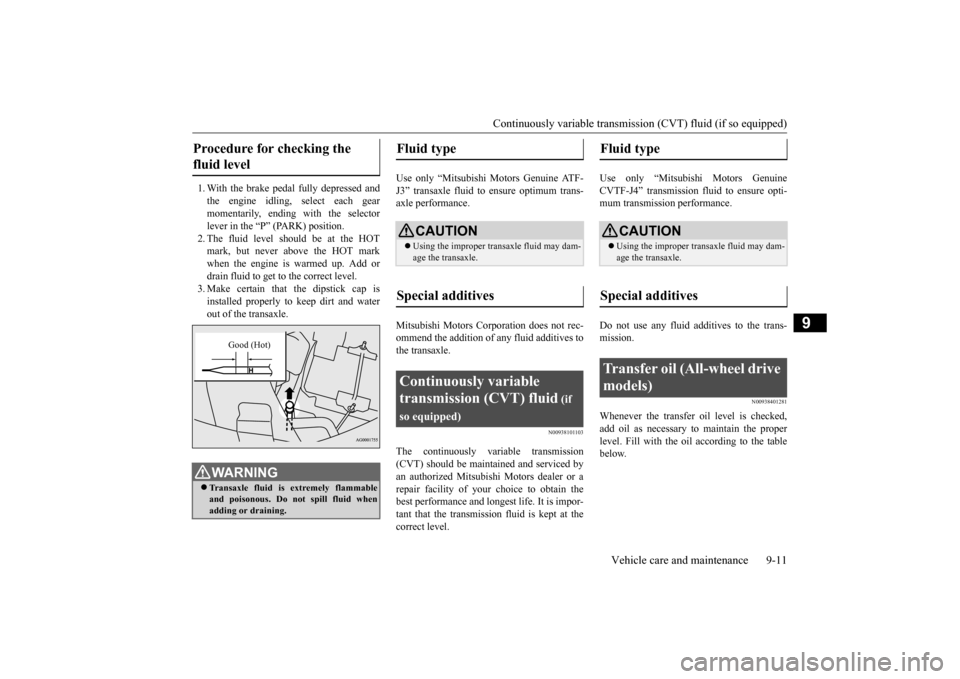
1. With the brake pedal fully depressed and the engine idling,
select each gear
momentarily, ending with the selectorlever in the “P” (PARK) position. 2. The fluid level should be at the HOT mark, but never a
bove the HOT mark
when the engine is warmed up. Add or drain fluid to get to the correct level. 3. Make certain that the dipstick cap is installed properly to
keep dirt and water
out of the transaxle.
Use only “Mitsubishi Motors Genuine ATF- J3” transaxle fluid to
ensure optimum trans-
axle performance. Mitsubishi Motors Cor
poration does not rec-
ommend the addition of
any fluid additives to
the transaxle.
N00938101103
The continuously variable transmission (CVT) should be maintained and serviced byan authorized Mitsubishi Motors dealer or a repair facility of your choice to obtain the best performance and longest life. It is impor-tant that the transmission fluid is kept at the correct level.
Use only “Mitsubish
i Motors Genuine
CVTF-J4” transmission fluid to ensure opti- mum transmission performance. Do not use any fluid additives to the trans- mission.
N00938401281
Whenever the transfer oil level is checked,add oil as necessary to
maintain the proper
level. Fill with the oil according to the table below.
Procedure for checking the fluid level
WA R N I N G Transaxle fluid is extremely flammable and poisonous. Do not spill fluid when adding or draining.
Good (Hot)
Fluid type
CAUTION Using the improper transaxle fluid may dam- age the transaxle.
Special additives
Continuously variable transmission (CVT) fluid
(if
so equipped)
Fluid type
CAUTION Using the improper transaxle fluid may dam- age the transaxle.
Special additives
Transfer oil (All-wheel drive models)
BK0211800US.book 11 ページ 2014年3月12日 水曜日 午後2時42分
Page 397 of 446

Tires 9-16 Vehicle care and maintenance
9
EXAMPLE: 95H
Maximum load indicates the maxi- mum load this tire is designed to carry.
R
Construction code •“R” means radial construc- tion. •“D” means diagonal or bias construction.
15 Rim diameter in inches (in)
NOTE
European/Japanese metric tire sizing is based on European/Jap- anese design standards. Tires designed to these standards havethe tire size molded into the sidewall beginning with the sec- tion width. The letter “P” isabsent from this tire size desig- nation. Example: 215/65R15 96H.
LT (Light Truck) -metric tiresizing is based on U.S.A. design standards. The size designation for LT-metric tires is the same asfor P-metric tires except for the letters “LT” that are molded into the sidewall preceding the sizedesignation. Example: LT235/85R16.Temporary spare tires are highpressure compact spares designed for temporary emer-gency use only. Tires designed to this standard have the letter “T” molded into the sidewallpreceding the si
ze designation.
Example: T145/80D18 103M.
Service Description 95
Load index A numerical code associated with the maximum load a tire can carry.NOTE
H
Speed symbol A symbol indicating the range of speeds at which a tire can carry a load corre- sponding to its load index under certain operating con- ditions. The maximum speed corre-sponding to the speed symbol should only be achieved under specified operating conditions. (i.e. tire pressure, vehicle loading, road condi- tions and posted speed limits)
Maximum Load
BK0211800US.book 16 ページ 2014年3月12日 水曜日 午後2時42分
Page 398 of 446
Tires
Vehicle care and maintenance 9-17
9
Maximum Pressure indicates the maximum permissible cold tire infla- tion pressure for this tire. The TIN may be found on one or both sides of the tire but the datecode may only be on one side. Look for the TIN on the outboard side of tires as mounted on the vehicle. If theTIN is not found on the outboard side then you will find it on the inboard side of the tire.
EXAMPLE: DOT MA L9 ABCD 1504
The treadwear grade is a comparative rating based on the wear rate of the tire when testedunder controlled conditions on a specified government test course. For example, a tire graded 150 would wear one and one-half (11/2) times as well on th
e government course
as a tire graded 100.
The relative performance
of tires depends upon th
e actual conditions of
their use, however, and may depart signifi-cantly from the norm due to variations in driving habits, service
practices and differ-
ences in road characteristics and climate. The traction grades, from highest to lowest, are AA, A, B and C. Those grades represent the tire’s ability to
stop on wet pavement as
measured under controlled conditions onspecified government te
st surfaces of asphalt
and concrete. A tire marked C may have poor traction performance.
WA R N I N GOverloading of your tire is dangerous. Overloading can cause tire failure, affect vehi- cle handling, and increaseyour stopping distance. Use tires of the recommended load capacity for your vehicle.Never overload them.
Maximum Pressure Tire Identification Number (TIN)
DOT
Department of Transporta- tion This symbol certifies that the tire is in compliance with the U.S. Department of Trans- portation tire safety stan- dards, and is approved for highway use.
MA
Code representing the tire manufacturing location. (2 digits)
L9 ABC D
Code representing the tire size. (2 digits) Code used by tire manufac-turer. (1 to 4 digits)
15
Number representing the week in which the tire was manufactured. (2 digits)
04
Number representing the year in which the tire was manufactured. (2 digits)
Treadwear, Traction and Temper-ature Grades Treadwear Traction
BK0211800US.book 17 ページ 2014年3月12日 水曜日 午後2時42分
Page 403 of 446

Emission-control system maintenance 9-22 Vehicle care and maintenance
9
detergent or non-abrasive
cleaner to clean the
blades and glass areas.Replace the blades if th
ey continue to streak
or smear. If the blades are frozen to the windshield or rear window, do not operate the wipers until the ice has melted and the blades are freed,otherwise the wiper mo
tor may be damaged.
N00940800328
Your vehicle is equi
pped with an emission-
control system that me
ets all the requirements
of the U.S. Environmental Protection Agency and Environment Cana
da. The emission-con-
trol system is made of: a positive crankcase ventilation system an evaporative emission-control system an exhaust emission-control system
To be sure the emissi
on-control system works
properly, have your ve
hicle inspected and
maintained by an authorized Mitsubishi Motors dealer or a repair facility of your choice. This should be done at the time ormileage specified in the “WARRANTY AND MAINTENANCE MANUAL”. These, and all the other “general” mainte-nance services listed in this manual, need to be performed to keep
your vehicle running
properly and reliably. You should also have
an inspection and ser-
vice any time you suspect a malfunction.
N00940900231
Spark plugs must fire properly to ensure proper engine perfo
rmance and emission-
control.Do not reuse spark plugs by cleaning or regapping. Spark plugs sh
ould be replaced at
the mileage specified in the “WARRANTYAND MAINTENANCE MANUAL”.
N00941000040
Check the hose surfaces for any heat and mechanical damage, ha
rd and brittle rubber,
cracking, tears, cuts and abrasions. Pay spe-cial attention to the hos
es closest to high heat
sources such as the exhaust manifold. Check all the hose connections, such as clamps andcouplings, to make sure they are secure and that there are no leaks. If you see any wear or damage, replace the hoses immediately.
NOTE
Do not run the wipers on dry glass for a long time. This wears out
the rubber and can
scratch the glass.
During cold weather Emission-control system maintenance
NOTE
To meet government
regulations and pro-
mote cleaner air, your
vehicle is equipped
with an onboard diagnostic system (OBD).The engine electroni
c control module that
controls OBD functions
stores various data
(especially about th
e exhaust emissions).
This data will be erased if the battery cable is disconnected, which c
ould make a rapid
diagnosis difficult.
Do not disconnect the
battery cable when the engine malfunction indicator (“SERVIC
E ENGINE SOON” or
“Check engine light”) is ON.
Spark plugs
NOTE
Use the recommended or
equivalent spark
plugs listed under “Engine specifications” onpage 11-6. Use of other plugs could cause engine damage, loss of
performance or radio
noise.
Fuel hoses
BK0211800US.book 22 ページ 2014年3月12日 水曜日 午後2時42分
Page 404 of 446
General maintenance
Vehicle care and maintenance 9-23
9
N00950100050
Have the valve clea
rance checked at an
authorized Mitsubishi Motors dealer at the mileage specified in the “WARRANTY ANDMAINTENANCE MANUAL”. If the engine sounds abnormally loud, have adjustments made by an authorizedMitsubishi Motors dealer.
N00941300173
Check these regularly for damage or leaks inthe fuel lines and connections. Check the fuel tank filler cap for dama
ge or looseness. Pay
special attention to the fuel lines closest tohigh heat sources such
as the exhaust mani-
fold.
N00941400187
If the fuel-vapor vent line is clogged or dam- aged, the fuel-vapor mixture will escape, pol- luting the air. Have the system checked at an authorizedMitsubishi Motors dealer at the mileage spec- ified in the “WARRANTY AND MAINTE- NANCE MANUAL”.
N00941501299
The next pages list th
e maintenance service
recommended by Mitsubishi Motors Corpo- ration. In addition to the general maintenance that needs to be performed at the times listed,there are other parts which do not usually need regular maintenance. But, if any of these parts stops working prop-erly, your vehicle performance could suffer. Have these items checked if you notice a problem with them. If you have any questions, see your autho- rized Mitsubishi Motors
dealer for assistance.
N00941600059
Good brakes are essential for safe driving. Check the brake pads for wear. For good braking performance, replace the brake padswith the same type pa
ds as the originals.
N00941700076
Brake hoses and tubing should be checked for: Severe surface cracki
ng, scuffing or worn
spots. If the fabric casing of the hose isshowing through any cracks or worn spots in the rubber hose cover, the hose should be replaced. The brakes can fail if thehose wears through. Improper installation may cause twisting, or wheel, tire or
chassis interference.
N00941800093
Check the following parts for damage and grease leaks: Ball joint boots of the suspension and steering linkage Bellows on both ends of the drive shaft
Intake valve clearance Fuel system (tank, pipe line and connection, and fuel tank filler cap)
WA R N I N G If you see a fuel leak
or if you smell fuel,
do not run the engine. Any spark (includ-ing from the ignition
), flame or smoking
material could cause an explosion or fire. Call an authorized Mitsubishi Motorsdealer or a repair fa
cility of your choice
for assistance.
Evaporative emission control system (except evaporative emission canister) General maintenance
Disc brake pads Brake hoses Ball joint, steering linkage seals, drive shaft boots
BK0211800US.book 23 ページ 2014年3月12日 水曜日 午後2時42分
Page 405 of 446
For cold and snowy weather 9-24 Vehicle care and maintenance
9
N00942201118
The best way to keep carbon monoxide gas from entering inside your
vehicle is to have
the engine exhaust syst
em properly serviced.
Have a competent mechanic inspect the com- plete exhaust system
and nearby body areas
for broken, damaged, deteriorated, or mispo- sitioned parts if you no
tice any of the follow-
ing: A change in the sound of the exhaust sys- tem The smell of exhaust fumes inside the vehicle The underside or rear of the vehicle is damaged
Also check the exhaust system each time the vehicle is raised for l
ubrication, oil changes,
or required service. A
ny open seams or loose
connections could le
t dangerous exhaust
fumes seep into the
luggage and passenger
compartments.
Check for holes or exhaust gas leaks caused by corrosion or damage. Check the joints and connections for looseness or exhaust gas leaks. Check the rubber hangers and brackets for damage.
N00942300079
The timing belt should be replaced with a new one at the mileage listed in the “WAR- RANTY AND MAINTENANCE MAN-UAL”.
N00942501124
The hood lock release mechanism and hood safety catch should be
checked, cleaned, and
oiled when needed for easy movement and toprevent rust and wear. Use Multipurpose Grease NLGI Grade 2 sp
aringly for all sliding
parts of the hood latc
h and release lever.
Work the grease into the hood lock mecha- nism until all the mo
vable surfaces are cov-
ered.
Also, put a light coat
of the same grease on
the safety catch wherever moving parts touch.
N00942600102
The ventilation slots in
front of the wind-
shield should be brushed clear after a heavy snowfall so that the operation of the heating and ventilation
systems will not be impaired.
To prevent freezing of the weatherstripping on the doors, engine hood, etc., they shouldbe treated with silicone grease. It is a good idea to carry a shovel or a short- handled spade in the vehicle during the win-ter so that you can clear away snow if you get stranded. A small hand-brush for sweeping snow off the vehicle a
nd a plastic scraper for
Exhaust system
WA R N I N GCarbon monoxide gas
from your vehicle’s
exhaust is poisonous. Breathing thesefumes can cause unconsciousness or death.
Check for any of the following conditions: Timing belt Hood lock release mechanism and safety catch
For cold and snowy weather Ventilation slots Weatherstripping Additional equipment (For regions where snow is encoun- tered)
BK0211800US.book 24 ページ 2014年3月12日 水曜日 午後2時42分