2015 MITSUBISHI OUTLANDER Check
[x] Cancel search: CheckPage 392 of 446
Continuously variable transmission (CVT) fluid (if so equipped)
Vehicle care and maintenance 9-11
9
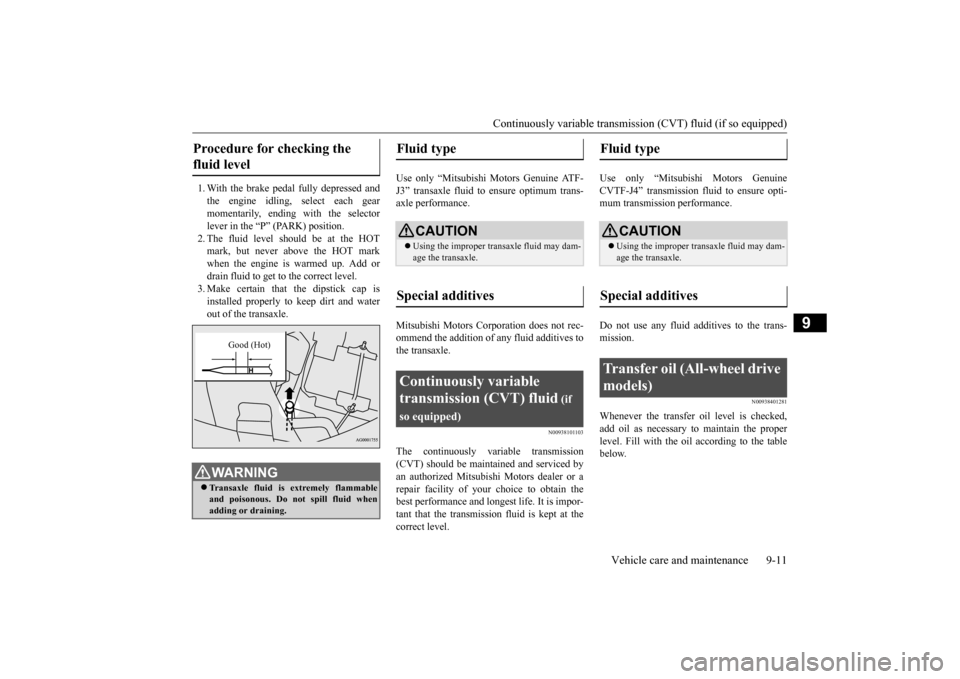
1. With the brake pedal fully depressed and the engine idling,
select each gear
momentarily, ending with the selectorlever in the “P” (PARK) position. 2. The fluid level should be at the HOT mark, but never a
bove the HOT mark
when the engine is warmed up. Add or drain fluid to get to the correct level. 3. Make certain that the dipstick cap is installed properly to
keep dirt and water
out of the transaxle.
Use only “Mitsubishi Motors Genuine ATF- J3” transaxle fluid to
ensure optimum trans-
axle performance. Mitsubishi Motors Cor
poration does not rec-
ommend the addition of
any fluid additives to
the transaxle.
N00938101103
The continuously variable transmission (CVT) should be maintained and serviced byan authorized Mitsubishi Motors dealer or a repair facility of your choice to obtain the best performance and longest life. It is impor-tant that the transmission fluid is kept at the correct level.
Use only “Mitsubish
i Motors Genuine
CVTF-J4” transmission fluid to ensure opti- mum transmission performance. Do not use any fluid additives to the trans- mission.
N00938401281
Whenever the transfer oil level is checked,add oil as necessary to
maintain the proper
level. Fill with the oil according to the table below.
Procedure for checking the fluid level
WA R N I N G Transaxle fluid is extremely flammable and poisonous. Do not spill fluid when adding or draining.
Good (Hot)
Fluid type
CAUTION Using the improper transaxle fluid may dam- age the transaxle.
Special additives
Continuously variable transmission (CVT) fluid
(if
so equipped)
Fluid type
CAUTION Using the improper transaxle fluid may dam- age the transaxle.
Special additives
Transfer oil (All-wheel drive models)
BK0211800US.book 11 ページ 2014年3月12日 水曜日 午後2時42分
Page 393 of 446
Rear axle oil (All-wheel drive models) 9-12 Vehicle care and maintenance
9
N00915201279
Whenever the oil level is checked, add oil as necessary to maintain the proper level. Fill with the oil according to the table below.
N00938601313
The windshield and rear
window washer fluid
reservoir is in the engine compartment.
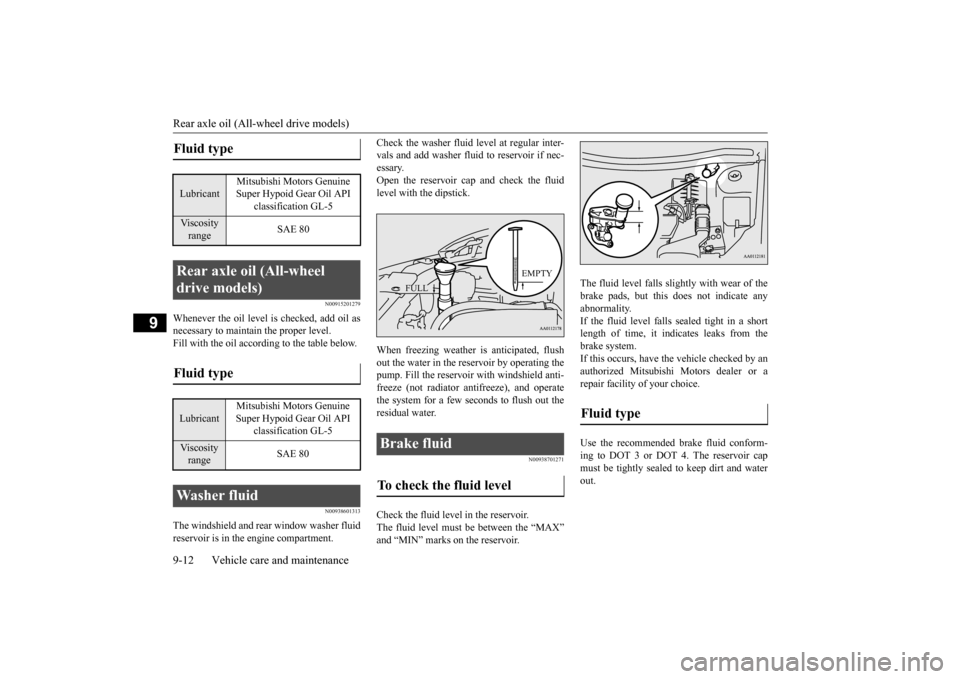
Check the washer fluid
level at regular inter-
vals and add washer fluid to reservoir if nec-essary. Open the reservoir cap and check the fluid level with the dipstick. When freezing weather is anticipated, flush out the water in the reservoir by operating thepump. Fill the reservoir with windshield anti- freeze (not radiator
antifreeze), and operate
the system for a few se
conds to flush out the
residual water.
N00938701271
Check the fluid level in the reservoir.The fluid level must be between the “MAX” and “MIN” marks on the reservoir.
The fluid level falls slightly with wear of the brake pads, but this
does not indicate any
abnormality. If the fluid level falls se
aled tight in a short
length of time, it indi
cates leaks from the
brake system. If this occurs, have the vehicle checked by an authorized Mitsubishi Motors dealer or arepair facility of your choice. Use the recommended brake fluid conform- ing to DOT 3 or DOT
4. The reservoir cap
must be tightly sealed to keep dirt and water out.
Fluid type Lubricant
Mitsubishi Motors Genuine Super Hypoid Gear Oil API
classification GL-5
Viscosity range
SAE 80
Rear axle oil (All-wheel drive models) Fluid type Lubricant
Mitsubishi Motors Genuine Super Hypoid Gear Oil API
classification GL-5
Viscosity range
SAE 80
Washer fluid
Brake fluid To check the fluid level
EMPTY
FULL
Fluid type
BK0211800US.book 12 ページ 2014年3月12日 水曜日 午後2時42分
Page 394 of 446
Battery
Vehicle care and maintenance 9-13
9
N00939101940
The condition of the batte
ry is very important
for quick starting and to keep the vehicle’selectrical system working properly. Check the battery regularly. If battery performance
is suspect, have the
battery and charging
system tested by an
authorized Mitsubishi Motors dealer or a repair facility
of your choice.
The electrolyte level
must be between the
limits shown on the outside
of the battery. Fill
it with distilled water
as needed. The inside of
the battery is divided into several compart- ments. Take the cap off of each compartmentand fill to the mark. Do not fill above the t
op line because a spill
during driving could cause damage. The battery is weaker in cold temperatures. This has to do with its chemical and physicalproperties and is why a very cold battery, especially one with a lo
w charge, will have a
hard time starting your vehicle.It is recommended that you have your battery and charging system checked by an autho- rized Mitsubishi Motors dealer or a repair
facility of your choice
before the start of cold
weather. If necessary, have it charged. Thiswill provide more reliab
le starting, and longer
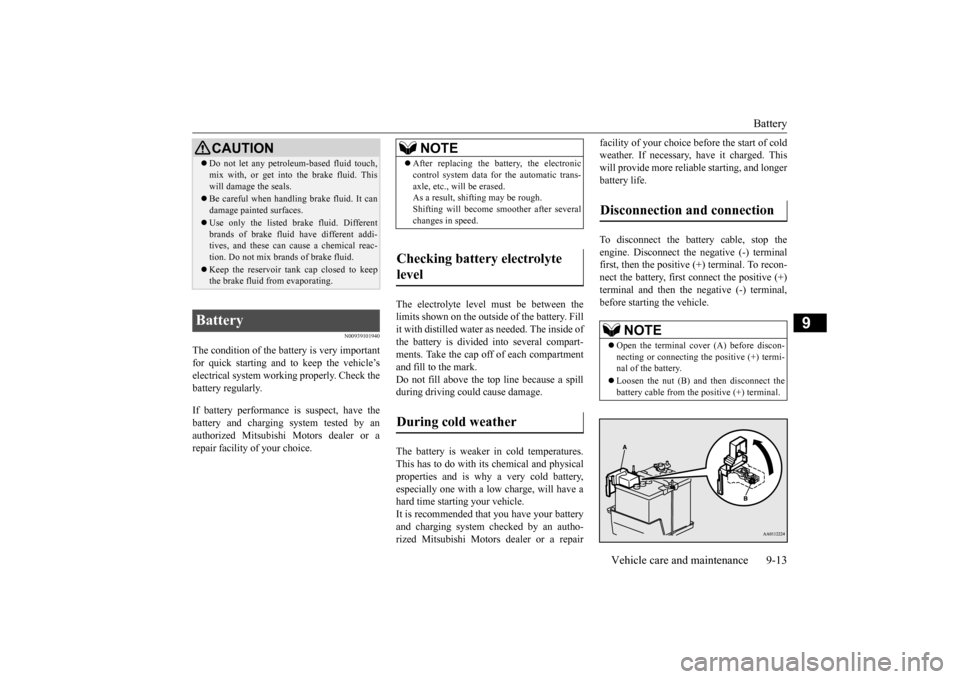
battery life. To disconnect the battery cable, stop the engine. Disconne
ct the negative (-) terminal
first, then the positive
(+) terminal. To recon-
nect the battery, first
connect the positive (+)
terminal and then the negative (-) terminal,before starting the vehicle.
CAUTION Do not let any petrol
eum-based fluid touch,
mix with, or get into the brake fluid. Thiswill damage the seals. Be careful when handling brake fluid. It can damage painted surfaces. Use only the listed brake fluid. Different brands of brake fluid have different addi-tives, and these can cause a chemical reac- tion. Do not mix brands of brake fluid. Keep the reservoir ta
nk cap closed to keep
the brake fluid from evaporating.
Battery
NOTE
After replacing the battery, the electronic control system data for the automatic trans-axle, etc., will be erased.As a result, shifting may be rough. Shifting will become smoother after several changes in speed.
Checking battery electrolyte level During cold weather
Disconnection and connection
NOTE
Open the terminal cover (A) before discon- necting or connecting the positive (+) termi- nal of the battery. Loosen the nut (B) and then disconnect the battery cable from the positive (+) terminal.
BK0211800US.book 13 ページ 2014年3月12日 水曜日 午後2時42分
Page 395 of 446
Tires 9-14 Vehicle care and maintenance
9
N00939201589
It is important to familiarize yourself with the following terms: Cold tire pressure: • The measured pressure after the vehicle has been parked for
at least three hours,
or• The measured pressure when the vehicle is driven less than 1 mile (1.6 km) after having been parked for three hours.
Maximum pressure: the maximum per- missible cold tire inflation pressure for this tire.
WA R N I N G Never disconnect the battery while the engine is running, or you could damagethe vehicle’s electrical parts. Never short-circuit the battery. This could cause it to overheat and be damaged. Keep sparks, cigarette
s, and flames away
from the battery because the battery couldexplode. Electrolyte (battery acid) is made of corro- sive diluted sulfuric acid. If it spills on nearby parts, it can crack, stain, or dis- color them. And if it gets on your skin orin your eyes, it can cause burns or blind- ness. Please observe the following han- dling instructions:• If electrolyte gets on plastic parts orother nearby parts, wipe it off with a softcloth or chamois soak
ed in a solution of
water and neutral detergent then imme- diately rinse the affected parts withplenty of water.• If electrolyte gets on your hands orclothes, rinse thoroughly with water. If electrolyte gets in
your eyes, flush them
with water immediately and get immedi-ate medical attention.
Open doors and wind
ows in any closed
space where you may be charging or working with the battery. Always wear protective clothing and gog- gles when working with the battery, or have a skilled automobi
le technician do it.
If you are quick-charging your battery, first disconnect the battery cables. In order to prevent a short-circuit, be sure to disconnect the negative (-) terminal first, and reconnect it last. If the electrolyte level
is very low, have the
battery checked at an
authorized Mitsubi-
shi Motors dealer or
a repair facility of
your choice. Battery posts, termin
als and related acces-
sories contain lead
and lead compounds.
Wash hands after handling.NOTE
Check each battery terminal for corrosion. You can prevent further corrosion by wash-ing with a solution of
baking soda and water.
Grease the posts and cl
amps after cleaning or
tightening them. Ensure the battery is securely installed and cannot be moved. Also
check each terminal
for tightness. If you will not be driv
ing your vehicle for a
long period of time, re
move the battery and
store it in a place where the battery fluid will not freeze. The batter
y only should be stored
with a full charge. Before cleaning the ba
ttery, tighten all the
filler port caps to keep
dirt and moisture out.
WA R N I N G
Tires
WA R N I N GDriving with tires that are worn, damaged or improperly inflated is dangerous.These type tire conditions will adversely affect vehicle performance. These type tire conditions can also cause atread separation or blowout which may result in an accide
nt causing serious
injury or death. Tires, including spar
e tire, degrade over
time with age even when they are notbeing used. It is recommended that tires over 6 years generally be replaced even if damage isnot obvious.
BK0211800US.book 14 ページ 2014年3月12日 水曜日 午後2時42分
Page 399 of 446
Tires 9-18 Vehicle care and maintenance
9
The temperature grades are A (the highest), B and C, representing the tire’s resistance to thegeneration of heat and
its ability to dissipate
heat when tested under controlled conditions on a specified indoor la
boratory test wheel.
Sustained high temper
ature can cause the
material of the tire to
degenerate and reduce
tire life, and excessive temperature can leadto sudden tire failure. The grade C corre- sponds to a level of performance which all passenger car tires must meet under the Fed- eral Motor Vehicle Safety Standard No. 109. Grades B and A represent higher levels ofperformance on the labora
tory test wheel than
the minimum required by law.
N00939300815
Proper tire inflation pres
sure is essential for
the safe and satisfactory operation of your vehicle. The wrong tire
pressure will cause
problems in three major areas: Safety Too little pressure increases flexing in the tire and can cause tire failure. Too muchpressure can cause a tire to lose its ability to cushion shock. Objects on the road and potholes could then cause tire damage thatmay result in tire failure.
Economy The wrong tire pressu
re can cause uneven
wear patterns in the tire tread. These abnormal wear patter
ns will reduce the
tread life, and the tire will have to bereplaced sooner. Too little pressure also
makes it harder for
the tire to roll, and this uses up more fuel. Ride comfort and vehicle stability The superior riding e
xperience built into
your vehicle partly depends on the correct tire pressure. Too much pressure gives an uncomfortable and ja
rring ride. Too little
pressure feels as if
your vehicle is slow to
respond. Unequal tire pressure
s can make steering
your vehicle uneven and unpredictable.
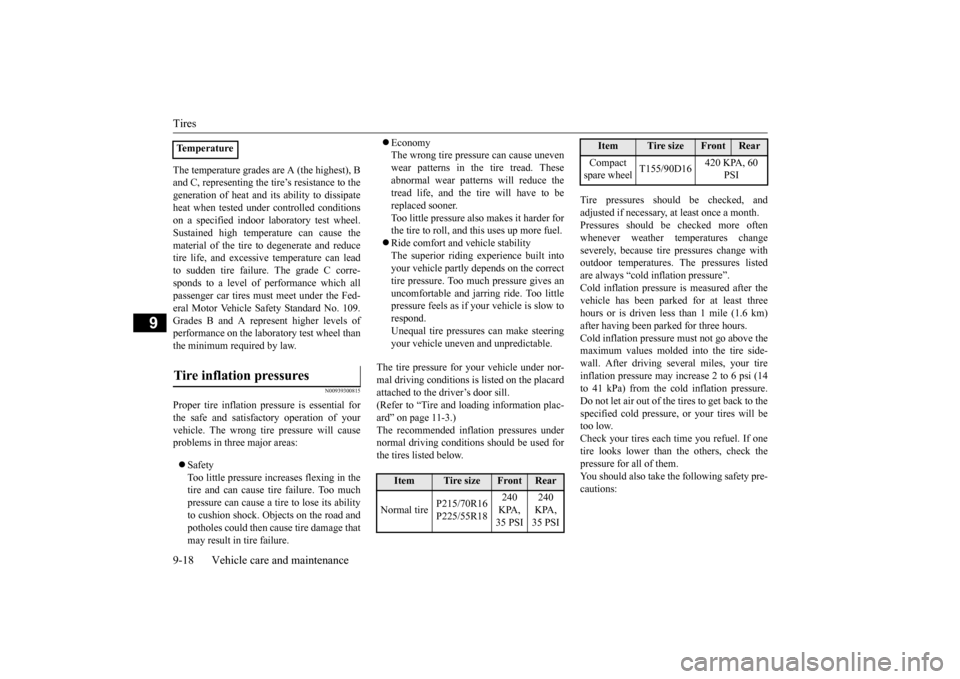
The tire pressure for your vehicle under nor- mal driving conditions is listed on the placard attached to the driver’s door sill.(Refer to “Tire and loading information plac- ard” on page 11-3.) The recommended infl
ation pressures under
normal driving conditions should be used for the tires listed below.
Tire pressures should be checked, and adjusted if necessary, at least once a month.Pressures should be checked more often whenever weather temperatures change severely, becaus
e tire pressures change with
outdoor temperatures. The pressures listed are always “cold in
flation pressure”.
Cold inflation pressure is measured after thevehicle has been parked
for at least three
hours or is driven less than 1 mile (1.6 km) after having been parked for three hours. Cold inflation pressure must not go above the maximum values molded into the tire side-wall. After driving seve
ral miles, your tire
inflation pressure may increase 2 to 6 psi (14 to 41 kPa) from the cold inflation pressure.Do not let air out of the tires to get back to the specified cold pressure, or your tires will be too low.Check your tires each time you refuel. If one tire looks lower than the others, check the pressure for all of them.You should also take the following safety pre- cautions:
TemperatureTire inflation pressures
Item
Tire size
Front
Rear
Normal tire
P215/70R16 P225/55R18
240 KPA, 35 PSI
240 KPA, 35 PSI
Compact spare wheel
T155/90D16
420 KPA, 60
PSI
Item
Tire size
Front
Rear
BK0211800US.book 18 ページ 2014年3月12日 水曜日 午後2時42分
Page 400 of 446
Tires
Vehicle care and maintenance 9-19
9
Keep your tires inflated to the recom- mended pressures. (See the tire and load-ing information placard attached to the driver’s door sill.) Stay within the recommended load limits. Make sure that the weight of any load in your vehicle is evenly distributed. Drive at safe speeds. After filling your tires to the correct pres- sure, check them for damage and air leaks. Be sure to reinstall the caps on the valve stems.
N00939600241
N00939700141
The following maintenance steps are recom- mended: Check tire pressures regularly. Have regular maintenance done on the wheel balance and front
and rear suspen-
sion alignment. Rotate your tires regularly as described in the “Tire rotation” se
ction on page 9-20.
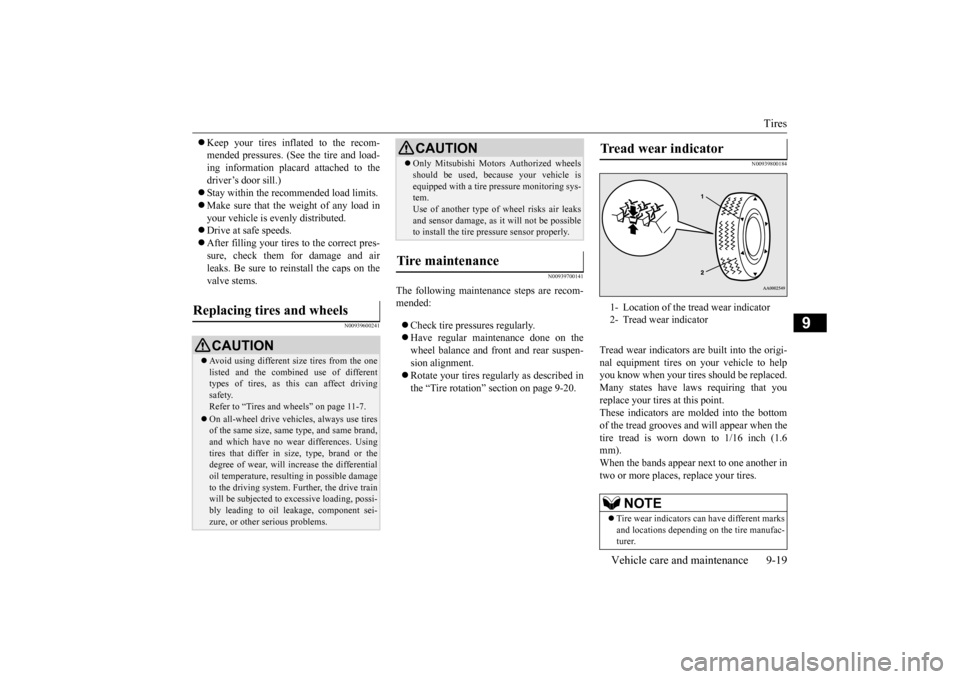
N00939800184
Tread wear indicators ar
e built into the origi-
nal equipment tires on
your vehicle to help
you know when your tires should be replaced. Many states have la
ws requiring that you
replace your tires at this point.These indicators are molded into the bottom of the tread grooves and will appear when the tire tread is worn down to 1/16 inch (1.6mm). When the bands appear next to one another in two or more places
, replace your tires.
Replacing tires and wheels
CAUTIONAvoid using different size tires from the one listed and the combined use of different types of tires, as this can affect driving safety.Refer to “Tires and wheels” on page 11-7. On all-wheel drive vehi
cles, always use tires
of the same size, same
type, and same brand,
and which have no wear differences. Using tires that differ in si
ze, type, brand or the
degree of wear, will increase the differential oil temperature, resulting in possible damage to the driving system. Further, the drive trainwill be subjected to ex
cessive loading, possi-
bly leading to oil leakage, component sei- zure, or other serious problems.
Only Mitsubishi Motors Authorized wheels should be used, beca
use your vehicle is
equipped with a tire pr
essure monitoring sys-
tem. Use of another type of
wheel risks air leaks
and sensor damage, as
it will not be possible
to install the tire pressure sensor properly.
Tire maintenance
CAUTION
Tread wear indicator 1- Location of the tread wear indicator 2- Tread wear indicator
NOTE
Tire wear indicators ca
n have different marks
and locations dependi
ng on the tire manufac-
turer.
BK0211800US.book 19 ページ 2014年3月12日 水曜日 午後2時42分
Page 401 of 446

Tires 9-20 Vehicle care and maintenance
9
N00939901528
To even out the wear on your tires and make them last longer, Mitsubishi Motors Corpora- tion recommends that y
ou rotate your tires at
the mileage listed in the “WARRANTY AND MAINTENANCE MANUAL”. However, the timing for tire rotation mayvary according to your vehicle condition, road surface conditions, and your own per- sonal driving habits. Any time you notice unusual wear, rotate your tires as soon as pos- sible. When rotating tires, check for uneven wear, damage, and wheel alignment. Abnormal wear is usually caused by a wrong tire pres- sure, wheels that ar
e not aligned properly,
wheels that are out-of-balance, or severe braking. Check with an author
ized Mitsubishi Motors
dealer or a repair facility of your choice to find out the reason for uneven tread wear. The first tire rotation is the most important one. It will allow all your
tires to wear evenly.
N00940000320
In some areas of the country, snow tires are required for winter driving. If snow tires are required in your area, you must choose snowtires of the same size
and type as the original
tires provided with your vehicle. Snow tires should also be installe
d on all four wheels.
Otherwise your safety and vehicle handling can be reduced. Even where laws may permit it, snow tiresshould not be operated
at sustained speeds
over 75 mph (120 km/h).
Tire rotation
CAUTION A compact spare tire can be installed tempo- rarily in place of a tire
that has been removed
during the tire rotation. However, it must notbe included in the regular tire rotation sequence. If the tires have arrows (A) indicating the correct direction of ro
tation, swap the front
and rear tires on the le
ft-hand side of the
vehicle and the front
and rear tires on the
right-hand side of th
e vehicle separately.
Keep each tire on its original side of the vehicle. When installing the tires, make surethe arrows point in the
direction in which the
wheels will turn when the vehicle moves for- ward. Any tire whose arrow points in thewrong direction will not
perform to its full
potential.
Tires that do not have arrows showing rotation direction Tires that have arrows s
howing rotation direction
Front Front
CAUTION Avoid the combined use of different types of tires. Using different t
ypes of tires can affect
vehicle performance and safety.
Snow tires
Front
BK0211800US.book 20 ページ 2014年3月12日 水曜日 午後2時42分
Page 402 of 446
Brake pedal free play
Vehicle care and maintenance 9-21
9
N00940101139 N00940300293
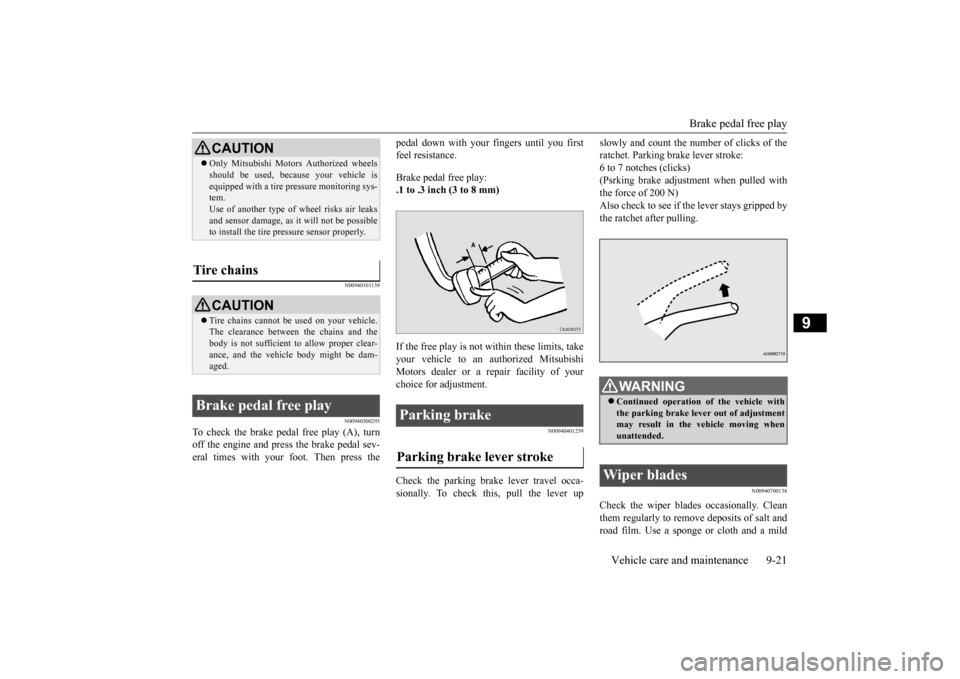
To check the brake pedal free play (A), turn off the engine and press the brake pedal sev- eral times with your
foot. Then press the
pedal down with your fingers until you first feel resistance. Brake pedal free play: .1 to .3 inch (3 to 8 mm) If the free play is not within these limits, take your vehicle to an authorized Mitsubishi Motors dealer or a repair facility of your choice for adjustment.
N00940401259
Check the parking brake lever travel occa- sionally. To check this, pull the lever up
slowly and count the number of clicks of the ratchet. Parking br
ake lever stroke:
6 to 7 notches (clicks) (Psrking brake adjustment when pulled with the force of 200 N)Also check to see if the lever stays gripped by the ratchet after pulling.
N00940700138
Check the wiper blades occasionally. Clean them regularly to rem
ove deposits of salt and
road film. Use a sponge or cloth and a mild
CAUTION Only Mitsubishi Motors Authorized wheels should be used, beca
use your vehicle is
equipped with a tire pr
essure monitoring sys-
tem. Use of another type of wheel risks air leaks and sensor damage, as it
will not be possible
to install the tire pressure sensor properly.
Tire chains
CAUTION Tire chains cannot be used on your vehicle. The clearance between the chains and the body is not sufficient
to allow proper clear-
ance, and the vehicle body might be dam- aged.
Brake pedal free play
Parking brake Parking brake lever stroke
WA R N I N G Continued operation
of the vehicle with
the parking brake leve
r out of adjustment
may result in the vehicle moving when unattended.
Wiper blades
BK0211800US.book 21 ページ 2014年3月12日 水曜日 午後2時42分