2015 MITSUBISHI MIRAGE Temperature
[x] Cancel search: TemperaturePage 222 of 300

Antenna
Comfort controls 7-41
7
To clean a disc, use a soft, clean, dry cloth. Wipe directly
from the center hole
toward the outer edge. Do not wipe in a circle. Never use any chemicals such as benzine, paint thi
nner, a disc spray
cleaner, or an anti-static agent on the disc. Do not use a ball point
pen, felt pen, pen-
cil, etc. to write on the label surface of thedisc. Do not put additional la
bels or stickers on
compact discs. Also, do not use any com- pact disc on which a label or sticker has started to peel off or any compact disc thathas stickiness or ot
her contamination left
by a peeled-off label or sticker. If you use such a compact disc, the CD player maystop working properly and you may not be able to eject the compact disc.
N00751900066
You may have trouble playing back some CD-R/RW discs recorded on CD record- ers (CD-R/RW drives), either due to theirrecording characterist
ics or dirt, finger-
prints, scratches, etc.
on the disc surface.
CD-R/RW discs are less resistant to high temperatures and high humidity than ordi- nary music CDs and can therefore be damaged and rendered unplayable if leftinside your vehicle for a long time.
Depending on the combination of the writing software, the CD recorder (CD-R/RW drive), and the di
sc used to create a
CD-R/RW, the disc might not play suc- cessfully. This player cannot play the CD-R/RW discs if the sessi
on is not closed.
This player cannot play CD-R/RW discs which contain data other than CD-DA or MP3 data (Video CD, etc.). Be sure to observe
the handling instruc-
tions for the CD-R/RW disc.
N00734201508
Turn the pole (A) counterclockwise.
Screw the pole (A) clockwise into the base (B) until it is securely retained.
Notes on CD-Rs/RWs
WA R N I N G Operating the CD player in a manner other than specifically instructed hereinmay result in hazardous radiation expo- sure. Do not remove the cover and attempt to repair the CD player by yourself. Thereare no user serviceable parts inside. In case of malfunction,
contact an authorized
Mitsubishi Motors dealer or a repair facil-ity of your choice.
Antenna To remove
To install
NOTE
Be sure to remove the roof antenna in the following cases: • When using an automatic car wash• When covering your ve
hicle with a car
cover • When driving into a structure that has a low ceiling.
BK0212400US.book 41 ページ 2014年4月1日 火曜日 午後2時21分
Page 227 of 300

If the vehicle breaks down 8-2 For emergencies
8
N00836300233
If your vehicle breaks down on the road, move to the shoulder and turn on the hazard warning flashers. If there is no shoulder, orthe shoulder is not safe, drive in the right lane slowly with the haza
rd lights flashing until
you come to a safe stopping place. Keep theflashers flashing. If the engine stops, there will be no power assist to the steering and brakes, making these difficult to use. The brake booster will not work, so the brakes will not grip well. The brake pedal will be harder to press than usual. Since there is no power steering assist, the steering wheel will be hard to turn.
Get help from your passengers, bystanders, etc. to push the vehicle
and move it to a safe
area.
N00836400768
If the engine cannot be started because the battery is weak or de
ad, you can start it with
the battery from anothe
r vehicle using jumper
cables. 1. Take off any metal jewelry such as watch bands or bracelets th
at might create an
accidental electrical contact. 2. Position the vehi
cles close enough
together so that the jumper cables canreach, but be sure the vehicles aren’t touching each other.
3. You could be injured if the vehicles move. Set the parking brake firmly on each vehi- cle. Put an automatic transaxle or CVT in “P” (PARK) or a manual transaxle in “N”(Neutral). 4. Turn the ignition switch to the “OFF” position or put the operation mode inOFF. 5. Make sure your battery electrolyte is at the proper level. (Refer to “Battery” on page 9-10.)
If the vehicle breaks down If the engine stops/fails When the engine fails at the intersection
Jump-starting the engine
WA R N I N G To reduce the risk of igniting flammable gas that may be emitted from the battery,carefully read this section before jump- starting the vehicle. Do not try to start you
r vehicle by pushing
or towing. This can cause an accident resulting in serious
injury or death and
can damage the vehicle.NOTE
Do not use jumper cables if they have dam- age or corrosion.
CAUTION Check the other vehicle.
It must have a 12-
volt battery. If the other system isn’t 12-volt,both systems can be damaged.NOTE
Turn off all lights, heat
er, and othe
r electrical
loads. This will avoid sparks and help save both batteries.WA R N I N G If the electrolyte fluid is not visible, or looks frozen, DO NOT ATTEMPT JUMPSTARTING!! The battery might spli
t open or explode if
the temperature is below the freezingpoint or if it is not filled to the proper level.
BK0212400US.book 2 ページ 2014年4月1日 火曜日 午後2時21分
Page 229 of 300

Engine overheating 8-4 For emergencies
8
If you drive your vehicle with a low battery charge after the engine has been started byusing jumper cables, the engine may misfire. This can cause the an
ti-lock braking system
warning light to blink on and off. This is onlydue to the low battery voltage. It is not a problem with the brak
e system. If this hap-
pens, fully charge the battery and ensure thecharging system is operating properly.
N00836500365
If the high coolant temperature warning lightilluminates during the engine is running, the engine may be overheating. If this happens: 1. Stop the vehicle in a safe place. Turn on the hazard warning flashers.2. With the engine st
ill running, carefully
raise the engine hood to vent the engine compartment.
3. Check that the cooling fan is running. If the fan is not turning, stop the engineimmediately and contact an authorized Mitsubishi Motors dealer or a repair facil- ity of your choice for assistance. 4. If you see steam or spray coming from under the hood, turn off the engine. 5. If you do not see stea
m or spray coming
from under the hood, leave the engine onuntil the high coolant temperature warn- ing light goes off. After the high coolant temperature warning light has gone off,you can start driving again. If the high coolant temperature warning light stays on, turn off the engine.
6. When you do not see any more steam or spray, open the hood. Look for obviousleaks, such as a split radiator hose. Be careful as components will be hot. Any leak source must be repaired.7. If there is no obvious leak source, check the coolant level in the engine coolant reserve tank. If there is none, or if it is toolow, slowly add coolant. 8. If the engine coolant reserve tank needs coolant, you will probably also need to add coolant to the radiator. Do not loosen or remove the radiator cap until the enginehas cooled down. 9. Start the engine, and slowly add coolant, up to the bottom of the filler neck. Use plain water if you have to (and replace itwith the right coolant as soon as possible).
Always wear protective clothing and gog- gles when working near the battery. Keep the battery out of the reach of chil- dren.
As your vehicle has anti-lock brakes Engine overheating
WA R N I N G
WA R N I N G To avoid personal injury
, keep hands, hair,
jewelry and clothes aw
ay from the cooling
fan. The cooling fan ca
n start at any time.
WA R N I N GBefore raising the engine hood, check to see if there is steam or spray coming fromunder the hood. Steam or spray comingfrom an overheated en
gine could seriously
scald you. Do not open the hood until there is nosteam or spray.
WA R N I N G Removing the radiat
or cap could scald
you with escaping hot water or steam. When checking the radiator level, coverthe cap with a cloth before trying to remove it. Turn it slowly counterclock- wise, without pressing down, to the firstnotch. The pressure in the system will then be let out. When the pressure is COM- PLETELY LET OUT, press down andkeep turning the cap counterclockwise until it comes off.
BK0212400US.book 4 ページ 2014年4月1日 火曜日 午後2時21分
Page 230 of 300

Jack and tools
For emergencies 8-5
8
10. Replace the radiator
cap and tighten it
fully. Check the coolant temperaturewarning light. You can start driving again when the high coolant temperature warn- ing light does not come on.
11. Have the system in
spected by your autho-
rized Mitsubishi Motors dealer or a repair facility of your choice.
N00836600379
The tools are stored beneath the floor boardof the cargo area. The jack (if so equipped) is stored under the driver’s seat.
Before removing or storing the jack, move the driver’s seat fully forward to access the jack from the rear seat area. (Refer to “Front seat” on page 4-3.) Turn the shaft end of the jack in the direction (1) until the jack fully retracts and remove the jack from the holder (A). Put the jack in the holder (A) and turn the shaft end of the jack in the direction (2) byhand until the jack is firmly secured.
Jack and tools Storage
1- Tools 2- Jack (if so equipped)Tools 1- Tools bag 2- Wheel nut wrenchType A Type B
3- Jack bar 4- Towing hookJack
(if so equipped)CAUTION Never access, remove or store the jack from the front of the driver’s seat. Doing so could damage electr
ical wires under the driver’s
seat.
To remove
To s t o r e
BK0212400US.book 5 ページ 2014年4月1日 火曜日 午後2時21分
Page 232 of 300
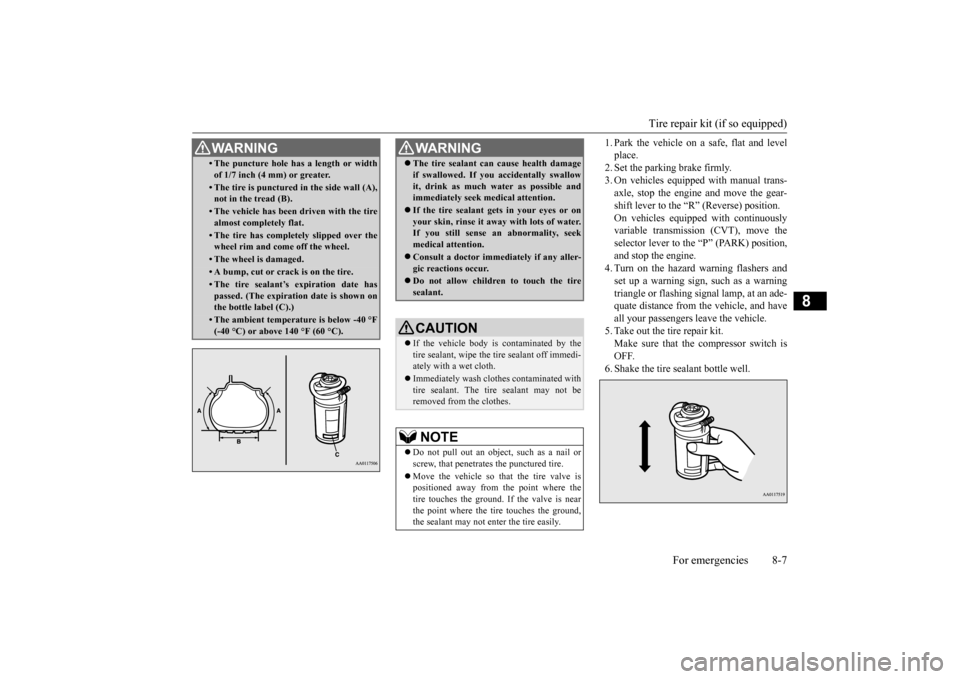
Tire repair kit (if so equipped)
For emergencies 8-7
8
1. Park the vehicle on a safe, flat and level place.2. Set the parking brake firmly. 3. On vehicles equipped with manual trans- axle, stop the engine and move the gear-shift lever to the “R” (Reverse) position. On vehicles equippe
d with continuously
variable transmissi
on (CVT), move the
selector lever to the “P” (PARK) position, and stop the engine. 4. Turn on the hazard warning flashers and set up a warning sign, such as a warning triangle or flashing signal lamp, at an ade-quate distance from the vehicle, and have all your passengers
leave the vehicle.
5. Take out the tire repair kit.Make sure that the compressor switch is OFF. 6. Shake the tire sealant bottle well.
• The puncture hole has a length or width of 1/7 inch (4 mm) or greater.• The tire is punctured in the side wall (A), not in the tread (B).• The vehicle has been driven with the tirealmost completely flat.• The tire has completely slipped over thewheel rim and come off the wheel.• The wheel is damaged.• A bump, cut or crack is on the tire.• The tire sealant’s expiration date has passed. (The expiration date is shown onthe bottle label (C).)• The ambient temperature is below -40 °F(-40 °C) or above 140 °F (60 °C).WA R N I N G
WA R N I N G The tire sealant can
cause health damage
if swallowed. If you
accidentally swallow
it, drink as much water as possible andimmediately seek
medical attention.
If the tire sealant ge
ts in your eyes or on
your skin, rinse it away with lots of water. If you still sense an abnormality, seek medical attention. Consult a doctor immediately if any aller- gic reactions occur. Do not allow children to touch the tire sealant.CAUTION If the vehicle body is contaminated by the tire sealant, wipe the tire sealant off immedi- ately with a wet cloth. Immediately wash clot
hes contaminated with
tire sealant. The tire sealant may not be removed from the clothes.NOTE
Do not pull out an object, such as a nail or screw, that penetrat
es the punctured tire.
Move the vehicle so that the tire valve is positioned away from the point where thetire touches the ground. If the valve is near the point where the tire touches the ground, the sealant may not enter the tire easily.
BK0212400US.book 7 ページ 2014年4月1日 火曜日 午後2時21分
Page 251 of 300

Engine oil and oil filter 9-6 Vehicle care and maintenance
9
Mitsubishi Motors recommends using only engine oils with the ILSAC certification sym- bol on the front of the container. If you cannot find oils
with the ILSAC certi-
fication symbol, use an API classification SN or higher oil with the following label.
This mark appears on the top of the oil con- tainer and tells you two important thingsabout the oil. Use engine oil with the proper thickness for the outdoor temperatures where you will bedriving.
CAUTION Overfilling will cause oil aeration and loss of oil pressure, which coul
d damage the engine.
WA R N I N GUsed engine oil is po
isonous, and can dam-
age your skin. Prolonged and repeatedcontact may cause serious skin disorders, including dermatitis and cancer. Do not let used oil touch your sk
in and wash thor-
oughly after working with it. Keep used oil out of
the reach of children.
NOTE
Engine oil consumption
is greatly influenced
by payload, engine speed, etc.
Good
The engine oil wi
ll deteriorate rapidly if the
vehicle is subj
ected to severe conditions (for
example, repeated operation on rough roads,in mountainous regions, on roads with many uphill and downhill gradients, or over short distances). Consequently
, the oil will require
earlier replacement in accordance with the schedule in the “WARRANTY AND MAIN- TENANCE MANUAL”.
Engine oil identification mark
NOTE
ILSAC certification symbol
1- The upper part indicates the quality of
the oil.
2- The center part i
ndicates the SAE grade
of the oil viscosity.
Recommended engine oil vis- cosity API service symbol
BK0212400US.book 6 ページ 2014年4月1日 火曜日 午後2時21分
Page 253 of 300

Air cleaner filter 9-8 Vehicle care and maintenance
9
The radiator cap must be
sealed tight to pre-
vent losing coolant, which may result in engine damage. Only use a Genuine Mitsubishi Parts radiator
cap, or an approved
equivalent.
Do not overfill the reserve tank. Your vehicle uses a special radiator cap that stays sealed and lets the coolant flow from the reserve tank back to the radiator when the engine cools down. If you needto change the cap, use the exact same kind. Check the coolant freeze point in the radi- ator with the proper gauge, and only when it is safe. If you add antifreeze, the con- tents of the reserve tank must be protectedagainst freezing. Keep the front of the radiator and con- denser clean. If the engine coolant temperature does not rise after the engine is warmed-up, take your vehicle to an au
thorized Mitsubishi
Motors dealer or a repair facility of your choice to have the thermostat checked, and replaced if necessary.
N00937900413
The air cleaner filter
will get dirty and dusty
from use and not filter
properly. Replace it
with a new filter using the schedule in the“WARRANTY AND MAINTENANCE MANUAL”. 1. Unclamp the cover. Open up the top of the cover and take out th
e air cleaner filter.
2. Replacing the air clea
ner filter and put the
cover back on in its original position.
The required concentrati
on of anti-freeze dif-
fers depending on the
expected ambient tem-
perature.Above -31 °F (-35 °C) : 50 % concentration of anti-freeze Below -31 °F (-35 °C) : 60 % concentrationof anti-freeze You can check the concentration level with a gauge from an automotive supply store, oryour authorized Mitsubi
shi Motors dealer or
service station can check it for you. Do not use water to adjust the concentration of coolant. Do not top off the tank with plain water only. Water by itself boils at a lower temperature and does not stop rust or freezing. If thewater freezes, it will
damage your cooling
system. Do not use tapwater. It can cause corrosion and rust.
Radiator cap
CAUTION
WA R N I N G Wait for the engine to cool down before opening the radiator
cap. Otherwise hot
steam or boiling c
oolant could spray up
from the radiator and scald you.
Points to remember
Air cleaner filter
NOTE
Genuine Mitsubishi Motors Parts are recom- mended when replacing th
e air cleaner filter.
Make sure that the
connector is properly
reconnected. After replacing the air cleaner filter, make sure that the hinges at the bottom of cover are firmly set.
BK0212400US.book 8 ページ 2014年4月1日 火曜日 午後2時21分
Page 256 of 300

Battery
Vehicle care and maintenance 9-11
9
N00901600060
The battery is weaker in cold temperatures. This has to do with it
s chemical and physical
properties and is why a very cold battery,especially one with a low charge, will have a hard time starting your vehicle. It is recommended th
at you have your battery
and charging system checked by an autho- rized Mitsubishi Motors dealer or a repair facility of your choice
before the start of cold
weather. If necessary, have it charged. This will provide more reliab
le starting, and longer
battery life.
N00901701130
To disconnect the battery cable, stop theengine. Disconne
ct the negative (-) terminal
first, then the positive
(+) terminal. To recon-
nect the battery, first
connect the positive (+)
terminal and then the negative (-) terminal,before starting the vehicle. If any of the caps has a loose fit, replace the battery.
During cold weather Disconnection and connection
WA R N I N G
NOTE
Open the terminal c
over (A) before discon-
necting or connecting
the positive (+) termi-
nal of the battery. Loosen the nut (B) and then disconnect the battery cable from the positive (+) terminal.WA R N I N G Never disconnect the battery while the engine is running, or you could damage the vehicle’s electrical parts. Never short-circuit the battery. This could cause it to overheat and be damaged. Keep sparks, cigarette
s, and flames away
from the battery because the battery couldexplode. Electrolyte (battery ac
id) is made of corro-
sive diluted sulfuric acid. If it spills on nearby parts, it can crack, stain, or dis- color them. And if it gets on your skin orin your eyes, it can cause burns or blind- ness. Please observe the following han- dling instructions:
• If electrolyte gets
on plastic parts or
other nearby parts, wi
pe it off with a soft
cloth or chamois soak
ed in a solution of
water and neutral detergent then imme- diately rinse the affected parts with plenty of water.• If electrolyte gets on your hands orclothes, rinse thoroughly with water. Ifelectrolyte gets in your eyes, flush them with water immediat
ely and get immedi-
ate medical attention.
Open doors and wind
ows in any closed
space where you may be charging orworking with the battery. Always wear protecti
ve clothing and gog-
gles when working with the battery, or have a skilled automobi
le technician do it.
If you are quick-charging your battery, first disconnect the battery cables. In order to prevent a short-circuit, be sure to disconnect the
negative (-) terminal
first, and reconnect it last. Battery posts, termin
als and related acces-
sories contain lead and lead compounds.Wash hands after handling.NOTE
Check each battery terminal for corrosion. You can stop more corrosion by washingwith a solution of baking soda and water. Grease the posts and cl
amps after cleaning or
tightening them.WA R N I N G
BK0212400US.book 11 ページ 2014年4月1日 火曜日 午後2時21分