2015 MITSUBISHI LANCER tire type
[x] Cancel search: tire typePage 374 of 434

Tires
Vehicle care and maintenance 9-17
9
N00939201563
It is important to familiarize yourself with the following terms: Cold tire pressure: • The measured pressure after the vehiclehas been parked for at least three hours, or • The measured pressure when the vehicleis driven less than 1 mile (1.6 km) after having been parked for three hours.
Maximum inflation pressure: the maxi- mum permissible cold tire inflation pres- sure for this tire.
Electrolyte (battery acid) is made of corro- sive diluted sulfuric
acid. If it spills on
nearby parts, it can crack, stain, or dis- color them. And if gets on your skin or in your eyes, it can cause burns or blindness.Please observe the following handling instructions:• If electrolyte gets on plastic parts orother nearby parts, wipe it off with a soft cloth or chamois soaked in a solution ofwater and neutral detergent then imme- diately rinse the affected parts with plenty of water.• If electrolyte gets on your hands orclothes, rinse thoroughly with water. Ifelectrolyte gets in your eyes, flush them with water immediately and get immedi- ate medical attention.
Open doors and windows in any closed space where you may be charging orworking with the battery. Always wear protective clothing and gog- gles when working with the battery, or have a skilled automobile technician do it. If you are quick-charging your battery, first disconnect the
battery cables.
In order to prevent a short circuit, be sure to disconnect the negative (-) terminal first, and reconnect it last. If the electrolyte level is very low, have the battery checked at an authorized Mitsubi- shi Motors dealer or a repair facility of your choice.WA R N I N G
Battery terminals and related accessories contain lead and lead compounds. Wash hands after handling. NOTE
Check each battery terminal for corrosion. You can stop more corrosion by washing with a solution of baking soda and water.Grease the posts and clamps after cleaning or tightening them. Check to see that the battery is securely installed and cannot be moved. Also check each terminal for tightness. If you will not be driving your vehicle for a long period of time, remove the battery andstore it in a place where the battery fluid will not freeze. Memory data for settings made by the user may be erased when the battery isremoved. If this happens, reset the settings again using the relevant procedures. The bat- tery only should be stored with a full charge. Before cleaning the battery, tighten all the filler port caps to keep dirt and moisture out.WA R N I N G
Tires
WA R N I N G Driving with tires that are worn, damaged or improperly inflated is dangerous. These type tire conditions will adversely affect vehicle performance.These type tire conditi
ons can also cause a
tread separation or blowout which may result in an accident causing seriousinjury or death. Tires, including spare tire, degrade over time with age even when they are not being used. It is recommended that tires over 6 years generally be replaced even ifdamage is not obvious.
BK0210300US.bo
ok 17 ページ 2014年4月8日 火曜日 午前10時46分
Page 379 of 434

Tires 9-22 Vehicle care and maintenance
9
Tire pressures should be checked, and adjusted if necessary, at least once a month. Pressures should be checked more often whenever weather temperatures changeseverely, because tire pressures change with outdoor temperatures. The pressures listed on the placard are always “cold inflation pres-sure”. Cold inflation pressure
is measured after the
vehicle has been parked for at least threehours or is driven less than 1 mile (1.6 km)after having been parked for three hours. Cold inflation pressure must not go above the maximum values molded into the tire side-wall. After driving several miles, your tire inflation pressure may increase 14 to 41 KPA, 2 to 6 PSI from the cold inflation pressure.Do not let air out of the tires to get back to the specified cold pressure, or your tire pressure will be too low.Check your tires each time you refuel. If one tire looks lower than the others, check the pressure for all of them.You should also take the following safety pre- cautions:
Keep your tires inflated to the recom- mended pressures. (See the tire and load- ing information placard attached to the sill of the driver’s door.) Stay within the recommended load limits. Make sure that the weight of any load in your vehicle is evenly distributed. Drive at safe speeds. After filling your tires to the correct pres- sure, check them for damage and airleaks. Be sure to reinstall the caps on thevalve stems.
N00939600368
N00939700154
The following maintenance steps are recom- mended: Check tire pressures regularly.
Compact spare tire
T125/90 D16
420 KPA, 60 PSI
Item
Tire size
Front
Rear
Replacing tires and wheels
CAUTION Avoid using different size tires and wheels from the ones listed, and avoid the combined use of different types of tires and wheels.Using different size or type tires and wheels may affect driving safety. Refer to “Tires and wheels” on page 11-5.
For All-wheel drive vehicles, always use tires of the same size, same type, and same brand, and which have no wear differences. Using tires that differ in size, type, brand or the degree of wear, will increase the differen-tial oil temperature, resulting in possible damage to the driving system. Further, the drive train will be subjected to excessiveloading, possibly leading to oil leakage, component seizure, or other serious prob- lems. Even if a wheel has the same rim size and offset as the specified type of wheel, itsshape may prevent it from being fitted cor- rectly. Consult an authorized Mitsubishi Motors dealer or a repair facility of yourchoice before using wheels that you have. Only Mitsubishi Motors genuine wheels should be used, because your vehicle is equipped with a tire pressure monitoring sys- tem.Use of another type of wheel risks air leaks and sensor damage, as it will not be possible to install the tire pressure sensor properly.
Tire maintenance
CAUTION
BK0210300US.bo
ok 22 ページ 2014年4月8日 火曜日 午前10時46分
Page 381 of 434

Clutch pedal free play (if so equipped) 9-24 Vehicle care and maintenance
9
N00940000359
In some areas of the country, snow tires are required for winter driving. If snow tires arerequired in your area, you must choose snow tires of the same size and type as the original tires provided with your vehicle. Snow tiresshould also be installed on all four wheels. Otherwise your safety and vehicle handling can be reduced.Even where laws may permit it, snow tiresshould not be operated at sustained speeds over 75 mph (120 km/h).
N00940100129 N00940201097
To check the clutch pedal free play (A), turn off the engine and press the pedal until you feel resistance. Clutch pedal free play: .2 to .4 inch (4 to 9 mm)
CAUTION If the tires have arrows (A) indicating the correct direction of rotation, swap the front and rear tires on the left-hand side of the vehicle and the front and rear tires on the right-hand side of the vehicle separately.Keep each tire on its original side of the vehicle. When installing the tires, make sure the arrows point in the direction in which thewheels will turn when the vehicle moves for- ward. Any tire whose arrow points in the wrong direction will not perform to its fullpotential.CAUTION Avoid the combined use of different types of tires. Using different types of tires can affectvehicle performance and safety.
Front
Snow tires
CAUTION If flange nuts are used on your vehicle, change to tapered nuts when using snow tireswith steel wheels. Only Mitsubishi Motors genuine wheels should be used, because your vehicle is equipped with a tire pressure monitoring sys- tem.Use of another type of wheel risks air leaks and sensor damage, as it will not be possible to install the tire pressure sensor properly.
Tire chains
CAUTION Tire chains cannot be used on your vehicle. The clearance between the chains and the body is not sufficient to allow proper clear- ance, and the vehicle body might be dam-aged.
Clutch pedal free play
(if so
equipped)
BK0210300US.bo
ok 24 ページ 2014年4月8日 火曜日 午前10時46分
Page 384 of 434

General maintenance
Vehicle care and maintenance 9-27
9
high heat sources such as the exhaust mani- fold.
N00941400116
If the fuel-vapor vent line is clogged or dam- aged, the fuel-vapor mixture will escape, pol- luting the air.Have the system checked at an authorized Mitsubishi Motors dealer at the mileage spec- ified in the “WARRANTY AND MAINTE-NANCE MANUAL”.
N00941500159
The next pages list the maintenance servicerecommended by Mitsubishi Motors Corpo- ration. In addition to the general maintenance that needs to be perfor
med at the times listed,
there are other parts which do not usually need regular maintenance. But, if any of these parts stops working prop- erly, your vehicle performance could suffer.Have these items checked if you notice a problem with them. See your authorized Mitsubishi Motors dealer for assistance, if you have any questions.
N00941600033
Good brakes are essen
tial to safe driving.
Check the brake pads and brake linings for wear and check the rear wheel cylinders for leaks. For good braking performance, replacethe brake pads with the
same type pads as the
originals.
N00941700047
Brake hoses and tubing should be checkedfor:
Severe surface cracking, scuffing or worn spots. If the fabric casing of the hose is showing through any cracks or worn spots in the rubber hose cover, the hose shouldbe replaced. The brakes can fail if the hose wears through. Improper installation may cause twisting, or wheel, tire or chassis interference.
N00941800077
Check the following parts for damage andgrease leaks: Ball joint boots of the front suspension and steering linkage Bellows on both ends of the drive shaft
N00942200108
The best way to keep carbon monoxide gas from entering inside your vehicle is to have the engine exhaust system properly serviced.
WA R N I N G If you see a fuel leak or if you smell fuel, do not run the engine. Any spark (includ- ing from the ignition), flame or smokingmaterial could cause an explosion or fire. Call an authorized Mitsubishi Motors dealer or a repair facility of your choicefor assistance.
Evaporative emission control system (except evaporative emission canister) General maintenance
Disc brake pads, rear drum brake linings and rear wheel cylinders Brake hoses
Ball joint, steering linkage seals and drive shaft boots Exhaust system
WA R N I N G Carbon monoxide gas from your vehicle’s exhaust is poisonous. Breathing these fumes can cause unconsciousness or death.
BK0210300US.bo
ok 27 ページ 2014年4月8日 火曜日 午前10時46分
Page 398 of 434

Replacement of light bulbs
Vehicle care and maintenance 9-41
9
2. Remove the entire socket and bulb assem- bly (E) by turning it counterclockwise.
3. Remove the bulb by pulling it out. 4. To install the bulb, perform the removal steps in reverse.
N00943601786
1. Remove the screw (A) and pull the coverout. 2. Remove the screws (B) and pull the entire light unit out.
Except for vehicles with turbochargerVehicles with turbocharger
* - Front of the vehicle
Front fog lights (Type 1)
(if so
equipped)
BK0210300US.bo
ok 41 ページ 2014年4月8日 火曜日 午前10時46分
Page 422 of 434
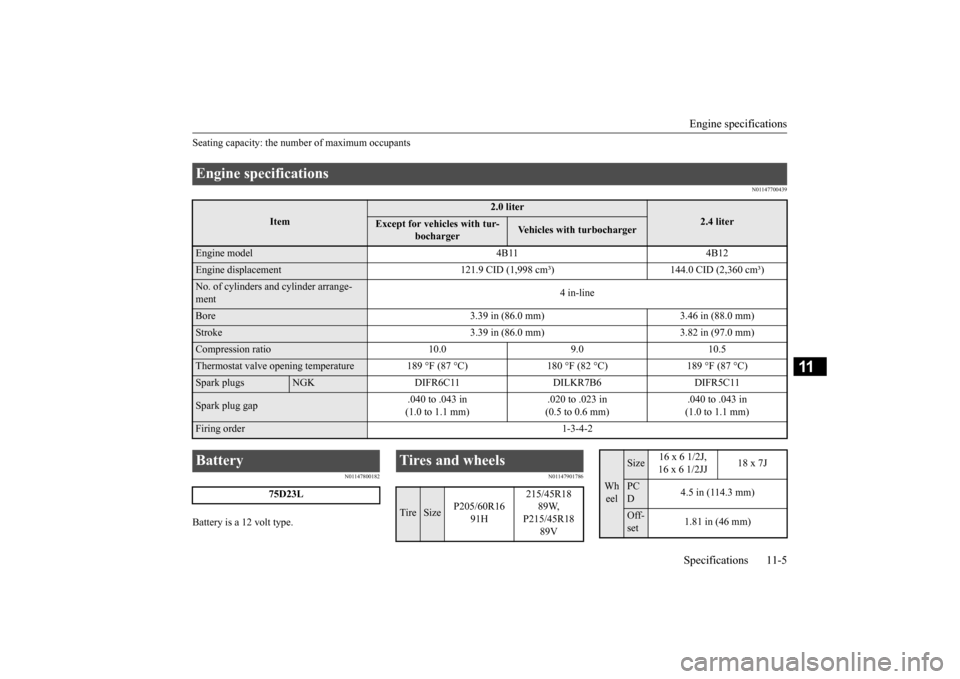
Engine specifications Specifications 11-5
11
Seating capacity: the number of maximum occupants
N01147700439
N01147800182
Battery is a 12 volt type.
N01147901786
Engine specifications
Item
2.0 liter
2.4 liter
Except for vehicles with tur-
bocharger
Vehicles with turbocharger
Engine model 4B11 4B12Engine displacement 121.9 CID (1,998 cm³) 144.0 CID (2,360 cm³)No. of cylinders and cylinder arrange- ment
4 in-line
Bore 3.39 in (86.0 mm) 3.46 in (88.0 mm)Stroke 3.39 in (86.0 mm) 3.82 in (97.0 mm)Compression ratio 10.0 9.0 10.5Thermostat valve opening temperature 189 °F (87 °C) 180 °F (82 °C) 189 °F (87 °C)Spark plugs
NGK DIFR6C11 DILKR7B6 DIFR5C11
Spark plug gap
.040 to .043 in (1.0 to 1.1 mm)
.020 to .023 in (0.5 to 0.6 mm)
.040 to .043 in (1.0 to 1.1 mm)
Firing order 1-3-4-2Battery
75D23L
Tires and wheels Tire
Size
P205/60R16
91H
215/45R18
89W,
P215/45R18
89V
Wheel
Size
16 x 6 1/2J, 16 x 6 1/2JJ
18 x 7J
PC D
4.5 in (114.3 mm)
Off- set
1.81 in (46 mm)
BK0210300US.bo
ok 5 ページ 2014年4月8日 火曜日 午前10時46分