2015 MITSUBISHI LANCER ECU
[x] Cancel search: ECUPage 41 of 434

Seat belts 4-12 Seat and restraint systems
4
N00418300165
The front passenger seat belt warning light is located in the instrument panel.
When the key is turned to the “ON” position, this indicator normally comes on and goes off a few seconds later. The light comes on when a person sits on thefront passenger seat but does not fasten the seat belt. It goes off when the seat belt is sub- sequently fastened.
N00406300315
To move the anchor
down, press the lock
knob (A) and slide the anchor down to the desired position.To move the anchor up, slide the anchor up to the desired position.
N00406701215
When your seat belt, even fully extended, isnot long enough, a seat belt extender must be
WA R N I N G In order to reduce the risk of serious injury or death in an accident, always wear your own seat belt. Do not allow any- one to ride in your vehicle unless he or she is also seated and wearing a seat belt.Children should additionally be restrained in a secure child restraint system.NOTE
At the same time, “FASTEN SEAT BELT” in the multi-information display.
Front passenger seat belt warn- ing light
WA R N I N G Do not install any accessory or sticker that makes the light difficult to see.
Adjustable seat belt shoulder anchor (front seats)
WA R N I N G Always adjust the shoulder belt anchor so that the shoulder belt is positioned across the center of your shoulder without touch- ing your neck. The shoulder belt shouldnot be able to fall off your shoulder. Fail- ure to follow this instruction can adversely affect seat belt performance and increasethe risk of serious injury or death in the event of an accident. Adjust the shoulder belt anchor only when the vehicle is not in motion. Make sure the anchor is securely locked in position after adjusting it.
Seat belt extender
Anchor down
Anchor up
BK0210300US.bo
ok 12 ページ 2014年4月8日 火曜日 午前10時46分
Page 45 of 434

Child restraint systems 4-16 Seat and restraint systems
4
WA R N I N G FRONT-FACING CHILD RESTRAINT SYSTEMS should be used in the rear seat whenever possible. If they must be used inthe front passenger seat, move the seat to the most rearward position and make sure the child stays in the child restraint sys-tem, properly restrained. Failure to follow these instructions could result in serious injury or death to the child.Airbag
WA R N I N G It is important to use an approved rear- facing infant restraint until the infant is one year old (unless the infant outgrows the seat sooner). This allows the infant’s neck and spine to develop enough to sup-port the weight of their head in the event of an accident. When installing a child restraint system, follow the instructions provided by the manufacturer and follow the directions inthis manual. Failure to do so can result in serious injury or death to your child in an accident or sudden stop. After installation, push and pull the child restraint system back and forth, and sideto side, to see that it is firmly secured. If the child restraint system is not installed securely, it may cause injury to the childor other occupants in the event of an acci- dent or sudden stop. When not in use, keep your child restraint system secured with the seat belt, or remove it from the vehicle, in order to pre-vent it from being thrown around inside the vehicle during an accident.
NOTE
Before purchasing a child restraint system, try installing it in the
rear seat to make sure
there is a good fit. Because of the location of the seat belt buckles and the shape of the seat cushion, it may be difficult to securely installsome manufacturer’s child restraint systems. If the child restraint system can be pulled forward or to either side easily on the seatcushion after the seat belt has been tightened, choose another manufacturer’s child restraint system.Depending on the seating position in the vehicle and the child restraint system that you have, the child restraint system can beattached using one of the following two methods: • To the lower anchorage in the rear seat ONLY if the child restraint system is com- patible with the LATCH system (See page4-17). • To the seat belt (See page 4-19).
BK0210300US.bo
ok 16 ページ 2014年4月8日 火曜日 午前10時46分
Page 46 of 434
Child restraint systems
Seat and restraint systems 4-17
4
N00418800131
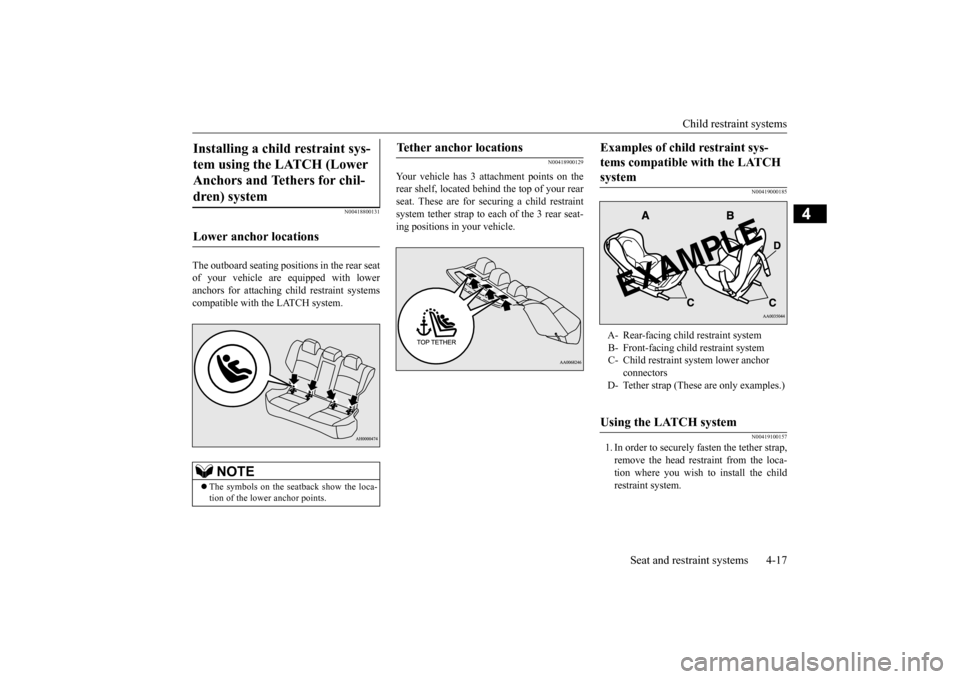
The outboard seating positions in the rear seat of your vehicle are equipped with loweranchors for attaching child restraint systemscompatible with the LATCH system.
N00418900129
Your vehicle has 3 attachment points on therear shelf, located behind the top of your rearseat. These are for securing a child restraint system tether strap to each of the 3 rear seat- ing positions in your vehicle.
N00419000185 N00419100157
1. In order to securely fasten the tether strap, remove the head restraint from the loca- tion where you wish to install the child restraint system.
Installing a child restraint sys- tem using the LATCH (Lower Anchors and Tethers for chil- dren) system Lower anchor locations
NOTE
The symbols on the seatback show the loca- tion of the lower anchor points.
Tether anchor locations
Examples of child restraint sys- tems compatible with the LATCH system A- Rear-facing child restraint system B- Front-facing child restraint systemC- Child restraint system lower anchor
connectors
D- Tether strap (These are only examples.)Using the LATCH system
BK0210300US.bo
ok 17 ページ 2014年4月8日 火曜日 午前10時46分
Page 47 of 434
Child restraint systems 4-18 Seat and restraint systems
4
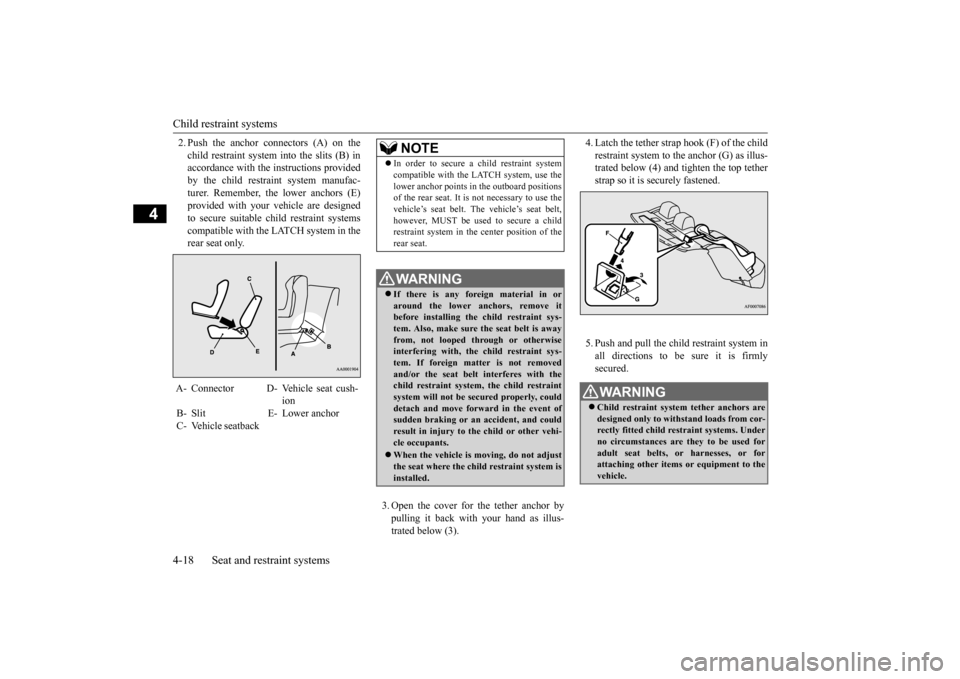
2. Push the anchor connectors (A) on the child restraint system into the slits (B) in accordance with the instructions provided by the child restraint system manufac-turer. Remember, the lower anchors (E) provided with your vehicle are designed to secure suitable child restraint systemscompatible with the LATCH system in the rear seat only.
3. Open the cover for the tether anchor by pulling it back with your hand as illus-trated below (3).
4. Latch the tether strap hook (F) of the child restraint system to the anchor (G) as illus- trated below (4) and tighten the top tether strap so it is securely fastened. 5. Push and pull the ch
ild restraint system in
all directions to be sure it is firmlysecured.
A- Connector D- Vehicle seat cush-
ion
B- Slit E- Lower anchorC- Vehicle seatback
NOTE
In order to secure a child restraint system compatible with the LATCH system, use the lower anchor points in the outboard positions of the rear seat. It is not necessary to use the vehicle’s seat belt. The vehicle’s seat belt,however, MUST be used to secure a child restraint system in the center position of the rear seat.WA R N I N G If there is any foreign material in or around the lower anchors, remove it before installing the child restraint sys-tem. Also, make sure the seat belt is away from, not looped through or otherwise interfering with, the child restraint sys-tem. If foreign matter is not removed and/or the seat belt interferes with the child restraint system, the child restraintsystem will not be secured properly, could detach and move forward in the event of sudden braking or an accident, and couldresult in injury to the child or other vehi- cle occupants. When the vehicle is moving, do not adjust the seat where the child restraint system isinstalled.
WA R N I N G Child restraint system tether anchors are designed only to withstand loads from cor-rectly fitted child restraint systems. Under no circumstances are they to be used for adult seat belts, or harnesses, or forattaching other items or equipment to the vehicle.
BK0210300US.bo
ok 18 ページ 2014年4月8日 火曜日 午前10時46分
Page 48 of 434
Child restraint systems
Seat and restraint systems 4-19
4
N00407301508
With the exception of the driver, the seat belt in all other seating positions can be convertedfrom normal Emergency Locking Retractor (ELR) mode to Automatic Locking Retractor (ALR) mode. This means that when you pullthe seat belt fully out of the retractor, theretractor will switch to its ALR child restraint installation function. Always use the ALR child restraint installation function when youinstall a child restraint system using the seat belt. Children 12 years old and under should always be restrained in the rear seat, when-ever possible, although the front passenger seat belt can also be converted to ALR mode.
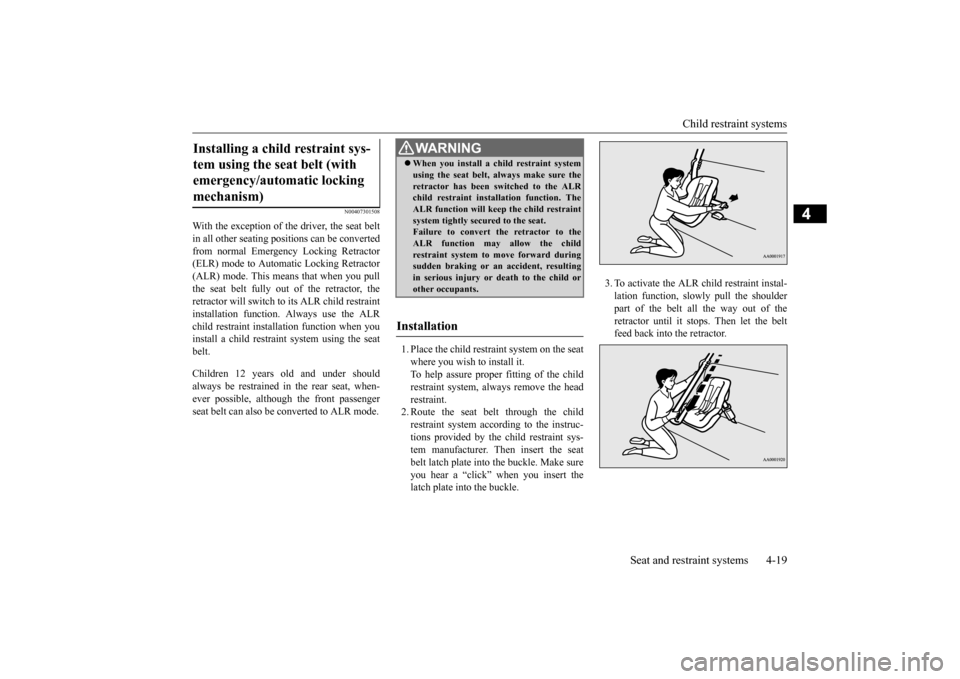
1. Place the child restraint system on the seat where you wish to install it. To help assure proper fitting of the childrestraint system, always remove the head restraint. 2. Route the seat belt through the childrestraint system according to the instruc- tions provided by the child restraint sys- tem manufacturer. Then insert the seatbelt latch plate into the buckle. Make sure you hear a “click” when you insert the latch plate into the buckle.
3. To activate the ALR child restraint instal- lation function, slowly pull the shoulder part of the belt all the way out of theretractor until it stops. Then let the belt feed back into the retractor.
Installing a child restraint sys- tem using the seat belt (with emergency/automatic locking mechanism)
WA R N I N G When you install a child restraint system using the seat belt, always make sure the retractor has been switched to the ALR child restraint installation function. The ALR function will keep the child restraintsystem tightly secured to the seat. Failure to convert the retractor to the ALR function may allow the childrestraint system to move forward during sudden braking or an accident, resulting in serious injury or death to the child orother occupants.
Installation
BK0210300US.bo
ok 19 ページ 2014年4月8日 火曜日 午前10時46分
Page 49 of 434

Child restraint systems 4-20 Seat and restraint systems
4
4. After the belt has retracted, tug on it. If the belt is in the ALR function, you will not be able to pull it out. If the webbing can be pulled out from retractor, the ALRfunction has not been activated and you will need to repeat steps 3 and 4. 5. After confirming that the belt is locked,grab the shoulder part of the belt near the buckle and pull up to remove any slack from the lap part of the belt allowing theslack to feed into the retractor. Remember,if the lap belt portion is not tight, the child restraint system will not be secure. It may help to put your weight on the childrestraint system and/or push on its seat- back while pulling up on the belt (see illustration).
6. Open the cover from the tether anchor installation point by pulling it back with your hand as illustrated below (6). 7. Latch the tether strap hook (A) of thechild restraint system to the tether anchor (B) as illustrated below (7) and tighten the top tether strap so it is securely fastened.
8. Before putting your child in the restraint, push and pull the restraint in all directions to be sure it is firmly secured. Do this before each use. If the child restraint sys-tem is not firmly secure, repeat steps 1 through 7. 9. To remove a child restraint system fromthe vehicle and deactivate the ALR mode, remove the child from the restraint. Unlatch the buckle. Then remove the beltfrom the restraint and let the belt fullyretract.
10. Reinstall the head restraint.
Refer to “Head restraints” on page 4-6.
N00407601644
Children who have outgrown a child restraintsystem should be seated in the rear seat and wear the seat belt. If the shoulder belt crosses their face or neck, and/or the lap belt crossestheir stomach, a commercially available booster seat must be used, to raise the child so that the shoulder belt crosses their shoulderand the lap belt remains positioned low across their hips. The booster seat should fit the vehicle seat and have a label certifyingcompliance with Federal Motor Vehicle Safety Standards or Motor Vehicle Restraint
If your child restraint system requires the use of a tether strap, fasten the tether strap in accordance with the following procedures.
WA R N I N G Child restraint system tether anchors are designed only to withstand loads from cor- rectly fitted child restraint systems. Under no circumstances are they to be used foradult seat belts, or harnesses, or for attaching other items or equipment to the vehicle.
Children who have outgrown child restraint systems
BK0210300US.bo
ok 20 ページ 2014年4月8日 火曜日 午前10時46分
Page 55 of 434

Supplemental Restraint System (SRS) - airbag 4-26 Seat and restraint systems
4
N00418100277
The passenger’s airbag off indicator is located in the instrument panel.
The indicator normally comes on when the ignition switch is turned to the “ON” positionand goes out a few seconds later. In the following situa
tions, the indicator will
stay on to show that the passenger’s front air-bag is not operational. The passenger’s seat weight sensors sense a weight of less than approximately 66 pounds (30 kg) on the front passenger seat. The front passenger’s seat is not occupied.
When the weight applied to the front passen- ger seat is sensed to be approximately 66 pounds (30 kg) or greater, the indicator goesout to show that the passenger’s front airbag is operational.
WA R N I N G If any of the following conditions occur, you should immediately have your vehicle inspected by an authorized Mitsubishi Motors dealer as soon as possible:• The SRS warning does not initially comeon when the ignition switch is turned to the “ON” or “START” position.• The SRS warning does not go out afterseveral seconds.• The SRS warning comes on while you aredriving.
To ensure that the passenger’s seat weight sensors can correctly sense the weightbeing applied to the seat, observe the fol- lowing instructions. Failure to follow these instructions can adversely affect the per-formance of the passenger’s airbag sys- tem.• Adjust the seat to the correct position,and sit well back against the seatback. Refer to “Front seats” on page 4-3.• Do not recline the seatback more thannecessary.• Never have more than one person (adultor child) sitting on the seat.• Do not place anything between the seatand the floor console.• Do not hang anything on the front pas-senger’s seatback.• Do not remove the head restraints.• When attaching a child restraint system,secure it firmly.
• Do not place luggage or other objects on the seat.• Do not use a seat cover or a cushion.• Do not modify or replace the seat andseat belt.• Do not place luggage or other objectsunder the seat.• Do not place the floor mat on the seatrails.• Do not expose the sensors to liquids orvapors.• Do not subject the sensors to shock.• Do not allow rear-seat occupants to push the front passenger seat with their feet or force the front passenger seat upward.• Do not allow rear-seat occupants to graspthe front passenger’s seatback or put their arms around it.• When attaching a child restraint systemin the rear seat, make sure it does notinterfere with the front seat.
If the vehicle is involved in a severe impact, have the SRS sensors inspected by an authorized Mitsubishi Motors dealer as soon as possible.
Passenger’s airbag off indicator
WA R N I N G
BK0210300US.bo
ok 26 ページ 2014年4月8日 火曜日 午前10時46分
Page 70 of 434

5
Features and controlsBreak-in recommendation
s ..............................................................5-3
Keys ..........................................
.......................................................5-3
Electronic immobilizer (Anti-thef
t starting system) ........................5-4
Keyless entry system (if so equipped) ..............................................5-7Free-hand Advanced Security Transmitter (F.A.S.T.-key) (if so
equipped) ..................................................5-12
Door locks .......................
...............................................................5-35
Power door locks ............
...............................................................5-37
“Child safety locks” for
rear door ..................................................5-39
Trunk lid ...................................
.....................................................5-39
Inside emergency trunk lid
release ................................................5-41
Theft-alarm system
................................................
........................5-42
Power windows ...............
...............................................................5-44
Sunroof (if so equipped
) .........................................
........................5-46
Parking brake ..................
...............................................................5-48
Steering wheel tilt lock lever .........................................................5-50Inside day/night rearview
mirror ...................................................5-50
Outside rearview mirr
ors ...............................................................5-52
Ignition switch ......
.................................................
........................5-53
Steering wheel lock
................................................
........................5-55
Starting and stopping the e
ngine ....................................................5-55
Turbocharger operation (if so equipped) ........................................5-59Manual transaxle (if so equipped) ..................................................5-59Continuously variable transmissi
on (CVT) (if so equipped)..........5-61
Twin Clutch SST (Sportronic Shift Transmission) (if so equipped) .
.................................................
........................5-70
ACD (Active center differential system) (if so equipped)..............5-82 Electronically controlled 4WD system (if so equipped).................5-84
All-wheel driving opera
tion .................................
......................... 5-86
Cautions on handling of all-wheel drive vehicles ......................... 5-87 Limited-slip differential (i
f so equipped) ....................................... 5-88
Service brake .................
.................................................
............... 5-89
Brake assist system
...............................................
......................... 5-90
Hill start assist (vehicles with
Twin Clutch SST) .......................... 5-90
Anti-lock braking syst
em .....................................
......................... 5-91
Active Stability Control (ASC
) (if so equipped) ............................ 5-94
Power steering system
..........................................
......................... 5-96
Cruise control (if so eq
uipped) ....................................................... 5-97
Tire pressure monitoring
system ................................................. 5-102
Rear-view camera (if so
equipped)..............
................................. 5-106
Instrument cluster
.................................................
....................... 5-108
Multi-information display ........................................................... 5-110 Indicator light, warning light, and information screen display list .......................................
.................................................... 5-131
Indicators .................................
.................................................... 5-143
Warning lights ................
.................................................
............. 5-144
Information screen disp
lay ...................................
....................... 5-145
Combination headlights and dimmer switch ............................... 5-147 Headlight leveling switch (if
so equipped)................................... 5-152
Turn signal lever ..
.................................................
....................... 5-152
Hazard warning flasher
switch .................................................... 5-153
Front fog light switch (if so
equipped) ......................................... 5-153
Wiper and washer swit
ch ......................................
....................... 5-154
Electric rear window def
ogger switch ......................................... 5-158
Horn switch .............................
.................................................... 5-159
Link System (if so equi
pped) ....................................................... 5-159
BK0210300US.bo
ok 1 ページ 2014年4月8日 火曜日 午前10時46分