2015 MITSUBISHI LANCER EVOLUTION wheel
[x] Cancel search: wheelPage 46 of 338

Supplemental Restraint System (SRS) - airbag
Seat and restraint systems 4-21
4
collisions. The SRS curtain airbags provide the driver and passengers on the front seat and rear outboard seat with protection against head injuries by deploying a bag on the sideimpacted in moderate to severe side impact collisions. The SRS airbags are NOT
a substitute for use
of the seat belts. For maximum protection inall types of accidents, seat belts must ALWAYS be worn by everyone who drives or rides in this vehicle (with infants and smallchildren in an appropriate child restraint sys-tem in the rear seat, and older children buck- led in the rear seat). Refer to “Child restraint systems” on page 4-13.
WA R N I N G IT IS VERY IMPORTANT TO ALWAYS WEAR YOUR SEAT BELT PROPERLY EVEN WITH AN AIRBAG.
• Seat belts help keep the driver and pas- sengers properly positioned. This reduces the risk of injury in all collisions, and reduces the risk of serious injuries or death when the airbags inflate.During sudden braking just before a col- lision, an unrestrained or improperly restrained driver or passengers can moveforward into direct contact with, or within close proximity to, the airbag when it begins to inflate.The beginning stage of airbag inflation is the most forceful and can cause serious injuries or death if the occupant comes incontact with the airbag at this time. • Seat belts reduce the risk of injury inrollovers, rear impact collisions, and in lower-speed frontal collisions, because the airbags are not designed to inflate inthose situations.• Seat belts reduce the risk of beingthrown from your vehicle in a collision or rollover.
IT IS VERY IMPORTANT TO BE PROP- ERLY SEATED.• A driver or front passenger sitting tooclose to the steering wheel or instrument panel during airbag deployment can be seriously injured or killed.WA R N I N G
• Airbags inflate very quickly and withgreat force. If the driver and front pas- senger are not properly seated and restrained, the airbag may not provide the proper protection and can cause seri-ous injuries or death when it inflates.• To reduce the risk to the driver of seriousinjury or death due to a deploying driver’s airbag, always properly wear your seat belt and adjust the driver’s seatas far back as possible, maintaining a position that still allows the driver to have good control of the steering wheel,brake, accelerator, and other vehicle con- trols.• To reduce the risk to the front passengerof serious injury or death from a deploy- ing passenger’s airbag, make sure thepassenger always wears the seat belt properly, remains seated upright and all the way back in the seat, and positionsthe seat as far back as possible. • Seat all infants and children in the rearseat, properly restrained in an appropri- ate child restraint system.
Airbags inflate very quickly and with great force. Do not sit on the edge of the seat or sit with your lower legs too close to the instrument panel, or lean your head or chest close to the steering wheel or theinstrument panel. Do not put your feet or legs on or against the instrument panel.WA R N I N G
BK0210800US.bo
ok 21 ページ 2014年4月8日 火曜日 午前11時28分
Page 51 of 338

Supplemental Restraint System (SRS) - airbag 4-26 Seat and restraint systems
4
N00408301622
Warning light
Warning display The system checks itself every time the igni- tion switch is turned to the “ON” position. The SRS warning light will come on for sev-eral seconds and then go out. This is normal and means the system is work- ing properly.If there is a problem involving one or more of the SRS components, the warning light will come on and stay on. At the same time, thewarning display will appear on the informa- tion screen in the multi information display. The SRS warning light/display is shared bythe SRS airbag and the seat belt pre-tensioner system.
N00407900028
The driver’s airbag is located under the pad-ded cover in the middle of the steering wheel. The front passenger’s airbag is contained inthe instrument panel above the glove com- partment. The driver’s airbag and the front passenger’s airbag are designed to deploy atthe same time. However,
the front passen-
ger’s airbag does not deploy when the front passenger seat is not occupied or when theweight sensor in the front passenger seat senses a weight on the seat of less than approximately 66 pounds (30 kg).
WA R N I N G If any of the following conditions occur, you should immediately have the airbag system in your vehicle inspected by an authorized Mitsubishi Motors dealer as soon as possible:• The passenger’s airbag off indicatorcomes on when an adult is sitting on thefront passenger seat.• The passenger’s airbag off indicator doesnot come on when the front passenger’s seat is not occupied.• The passenger’s airbag off indicator doesnot come on when the ignition switch is turned to the “ON” position.• The passenger’s airbag off indicatorcomes on and goes out repeatedly.
Do not attach any accessory to your vehi- cle that makes the passenger’s airbag offindicator difficult or impossible to see. You must be able to see the passenger’s airbag off indicator and verify the statusof the passenger’s airbag system.
SRS warning light/display
WA R N I N G If any of the following conditions occur, there may be a problem with the SRS air- bags and/or seat belt pre-tensioners, and they may not function properly in a colli-sion or may suddenly activate without a collision:• Even when the ignition switch is in ON,the SRS warning light does not come on or it remains on.
• The SRS warning light and/or the warn- ing display comes on while driving.The SRS airbags and seat belt pre-ten- sioners are designed to help reduce therisk of serious injury or death in certain collisions. If either of the above conditions occurs, immediately have your vehiclechecked by an authorized Mitsubishi Motors dealer.
Driver’s and passenger’s front airbag system
WA R N I N G
BK0210800US.bo
ok 26 ページ 2014年4月8日 火曜日 午前11時28分
Page 52 of 338
Supplemental Restraint System (SRS) - airbag
Seat and restraint systems 4-27
4
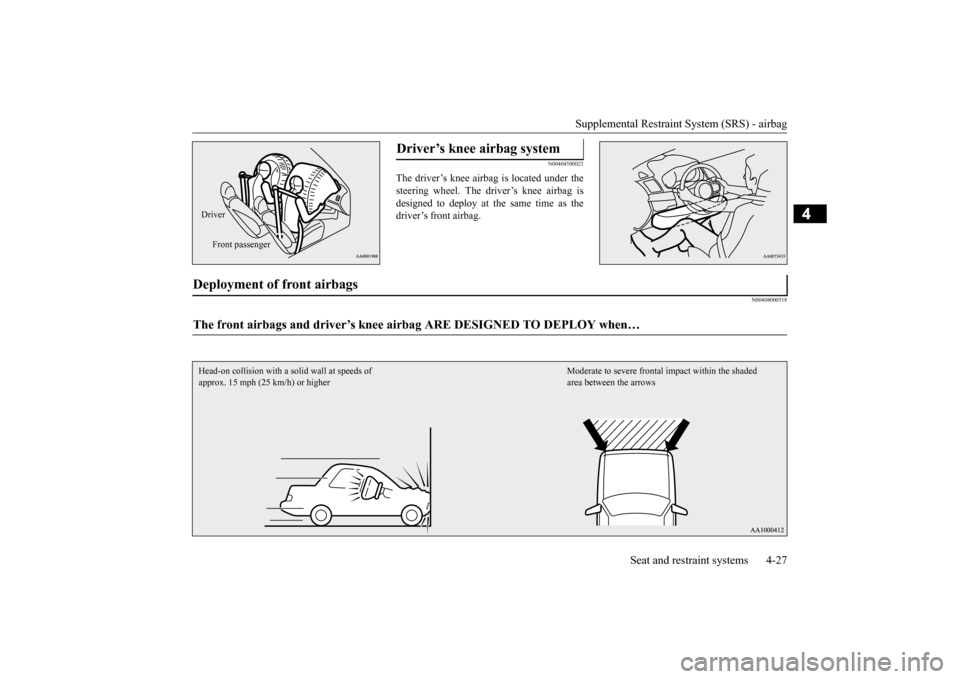
N00404500023
The driver’s knee airbag is located under the steering wheel. The driver’s knee airbag isdesigned to deploy at the same time as the driver’s front airbag.
N00408000518
Driver Front passenger
Driver’s knee airbag system
Deployment of front airbags The front airbags and driver’s knee airb
ag ARE DESIGNED TO DEPLOY when…
Head-on collision with a so
lid wall at speeds of
approx. 15 mph (25 km/h) or higher
Moderate to severe frontal
impact within the shaded
area between the arrows
BK0210800US.bo
ok 27 ページ 2014年4月8日 火曜日 午前11時28分
Page 55 of 338

Supplemental Restraint System (SRS) - airbag
4-30 Seat and restraint systems
4
Collision with an elevated median/island or curb
Vehicle travels over a deep hole/pothole
Vehicle drives down a steep slope and hits the
ground
WA R N I N G Do not attach anything to the steering
wheel’s padded cover, such as trim mate-
rial, badges, etc. These could strike and
injure an occupant if the airbag inflates. Do not set anything on, or attach anything
to, the instrument panel above the glove
compartment. Such items could strike and
injure an occupant if the airbag inflates. WA R N I N GDo not attach accessories to, or put them
in front of, the windshield. They could
restrict the airbag inflation, or strike and
injure an occupant, when the airbag
inflates.
Do not attach additional keys or accesso-
ries (hard, pointed or heavy objects) to the
ignition key. Such objects could prevent
the driver’s knee airbag from inflating
normally or could be propelled to cause
serious injury if the airbag inflates. Do not attach accessories to the lower por-
tion of the driver’s side instrument panel.
Such objects could prevent the driver’s
knee airbag from inflating normally or
could be propelled to cause serious injury
if the airbag inflates.WA R N I N GDo not attempt to remove, install, disas-
semble or repair the SRS airbags.WA R N I N G
SC00000500-2.fm 30 ページ 2014年4月16日 水曜日 午後2時2分
Page 60 of 338

Supplemental Restraint System (SRS) - airbag
Seat and restraint systems 4-35
4
N00408500672
SRS servicing
WA R N I N G Any maintenance performed on or near the components of the SRS should be per- formed only by an authorized Mitsubishi Motors dealer. Do not permit anyone elseto do any service, inspection, maintenance or repair on any SRS components or wir- ing. Similarly, no part of the SRS shouldever be handled, removed or disposed by anyone except an authorized Mitsubishi Motors dealer.Improper work methods on the SRS com- ponents or wiring could result in an acci- dental airbag deployment or could makethe SRS inoperable. Either of these situa- tions could result in serious injury or death. Do not modify your steering wheel or any other SRS component or related vehiclepart. For example, replacement of the steering wheel, or modifications to the front bumper or body structure canadversely affect SRS performance and may lead to injury. If your vehicle has received any damage, you should have the SRS inspected by an authorized Mitsubishi Motors dealer to make sure it is in proper working order.
Do not modify your front seats, center pil- lar or center console. Such modifications can adversely affect SRS performance and may lead to injury. Also, if you discover any tear or openseam in the seat fabric near the side air- bag, have the seat inspected by an autho- rized Mitsubishi Motors dealer. If you find a crack in or damage to the front pillar, rear pillar, or roof side railwhere the curtain airbag is located, have the SRS inspected by an authorized Mit- subishi Motors dealer.NOTE
When you transfer ownership of the vehicle to another person, we urge you to alert the new owner that it is equipped with the SRS and refer that owner to the applicable sec-tions in this owner’s manual. If you decide to junk or scrap your vehicle, we urge you to first take
it to an authorized
Mitsubishi Motors dealer so that the SRS can be made safe for disposal. If any of the following parts needs to be modified for use by a handicapped person, the advanced airbag system will be greatly affected. Please consult an authorized Mit-subishi Motors dealer for assistance. • Driver’s seat• Front passenger seat • Front seat beltWA R N I N G
• Steering wheel • Instrument panel[For vehicles sold in U.S.A.] To contact Mitsubishi Motors North America, Inc. call 1-888-648-7820 or write to:Mitsubishi Motors North America, Inc. Customer Relations DepartmentP. O. Box 6400Cypress, CA 90630-0064 [For vehicles sold in Canada] To contact Mitsubishi Motor Sales of Canada, Inc. call 1-888-576-4878 or write to:Mitsubishi Motor Sales of Canada, Inc. Customer Relations DepartmentP.O. Box 41009 4141 Dixie Road Mississauga, ON L4W 5C9NOTE
BK0210800US.bo
ok 35 ページ 2014年4月8日 火曜日 午前11時28分
Page 62 of 338

5
Features and controlsBreak-in period ...............
.................................................................5-3
Keys ..........................................
.......................................................5-3
Electronic immobilizer (Anti-thef
t starting system) ........................5-4
Keyless entry system (if so equipped) ..............................................5-7Free-hand Advanced Security Transmitter (F.A.S.T.-key) (if so equipped) .
.................................................
........................ 5-11
Door locks .......................
...............................................................5-33
Power door locks ............
...............................................................5-35
“Child safety locks” for
rear door ..................................................5-36
Trunk lid ...................................
.....................................................5-37
Inside emergency trunk lid
release ................................................5-38
Theft-alarm system
................................................
........................5-39
Power windows ...............
...............................................................5-42
Sunroof (if so equipped
) .........................................
........................5-44
Parking brake ..................
...............................................................5-46
Steering wheel tilt lock lever .........................................................5-47Inside day/night rearview
mirror ...................................................5-48
Outside rearview mirr
ors ...............................................................5-49
Ignition switch ......
.................................................
........................5-50
Steering wheel lock
................................................
........................5-52
Starting and stopping the e
ngine ....................................................5-52
Turbocharger operation
..........................................
........................5-55
Clutch pedal operation (if so equipped)..........................................5-56Manual transaxle (if so equipped) ..................................................5-56 Twin Clutch SST (Sportronic Shift Transmission) (if so equipped) .
.................................................
........................5-58
All-wheel drive system
..........................................
........................5-70
Cautions on handling of all-wheel drive vehicles ..........................5-70
S-AWC (Super-All Wheel C
ontrol) ............................................... 5-71
Anti-lock braking syst
em .....................................
......................... 5-74
Active stability control
(ASC) ....................
................................... 5-76
Limited-slip differenti
al ..............................
................................... 5-78
Service brake .................
.................................................
............... 5-79
Brake assist system
...............................................
......................... 5-80
Power steering system
..........................................
......................... 5-80
Cruise control ................
.................................................
............... 5-80
Tire pressure monitoring
system ................................................... 5-85
Instrument cluster
.................................................
......................... 5-89
Multi-information disp
lay ....................................
......................... 5-90
Indicator light, warning light, and information screen display list ...........................
.................................................... 5-110
Indicators .................................
.................................................... 5-120
Warning lights ................
.................................................
............. 5-121
Information screen disp
lay ...................................
....................... 5-122
Combination headlights and dimmer switch ............................... 5-124 Turn signal lever ..
.................................................
....................... 5-129
Hazard warning flasher
switch .................................................... 5-130
Front fog light switch
...........................................
....................... 5-130
Wiper and washer swit
ch ......................................
....................... 5-131
Electric rear window def
ogger switch ......................................... 5-135
Horn switch .............................
.................................................... 5-136
Link System .............................
.................................................... 5-136
Bluetooth
® 2.0 interface ..........
.................................................... 5-136
USB input terminal
...............................................
....................... 5-157
Sun visors ......................
.................................................
............. 5-160
12 V power outlet ..........
.................................................
............. 5-160
BK0210800US.bo
ok 1 ページ 2014年4月8日 火曜日 午前11時28分
Page 77 of 338

Free-hand Advanced Security Transmitter (F.A.S.T.-key) (if so equipped) 5-16 Features and controls
5
While carrying the F.A.S.T.-key, the ignition switch can be turned to start the engine. The position where the steering wheel is locked. When the ID code verification inside the vehicle produces a match, the ignition switchcan be turned. Allows operation of electrical accessories with the engine off.
The engine runs and all electrical accessories can be used. Engages the starter. Release the ignition switch when the engine starts. The ignitionswitch returns automatically to the “ON”position.
N00513600047
Turn slowly after pressing the ignition switch.
LOCK (PUSH OFF)
LOCK (PUSH ON)
ACC
ON
START
NOTE
Your vehicle is equipped with an electronic immobilizer. To start the engine, the ID code which the F.A.S.T.-key sends must match the one registered to the immobilizer computer.(Refer to “Electronic immobilizer (Anti-theft starting system)” on page 5-26) If the ignition switch is not turned to the “LOCK (PUSH OFF)” position when the engine is not running, the ID code cannot beverified and the engine will not start even if the ignition switch is turned to the “START” position. If this happens, fully return the ignition switch to the “LOCK (PUSH OFF)” position, and start the engine again.
To turn from “LOCK (PUSH OFF)” to “ACC”
A- Steering wheel locked B- Steering wheel lock released
NOTE
To turn the ignition switch from the “LOCK (PUSH OFF)” position to the “ACC” posi- tion, push the ignition switch again, turn the steering wheel in both directions and thenturn the ignition switch. The ignition switch cannot be turned unless the F.A.S.T.-key is inside the vehicle. Refer to “Operating range for starting the engine” on page 5-14.
BK0210800US.bo
ok 16 ページ 2014年4月8日 火曜日 午前11時28分
Page 80 of 338

Free-hand Advanced Security Transmit
ter (F.A.S.T.-key) (if so equipped)
Features and controls 5-19
5
sounds for about 3 seconds as a warning, and the doors cannot be locked.
N00514300054
Turn the ignition switch to the “LOCK” posi- tion. Turn the steering wheel until it is locked. Turn the ignition switch to the “ACC” posi- tion while moving the steering wheel slightly.
N00514601315
Do not operate the starter motor for longer than 15 seconds as this could run the bat- tery down or damage the starter motor. Ifthe engine does not start, turn the ignition switch back to the “LOCK” position, wait a few seconds, and then try again. Tryingrepeatedly with the engine or starter motor still turning will damage the starter mechanism.
If the engine will not start because the bat- tery is weak or discharged, refer to “Jump-starting the engine” on page 8-2 for instructions. A longer warm up period will only con- sume extra fuel. The engine is warmed up enough for driving when the bar graph ofthe engine coolant temperature display starts to move. Refer to “Interrupt display screen (With ignition switch in the “ON”position)” on page 5-99. On vehicles equipped with the Twin Clutch SST, the following may occur after the engine is started, but they do not indi-cate an abnormality. • You may hear operational sounds of the Twin Clutch SST and you may feelvibration in the vehicle body. • If you shift the gearshift lever into the “N” (NEUTRAL) position and depressthe accelerator pedal, increases in the engine speed will be limited.
Steering wheel lock
To l o c k
To u n l o c k
CAUTION Carry the key with you when leaving the vehicle. If your vehicle needs to be towed, turn the ignition switch to the “ACC” position tounlock the steering wheel.NOTE
If the front wheels are turned, the anti-theft lock may sometimes make it difficult to turnthe ignition switch from “LOCK” to “ACC” position. Firmly turn the steering wheel to the left or to the right
as you turn the ignition
switch.
St arting
Tips for starting
WA R N I N G Never run the engine in a closed or poorly ventilated area any longer than is needed to move your vehicle out of the area. Car- bon monoxide gas, which is odorless andextremely poisonous, could build up and cause serious injury or death.
BK0210800US.bo
ok 19 ページ 2014年4月8日 火曜日 午前11時28分