2015 MERCEDES-BENZ SPRINTER warning
[x] Cancel search: warningPage 27 of 334

Diagnostics connection
The diagnostics connection is only intended
for the connection of diagnostic equipment at
a qualified specialist workshop. G
WARNING
If you connect equipment to the diagnostics
connection in the vehicle, it may affect the
operation of the vehicle systems. As a result, the operating safety of the vehicle could be
affected. There is a risk of an accident.
Do not connect any equipment to a diagnos-
tics connection in the vehicle. Changing the engine power output
! Increases in engine power can:
R change the emission values
R cause malfunctions
R cause consequential damage
The operating reliability of the engine is not
guaranteed in all cases.
Any tampering with the engine management
system in order to increase the engine power output will lead to the loss of the New Vehicle
Limited Warranty and other warranty entitle-
ments.
If you sell the vehicle, inform the purchaser
about the changes to the engine power out-
put of the vehicle. If you do not inform the
buyer, this may constitute a punishable
offense under national legislation. Qualified specialist workshops
An authorized Sprinter Dealer is a qualified
specialist workshop.
A qualified specialist workshop has the nec-
essary specialist knowledge, tools and quali-
fications to correctly carry out the work
required on the vehicle.
This is especially the case for work relevant to
safety. Observe the information in the Main-
tenance Booklet. The following work should always be carried
out at qualified specialist workshop:
R work relevant to safety
R service and maintenance work
R repair work
R modifications as well as installations and
alterations
R work on electronic components
For this reason, we recommend an authorized Sprinter Dealer.
! Only have work carried out on the engine
electronics and its associated parts, such
as control units, sensors, actuating com-
ponents and connector leads, at a qualified specialist workshop. Vehicle components
may otherwise wear more quickly and the
vehicle's operating permit may be invalida-
ted. Registering your vehicle
We may ask our authorized Sprinter Dealers
to carry out technical inspections on certain
vehicles to improve their quality or safety. We can only inform you about vehicle checks if
we have your registration data.
Your registration data is not stored if:
R you did not purchase your vehicle at an
authorized Sprinter Dealer.
R your vehicle has never been inspected at an
authorized Sprinter Dealer.
It is advisable to register your vehicle with an
authorized Sprinter Dealer. Please inform us
as soon as possible about any change of
address or vehicle ownership. Exhaust gas aftertreatment
To function properly, exhaust gas aftertreat-
ment must be operated with Diesel Exhaust
Fluid (DEF) reducing agent . The DEF range is dependent on operating and driving condi-
tions. Therefore, add to the DEF supply tank
regularly during vehicle operation or, at the Int
roduction
25 Z
Page 28 of 334

latest, after receiving the first warning mes-
sage via the on-board computer.
To conform to emission regulations, you must
operate the vehicle with DEF and refill the
supply regularly. The engine management
recognizes attempts to operate the vehicle
without DEF, with thinned DEF or with
another reducing agent. After previous warn-
ing messages, the engine management then
prevents a further engine start.
If the DEF level drops below 1.5 US gal (5.5 l), the first warning message is issued and a
warning tone sounds. After the message
appears for the first time, and under normal
driving conditions, the remaining DEF supply
will last for approximately 1000 miles
(1600 km).
If a reserve mark of 0.8 US gal (3.0 l) is
reached, a second warning message is issued and a warning tone sequence sounds. After
the first message, the DEF supply will last for
approximately 1200 miles (1900 km). Subse-
quently, you will only be able to start the
engine a further 16 times.
You should immediately add 2.0 US gal (7.6 l)
of DEF (Y page 147) or have the DEF supply
reservoir filled at a qualified specialist work-
shop.
When the number of remaining engine starts
is 0
0 and the engine is restarted, the engine
management prevents the vehicle from being
driven at a speed exceeding 5 mph (8 km/h).
If the 00B9 Check Engine indicator lamp lights
up, the exhaust gas aftertreatment is faulty or
an emission-related malfunction has occur-
red (Y page 211). You will then only be able to
drive a maximum 50 mi (80 km) before the
engine management restricts the number of
starts remaining.
If the exhaust gas aftertreatment is faulty,
have it checked and repaired at a qualified
specialist workshop.
Further information on DEF can be found in
the "Refueling" (Y page 147) and "Service
products and capacities" (Y page 320) sec-
tions. Attachments, bodies, equipment and
conversions
Information about body/equipment
mounting directives !
For safety reasons, have add-on equip-
ment manufactured and installed accord-
ing to the Sprinter body/equipment mount- ing directives in force. These body/equip-
ment mounting directives ensure that the
chassis and the body form one unit and that
maximum operating and road safety is ach- ieved.
We recommend for safety reasons that:
R you carry out no other modifications to
the vehicle.
R you obtain the agreement of the distrib-
utor named on the inside of the front
cover for any deviations from the
approved body/equipment mounting
directives.
Approval from certified inspection agen-
cies or official approvals cannot rule out
risks to your safety.
Please observe the information concerning
Mercedes-Benz Genuine Parts (Y page 27).
Further information can be obtained at any
authorized Sprinter Dealer. G
WARNING
The function of systems or components can
be affected by conversions or modifications
to the vehicle. They might not function prop-
erly any more and/or jeopardize the opera-
tional safety of the vehicle. There is an
increased risk of an accident and injury.
Conversions or modifications should always
be carried out at qualified specialist work-
shop.
If you intend to make modifications to your
vehicle, we strongly recommend that you
contact the distributor named on the inside of
the front cover. There you will receive all the
necessary information and a charge may be
levied. 26
Introduction
Page 34 of 334
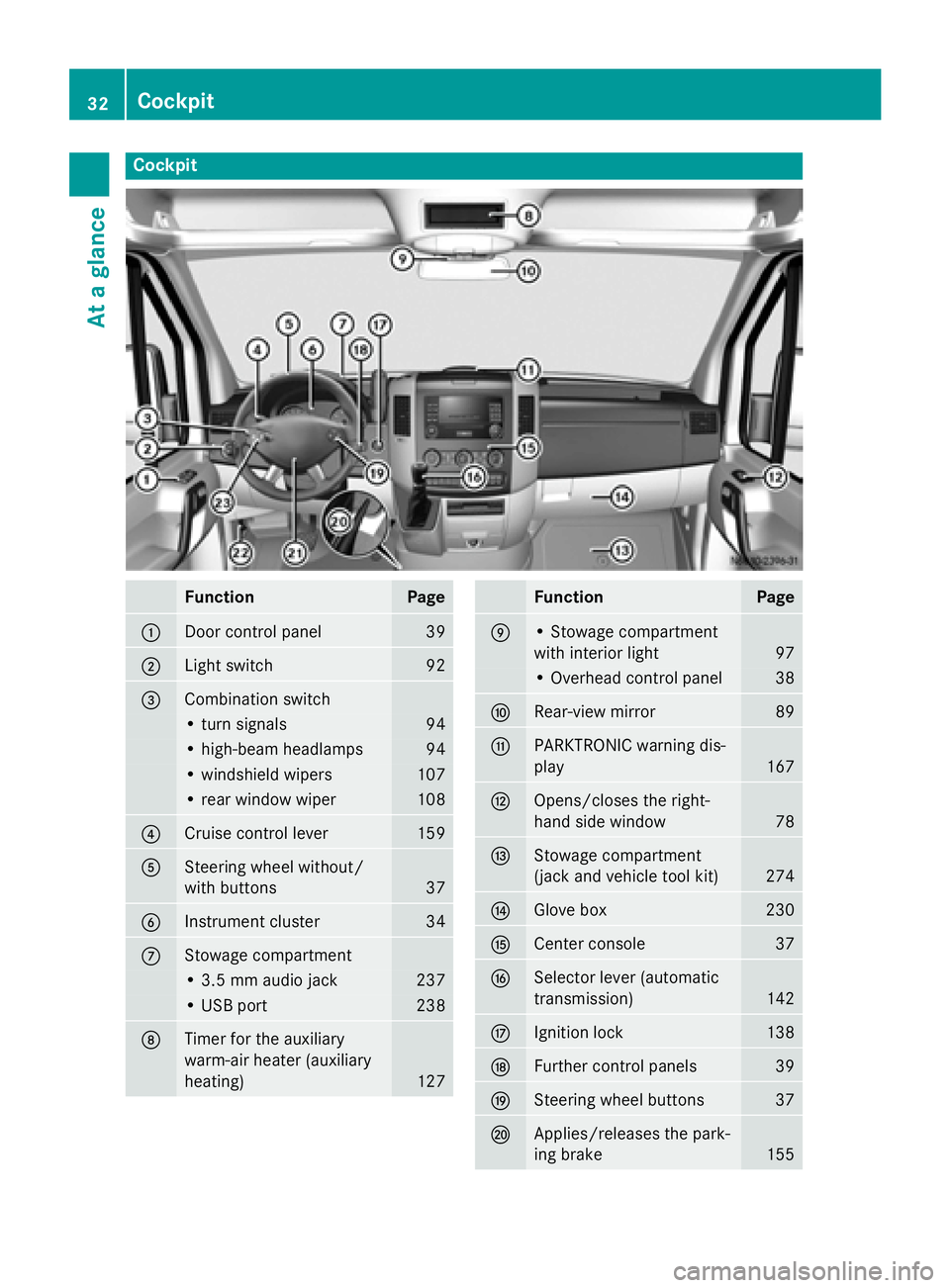
Cockpit
Function Page
0043
Door control panel 39
0044
Light switch 92
0087
Combination switch
• turn signals 94
• high-beam headlamps 94
• windshield wipers 107
• rear window wiper 108
0085
Cruise control lever 159
0083
Steering wheel without/
with buttons
37
0084
Instrument cluster 34
006B
Stowage compartment
• 3.5 mm audio jack 237
• USB port 238
006C
Timer for the auxiliary
warm-air heater (auxiliary
heating)
127 Function Page
006D
• Stowage compartment
with interior light
97
• Overhead control panel 38
006E
Rear-view mirror 89
006F
PARKTRONIC warning dis-
play
167
0070
Opens/closes the right-
hand side window
78
0071
Stowage compartment
(jack and vehicle tool kit)
274
0072
Glove box 230
0073
Center console 37
0074
Selector lever (automatic
transmission)
142
0075
Ignition lock 138
0076
Further control panels 39
0077
Steering wheel buttons 37
0078
Applies/releases the park-
ing brake
15532
CockpitAt a glance
Page 37 of 334

Indicator and warning lamps
Instrument cluster on vehicles without steering wheel buttons
Instrument cluster in vehicles with steering-wheel buttons
Function Page
0043 Speedometer with warn-
ing and indicator lamps
0072
ESP
®
warning lamp 218
ASR warning lamp 218
003F
Coolant level too low 223
00AC
Coolant temperature too
high 223
0075
Restraint systems malfunc-
tion 42
0065
Brake fluid level too low 219
EBD malfunctioning 218
Trailer brake force booster
malfunction
219
00B2
Engine oil level warning 222 Function Page
00B9
Check Engine indicator
lamp
224
0028
Preglow 139
Preglow system malfunc-
tion
225
0044 Indicator and warning
lamps
004A
Left-hand turn signal 94
0025
ABS malfunction 218
0077
Tire pressure loss or the tire
pressure monitor is mal-
functioning (USA only) 226
Tire pressure loss (Canada
only)
292Instrument cluster
35At a glance
Page 38 of 334
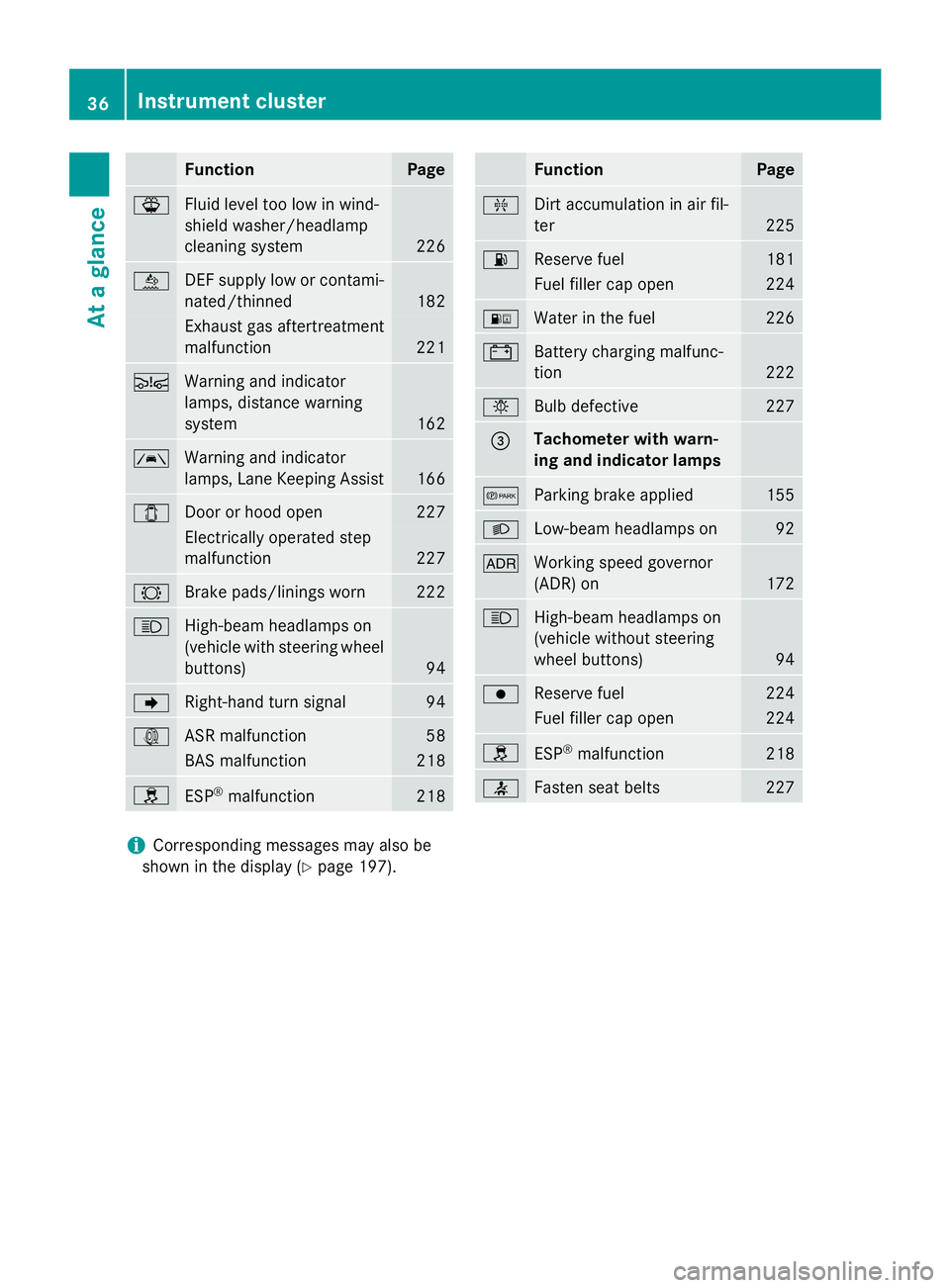
Function Page
00B1
Fluid level too low in wind-
shield washer/headlamp
cleaning system
226
00E2
DEF supply low or contami-
nated/thinned 182
Exhaust gas aftertreatment
malfunction 221
00C7
Warning and indicator
lamps, distance warning
system
162
00B0
Warning and indicator
lamps, Lane Keeping Assist
166
003E
Door or hood open 227
Electrically operated step
malfunction 227
0026
Brake pads/linings worn 222
0057
High-beam headlamps on
(vehicle with steering wheel
buttons) 94
004D
Right-hand turn signal 94
003D
ASR malfunction 58
BAS malfunction 218
0089
ESP
®
malfunction 218 Function Page
009F
Dirt accumulation in air fil-
ter
225
00B4
Reserve fuel 181
Fuel filler cap open 224
00B8
Water in the fuel 226
003D
Battery charging malfunc-
tion
222
0049
Bulb defective 227
0087 Tachometer with warn-
ing and indicator lamps 0066
Parking brake applied 155
0058
Low-beam headlamps on 92
004E
Working speed governor
(ADR) on
172
0057
High-beam headlamps on
(vehicle without steering
wheel buttons) 94
0077
Reserve fuel 224
Fuel filler cap open 224
0089
ESP
®
malfunction 218
0076
Fasten seat belts 227
i
Corresponding messages may also be
shown in the display (Y page 197).36
Instrument clusterAt a glance
Page 40 of 334

Function Page
002F
Switches the hazard warn-
ing lamps on/off
95
00E3
Activates/deactivates ASR 58
00BF
00C0
Central locking, interior/
rear compartment
71
00D4
Activates/deactivates the
distance warning function
162
j
Activates/deactivates
Lane Keeping Assist
166
Activates/deacti-
vates Blind Spot Assist 163
0083
• Stowage compartment or
• CD changer; see the sep-
arate operating instruc-
tions, or 0084
Cup holder with: 234
• ashtray 235
• cigarette lighter 235
006B
12 V socket 236 Overhead control panel
Function Page
0043
Microphone for the mobile
phone 236
0044
Switches the reading lamp
on/off, right 97
0087
Switches the automatic
interior lighting on/off 97
0085
• Eyeglasses compartment
or 231
• Anti-Theft Alarm system
(ATA)
61
0083
Switches the interior light-
ing on/off 97
0084
Switches the reading lamp
on/off, left 9738
Overhead control panelAt a glance
Page 44 of 334

Useful information
This Operator's Manual describes all models
as well as standard and optional equipment of your vehicle that were available at the time of going to print. Country-specific variations are
possible. Note that your vehicle may not be
equipped with all of the described functions.
This also applies to systems and functions
relevant to safety.
Read the information on qualified specialist
workshops (Y page 25). Occupant safety
Restraint system introduction
The restraint system reduces the risk of vehi- cle occupants coming into contact with parts of the vehicle's interior in the event of an
accident. The restraint system can also
reduce the forces to which vehicle occupants
are subjected during an accident.
The restraint system comprises:
R Seat belt system
R Air bags
R Child restraint system
R Child seat securing systems
The components of the restraint system work
in conjunction with each other. They can only
deploy their protective function if, at all times,
all vehicle occupants:
R have fastened their seat belts correctly
(Y page 45)
R have adjusted their seat and head restraint
properly (Y page 82).
As the driver, you also have to make sure that
the steering wheel is adjusted correctly.
Observe the information relating to the cor-
rect driver's seat position (Y page 82).
You also have to make sure that an air bag can inflate properly if deployed (Y page 47).
An air bag supplements a correctly worn seat
belt. As an additional safety device, the air
bag increases the level of protection for vehi- cle occupants in the event of an accident. For
example, if, in the event of an accident, the
protection offered by the seat belt is suffi-
cient, the air bags are not deployed. When an
accident occurs, only the air bags that
increase protection in that particular accident
situation are deployed. However, seat belts
and air bags generally do not protect against objects penetrating the vehicle from the out-
side.
Information on restraint system operation
can be found under "Deployment of Emer-
gency Tensioning Devices and air bags"
(Y page 49).
For more information about children traveling with you in the vehicle and on child restraint
systems, see "Children in the vehicle"
(Y page 51). Important safety notes
G
WARNING
Modifications to the restraint system, may
cause it to no longer work as intended. The
restraint system may then not perform its
intended protective function and may fail in an accident or trigger unexpectedly, for example.
This poses an increased risk of injury or even fatal injury.
Never modify parts of the restraint system.
Never tamper with the wiring, the electronic
components or their software.
If it is necessary to modify an airbag system to
accommodate a person with disabilities, con- tact an authorized Sprinter dealership for
details. USA only: contact our Customer
Assistance Center at 1‑877‑762 ‑8267 for
details. Restraint system warning lamp
The restraint systems functions are checked
after the ignition is switched on and at regular
intervals when the engine is running. This 42
Occupant safetySafety
Page 45 of 334

allows malfunctions to be detected in good
time.
When the ignition is switched on, the 0075
restraint system warning lamp in the instru-
ment cluster lights up. It goes out no later
than a few seconds after the vehicle is star-
ted. The components of the restraint system
are on standby.
A malfunction has occurred if the 0075
restraint system warning lamp:
R does not light up after the ignition is
switched on.
R does not switch off after a few seconds.
R goes out, but then lights up again, e.g. when
the engine is running. G
WARNING
If restraint system is malfunctioning, restraint system components may be triggered unin-
tentionally or might not be triggered at all in
the event of an accident with a high rate of
vehicle deceleration. This can affect the Emer- gency Tensioning Device or air bag, for exam-
ple. This poses an increased risk of injury or
even fatal injury.
Have the restraint system checked and
repaired in a qualified specialist workshop as
soon as possible. Seat belts
Introduction Seat belts are the most effective means of
restricting the movement of vehicle occu-
pants in the event of an accident or the vehi-
cle rolling over. This reduces the risk of vehi- cle occupants coming into contact with parts
of the vehicle interior or being ejected from
the vehicle. Furthermore, the seat belt helps
to keep the vehicle occupant in the best posi- tion in relation to the air bag. The seat belt system comprises:
R Seat belts
R Emergency Tensioning Devices and seat
belt force limiters for the driver's and front-
passenger seat belts
On vehicles with two seats on the front-
passenger side, both seat belts on the
front-passenger side have an Emergency
Tensioning Device. Only the seat belt on the
outer front-passenger seat has a seat belt
force limiter.
The seat belt system only includes Emer-
gency Tensioning Devices and seat belt force
limiters for the driver and front passenger if
the vehicle is equipped with a driver's air bag.
If the seat belt is pulled out of the belt outlet quickly or with a jerky movement, the belt
retractor locks. The belt strap cannot be
extracted any further.
The Emergency Tensioning Device tightens
the seat belt in an accident, pulling the belt
close against the body. However it does not
pull the vehicle occupant back in the direction
of the backrest.
The Emergency Tensioning Device does not
correct an incorrect seat position or the rout- ing of an incorrectly fastened seat belt.
When triggered, seat belt force limiters help
to reduce the force exerted by the seat belt on
the vehicle occupant.
The seat belt force limiters are synchronized
with the front air bags, which absorb part of
the deceleration force. This can reduce the
force exerted on the vehicle occupants during an accident.
! If the front-passenger seat is unoccupied,
do not insert the belt tongue into the buckle of the front-passenger seat. This may oth-
erwise lead to the triggering of the Emer-
gency Tensioning Device in the event of anaccident, which will then need to be
replaced.
Vehicles with two seats on the front-
passenger side: the Emergency Tensioning
Device of the inner front-passenger seat is Occupant safety
43Safety Z