2015 MERCEDES-BENZ SPRINTER warning light
[x] Cancel search: warning lightPage 23 of 334

W
Warning Stickers .......................................... .22
Warning and indicator lamps
Brakes .......................................... .219
Check Engine ................................. 224
Coolant .......................................... 223
Diesel Exhaust Fluid (DEF) ............. 221
Electrical step ................................ 227
ESP ®
.............................................. 218
ESP ®
function ................................ 221
Overview .......................................... 35
Seat belt ........................................ 227
Warning lamp ................................... .275
Warning triangle ................................ 275
Warning- and indicator lamps
ABS ................................................ 218
Air filter .......................................... 225
ASR ................................................ 218
BAS ................................................ 218
Battery charge ............................... 222
Brake wear ................................... .222
Bulbs .............................................. 227
Doors ............................................. 227
Engine oil level ............................... 222
Preglow .......................................... 225
Reserve fuel ................................... 224
Tire pressure monitor .................... 226
Water separator ............................ .226
Windshield washer fluid ................. 226
Washer fluid
Adding .......................................... .255
Capacities ...................................... 327
Display message ............................ 217
Indicator lamp ................................ 226
Notes ............................................. 326
Wiping with ................................... .107
Wheels
Changing a wheel .......................... 305
Checking ........................................ 285
Cleaning ......................................... 267
Important safety notes .................. 284
Installing the adapter (spare
wheel) ............................................ 309
Interchanging/changing ................ 305
Mounting a new wheel ................... 309
Mounting a wheel .......................... 306 Removing a wheel .......................... 309
Removing and mounting the spare
wheel ............................................. 313
Snow chains .................................. 287
Storing .......................................... .306
Tightening torque ........................... 310
Wheel size/tire size ....................... 311
Window curtain air bag ....................... 49
Windows
see Side windows
Windshield
Defrosting ...................................... 118
Windshield heating
Problem (malfunction) ................... 119
Switching on/off ........................... 119
Windshield washer fluid
Adding .......................................... .255
Indicator lamp ................................ 226
Windshield wipers
Problem (malfunction) ................... 109
Rain and light sensor ..................... 107
Rear window wiper ........................ 108
Replacing the wiper blades ............ 108
Setting the sensitivity (vehicles
with steering wheel buttons and
rain/light sensor) ........................... 193
Switching on/off ........................... 107
Wiping with windshield washer
fluid ............................................... 107
Winter diesel ..................................... 319
Winter driving
Slippery road surfaces ................... 156
Snow chains .................................. 287
Winter operation
General notes ................................ 286
Radiator cover ................................. 27
Winter tires
M+S tires ....................................... 286
Setting a limit speed ..................... .153
Wiper blades
Cleaning ......................................... 268
Replacing ....................................... 108
Workshop
see Qualified specialist workshop Index
21
Page 28 of 334

latest, after receiving the first warning mes-
sage via the on-board computer.
To conform to emission regulations, you must
operate the vehicle with DEF and refill the
supply regularly. The engine management
recognizes attempts to operate the vehicle
without DEF, with thinned DEF or with
another reducing agent. After previous warn-
ing messages, the engine management then
prevents a further engine start.
If the DEF level drops below 1.5 US gal (5.5 l), the first warning message is issued and a
warning tone sounds. After the message
appears for the first time, and under normal
driving conditions, the remaining DEF supply
will last for approximately 1000 miles
(1600 km).
If a reserve mark of 0.8 US gal (3.0 l) is
reached, a second warning message is issued and a warning tone sequence sounds. After
the first message, the DEF supply will last for
approximately 1200 miles (1900 km). Subse-
quently, you will only be able to start the
engine a further 16 times.
You should immediately add 2.0 US gal (7.6 l)
of DEF (Y page 147) or have the DEF supply
reservoir filled at a qualified specialist work-
shop.
When the number of remaining engine starts
is 0
0 and the engine is restarted, the engine
management prevents the vehicle from being
driven at a speed exceeding 5 mph (8 km/h).
If the 00B9 Check Engine indicator lamp lights
up, the exhaust gas aftertreatment is faulty or
an emission-related malfunction has occur-
red (Y page 211). You will then only be able to
drive a maximum 50 mi (80 km) before the
engine management restricts the number of
starts remaining.
If the exhaust gas aftertreatment is faulty,
have it checked and repaired at a qualified
specialist workshop.
Further information on DEF can be found in
the "Refueling" (Y page 147) and "Service
products and capacities" (Y page 320) sec-
tions. Attachments, bodies, equipment and
conversions
Information about body/equipment
mounting directives !
For safety reasons, have add-on equip-
ment manufactured and installed accord-
ing to the Sprinter body/equipment mount- ing directives in force. These body/equip-
ment mounting directives ensure that the
chassis and the body form one unit and that
maximum operating and road safety is ach- ieved.
We recommend for safety reasons that:
R you carry out no other modifications to
the vehicle.
R you obtain the agreement of the distrib-
utor named on the inside of the front
cover for any deviations from the
approved body/equipment mounting
directives.
Approval from certified inspection agen-
cies or official approvals cannot rule out
risks to your safety.
Please observe the information concerning
Mercedes-Benz Genuine Parts (Y page 27).
Further information can be obtained at any
authorized Sprinter Dealer. G
WARNING
The function of systems or components can
be affected by conversions or modifications
to the vehicle. They might not function prop-
erly any more and/or jeopardize the opera-
tional safety of the vehicle. There is an
increased risk of an accident and injury.
Conversions or modifications should always
be carried out at qualified specialist work-
shop.
If you intend to make modifications to your
vehicle, we strongly recommend that you
contact the distributor named on the inside of
the front cover. There you will receive all the
necessary information and a charge may be
levied. 26
Introduction
Page 34 of 334
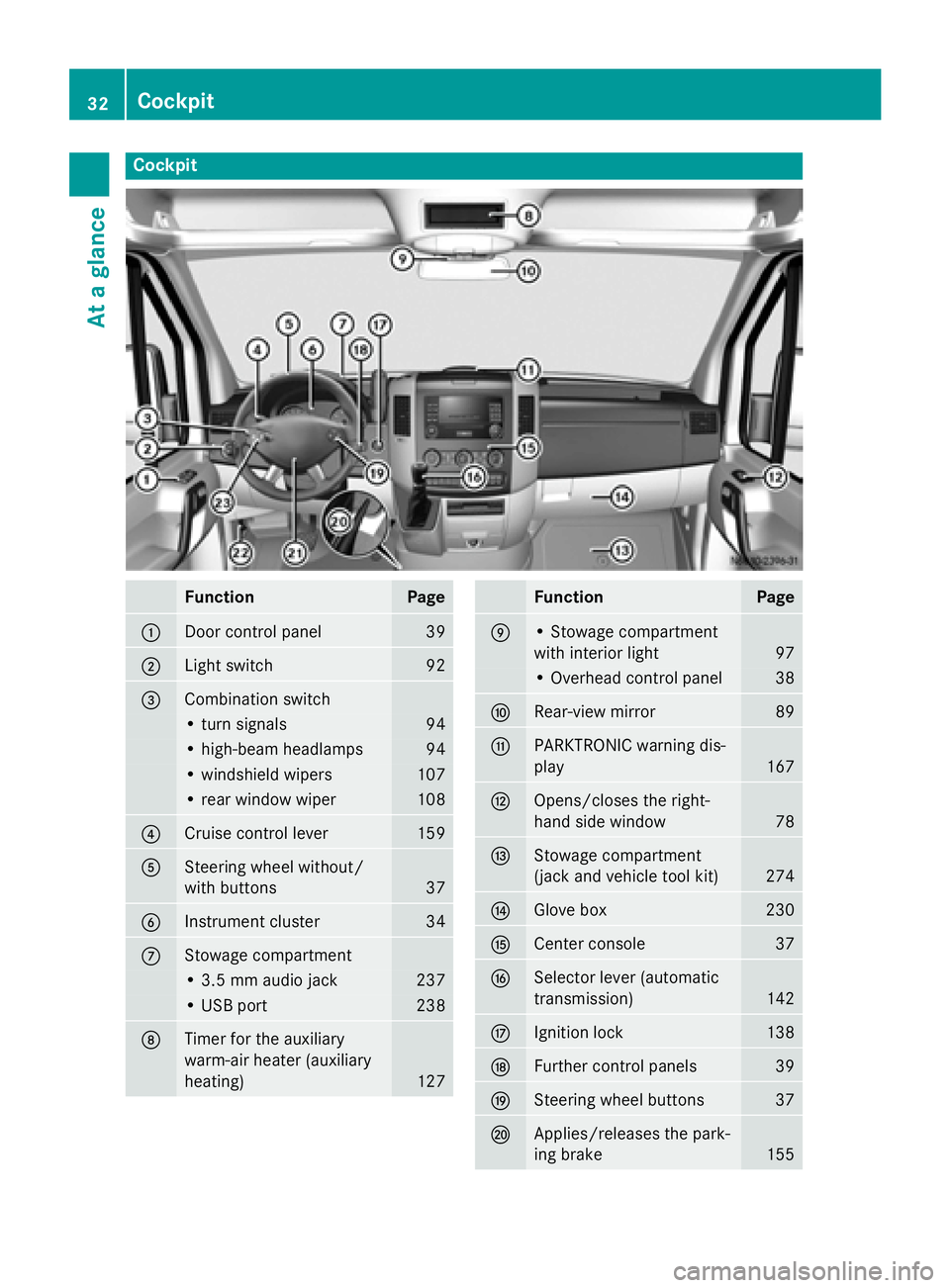
Cockpit
Function Page
0043
Door control panel 39
0044
Light switch 92
0087
Combination switch
• turn signals 94
• high-beam headlamps 94
• windshield wipers 107
• rear window wiper 108
0085
Cruise control lever 159
0083
Steering wheel without/
with buttons
37
0084
Instrument cluster 34
006B
Stowage compartment
• 3.5 mm audio jack 237
• USB port 238
006C
Timer for the auxiliary
warm-air heater (auxiliary
heating)
127 Function Page
006D
• Stowage compartment
with interior light
97
• Overhead control panel 38
006E
Rear-view mirror 89
006F
PARKTRONIC warning dis-
play
167
0070
Opens/closes the right-
hand side window
78
0071
Stowage compartment
(jack and vehicle tool kit)
274
0072
Glove box 230
0073
Center console 37
0074
Selector lever (automatic
transmission)
142
0075
Ignition lock 138
0076
Further control panels 39
0077
Steering wheel buttons 37
0078
Applies/releases the park-
ing brake
15532
CockpitAt a glance
Page 40 of 334

Function Page
002F
Switches the hazard warn-
ing lamps on/off
95
00E3
Activates/deactivates ASR 58
00BF
00C0
Central locking, interior/
rear compartment
71
00D4
Activates/deactivates the
distance warning function
162
j
Activates/deactivates
Lane Keeping Assist
166
Activates/deacti-
vates Blind Spot Assist 163
0083
• Stowage compartment or
• CD changer; see the sep-
arate operating instruc-
tions, or 0084
Cup holder with: 234
• ashtray 235
• cigarette lighter 235
006B
12 V socket 236 Overhead control panel
Function Page
0043
Microphone for the mobile
phone 236
0044
Switches the reading lamp
on/off, right 97
0087
Switches the automatic
interior lighting on/off 97
0085
• Eyeglasses compartment
or 231
• Anti-Theft Alarm system
(ATA)
61
0083
Switches the interior light-
ing on/off 97
0084
Switches the reading lamp
on/off, left 9738
Overhead control panelAt a glance
Page 45 of 334

allows malfunctions to be detected in good
time.
When the ignition is switched on, the 0075
restraint system warning lamp in the instru-
ment cluster lights up. It goes out no later
than a few seconds after the vehicle is star-
ted. The components of the restraint system
are on standby.
A malfunction has occurred if the 0075
restraint system warning lamp:
R does not light up after the ignition is
switched on.
R does not switch off after a few seconds.
R goes out, but then lights up again, e.g. when
the engine is running. G
WARNING
If restraint system is malfunctioning, restraint system components may be triggered unin-
tentionally or might not be triggered at all in
the event of an accident with a high rate of
vehicle deceleration. This can affect the Emer- gency Tensioning Device or air bag, for exam-
ple. This poses an increased risk of injury or
even fatal injury.
Have the restraint system checked and
repaired in a qualified specialist workshop as
soon as possible. Seat belts
Introduction Seat belts are the most effective means of
restricting the movement of vehicle occu-
pants in the event of an accident or the vehi-
cle rolling over. This reduces the risk of vehi- cle occupants coming into contact with parts
of the vehicle interior or being ejected from
the vehicle. Furthermore, the seat belt helps
to keep the vehicle occupant in the best posi- tion in relation to the air bag. The seat belt system comprises:
R Seat belts
R Emergency Tensioning Devices and seat
belt force limiters for the driver's and front-
passenger seat belts
On vehicles with two seats on the front-
passenger side, both seat belts on the
front-passenger side have an Emergency
Tensioning Device. Only the seat belt on the
outer front-passenger seat has a seat belt
force limiter.
The seat belt system only includes Emer-
gency Tensioning Devices and seat belt force
limiters for the driver and front passenger if
the vehicle is equipped with a driver's air bag.
If the seat belt is pulled out of the belt outlet quickly or with a jerky movement, the belt
retractor locks. The belt strap cannot be
extracted any further.
The Emergency Tensioning Device tightens
the seat belt in an accident, pulling the belt
close against the body. However it does not
pull the vehicle occupant back in the direction
of the backrest.
The Emergency Tensioning Device does not
correct an incorrect seat position or the rout- ing of an incorrectly fastened seat belt.
When triggered, seat belt force limiters help
to reduce the force exerted by the seat belt on
the vehicle occupant.
The seat belt force limiters are synchronized
with the front air bags, which absorb part of
the deceleration force. This can reduce the
force exerted on the vehicle occupants during an accident.
! If the front-passenger seat is unoccupied,
do not insert the belt tongue into the buckle of the front-passenger seat. This may oth-
erwise lead to the triggering of the Emer-
gency Tensioning Device in the event of anaccident, which will then need to be
replaced.
Vehicles with two seats on the front-
passenger side: the Emergency Tensioning
Device of the inner front-passenger seat is Occupant safety
43Safety Z
Page 48 of 334

X
Adjust the seat (Y page 82).
The seat backrest must be in an almost
upright position.
X Pull the seat belt smoothly from belt sash
guide 0087and engage belt tongue 0044into
belt buckle 0043.
X If necessary, pull upwards on the shoulder
section of the seat belt to tighten the belt
across your body. The shoulder section of the belt must always
run over the center of the shoulder. Adjust the
belt outlet if necessary.
X To raise: slide belt guide 0087upwards.
The belt outlet engages in various posi-
tions.
X To lower: press belt guide release 0085and
slide belt guide 0087downwards.
X Let go of belt guide release 0085in the
desired position and make sure that the
belt guide engages.
All seat belts in the vehicle, except the driv-
er's seat belt, are equipped with a special seat belt retractor to secure child restraint sys-
tems properly. Further information can be
found under "Special seat belt retractor"
(Y page 52).
Releasing seat belts !
Make sure that the seat belt is fully rolled
up. Otherwise, the seat belt or belt tongue
will be trapped in the door or in the seat
mechanism. This could damage the door,
the door trim panel and the seat belt. Dam-
aged seat belts can no longer fulfill their protective function and must be replaced.
Visit a qualified specialist workshop.
X
Press release button 0043, hold belt
tongue 0044firmly and guide it back towards
belt outlet 0087.
Belt warning for drivers and co-drivers The
0076 seat belt warning lamp in the instru-
ment cluster is a reminder for all occupants to
fasten their seat belts. It may light up contin-
uously or flash. A warning tone may also
sound.
Regardless of whether the driver has already
fastened their seat belt, the 0076seat belt
warning lamp lights up for 6 second s each
time the ignition is switched on. After the
engine is started, it goes out as soon as the
driver's seat belt had been fastened.
If the driver's seat belt is not fastened after
the engine is started, an additional warning
tone will sound. This warning tone switches
off after a maximum of 6 seconds or once the
driver's seat belt is fastened.
If a vehicle speed of 15 mph (25 km/h) is
exceeded and the driver has still not fastened their seat belt, a warning tone sounds again.
The warning tone sounds for 60 seconds or
until the driver has fastened their seat belt. 46
Occupant safetySafety
Page 51 of 334

Thorax bags are only available in combination
with individual seats on the driver's and co-
driver's side.
When deployed, thorax bag 0043offers addi-
tional thorax protection. However, it does not protect the:
R head
R neck
R arms
The thorax bag is deployed on the side of the impact.
Window curtain air bags Window curtain air bags
0043are integrated
into the side of the roof frame above the front
doors.
When deployed, the window curtain air bag
enhances the level of protection for the head.
However, it does not protect the chest or
arms.
In the event of a side impact, the window cur- tain air bag is deployed on the side on which
the impact occurs.
If the system determines that they can offer
additional protection to that provided by the
seat belt, a window curtain air bag may be
deployed in other accident situations
(Y page 49). Deployment of Emergency Tensioning
Devices and air bags
Important safety notes G
WARNING
The air bag parts are hot after an air bag has
been deployed. There is a risk of injury.
Do not touch the air bag parts. Have a
deployed air bag replaced at a qualified spe-
cialist workshop as soon as possible. G
WARNING
A deployed air bag no longer offers any pro-
tection and cannot provide the intended pro-
tection in an accident. There is an increased
risk of injury.
Have the vehicle towed to a qualified special- ist workshop in order to have a deployed air
bag replaced.
It is important for your safety and that of your
passenger to have deployed air bags replaced and to have any malfunctioning air bags
repaired. This will help to make sure the air
bags continue to perform their protective
function for the vehicle occupants in the
event of a crash. G
WARNING
Pyrotechnic Emergency Tensioning Devices
that have been deployed are no longer opera- tional and are unable to perform their inten-
ded protective function. This poses an
increased risk of injury or even fatal injury.
Therefore, have pyrotechnic Emergency Ten-
sioning Devices which have been triggered
immediately replaced at a qualified specialist workshop.
If Emergency Tensioning Devices are trig-
gered or air bags are deployed, you will hear a
bang, and a small amount of powder may also be released. The 0075restraint system warn-
ing lamp lights up.
Only in rare cases will the bang affect your
hearing. The powder that is released gener-
ally does not constitute a health hazard, but it Occupant safety
49Safety Z
Page 53 of 334

If the restraint system control unit detects a
side impact or that the vehicle is rolling over, the relevant restraint system components areactivated independently of one another
depending on the apparent type of accident.
If the system determines a need for additional
protection for the vehicle occupants, the
Emergency Tensioning Devices are triggered.
R Thorax bag on the side of impact, inde-
pendently of the Emergency Tensioning
Device and the use of the seat belt
R Window curtain air bag on the side of
impact, independently of the use of the
seat belt and independently of whether the
front-passenger seat is occupied
i Not all air bags are deployed in an acci-
dent. The different air bag systems work
independently of each other.
How the air bag system works is deter-
mined by the severity of the accident detec- ted, especially the vehicle deceleration or
acceleration and the apparent type of acci-
dent:
R frontal collision
R side impact Children in the vehicle
Important safety notes
Accident statistics show that children
secured in the rear seats are safer than chil-
dren secured in the front-passenger seat. For this reason, we strongly advise that you install
a child restraint system on a rear seat. Chil-
dren are generally better protected there.
If a child younger than 12 years and under 5 ft
(1.50 m) in height is traveling in the vehicle:
R always secure the child in a child restraint
system suitable for this vehicle. The child
restraint system must be appropriate to the
age, weight and size of the child
R be sure to observe the instructions and
safety notes in this section in addition to the child restraint system manufacturer's
installation instructions G
WARNING
If you leave children unsupervised in the vehi- cle, they could set it in motion by, for example:
R release the parking brake.
R shift the automatic transmission out of the
parking position P.
R start the engine.
In addition, they may operate vehicle equip-
ment and become trapped. There is a risk of
an accident and injury.
When leaving the vehicle, always take the
SmartKey with you and lock the vehicle. Never
leave children unsupervised in the vehicle. G
WARNING
If persons, particularly children are subjected to prolonged exposure to extreme heat or
cold, there is a risk of injury, possibly even
fatal. Never leave children unattended in the
vehicle. G
WARNING
If the child restraint system is subjected to
direct sunlight, parts may get very hot. Chil-
dren may burn themselves on these parts,
particularly on the metal parts of the child
restraint system. There is a risk of injury.
If you leave the vehicle, taking the child with
you, always ensure that the child restraint
system is not exposed to direct sunlight. Pro- tect it with a blanket, for example. If the child
restraint system has been exposed to direct
sunlight, let it cool down before securing the
child in it. Never leave children unattended in the vehicle.
Always ensure that all vehicle occupants have
their seat belts fastened correctly and are sit- ting properly. Particular attention must be
paid to children.
Observe the safety notes on the seat belt
(Y page 44) and the notes on correct use of
seat belts (Y page 45). Children in the vehicle
51Safety Z