2015 MERCEDES-BENZ S-Class Egr
[x] Cancel search: EgrPage 3 of 502

Welcome to the world of Mercedes-Benz
We urge you to read this Operator's Manual
carefully and familiarize yourself with the
vehicle before driving. For your own safety
and a longer vehicle life, follow the instruc-
tions and warning notices in this manual.
Ignoring them could result in damage to the
vehicle or personal injury to you or others.
Vehicle damage caused by failure to follow
instructions is not covered by the Mercedes-
Benz Limited Warranty.
The equipment or product designation of your
vehicle may vary depending on:
R model
R order
R country specification
R availability
Mercedes-Benz therefore reserves the right
to introduce changes in the following areas:
R design
R equipment
R technical features
The equipment in your vehicle may therefore
differ from that shown in the descriptions and illustrations.
The following are integral components of the vehicle:
R Operator's Manual
R Maintenance Booklet
R Equipment-dependent supplements
Keep these documents in the vehicle at all
times. If you sell the vehicle, always pass all
documents on to the new owner.
You can also use the S ‑Class Guide smart-
phone app: Apple
®
iOS Android™
Please note that the Mercedes-Benz Guides
App may not yet be available in your country.
The technical documentation team at
Daimler AG wishes you safe and pleasant
motoring.
Mercedes-Benz USA, LLC
Mercedes-Benz Canada, Inc.
A Daimler Company
2225840803 É2225840803IËÍ
Page 55 of 502
fail to deploy when necessary. This poses an
increased risk of injury or even fatal injury.
Never modify the seat belts, Emergency Ten-
sioning Devices, belt anchorages or inertia
reels. Make sure that the seat belts are
undamaged, not worn out and clean. Follow-
ing an accident, have the seat belts checked
immediately at a qualified specialist work-
shop.
Only use seat belts that have been approved
for your vehicle by Mercedes-Benz. Any such
modifications could invalidate the vehicle's
general operating permit.
Proper use of the seat belts Observe the safety notes on the seat belt
(Y page 51).
All vehicle occupants must be wearing the
seat belt correctly before beginning the jour-
ney. Also make sure that all vehicle occu-
pants are always wearing the seat belt cor-
rectly while the vehicle is in motion.
When fastening the seat belt, always make
sure that:
R the seat belt tongue is only inserted to the
belt buckle belonging to that seat.
R the seat belt is tight across your body.
Avoid wearing bulky clothing, e.g. a winter
coat.
R the seat belt is not twisted.
Only then can the forces which occur be
distributed over the area of the belt.
R the shoulder section of the belt is always
routed across the center of your shoulder.
The shoulder section of the belt must not
come into contact with your neck or be
routed under your arm. Where possible,
adjust the seat belt to the appropriate
height.
R the lap belt passes tightly and as low down
as possible across your lap.
The lap belt must always be routed across
your hip joints and not across your abdo-
men. This applies particularly to pregnant women. If necessary, push the lap belt
down to your hip joint and pull it tight using
the shoulder section of the belt.
R the seat belt is not routed across sharp,
pointed or fragile objects.
If you have such items located on or in your clothing, e.g. pens, keys or eyeglasses,
store these in a suitable place.
R only one person is using a seat belt at a
time.
Infants and children must never travel sit-
ting on the lap of a vehicle occupant. In the
event of an accident, they could be crushed
between the vehicle occupant and seat
belt.
R objects are never secured with a seat belt if
the seat belt is also being used by one of the vehicle's occupants.
Seat belts are only intended to secure and
restrain vehicle occupants. Always observe
the "Loading guidelines" for securing objects,
luggage or loads (Y page 372).
Rear beltbags i
Observe the "Important safety notes" sec-
tion (Y page 56).
Depending on the vehicle's equipment, the
outer rear seat belts are equipped with a belt bag. This can be seen from the BELTBAG iden-
tification on the rear seat belt. G
WARNING
In an accident, the belt bag may damage a
non-approved child restraint system. As a
result, the child restraint system may not be
able to provide the intended level of protec-
tion. This poses an increased risk of injury or
even fatal injury.
For this reason, a child restraint system with
an integrated seat belt should always be
installed using LATCH-type (ISOFIX). In a vehi- cle with optional belt bags for the rear seats,
you should only ever use a booster seat with
integrated backrest that has been tested and
approved by Mercedes-Benz in conjunction Occupant safety
53Safety
Z
Page 57 of 502

Rear seat belt buckle extenders
The seat belt extender is an integral part of
the PRE-SAFE ®
convenience function. It is
used on the outer rear seats.
Always ensure that it is possible to move the
belt buckle freely. Always stow objects in the
vehicle correctly.
To assist you in finding the seat belt buckle
and fastening the seat belt:
R the belt buckle moves forwards to a con-
venient position
R the belt buckle is illuminated
After the seat belt is fastened, the belt buckle returns to its normal position. The seat belt
then lies tight across the lap and thorax areas.
Incorporation into the PRE-SAFE ®
system:
the belt buckle is lowered quickly in certain
hazardous situations. This pre-tensions the
seat belt.
Incorporation into the automatic meas-
ures after the accident: in this situation, the
belt buckle is illuminated and extended after
a rear door is opened.
Releasing seat belts !
Make sure that the seat belt is fully rolled
up. Otherwise, the seat belt or belt tongue
will be trapped in the door or in the seat
mechanism. This could damage the door,
the door trim panel and the seat belt. Dam- aged seat belts can no longer fulfill their
protective function and must be replaced.
Visit a qualified specialist workshop. X
Press release button :, hold belt
tongue ;firmly and guide it back towards
belt outlet =.
Seat belt adjustment The seat-belt adjustment is an integral part of
the PRE-SAFE ®
convenience function. This
function adjusts the driver's and front-
passenger seat belt to the upper body of the
occupants.
The belt strap is tightened slightly when:
R the belt tongue is engaged in the buckle
and
R the ignition is switched on
The seat-belt adjustment will apply a certain
retraction force if any slack is detected
between the vehicle occupant and the seat
belt. Do not hold on to the seat belt tightly
while it is adjusting.
You can switch the seat-belt adjustment on
and off using COMAND. Information on
switching the belt adjustment function on and off can be found in the Digital Operator's
Manual or in the separate COMAND operating
instructions. Occupant safety
55Safety Z
Page 61 of 502

Window curtain air bags
Window curtain air bags
:are integrated
into the side of the roof frame and deployed in
the area from the A-pillar to the C-pillar.
When deployed, the window curtain air bag
enhances the level of protection for the head.
However, it does not protect the chest or
arms.
In the event of a side impact, the window cur-
tain air bag is deployed on the side on which
the impact occurs.
If the system determines that they can offer
additional protection to that provided by the
seat belt, a window curtain air bag may be
deployed in other accident situations
(Y page 65).
Cushion air bags i
Observe the "Important safety notes" sec-
tion (Y page 56).
The rear reclining seat is equipped with a
cushion air bag. If the seat backrest is
reclined, the cushion air bag can provide addi-
tional occupant protection in the event of
frontal collision situations. When triggered,
the cushion air bag deploys under the seat
cushion. This helps prevent the occupant
from slipping off the seat cushion. G
WARNING
If a child restraint system is installed and the
seat backrest is reclined too far backwards,
the cushion air bag may deploy by mistake in the event of an accident. There is an increased
risk of injury. When using a child restraint system, always
ensure that the seat is correctly adjusted and
that the backrest is almost vertical.
If you install a child restraint system on the
rear reclining seat, always observe: R the instructions and safety notes in "Chil-
dren in the vehicle" (Y page 69)
R the child restraint system manufacturer's
installation instructions. Occupant Classification System
(OCS)
Introduction The Occupant Classification System (OCS)
categorizes the person in the front-passenger
seat. Depending on that result, the front-
passenger front air bag is either enabled or
deactivated.
The system does not deactivate:
R the side impact air bag
R the window curtain air bag
R the Emergency Tensioning Devices
Prerequisites To be classified correctly, the front passenger
must sit:
R with the seat belt fastened correctly
R in an almost upright position with their
back against the seat backrest
R with their feet resting on the floor, if possi-
ble
If the front passenger does not observe these
conditions, OCS may produce a false classi-
fication, e.g. because the front passenger:
R transfers their weight by supporting them-
selves on a vehicle armrest
R sits in such a way that their weight is raised
from the seat cushion
If it is absolutely necessary to install a child
restraint system on the front-passenger seat,
be sure to observe the correct positioning of Occupant safety
59Safety Z
Page 70 of 502

bolsters is reduced again. All settings made
by PRE-SAFE ®
can then be reversed.
If the seat belt pre-tensioning is not reduced:
X Move the seat backrest or seat back
slightly when the vehicle is stationary.
The seat belt pre-tensioning is reduced and
the locking mechanism is released.
The seat-belt adjustment is an integral part of
the PRE-SAFE ®
convenience function. Infor-
mation about the convenience function can
be found under "Belt adjustment"
(Y page 55). PRE-SAFE
®
PLUS (anticipatory occu-
pant protection system PLUS)
Introduction PRE-SAFE
®
PLUS is only available in vehicles
with the Driving Assistance package.
Using the radar sensor system, PRE-SAFE ®
PLUS is able to detect that a head-on or rear-
end collision is imminent. In certain hazard-
ous situations, PRE-SAFE ®
PLUS takes pre-
emptive measures to protect the vehicle
occupants.
Important safety notes The intervention of PRE-SAFE
®
PLUS cannot
prevent an imminent collision.
The driver is not warned when PRE-SAFE ®
PLUS intervenes.
PRE-SAFE ®
PLUS does not intervene if the
vehicle is backing up.
PRE-SAFE ®
PLUS does not perform braking
actions while the vehicle is in motion or when
Parking Guidance is active.
Function PRE-SAFE
®
PLUS intervenes in certain situa-
tions if the radar sensor system detects an
imminent head-on or rear-end collision. PRE-SAFE
®
PLUS takes the following meas-
ures depending on the hazardous situation
detected:
R if the radar sensor system detects that a
head-on collision is imminent, the seat
belts are pre-tensioned.
R if the radar sensor system detects that a
rear-end collision is imminent:
- the brake pressure is increased if the
driver applies the brakes when the vehi-
cle is stationary.
- the seat belts are pre-tensioned.
The PRE-SAFE ®
PLUS braking application is
canceled:
R if the accelerator pedal is depressed when
a gear is engaged
R if the risk of a collision passes or is no lon-
ger detected
R if DISTRONIC PLUS indicates an intention
to pull away
If the hazardous situation passes without
resulting in an accident, the original settings
are restored. Automatic measures after an acci-
dent
Immediately after an accident, the following
measures are implemented, depending on
the type and severity of the impact:
R the hazard warning lamps are activated
R the emergency lighting is activated
R the vehicle doors are unlocked
R the front side windows are lowered
R the electrically adjustable steering wheel is
raised
R the engine is switched off and the fuel sup-
ply is cut off
R vehicles with seat belt extenders: the seat-
belt buckles for the outer rear seats are
illuminated and extend forwards 68
Occupant safetySafety
Page 73 of 502
G
WARNING
Child restraint systems or their securing sys-
tems which have been damaged or subjected to a load in an accident can no longer protect
as intended. The child cannot then be
restrained in the event of an accident, heavy
braking or sudden changes of direction. There is an increased risk of injury, possibly even
fatal.
Replace child restraint systems which have
been damaged or subjected to a load in an
accident as soon as possible. Have the secur-
ing systems on the child restraint system
checked at a qualified specialist workshop,
before you install a child restraint system
again.
The securing systems of child restraint sys-
tems are:
R the seat belt system
R the LATCH-type (ISOFIX) securing rings
R the Top Tether anchorages
If it is absolutely necessary to carry a child on the front-passenger seat, be sure to observe
the information on the "Occupant Classifica-
tion System (OCS)" (Y page 59). There you
will also find information on deactivating the
front-passenger front air bag.
All child restraint systems must meet the fol- lowing standards:
R U.S. Federal Motor Vehicle Safety Stand-
ards 213 and 225
R Canadian Motor Vehicle Safety Standards
213 and 210.2
Confirmation that the child restraint system
corresponds to the standards can be found
on an instruction label on the child restraint
system. This confirmation can also be found
in the installation instructions that are inclu-
ded with the child restraint system.
Observe the warning labels in the vehicle inte-
rior and on the child restraint system. Vehicles with seat belt extenders:
when
securing a child in a child restraint system on
a rear seat, observe the following instruc-
tions:
R make sure that the seat belt on the child
restraint system is fastened according to
the manufacturer's installation instruc-
tions for the child restraint system.
R for child restraint systems with a belt
clamp: engage the belt tongue in the buckle
before you tighten the seat belt using the
belt clamp.
Vehicles with a rear reclining seat: when
installing a child restraint system, move the
rear reclining seat backrest to an almost ver-
tical position. The rear reclining seat backrest
must rest against the child restraint system.
Observe the notes on the cushion air bag
(Y page 59).
Vehicles with belt bags: only use a child
restraint system which has been approved by
Mercedes-Benz. Always observe the instruc-
tions and safety notes on belt bags for the
outer seat belts in the rear (Y page 53). LATCH-type (ISOFIX) child seat secur-
ing system G
WARNING
LATCH-type (ISOFIX) child restraint systems
do not offer sufficient protective effect for
children whose weight is greater than 48 lbs
(22 kg) who are secured using the safety belt integrated in the child restraint system. In the
event of an accident, a child might not be
restrained correctly. This poses an increased
risk of injury or even fatal injury.
If the child weighs more than 48 lbs (22 kg),
only use LATCH-type (ISOFIX) child restraint
systems with which the child is also secured
with the vehicle seat belt. Also secure the
child restraint system with the Top Tether
belt, if available. Children in the vehicle
71Safety Z
Page 85 of 502

Only deactivate ESP
®
in the situations descri-
bed in the following.
It may be best to deactivate ESP ®
in the fol-
lowing situations:
R when using snow chains
R in deep snow
R on sand or gravel
i Activate ESP ®
as soon as the situations
described above no longer apply. ESP ®
will
otherwise not be able to stabilize the vehi-
cle if the vehicle starts to skid or a wheel
starts to spin.
! Avoid spinning the driven wheels for an
extended period with ESP ®
deactivated.
You could otherwise damage the drivetrain.
Deactivating/activating ESP ®
You can deactivate or activate ESP ®
via the
on-board computer.
X To deactivate: (Ypage 82).
The å ESP®
OFF warning lamp in the
instrument cluster lights up.
X To activate: (Ypage 82).
The å ESP®
OFF warning lamp in the
instrument cluster goes out.
Characteristics when ESP ®
is deactivated
If ESP ®
is deactivated and one or more wheels
start to spin, the ÷ESP®
warning lamp in
the instrument cluster flashes. In such situa-
tions, ESP ®
will not stabilize the vehicle.
If you deactivate ESP ®
:
R ESP ®
no longer improves driving stability.
R engine torque is no longer limited and the
drive wheels are able to spin.
The spinning of the wheels results in a cut- ting action for better traction on loose sur-faces.
R traction control is still activated.
R ESP ®
still provides support when you
brake. Crosswind Assist (vehicles without
MAGIC BODY CONTROL) General information
Vehicles with MAGIC BODY CONTROL: infor-
mation on stabilizing the vehicle in the event
of crosswind (Y
page 243).
Strong crosswinds can cause your vehicle to
deviate from a straight course. The crosswind
driving assistance function integrated into
ESP ®
significantly reduces these effects.
ESP ®
intervenes automatically according to
the direction and intensity of the crosswinds
affecting your vehicle.
ESP intervenes with stabilizing braking to
assist you in keeping the vehicle in the lane.
Crosswind Assist is active at vehicle speeds
above 50 mph (80 km/h) when driving
straight ahead or cornering gently.
Important safety notes
Crosswind Assist does not work if ESP ®
is
deactivated or disabled because of a mal-
function. EBD (electronic brake force distribu-
tion)
General information EBD monitors and controls the brake pres-
sure on the rear wheels to improve driving
stability while braking.
Important safety notes i
Observe the "Important safety notes" sec-
tion (Y page 76). G
WARNING
If EBD is malfunctioning, the rear wheels can
lock, e.g. under full braking. This increases the risk of skidding and an accident.
You should therefore adapt your driving style
to the different handling characteristics. Have the brake system checked at a qualified spe-
cialist workshop. Driving safety systems
83Safety Z
Page 116 of 502
Operating from the rear compartment
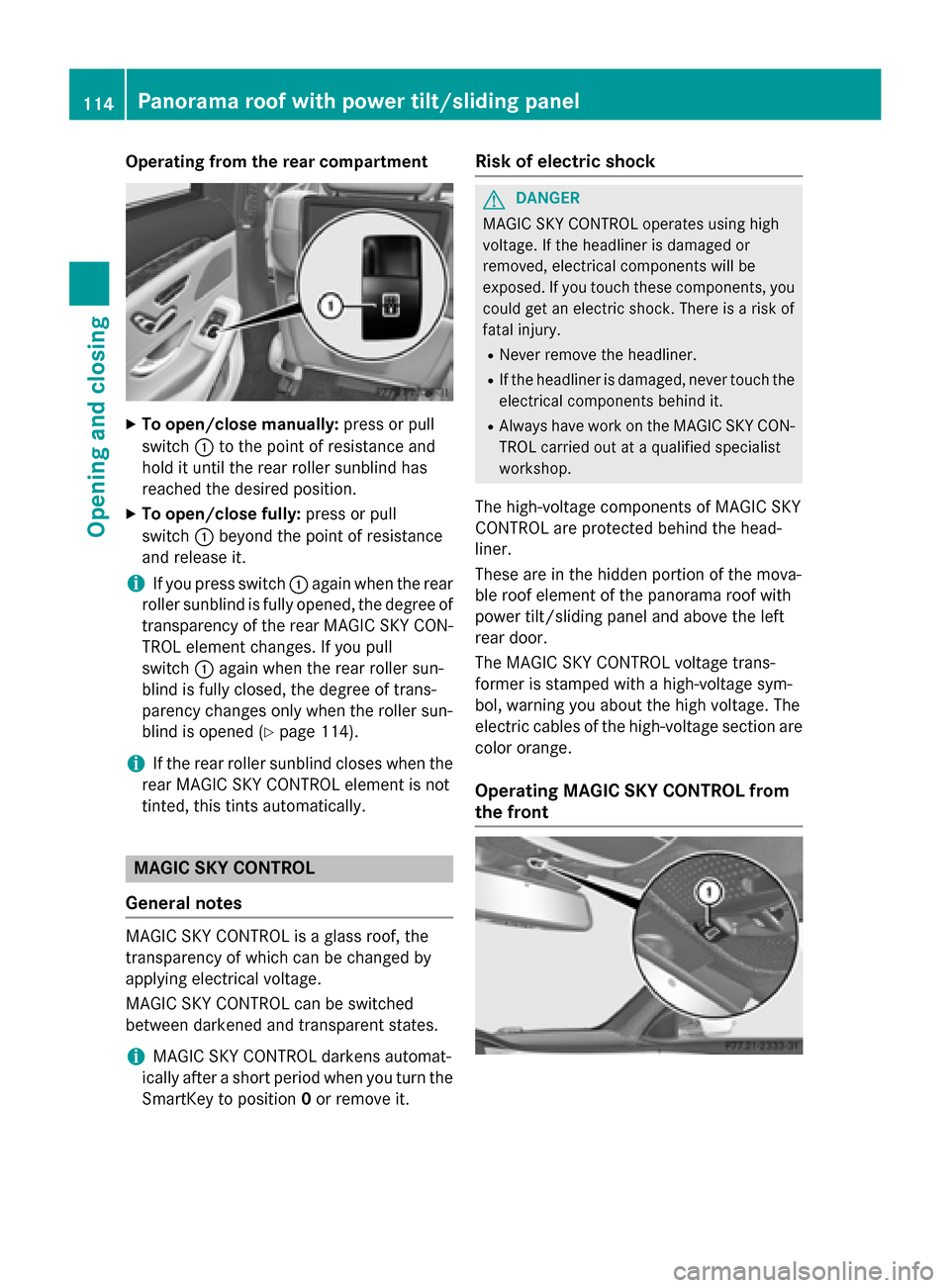
X
To open/close manually: press or pull
switch :to the point of resistance and
hold it until the rear roller sunblind has
reached the desired position.
X To open/close fully: press or pull
switch :beyond the point of resistance
and release it.
i If you press switch
:again when the rear
roller sunblind is fully opened, the degree of transparency of the rear MAGIC SKY CON-
TROL element changes. If you pull
switch :again when the rear roller sun-
blind is fully closed, the degree of trans-
parency changes only when the roller sun-
blind is opened (Y page 114).
i If the rear roller sunblind closes when the
rear MAGIC SKY CONTROL element is not
tinted, this tints automatically. MAGIC SKY CONTROL
General notes MAGIC SKY CONTROL is a glass roof, the
transparency of which can be changed by
applying electrical voltage.
MAGIC SKY CONTROL can be switched
between darkened and transparent states.
i MAGIC SKY CONTROL darkens automat-
ically after a short period when you turn the SmartKey to position 0or remove it. Risk of electric shock G
DANGER
MAGIC SKY CONTROL operates using high
voltage. If the headliner is damaged or
removed, electrical components will be
exposed. If you touch these components, you could get an electric shock. There is a risk of
fatal injury.
R Never remove the headliner.
R If the headliner is damaged, never touch the
electrical components behind it.
R Always have work on the MAGIC SKY CON-
TROL carried out at a qualified specialist
workshop.
The high-voltage components of MAGIC SKY
CONTROL are protected behind the head-
liner.
These are in the hidden portion of the mova-
ble roof element of the panorama roof with
power tilt/sliding panel and above the left
rear door.
The MAGIC SKY CONTROL voltage trans-
former is stamped with a high-voltage sym-
bol, warning you about the high voltage. The
electric cables of the high-voltage section are color orange.
Operating MAGIC SKY CONTROL from
the front 114
Panorama roof with power tilt/sliding panelOpening and closing