2015 MERCEDES-BENZ GLC SUV light
[x] Cancel search: lightPage 36 of 497
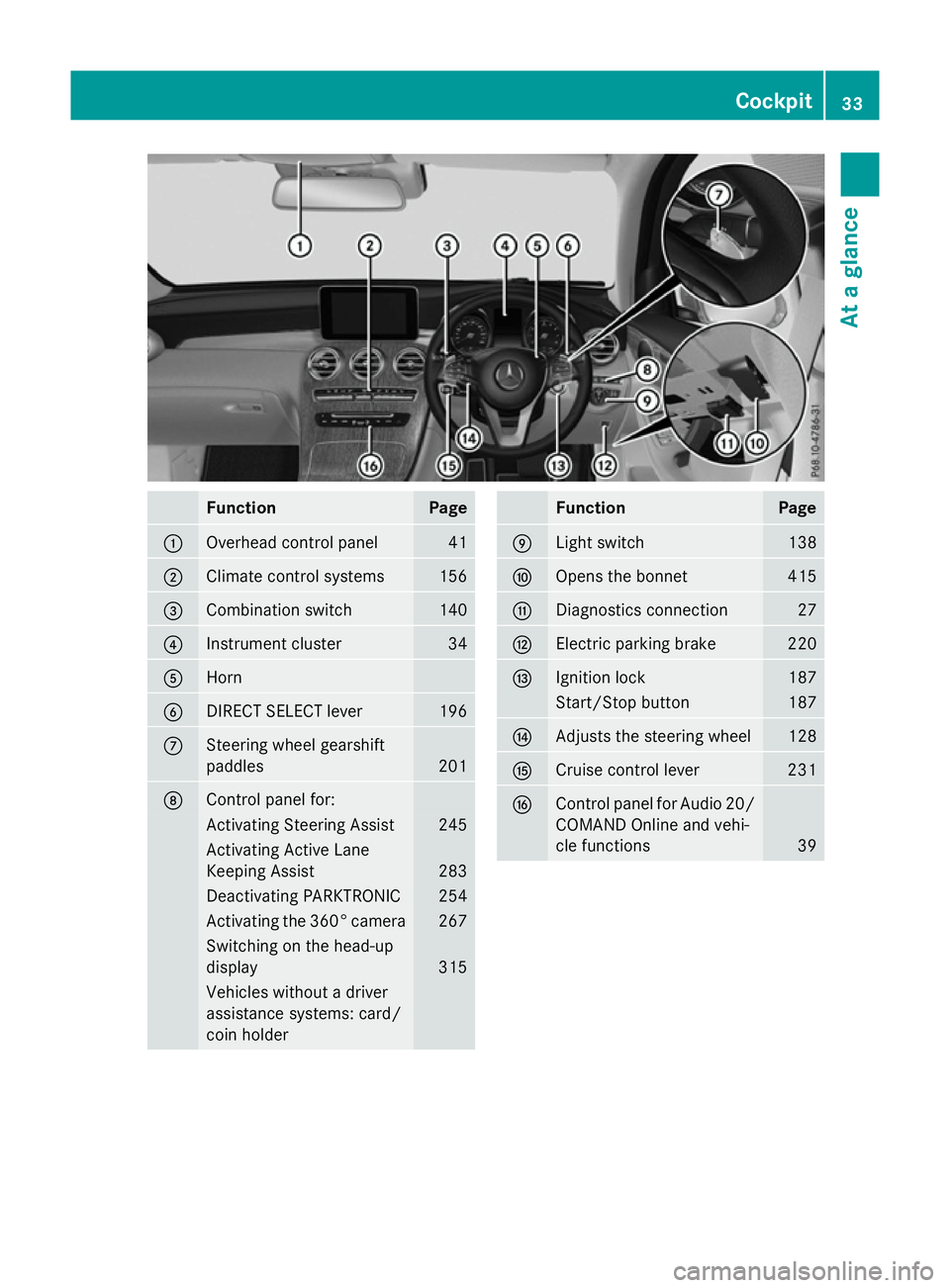
Function Page
:
Overhead control panel 41
;
Climate control systems 156
=
Combination switch 140
?
Instrument cluster 34
A
Horn
B
DIRECT SELECT lever 196
C
Steering wheel gearshift
paddles
201
D
Control panel for:
Activating Steering Assist 245
Activating Active Lane
Keeping Assist
283
Deactivating PARKTRONIC 254
Activating the 360° camera 267
Switching on the head-up
display
315
Vehicles without a driver
assistance systems: card/
coin holder Function Page
E
Light switch 138
F
Opens the bonnet 415
G
Diagnostics connection 27
H
Electric parking brake 220
I
Ignition lock 187
Start/Stop button 187
J
Adjusts the steering wheel 128
K
Cruise control lever 231
L
Control panel for Audio 20/
COMAND Online and vehi-
cle functions 39Cockpit
33At a glance
Page 39 of 497
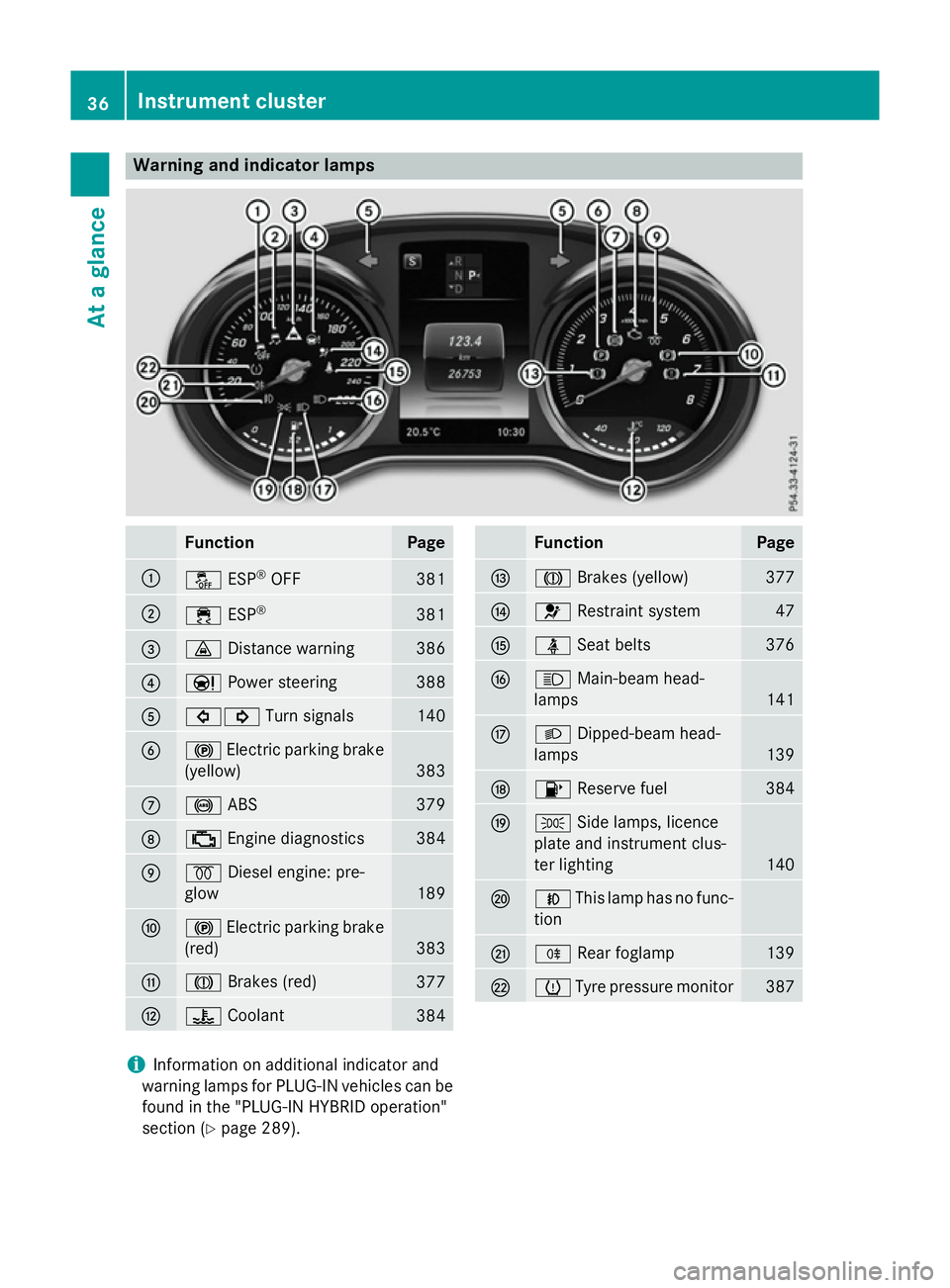
Warning and indicator lamps
Function Page
:
å
ESP®
OFF 381
;
÷
ESP® 381
=
·
Distance warning 386
?
Ð
Power steering 388
A
#!
Turn signals 140
B
!
Electric parking brake
(yellow) 383
C
!
ABS 379
D
;
Engine diagnostics 384
E
%
Diesel engine: pre-
glow 189
F
!
Electric parking brake
(red) 383
G
J
Brakes (red) 377
H
?
Coolant 384 Function Page
I
J
Brakes (yellow) 377
J
6
Restraint system 47
K
ü
Seat belts 376
L
K
Main-beam head-
lamps 141
M
L
Dipped-beam head-
lamps 139
N
8
Reserve fuel 384
O
T
Side lamps, licence
plate and instrument clus-
ter lighting 140
P
N
This lamp has no func-
tion Q
R
Rear foglamp 139
R
h
Tyre pressure monitor 387
i
Information on additional indicator and
warning lamps for PLUG-IN vehicles can be
found in the "PLUG-IN HYBRID operation"
section (Y page 289). 36
Instrument clusterAt a glance
Page 43 of 497
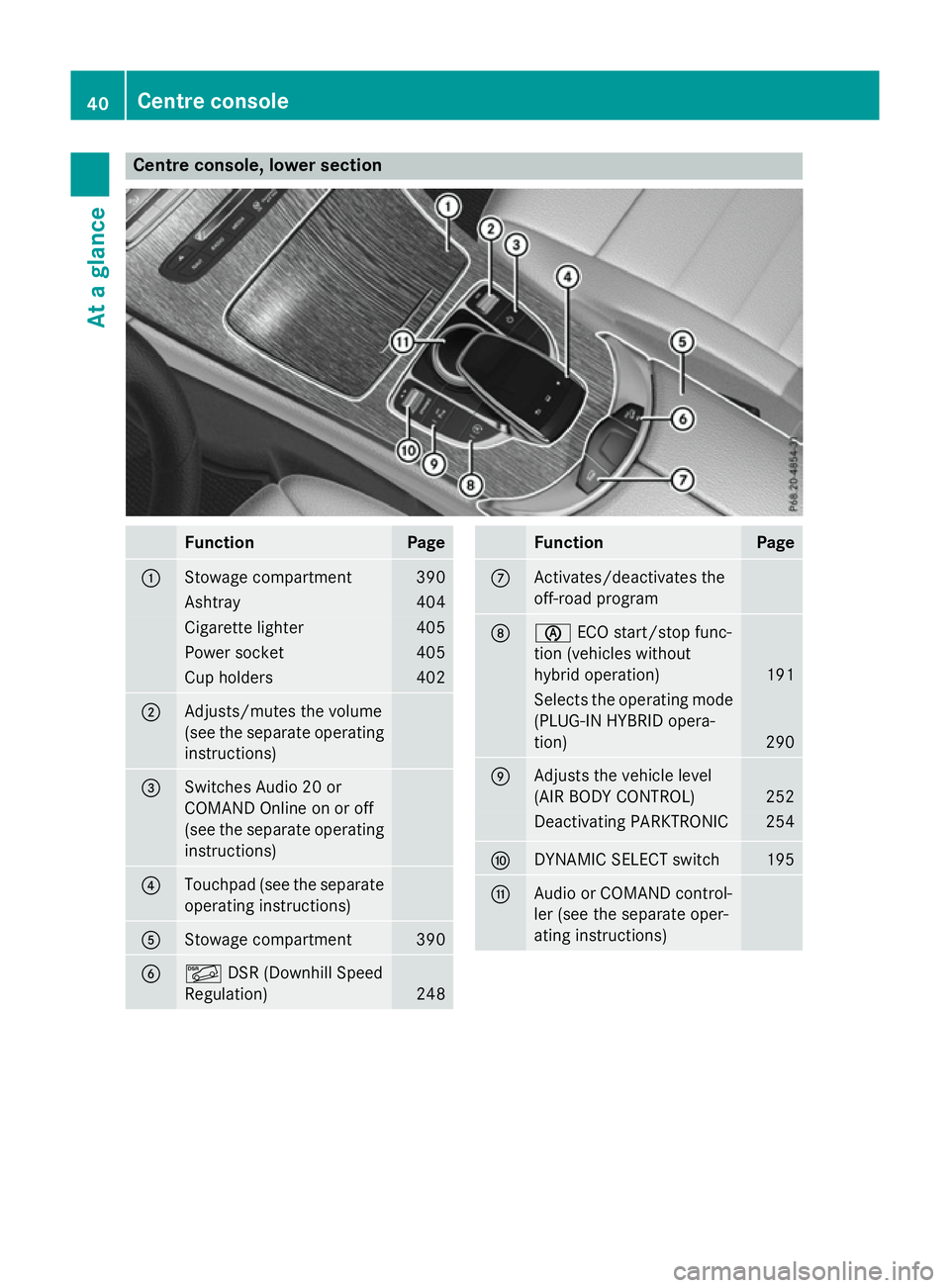
Centre console, lower section
Function Page
:
Stowage compartment 390
Ashtray 404
Cigarette lighter 405
Power socket 405
Cup holders 402
;
Adjusts/mutes the volume
(see the separate operating
instructions) =
Switches Audio 20 or
COMAND Online on or off
(see the separate operating
instructions) ?
Touchpad (see the separate
operating instructions) A
Stowage compartment 390
B
Ã
DSR (Downhill Speed
Regulation) 248 Function Page
C
Activates/deactivates the
off-road program
D
è
ECO start/stop func-
tion (vehicles without
hybrid operation) 191
Selects the operating mode
(PLUG-IN HYBRID opera-
tion) 290
E
Adjusts the vehicle level
(AIR BODY CONTROL)
252
Deactivating PARKTRONIC 254
F
DYNAMIC SELECT switch 195
G
Audio or COMAND control-
ler (see the separate oper-
ating instructions)40
Centre consoleAt a glance
Page 44 of 497
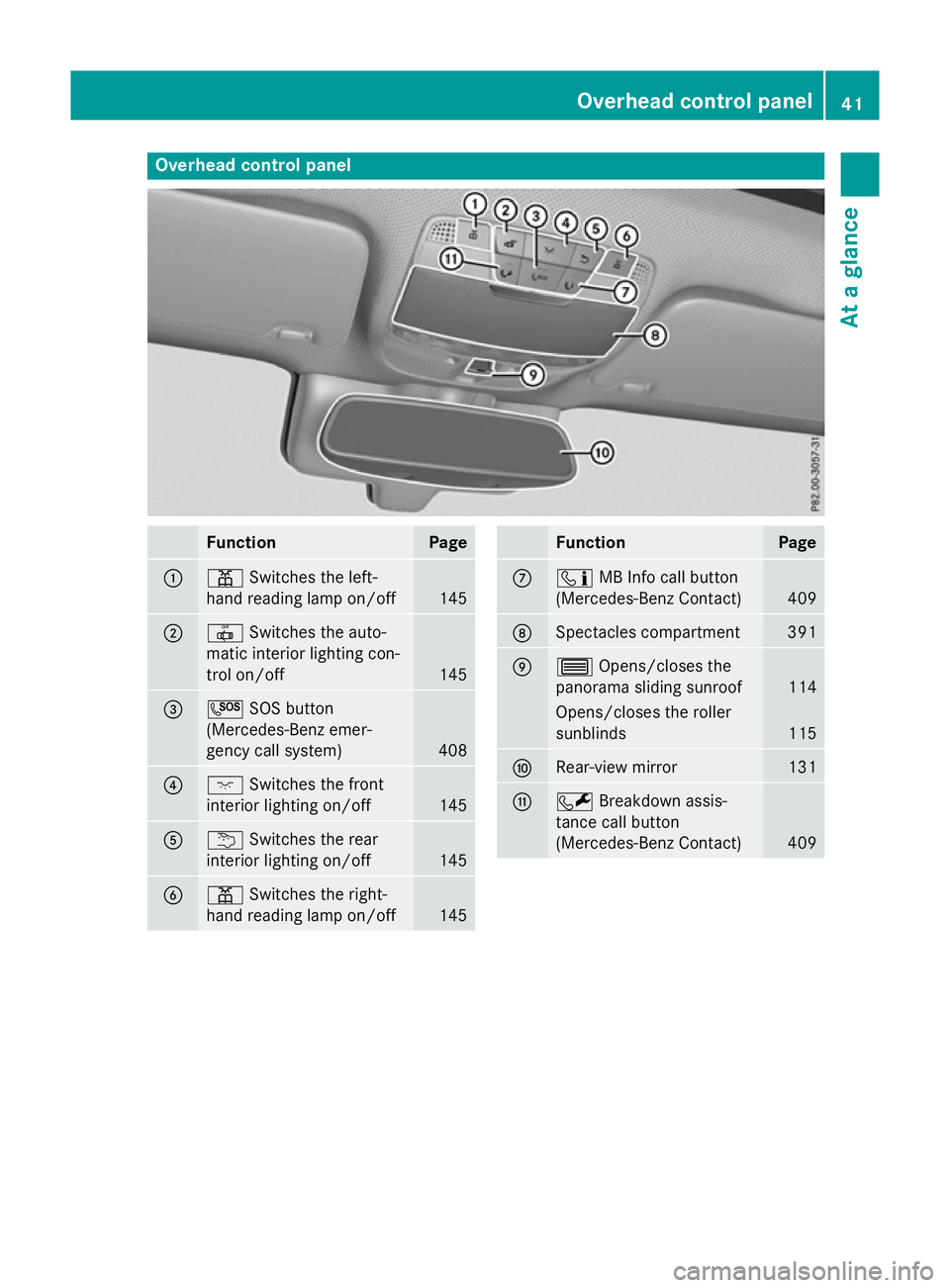
Overhead control panel
Function Page
:
p
Switches the left-
hand reading lamp on/off 145
;
|
Switches the auto-
matic interior lighting con-
trol on/off 145
=
G
SOS button
(Mercedes-Benz emer-
gency call system) 408
?
c
Switches the front
interior lighting on/off 145
A
u
Switches the rear
interior lighting on/off 145
B
p
Switches the right-
hand reading lamp on/off 145 Function Page
C
ï
MB Info call button
(Mercedes-Benz Contact) 409
D
Spectacles compartment 391
E
3
Opens/closes the
panorama sliding sunroof 114
Opens/closes the roller
sunblinds
115
F
Rear-view mirror 131
G
F
Breakdown assis-
tance call button
(Mercedes-Benz Contact) 409Overhead control panel
41At a glance
Page 48 of 497
!
To prevent damage to the hybrid drive
system please observe the following
instructions:
R only deactivate the hybrid drive system
manually in the following situations.
R work on the hybrid drive system may only
be carried out at a qualified specialist
workshop, even when it has been deac-
tivated manually.
Deactivate the hybrid system manually if:
R the 6 restraint system warning lamp in
the instrument cluster lights up after an
accident
R the vehicle is badly damaged, e.g. after an
accident, and the restraint system compo-
nents were not activated
R the vehicle is badly damaged and has to be
towed or transported
X If possible, move the vehicle out of the
danger zone: shift the transmission into
position N.
X Release the electric parking brake.
X Roll the vehicle to a safe place and park it
safely.
Get assistance from others if necessary.
The vehicle is locked automatically when the
ignition is switched on and the wheels are
turning. There is therefore a risk of being
locked out if the vehicle is being pushed or
tested on a dynamometer.
X Switch the ignition off.
X Shift the transmission to position P.
Apply the electric parking brake
(Y page 220).
Secure the vehicle against rolling away
(Y page 465).
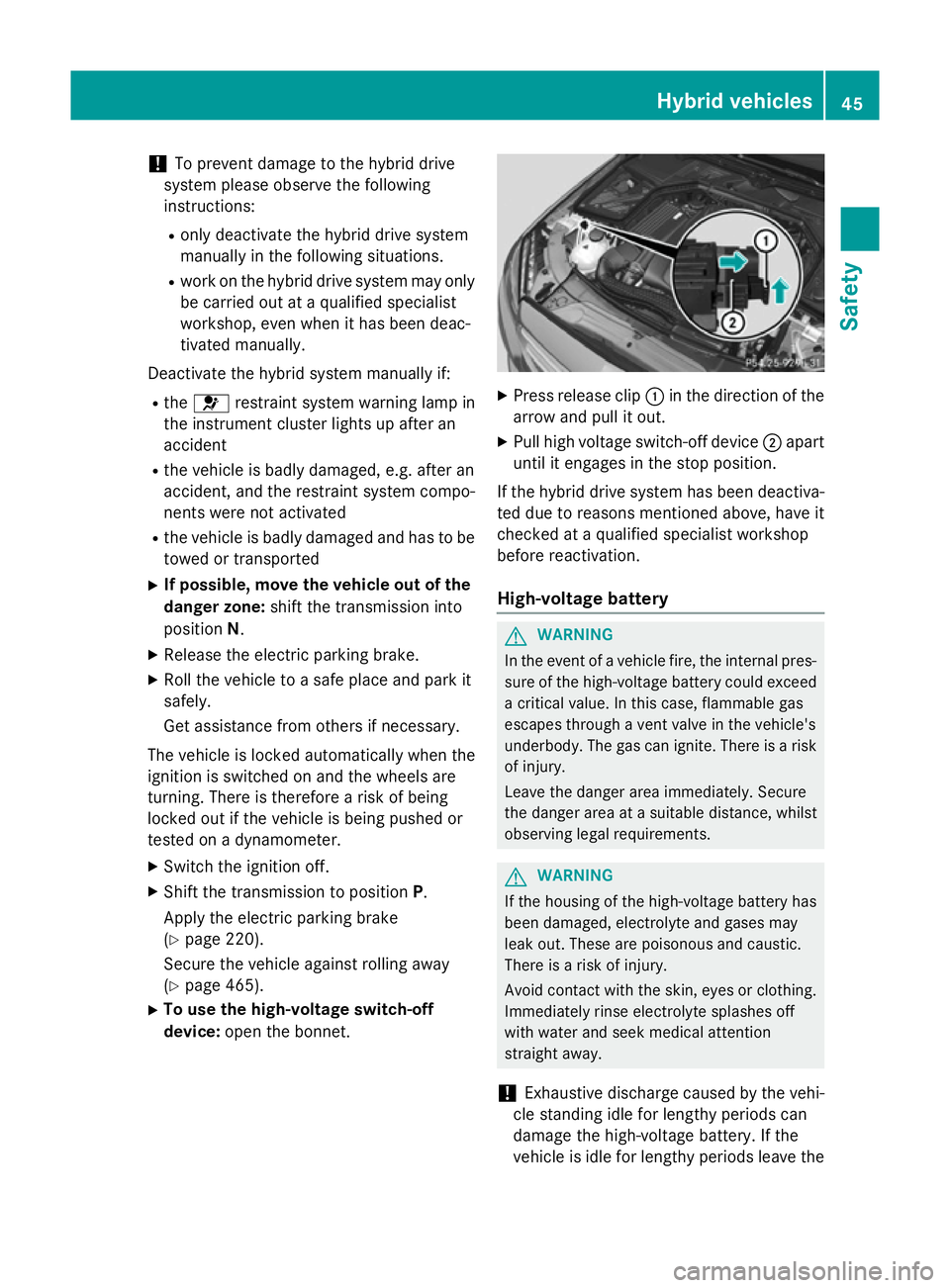
X To use the high-voltage switch-off
device: open the bonnet. X
Press release clip :in the direction of the
arrow and pull it out.
X Pull high voltage switch-off device ;apart
until it engages in the stop position.
If the hybrid drive system has been deactiva- ted due to reasons mentioned above, have it
checked at a qualified specialist workshop
before reactivation.
High-voltage battery G
WARNING
In the event of a vehicle fire, the internal pres- sure of the high-voltage battery could exceeda critical value. In this case, flammable gas
escapes through a vent valve in the vehicle's
underbody. The gas can ignite. There is a risk
of injury.
Leave the danger area immediately. Secure
the danger area at a suitable distance, whilst
observing legal requirements. G
WARNING
If the housing of the high-voltage battery has
been damaged, electrolyte and gases may
leak out. These are poisonous and caustic.
There is a risk of injury.
Avoid contact with the skin, eyes or clothing. Immediately rinse electrolyte splashes off
with water and seek medical attention
straight away.
! Exhaustive discharge caused by the vehi-
cle standing idle for lengthy periods can
damage the high-voltage battery. If the
vehicle is idle for lengthy periods leave the Hybrid vehicles
45Safety Z
Page 50 of 497
An airbag supplements a correctly fastened
seat belt. As an additional safety device, the
airbag increases the level of protection for
vehicle occupants in the event of an accident.
For example, if the protection of the seat belt is sufficient in an accident, the airbags are not
deployed. In the event of an accident, only the airbags that increase protection in the rele-
vant accident situation are deployed. How-
ever, seat belts and airbags generally do not
protect against objects penetrating the vehi-
cle from the outside.
Information on the restraint system operation
can be found under "Triggering of belt ten-
sioners and airbags" (Y page 62).
For more information about children travel-
ling with you in the vehicle, see "Children in
the vehicle" (Y page 65). Important safety notes
G
WARNING
If the restraint system is modified, it may no
longer work as intended. The restraint system
may then not perform its intended protective function by failing in an accident or triggering
unexpectedly, for example. There is an
increased risk of injury, possibly even fatal.
Never modify parts of the restraint system. Do not attempt to modify the wiring as well as
electronic components or their software.
If it is necessary to modify an airbag system to
accommodate a person with disabilities, con- tact a Mercedes-Benz Service Centre. Restraint system warning lamp
The functions of the restraint system are
checked after the ignition is switched on and at regular intervals while the engine is run-
ning. Therefore, malfunctions can be detec-
ted in good time.
The 6 restraint system warning lamp in
the instrument cluster lights up when the igni- tion is switched on. It goes out no later than a few seconds after the vehicle is started. The
components of the restraint system are in
operational readiness.
A malfunction has occurred if the
6
restraint system warning lamp:
R does not light up after the ignition is
switched on
R does not go out after a few seconds with
the engine running
R lights up again while the engine is running
All vehicles, except hybrid vehicles: G
WARNING
If the restraint system is malfunctioning,
restraint system components may be trig-
gered unintentionally or might not be trig-
gered at all in the event of an accident with a high rate of vehicle deceleration. This can
effect belt tensioners or airbags, for example. There is an increased risk of serious or even
fatal injuries.
Have the restraint system checked and
repaired immediately at a qualified specialist
workshop.
Hybrid vehicles: G
DANGER
If the restraint system is malfunctioning,
restraint system components may be trig-
gered unintentionally or might not be trig-
gered at all in the event of an accident with a high rate of vehicle deceleration. This can
effect belt tensioners or airbags, for example. In addition, the vehicle's high-voltage electri-
cal system may not be deactivated as inten-
ded in the event of an accident. Touching
damaged components of the vehicle's high-
voltage electrical system could result in an
electric shock. There is an increased risk of
injury, possibly even fatal.
Have the restraint system checked and
repaired immediately at a qualified specialist
workshop. After an accident, immediately
switch the ignition off and remove the key
from the ignition lock. Occupant safety
47Safety Z
Page 51 of 497
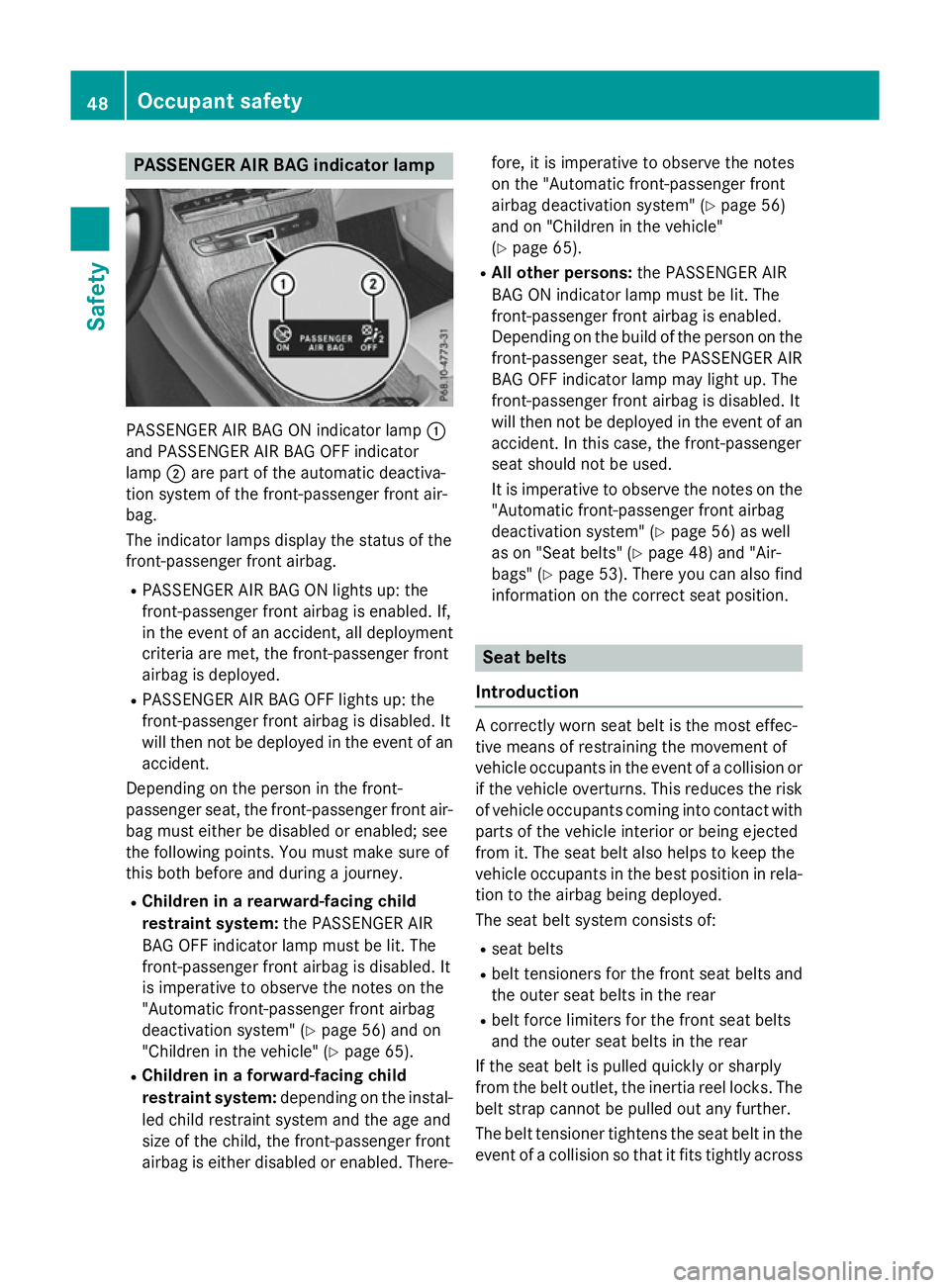
PASSENGER AIR BAG indicator lamp
PASSENGER AIR BAG ON indicator lamp
:
and PASSENGER AIR BAG OFF indicator
lamp ;are part of the automatic deactiva-
tion system of the front-passenger front air-
bag.
The indicator lamps display the status of the
front-passenger front airbag.
R PASSENGER AIR BAG ON lights up: the
front-passenger front airbag is enabled. If,
in the event of an accident, all deployment
criteria are met, the front-passenger front
airbag is deployed.
R PASSENGER AIR BAG OFF lights up: the
front-passenger front airbag is disabled. It
will then not be deployed in the event of an
accident.
Depending on the person in the front-
passenger seat, the front-passenger front air-
bag must either be disabled or enabled; see
the following points. You must make sure of
this both before and during a journey.
R Children in a rearward-facing child
restraint system: the PASSENGER AIR
BAG OFF indicator lamp must be lit. The
front-passenger front airbag is disabled. It
is imperative to observe the notes on the
"Automatic front-passenger front airbag
deactivation system" (Y page 56) and on
"Children in the vehicle" (Y page 65).
R Children in a forward-facing child
restraint system: depending on the instal-
led child restraint system and the age and
size of the child, the front-passenger front
airbag is either disabled or enabled. There- fore, it is imperative to observe the notes
on the "Automatic front-passenger front
airbag deactivation system" (Y
page 56)
and on "Children in the vehicle"
(Y page 65).
R All other persons: the PASSENGER AIR
BAG ON indicator lamp must be lit. The
front-passenger front airbag is enabled.
Depending on the build of the person on the front-passenger seat, the PASSENGER AIR
BAG OFF indicator lamp may light up. The
front-passenger front airbag is disabled. It
will then not be deployed in the event of an
accident. In this case, the front-passenger
seat should not be used.
It is imperative to observe the notes on the "Automatic front-passenger front airbag
deactivation system" (Y page 56) as well
as on "Seat belts" (Y page 48) and "Air-
bags" (Y page 53). There you can also find
information on the correct seat position. Seat belts
Introduction A correctly worn seat belt is the most effec-
tive means of restraining the movement of
vehicle occupants in the event of a collision or
if the vehicle overturns. This reduces the risk of vehicle occupants coming into contact with
parts of the vehicle interior or being ejected
from it. The seat belt also helps to keep the
vehicle occupants in the best position in rela-
tion to the airbag being deployed.
The seat belt system consists of:
R seat belts
R belt tensioners for the front seat belts and
the outer seat belts in the rear
R belt force limiters for the front seat belts
and the outer seat belts in the rear
If the seat belt is pulled quickly or sharply
from the belt outlet, the inertia reel locks. The
belt strap cannot be pulled out any further.
The belt tensioner tightens the seat belt in the event of a collision so that it fits tightly across 48
Occupant safetySafety
Page 55 of 497
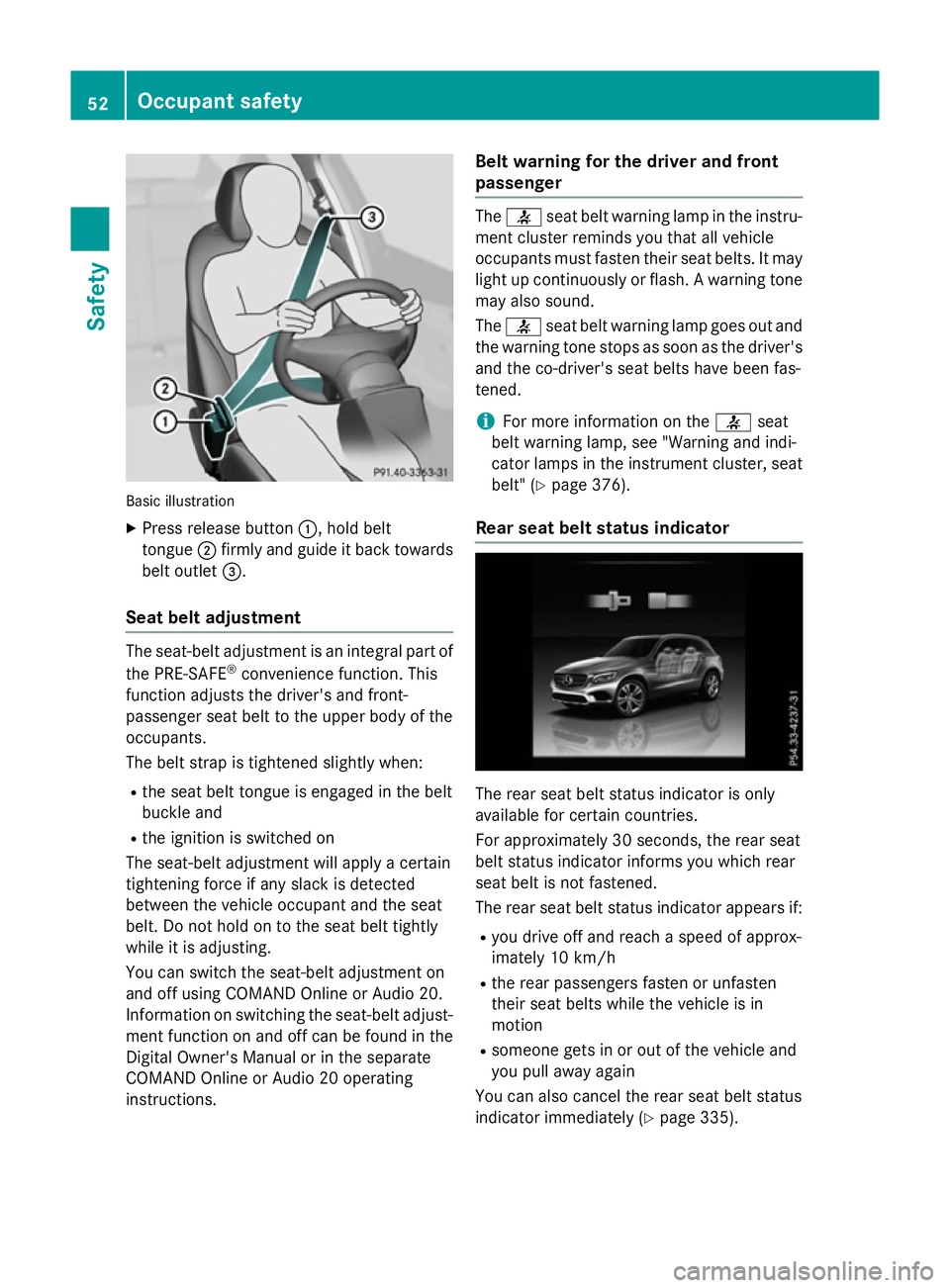
Basic illustration
X Press release button :, hold belt
tongue ;firmly and guide it back towards
belt outlet =.
Seat belt adjustment The seat-belt adjustment is an integral part of
the PRE-SAFE ®
convenience function. This
function adjusts the driver's and front-
passenger seat belt to the upper body of the
occupants.
The belt strap is tightened slightly when:
R the seat belt tongue is engaged in the belt
buckle and
R the ignition is switched on
The seat-belt adjustment will apply a certain
tightening force if any slack is detected
between the vehicle occupant and the seat
belt. Do not hold on to the seat belt tightly
while it is adjusting.
You can switch the seat-belt adjustment on
and off using COMAND Online or Audio 20.
Information on switching the seat-belt adjust-
ment function on and off can be found in the
Digital Owner's Manual or in the separate
COMAND Online or Audio 20 operating
instructions. Belt warning for the driver and front
passenger The
7 seat belt warning lamp in the instru-
ment cluster reminds you that all vehicle
occupants must fasten their seat belts. It may
light up continuously or flash. A warning tone
may also sound.
The 7 seat belt warning lamp goes out and
the warning tone stops as soon as the driver's and the co-driver's seat belts have been fas-
tened.
i For more information on the
7seat
belt warning lamp, see "Warning and indi-
cator lamps in the instrument cluster, seat
belt" (Y page 376).
Rear seat belt status indicator The rear seat belt status indicator is only
available for certain countries.
For approximately 30 seconds, the rear seat
belt status indicator informs you which rear
seat belt is not fastened.
The rear seat belt status indicator appears if:
R you drive off and reach a speed of approx-
imately 10 km/h
R the rear passengers fasten or unfasten
their seat belts while the vehicle is in
motion
R someone gets in or out of the vehicle and
you pull away again
You can also cancel the rear seat belt status
indicator immediately (Y page 335).52
Occupant safetySafety