2015 MERCEDES-BENZ E-CLASS SALOON towing
[x] Cancel search: towingPage 25 of 497
Trim piece
s(clea ning instruc-
tions) .................................................. 392
Trip computer (on-board com-
puter) .................................................. 280
Trip meter
Calling up ....................................... 280
Resetting (on-boar dcomputer) ...... 281
Turn signals
Changing bulb s(front) ................... 151
Switching on/off ........................... 144
TV
Operating (on-boar dcomputer) ..... 284
see Separate operating instructions
Two-way radio
Frequencie s................................... 470
Installation ..................................... 470
Transmission outpu t(maximum) .... 470
Type identificatio nplate
see Vehicl eide ntificatio nplate
Tyre changin gtoolkit....................... 395
Tyre pressure
Calling up (on-boar dcomputer) ..... 423
Display message ............................ 322
Not reache d(TIRE FIT) .................... 400
Reached (TIREFIT) .......................... 400
Recommended ............................... 420
Tyre pressure loss warning
Genera lnotes ................................ 421
Important safety notes .................. 422
Restarting ...................................... 422
Tyre pressure monitor
Checking the tyr epressure elec-
tronically ........................................ 424
Function/note s............................. 423
Genera lnotes ................................ 423
Important safety notes .................. 423
Radi otypea pproval for the tyre
pressure monitor ........................... 425
Restarting ...................................... 424
Warning lamp ................................. 339
Warning message .......................... 424
Tyres
Changing awheel .......................... 426
Checking ........................................ 417
Directio nofrotation ...................... 426
Displa ymessage ............................ 322
Genera lnotes ................................ 431
Important safety notes .................. 416 Information on driving .................... 416
MOExtended tyre s......................... 418
Replacing ....................................... 426
Service life ..................................... 417
Storing ........................................... 426
Tyre size (data ).............................. 431
Tyre trea d...................................... 417
Wheel and tyre combinations ........ 433
see Fla ttyre U
Unlocking Emergency unlocking ..................... 102
From inside the vehicl e(central
unlocking button) ........................... 101 V
Vanity mirro r(in sun visor) .............. 363
Variable SPEEDTRONIC
see SPEEDTRONIC
Vehicle
Correct us e...................................... 27
Data acquisition ............................... 28
Displa ymessage ............................ 324
Electronics ..................................... 470
Equipment ....................................... 25
Implied warranty .............................. 27
Individua lsettings .......................... 289
Leaving parked up ......................... 207
Locking (i nanemergency) ............. 103
Locking (key) ................................... 95
Lowering ........................................ 430
Pulling away ................................... 182
Raising ........................................... 427
Registration ..................................... 27
Securing from rolling away ............ 427
Tow-starting ................................... 407
Towing away .................................. 407
Transporting .................................. 410
Unlocking (i nanemergency) ......... 102
Unlocking (key) ................................ 95
Vehicl edata. .................................. 481
Vehicl edata ....................................... 481
Vehicl edimensions ........................... 481
Vehicl eemergenc yloc king .............. 103 22
Index
Page 60 of 497

R
vehicles with the memory function: the
front-passenge rseat is adjusted if it is in an
unfavourable position.
R vehicles with amulticontour seat or active
multicontour seat: the air pressure in the
side bolsters of the backrest is increased.
If the hazardous situation passes without
resulting in an accident, PRE-SAFE ®
slackens
the beltp re-tensioning. On vehicles with mul-
ticontour seats/active multicontour seats,
the air pressure in the side bolsters is reduced
again. All settings made by PRE-SAFE ®
can
then be reversed.
If the seat beltp re-tensioning is not reduced:
X Move the seat backrest or seat back
slightly when the vehicl eisstationary.
Seat beltp re-tensioning is reduced and the
locking mechanism is released.
The seat-belt adjustment is an integral part of
the PRE-SAFE ®
convenience function. Infor-
mation about the convenience function can
be found under "Bel tadjustment"
(Y page4 9). PRE-SAFE
®
PLUS( anticipatory occu-
pant protectio nPLUS)
Introduction PRE-SAFE
®
PLUS is only available in vehicles
with the Driving Assistance package.
Using the rada rsensor system, PRE-SAFE ®
PLUS is abletod etect thatahead-on or rear-
end collision is imminent. In certain hazard-
ous situations, PRE-SAFE ®
PLUS takes pre-
emptive measures to protect the vehicle
occupants.
Important safety notes The intervention of PRE-SAFE
®
PLUS cannot
prevent an imminent collision.
The drive risnot warned before the interven-
tion of PRE-SAFE ®
PLUS. PRE-SAFE
®
PLUS does not intervene:
R if the vehicl eisreversing
R when the vehicl eistowing atrailer and
there is arisk of arear-end collision
PRE-SAFE ®
PLUS does not perform braking
actions while the vehicl eisinmotion or when
Parking Guidance is active.
Function PRE-SAFE
®
PLUS intervenes in certain situa-
tions if the rada rsensor system detects an
imminent head-on or rear-end collision.
PRE-SAFE ®
PLUS takes the following meas-
ures depending on the hazardous situation
detected:
R If the rada rsensor system detects that a
head-on collision is imminent, the seat
belts are pre-tensioned.
R If the rada rsensor system detects that a
rear-end collision is imminent:
- the rear hazard warning lamp sare acti-
vated and flas hatahigher frequency.
- the brake pressure is increase difthe
drive rappliest he brakes when the vehi-
cle is stationary.
- the seat belts are pre-tensioned.
The PRE-SAFE ®
PLUS braking application is
cancelled:
R if the accelerator peda lisdepressed when
ag earise ngaged
R if the risk of acollision passes or is no lon-
ger detected
R if DISTRONIC PLUS indicates an intention
to pulla way
If the hazardous situation passes without
resulting in an accident, the original settings
are restored. Occupant safety
57Safety Z
Page 62 of 497
Child restraint system
Do no tfitar earward-facing child restraint
system on th ecentr erear seat.
Be sure to observ ethe correct use of th echild
restraint system (Y page 70).
For safety reasons, Mercedes-Ben zrecom-
mends that you only use achild restraint sys-
te mr ecommended by Mercedes-Benz
(Y page 74). G
WARNING
If th echild restraint system is incorrectly fit-
te dont heseat positio nsuitable for this pur-
pose ,itcanno tperform its intended protec-
tiv ef unction .Intheevent of an accident,
shar pbraking or asudde nchang eind irection,
th ec hild may no tbeheld securely. Ther eisan
increased ris kofserious or eve nfatal injuries.
Observ ethe manufacturer' sinstallation
instruction sand th ecorrec tuse for th echild
restraint system. Mak esure that th eentire
surface of th echild restraint system is resting
on th eseat surface. Never plac eobjects
unde rorb ehindthe child restraint system,
e.g .cushions. Only use child restraint sys-
tems wit hthe original cover designe dfor
them. Only replace damaged covers wit hgen-
uine covers. G
WARNING
If th echild restraint system is fitte dincor-
rectly or is no tsecured, it can com eloos ein
th ee vent of an accident, heav ybraking or a
sudde nchang eind irection .The child
restraint system coul dbethrown about ,strik-
ing vehicle occupants .Ther eisani ncreased
ris kofi njury, possibly eve nfatal.
Always fit child restraint systems properly,
eve nift heya re no tbein gu sed. Mak esure
that you observ ethe child restraint system
manufacturer' sinstallatio ninstructions.
You will fin dfurther informatio nonstowing
objects, luggage and loads securely under
"Loading guidelines" (Y page 342). G
WARNING
Child restraint systems or their securin gsys-
tems that have been damaged or subjected to al oad in an acciden tcanno tperform their
intended protective function .Intheevent of
an accident, shar pbraking or asudden
chang eindirection ,the child may no tbeheld
securely. Ther eisanincreased ris kofserious
or eve nfatal injuries.
Immediately replace child restraint systems
that have been damaged or subjected to a
load in an accident. Hav ethe child restraint
securin gsystems checked in aqualified spe-
cialist worksho pbefore fittin gachild restraint
system again.
Securin gsystems for child restraint systems
include:
R thes eat belt system
R theI SOFI Xsecurin grings
R Top Tether anchorage points
If it is absolutely necessary to carry achild on
th ec o-driver's seat ,besure to observ ethe
note son" Child restraint systems on th eco-
driver' sseat "(Ypage 67). Information
about deactivatin gthe co-driver's fron tairbag
can also be foun dthere.
Observ ethe warning labels in th evehicle inte-
rior and on th echild restraint system.
i It is advisable to use Mercedes-Ben
zcare
product stoclean child restraint systems
recommended by Mercedes-Benz. You can obtain informatio nfroma ny Mercedes-
Ben zServic eCentre. ISOFIX child seat securing system
G
WARNING
ISOFIX child restraint systems do no toffer
sufficient protective effect for childre nwhose
weigh tisgreate rtha n2 2k gw ho are secured
usin gthe safety belt integrate dinthechild
restraint system. The child could, for example, no tber estraine dcorrectly in th eevent of an Children in th
evehicle
59Safety
Z
Page 67 of 497
G
WARNING
If the ICS padded playt able has been incor-
rectly fitted to the integrated child seat, it
cannot perform its intended protective func-
tion. Achild therefore cannot be restrained in
the event of an accident, heavy braking or a
sudden change of direction. In addition, the
ICS padded playt able couldbecome loose
and be thrown around, endangering vehicle
occupants. This pose sanincreased risk of
injury or even fatal injury.
Fit the ICS padded playt able as described.
After fitting the ICS padded playt able,make
sure that it is secure dcorrectly. For safety
reasons, only use the ICS padded playt able
that has been tested and approved for your
vehicle.
The ICS padded playt able is only suitable for
use with the folded-out integrated child seat.
On the rear seats with an integrated child
seat, only use the ICS padded playt able that
is recommende dfor Mercedes-Benz vehicles.
Only use the ICS padded playt able with its
original cover. Withou tthe original cover, the
officia lapproval is invalidated.
Use the ICS padded playt able in accordance
with the instructions in the table in the "Inte-
grated child seat( ICS)"section (Y page62).
Note that children under two years old and
children who weigh less than 12.5 kg require ad ifferent and suitable child restraint system.
Information about other child restraint sys-
tems is available at any Mercedes-Benz Ser-
vice Centre.
You must not use the integrated child seat
with ICS padded playt able asadirect attach-
ment to ababyc ar seatf or which abody
weight of up to 10 kg is permissible. Note that
children younger than 24 months old require
ad ifferent child restraint system
(Y page7 4).
If you are not using the ICS padded playt able,
stow it in an appropriate place, e.g. in the
boot/luggage compartment. You willf ind fur-
ther information on stowing objects, luggage and loads securely under "Loading guide-
lines".
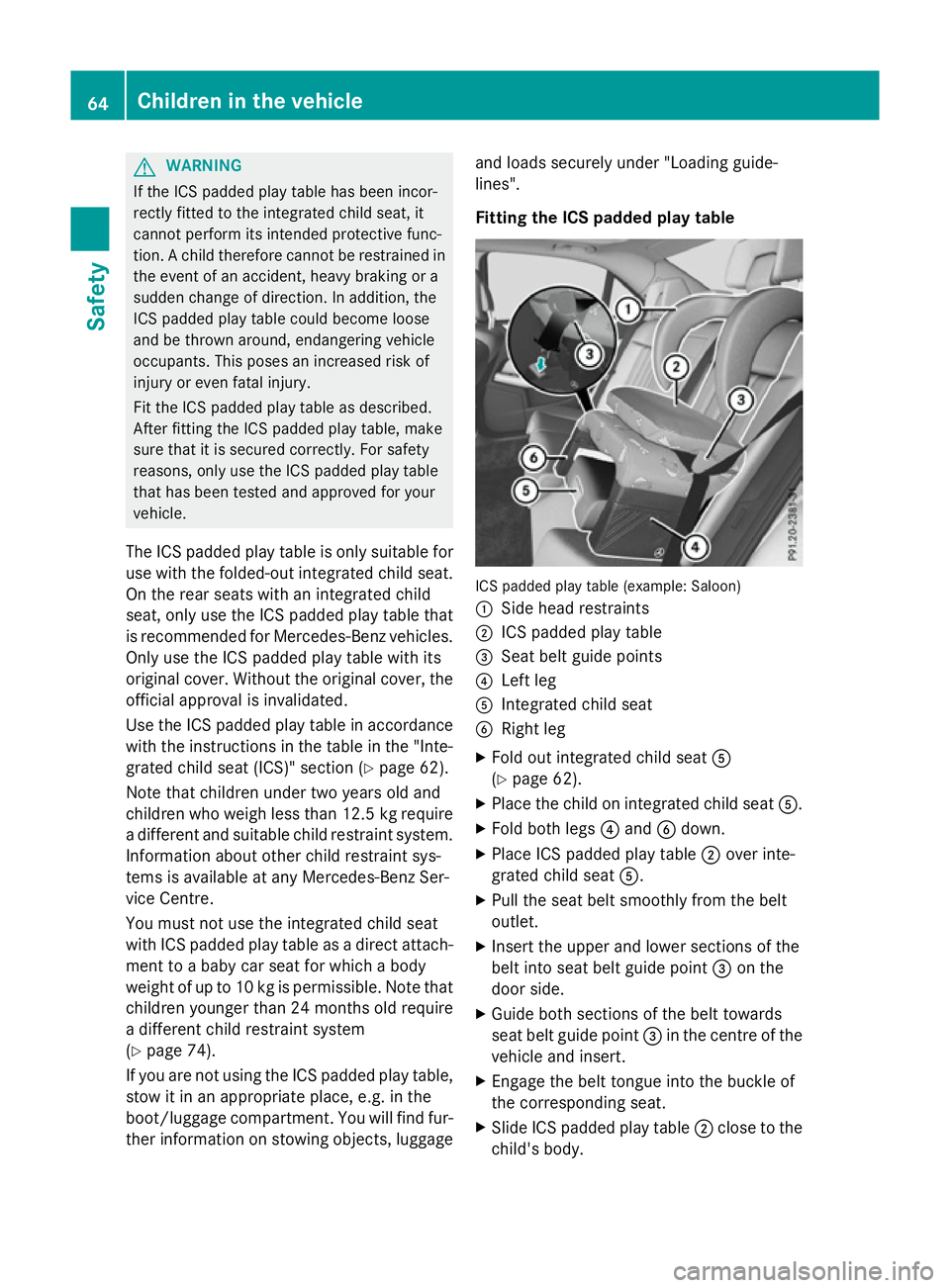
Fittin gthe ICSp added play table ICS padded pla
ytable (example: Saloon)
: Side headr estraints
; ICS padded playt able
= Seat beltg uide points
? Left leg
A Integrated child seat
B Right leg
X Fold out integrated child seat A
(Y page6 2).
X Place the child on integrated child seat A.
X Fold both legs ?and Bdown.
X Place ICS padded playt able;over inte-
grated child seat A.
X Pullt he seat belts moothly from the belt
outlet.
X Insert the upper and lower sections of the
belti nto seat beltg uide point=on the
door side.
X Guide both sections of the beltt owards
seat beltg uide point =in the centre of the
vehicl eand insert.
X Engage the beltt ongue into the buckle of
the corresponding seat.
X Slide ICS padded playt able;close to the
child's body. 64
Children in the vehicleSafety
Page 180 of 497
Useful information
............................178
Running-in notes ............................... 178
Driving ............................................... 178
Manual transmission ........................188
Automatic transmission ...................189
Refuelling ........................................... 200
Parking ............................................... 205
Driving tips ........................................ 207
Driving systems ................................ 211
Towing atrailer ................................. 266 177Driving and parking
Page 191 of 497

Problem
Possible causes/consequences and
M
MSolutions Vehicles with
apetrol
engine:
The engine is not run-
ning smoothly and is
misfiring. There is
amalfunction in the engine electronics or in amechanical
componentoft he engine management system.
X Only depress the accelerator pedal slightly.
Otherwise, non-combusted fuel may get into the catalytic con-
verter and damage it.
X Have the cause rectified immediately at aqualified specialist
workshop. The coolant tempera-
ture display is showing
more than 120 †. The
coolant warning lamp
may also be on and a
warning tone may
sound. The coolant level is too low. The coolant is too hot and the engine
is no longer being cooled sufficiently.
X Stop as soon as possible and allow the engine and the coolant to
cool down.
X Check the coolant level (Y page 382). Observe the warning
notes as you do so and top up the coolant if necessary. If the coolant level is correct,t
he engine radiator fan may be faulty.
The coolant is too hot and the engine is no longer being cooled
sufficiently.
X If the coolant temperature is below 120 †, you can continue
driving to the nearest qualified specialist workshop.
X Avoid heavy loads on the engine as you do so, e.g. driving in
mountainous terrain and stop-start traffic. Manual transmission
Gear lever
! Only engage gear when the clutch pedal is
depressed.
! When shifting between
5thand 6thgear,
you should always push the gear lever all
the way to the right. Otherwise, you could
shift unintentionally into 3rdor4th gear
and damage the transmission.
If you shift down at too high aspeed (trans-
mission braking), this can cause the engine to overrev, leading to engine damage.
Do not use the clutch bite point to keep the
vehicle stationary on uphill gradients.
There is otherwise arisk of damaging the
clutch.
! On long and steep downhill gradients,
especially if the vehicle is laden or towing a trailer, you must shift into gear
1, 2or3in
good time. This uses the engine's braking
effect.T his relieves the load on the brake
system and preventst he brakes from over-
heating and wearing too quickly. k
Reverse gear
1 -6
Forward gears 188
Manual transmissionDriving and parking
Page 197 of 497
AMG vehicles
When shifting down
,the double-clutch func-
tion is active regardless of th ecurrentl yselec-
te dd rivep rogram .The double-clutch function
reduce sload chang ereaction sand is condu-
civ etoas portydriving style. The soun dgen-
erated by th edouble-clutch function depends
on th edrivep rogram selected.
Kickdown Use kickdown for maximum acceleration:
X Depress th eaccelerato rpedal beyon dthe
pressur epoint.
The transmission shifts to alower gear
depending on th eengines peed.
X Eas eoff th eaccelerato rpedal once the
desired spee disreached.
The automatic transmission shifts bac kup.
Towing atrailer Towin
gatrailer is no tpossible wit hall mod-
els. Fo rfurther information ,see
(Y page 267).
X Drive in th emiddle of th eengines peed
range on uphill gradients.
X Manua ldrive program: depending on the
uphill or downhill gradient, shif tint oag ear
(Y page 197) in whic hthe engin ewill run in
th em iddle of th eengines pee drange. This
also applie sifcruise control ,DISTR ONIC
PLU SorS PEEDTR ONICare activated. Program selector button
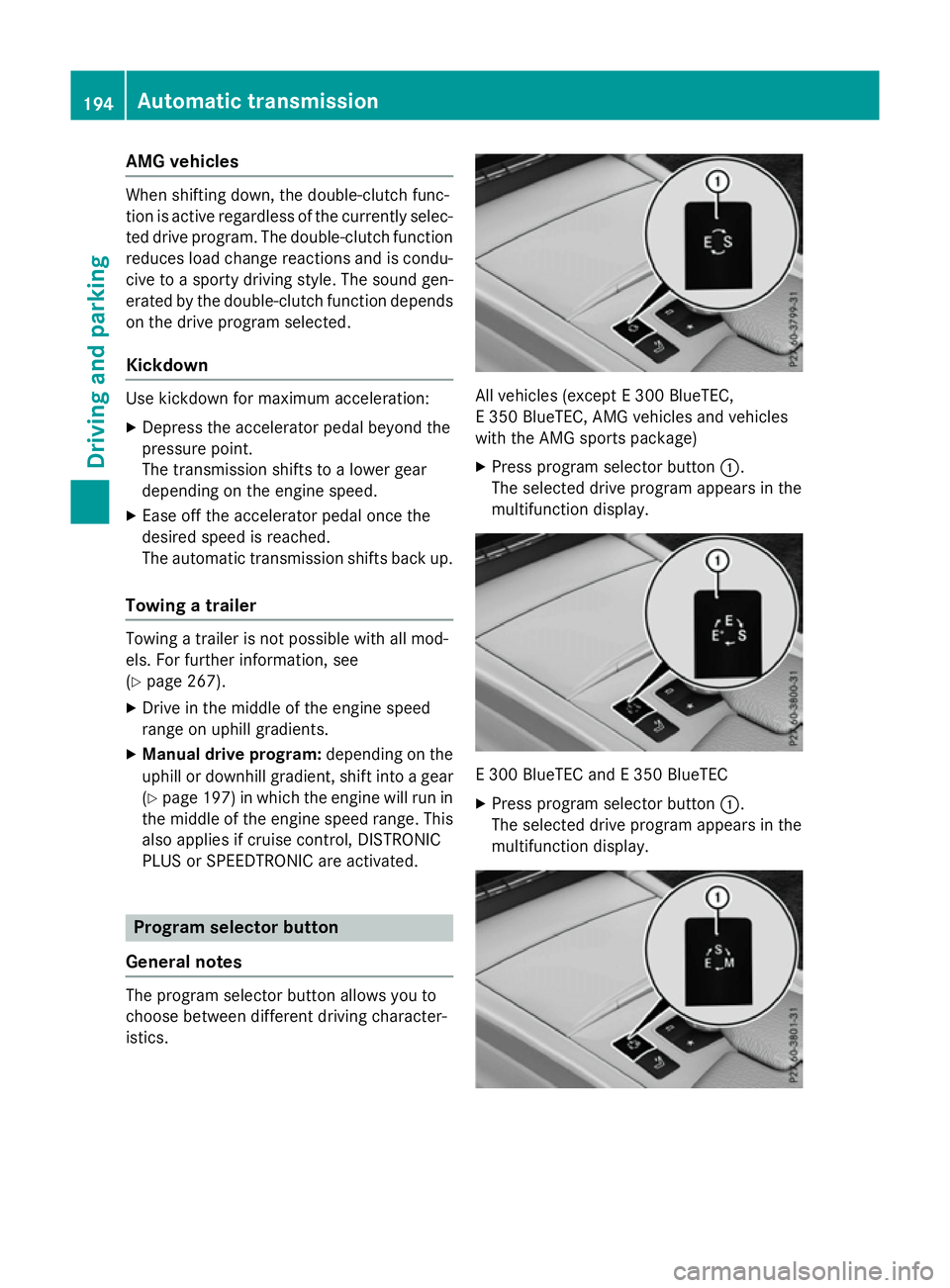
Genera lnotes The program selector butto
nallows you to
choos ebetween differen tdriving character-
istics. All vehicles (except
E300 BlueTEC,
E3 50 BlueTEC, AM Gvehicles and vehicles
wit hthe AM Gsport spackage)
X Press program selector button :.
The selected driv eprogram appear sinthe
multifunction display. E3
00 BlueTE CandE3 50 BlueTEC
X Press program selector button :.
The selected driv eprogram appear sinthe
multifunction display. 194
Automatic trans
missionDriving andparking
Page 212 of 497
Brakes
Important safety notes G
WARNING
If yo ushift down on aslipper yroads urface in
an attempt to increas ethe engine's braking
effect, the drive wheels could lose thei rgrip.
Thi sincreases the ris kofskidding and having
an accident.
Do not shift down for additional engine brak-
ing on aslipper yroads urface.
Downhil lgradients Do not depress the brake peda
lcontinuously
whil ethe vehicl eisinmotion, e.g .never
cause the brakes to ru bbyconstantly apply-
ing light pressure to the pedal. Thi sresults in
excessive and premature wear to the brake
pads.
Chang einto alower gearing oodtime on long
and stee pdownhil lgradients.
Take particula rnote of thi swhend riving a
lade nvehicl eand when towing atrailer.
i Thi
salsoa pplies if youhavea ctivated
cruis econtrol, SPEEDTRONIC or
DISTRONIC PLUS.
Thi sw illu se the braking effect of the engine,
so less braking will be required to maintain
vehicl espeed .Thisr elieves the load on the
brake system and prevents the brakes from
overheating and wearing too quickly.
Heavy and light loads G
WARNING
The braking system can overheat if yo ulea ve
your foo tonthe brake peda lwhile driving.
Thi sincreases the braking distance and could
eve ncause the braking system to fail. There is
ar iskofana ccident.
Never us ethe brake peda lasafootrest. Do
not simultaneousl ydepress both the brake
peda land the accelerato rpedal whiledriving. !
Depressing the brake peda
lconstantly
results in excessive and premature wear to
the brake pads.
If the brakes have been subjected to aheavy
load ,don ot stop the vehicl eimmediately, but
drive on for ashort while. Thi sallow sthe air-
flo wtoc ool the brakes more quickly.
If the brakes have been used onl ymoderately,
yo us houl doccasionall ytest thei reffective-
ness .Todot his, brake more firmly from a
highe rspeed whil epayin gattentio ntothe
traffic conditions. Thi simprove sthe gri pof
the brakes.
Wet road surfaces If yo
uhaved riven for alon gtime in heavy rain
withou tbraking ,ther em aybe adelayed reac-
tio nfrom the brakes when braking for the first
time .Thism ayalso occu rafte rac ar wash or
afte rdriving throug hdeepw ater.
Yo uw illh av etod epress the brake peda lmore
firmly .Maintain agreate rdistance to the vehi-
cle in front.
After driving on awetroa dorh aving the vehi-
cle washed, brake firmly whil epayin gatten-
tio ntot he traffic conditions. Thi swillw armup
the brake discs, thereb ydrying them more
quickl yand protecting them against corro-
sion.
Limite dbraking performanc eonsalt-
treate droads If yo
udrive on salt-treate droads, alayer of
salt ma yform on the brake discs and pads.
Thi scan increas ethe braking distance con-
siderably.
R In order to prevent any salt build-up, apply
the brakes occasionall ywhile paying atten-
tio ntot he traffic conditions.
R Carefull ydepress the brake peda latthe
end of the journey and when starting the
next journey.
R Maintain amuchg reate rdistance to the
vehicl einfront. Driving tips
209Driving andparking Z