2015 MERCEDES-BENZ E-CLASS SALOON lock
[x] Cancel search: lockPage 194 of 497
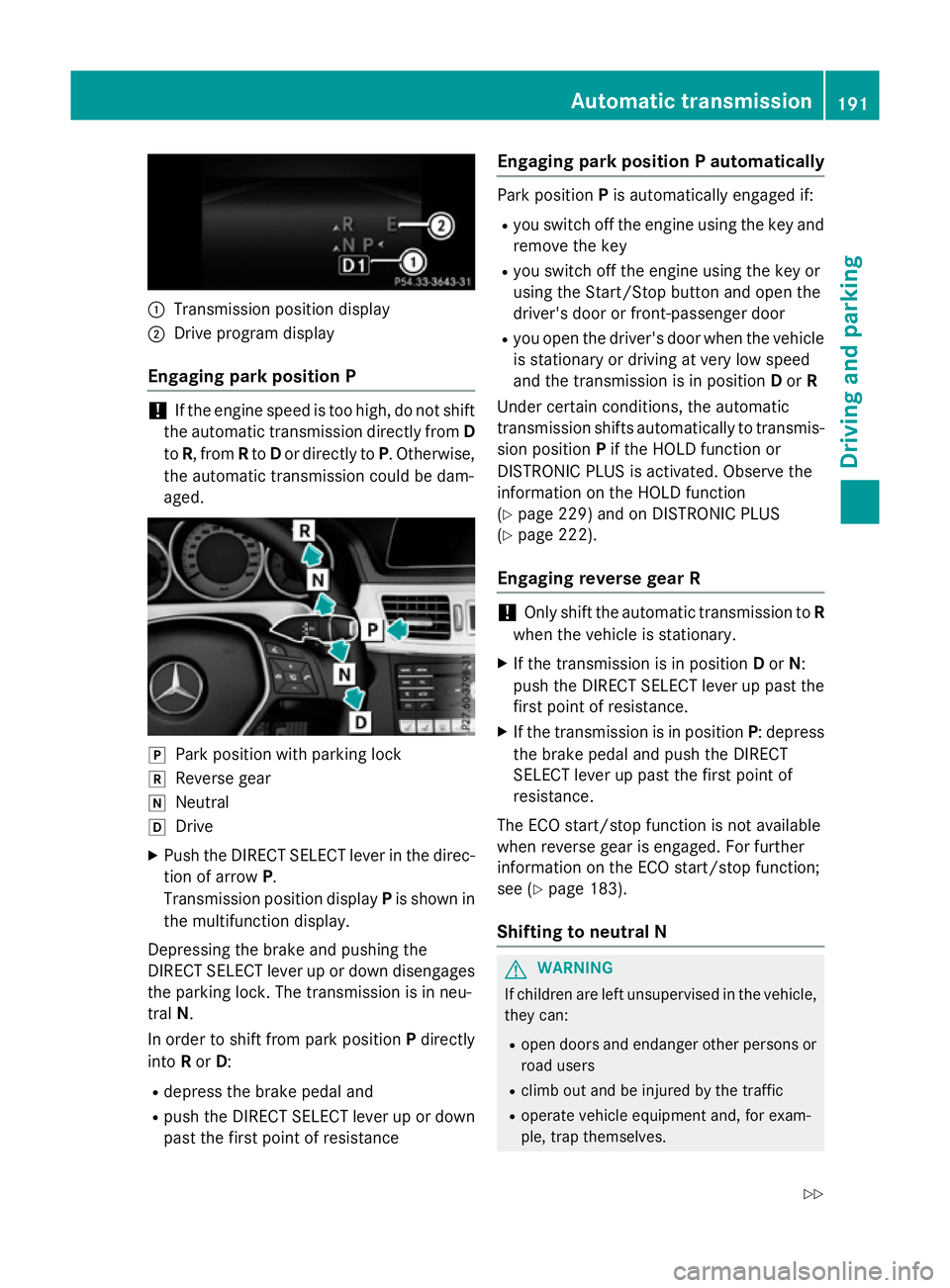
:
Transmission position display
; Drive program display
Engaging parkp osition P !
If the engine speed is too high, do not shift
the automatic transmission directly from D
to R,f rom Rto Dor directly to P.Otherwise,
the automatic transmission could be dam-
aged. j
Park position with parking lock
k Reverse gear
i Neutral
h Drive
X Push the DIRECT SELECT lever in the direc-
tion of arrow P.
Transmission position display Pis shown in
the multifunction display.
Depressin gthe brake and pushing the
DIRECT SELECT lever up or down disengages the parking lock. The transmission is in neu-
tral N.
In order to shift from park position Pdirectly
into Ror D:
R depress the brake pedal and
R push the DIRECT SELECT lever up or down
past the first point of resistance Engaging parkp
ositionPautomatically Park position
Pis automatically engaged if:
R you switch off the engine using the key and
remove the key
R you switch off the engine using the key or
using the Start/Stop button and open the
driver's door or front-passenger door
R you open the driver's door when the vehicle
is stationary or driving at very low speed
and the transmission is in position Dor R
Under certain conditions, the automatic
transmission shifts automatically to transmis-
sion position Pif the HOLD function or
DISTRONIC PLUS is activated. Observe the
information on the HOLD function
(Y page 229) and on DISTRONIC PLUS
(Y page 222).
Engaging reverse gear R !
Only shift the automatic transmission to
R
when the vehicle is stationary.
X If the transmission is in position Dor N:
push the DIRECT SELECT lever up past the first point of resistance.
X If the transmission is in position P:depress
the brake pedal and push the DIRECT
SELECT lever up past the first point of
resistance.
The ECO start/stop function is not available
when reverse gear is engaged. For further
information on the ECO start/stop function;
see (Y page 183).
Shifting to neutral N G
WARNING
If children are left unsupervised in the vehicle, they can:
R open doors and endanger other persons or
road users
R climb out and be injured by the traffic
R operate vehicle equipment and, for exam-
ple, trap themselves. Automatic transmission
191Driving and parking
Z
Page 195 of 497
Children could also set th
evehicle in motion,
for example by:
R releasin gthe parking brake
R shiftin gthe automatic transmission out of
park position P
R starting th eengine.
Ther eisar iskofana ccidentand injury.
When leaving th evehicle ,always tak ethe key
wit hyou and loc kthe vehicle .Never leave
children unattende dinthevehicle .Always
keep th ekeyout of reac hofchildren.
X If th etransmission is in position Dor R:
push th eDIRECT SELECT leve rupordown
to th efirst poin tofresistance.
X If th etransmission is in position P:depress
th eb rak epedal and push th eDIRECT
SELECT leve rupordown to th efirst poin tof
resistance.
If you switch th eengineo ff wit hthe trans-
mission in position Ror D,t heautomatic
transmission shifts to Nautomatically.
Wit hthe key: if you then open th edriver's
door or th efront-pa ssenger door or remove
th ek eyfrom th eignition ,the automatic trans-
mission shifts to Pautomatically.
Wit hKEYLESS-GO: if you then open th edriv-
er' sorf ront-pa ssenger door ,the automatic
transmission shifts to P.
If you want th eautomatic transmission to
remain in neutral N,e.g.w hen havin gthe
vehicle cleane dinanautomatic car wash with
at ow ing system:
Wit hthe key:
X Switch th eignition on.
X Depres sthe brak epedal and keep it
depressed.
X Shift to neutral N.
X Release th ebrak epedal.
X Release th eparking brake.
X Switch off th eignition and leave th ekeyin
th ei gnition lock. Wit
hKEYLESS-GO:
X Remove th eStart/Sto pbutto nfromt he
ignition lock.
X Inser tthe keyintot he ignition lock.
X Switch th eignition on.
X Depres sthe brak epedal and keep it
depressed.
X Shift to neutral N.
X Release th ebrak epedal.
X Release th eparking brake.
X Switch off th eignition and leave th ekeyin
th ei gnition lock.
Engaging drive position D X
If th etransmission is in position Ror N:
push th eDIRECT SELECT leve rdown past
th ef irst poin tofresistance.
X If th etransmission is in position P:depress
th eb rak epedal and push th eDIRECT
SELECT leve rdown past th efirst poin tof
resistance. 192
Automatic transmissionDriving and parking
Page 204 of 497
If you or others come into contact with fuel,
observe the following:
R Wash the fuel off any affected areasofs kin
with water and soap immediately.
R If you get fuel in youre yes,rinse them thor-
oughlyw ith clean water immediately.S eek
immediate medica lattention.
R If fuel is swallowed, seek immediate medi-
cal attention. Do not induce vomiting.
R Change any clothing that has come into
contact with fuel immediately. G
WARNING
Electrostatic charge can cause sparks and
thereby ignite fuel vapours. There is arisk of
fire and explosion.
Alwayst ouch the vehicle body before opening
the fuel fillerf lap or touching the fuel pump
nozzle. This discharges any electrostatic
charge that may have built up. G
WARNING
Vehicle swithadiese lengine:
If you mix dieself uel with petrol, the flash
point of this fuel mixture is lowert han that of
pure dieself uel. When the engine is running,
components in the exhaust system may over-
heat unnoticed. There is arisk of fire.
Never refuel with petrol. Never add petrol to
dieself uel.
! Do not use dieseltor
efuel vehicleswith a
petrol engine. Do not switch on the ignition if you accidentally refuel with the wrong
fuel.O therwise ,the fuel wille nter the fuel
system. Even small amounts of the wrong
fuel can resultind amage to the fuel system
and the engine. Notify aqualified specialist
workshop and have the fuel tank and fuel
lines drained completely.
! Do not use petrol to refuel vehicle
swith a
diesele ngine. Do not switch on the ignition
if you accidentally refuel with the wrong
fuel.O therwise ,fuel can enter the fuel sys-
tem. Even small amounts of the wrong fuel could resultind
amage to the fuel system
and the engine. The repairc osts are high.
Notify aqualified specialist workshop and
have the fuel tank and fuel lines drained
completely.
! Overfilling the fuel tank could damage the
fuel system.
! Take care not to spilla
ny fuel on painted
surfaces .You could otherwis edamage the
paintwork.
! Use
afilter when adding fuel from afuel
can. The fuel lines and/or the dieseli njec-
tion system could otherwis ebeblocked by
particle sfrom the fuel can.
Do not get into the vehicle again during the
refuelling process. Otherwise ,electrostatic
charge could build up again.
If you overfill the fuel tank, some fuel may
spray out when you remove the fuel pump
nozzle.
Further information on fuel and fuel quality
(Y page 473). Refuelling
General notes Observe the important safety notes
(Y
page 200).
The fuel filler flap is unlocked or locked auto-
matically when you unlock or lock the vehicle
with the key or using KEYLESS-GO.
The positio nofthe8 fuel filler cap is dis-
played in the instrument cluster. The arrow
next to the filling pump indicates the side of
the vehicle. Refuelling
201Driving and parking Z
Page 205 of 497
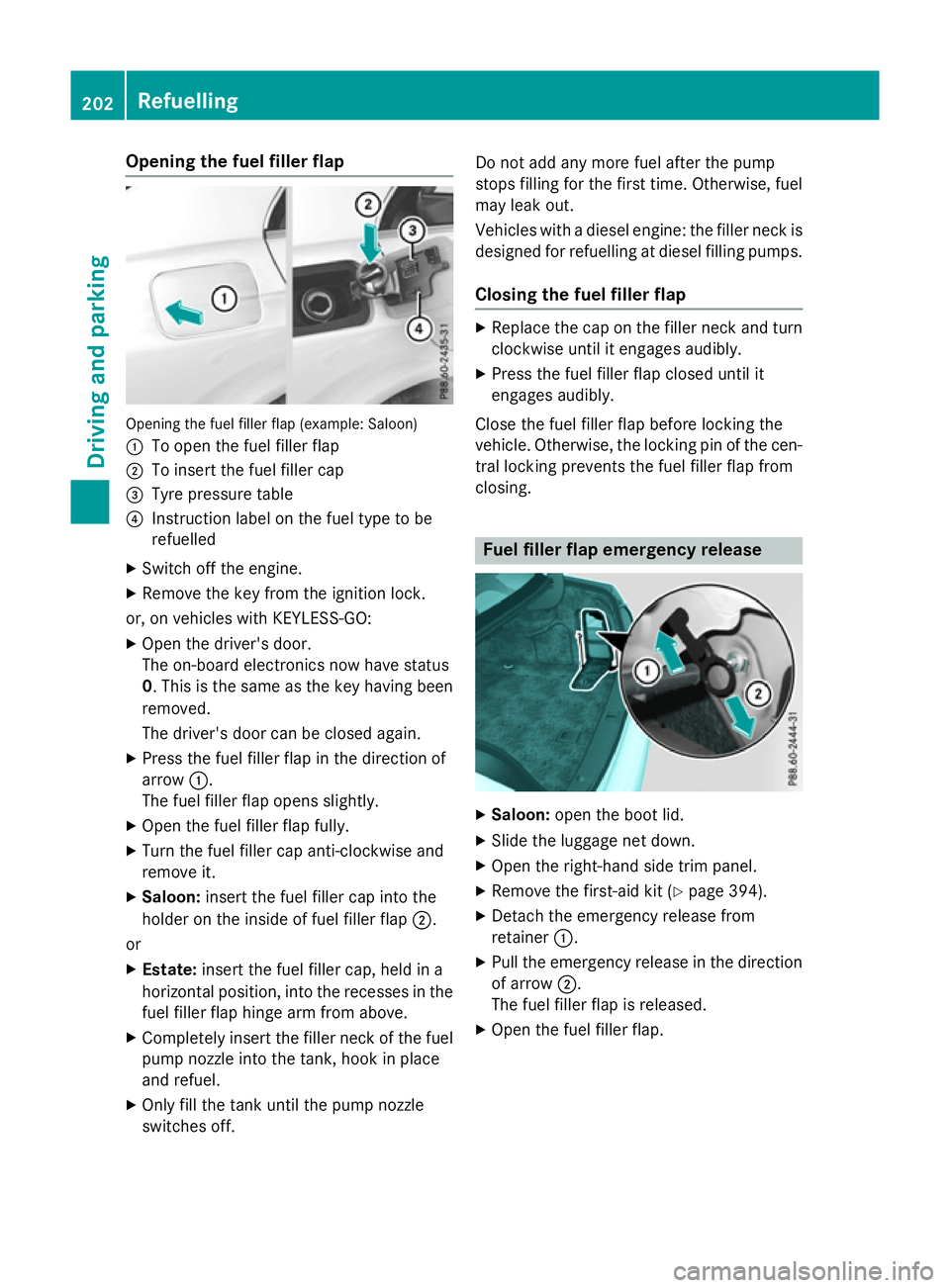
Opening the fuel filler flap
Openin
gthe fuel filler flap (example: Saloon)
: To open the fuel filler flap
; To insert the fuel filler cap
= Tyre pressure table
? Instruction label on the fuel type to be
refuelled
X Switc hoff the engine.
X Remove the key from the ignition lock.
or, on vehicles with KEYLESS‑GO: X Open the driver's door.
The on-board electronics now have status
0.T his is the same as the key having been
removed.
The driver's door can be closed again.
X Press the fuel filler flap in the direction of
arrow :.
The fuel filler flap opens slightly.
X Open the fuel filler flap fully.
X Turn the fuel filler cap anti-clockwise and
remove it.
X Saloon: insert the fuel filler cap intot he
holder on the inside of fuel filler flap ;.
or
X Estate: insert the fuel filler cap, held in a
horizontal position ,intot he recesses in the
fuel filler flap hinge arm from above.
X Completely insert the filler neckoft he fuel
pump nozzle intot he tank,hook in place
and refuel.
X Only fill the tank until the pump nozzle
switches off. Do not add any more fuel after the pump
stops filling for the first time. Otherwise, fuel
may leak out.
Vehicles with adiesel engine: the filler neckis
designed for refuelling at diesel filling pumps.
Closing the fuel filler flap X
Replace the cap on the filler necka nd turn
clockwise until it engages audibly.
X Press the fuel filler flap closed until it
engages audibly.
Close the fuel filler flap before lockin gthe
vehicle. Otherwise, the lockin gpin of the cen-
tral lockin gprevents the fuel filler flap from
closing. Fuel filler flap emergency release
X
Saloon: open the boot lid.
X Slide the luggage net down.
X Open the right-hand side trim panel.
X Remove the first-aid kit (Y page 394).
X Detach the emergency release from
retainer :.
X Pull the emergency release in the direction
of arrow ;.
The fuel filler flap is released.
X Open the fuel filler flap. 202
RefuellingDriving and parking
Page 207 of 497
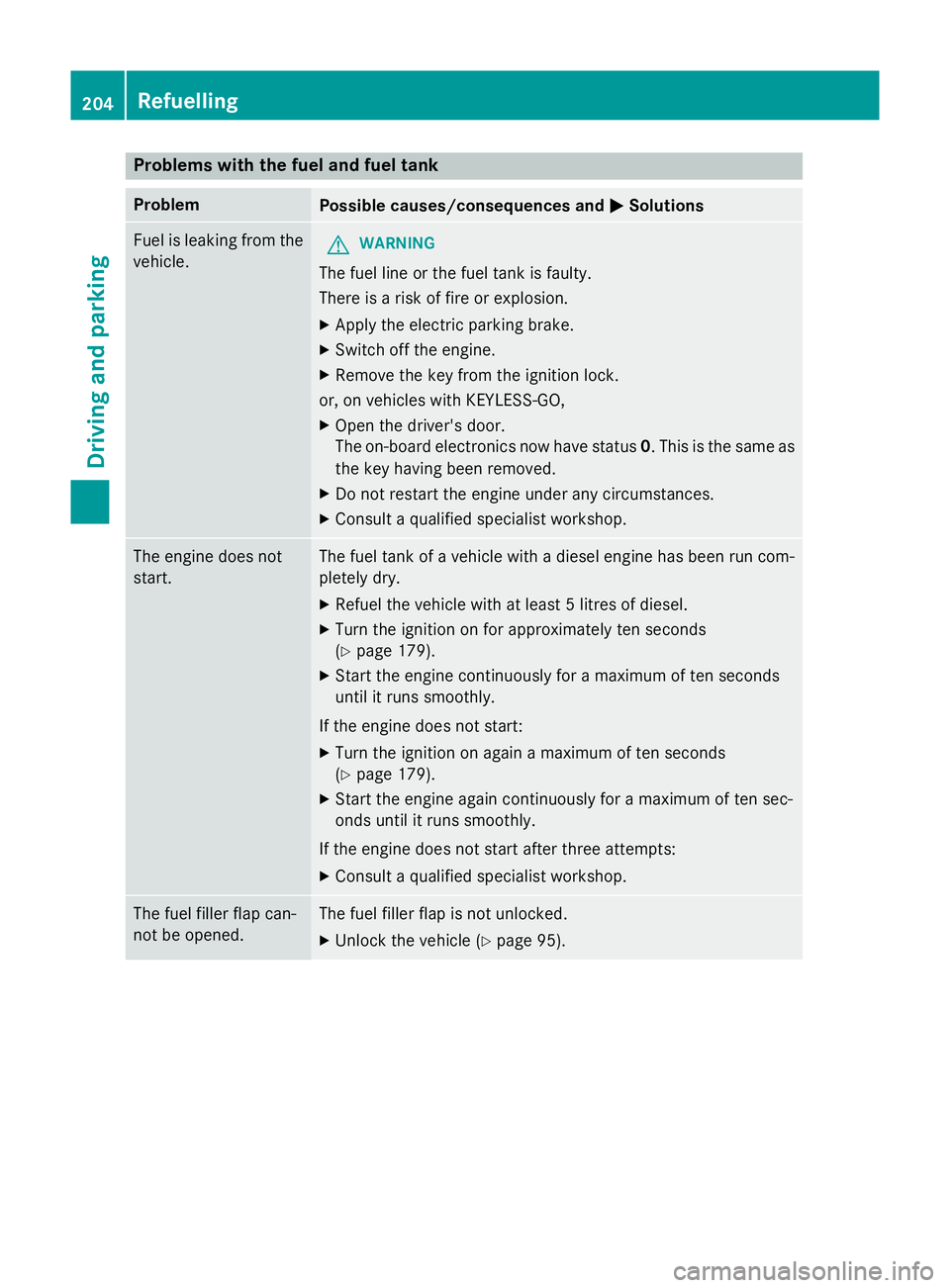
Problems with the fuel and fuel tank
Problem
Possible causes/consequences and
M
MSolutions Fuel is leaking from the
vehicle. G
WARNING
The fuel line or the fuel tank is faulty.
There is arisk of fire or explosion.
X Apply the electric parking brake.
X Switch off the engine.
X Remove the key from the ignition lock.
or, on vehicles with KEYLESS‑GO,
X Open the driver's door.
The on-board electronics now have status 0.This is the same as
the key having been removed.
X Do not restart the engine under any circumstances.
X Consult aqualified specialist workshop. The engine does not
start. The fuel tank of
avehicle with adiesel engine has been run com-
pletely dry.
X Refuel the vehicle with at least 5litres of diesel.
X Turn the ignition on for approximately ten seconds
(Y page 179).
X Start the engine continuously for amaximum of ten seconds
until it runs smoothly.
If the engine does not start:
X Turn the ignition on again amaximum of ten seconds
(Y page 179).
X Start the engine again continuously for amaximum of ten sec-
onds until it runs smoothly.
If the engine does not start after three attempts:
X Consult aqualified specialist workshop. The fuel filler flap can-
not be opened. The fuel filler flap is not unlocked.
X Unlock the vehicle (Y page 95).204
RefuellingDriving and parking
Page 208 of 497
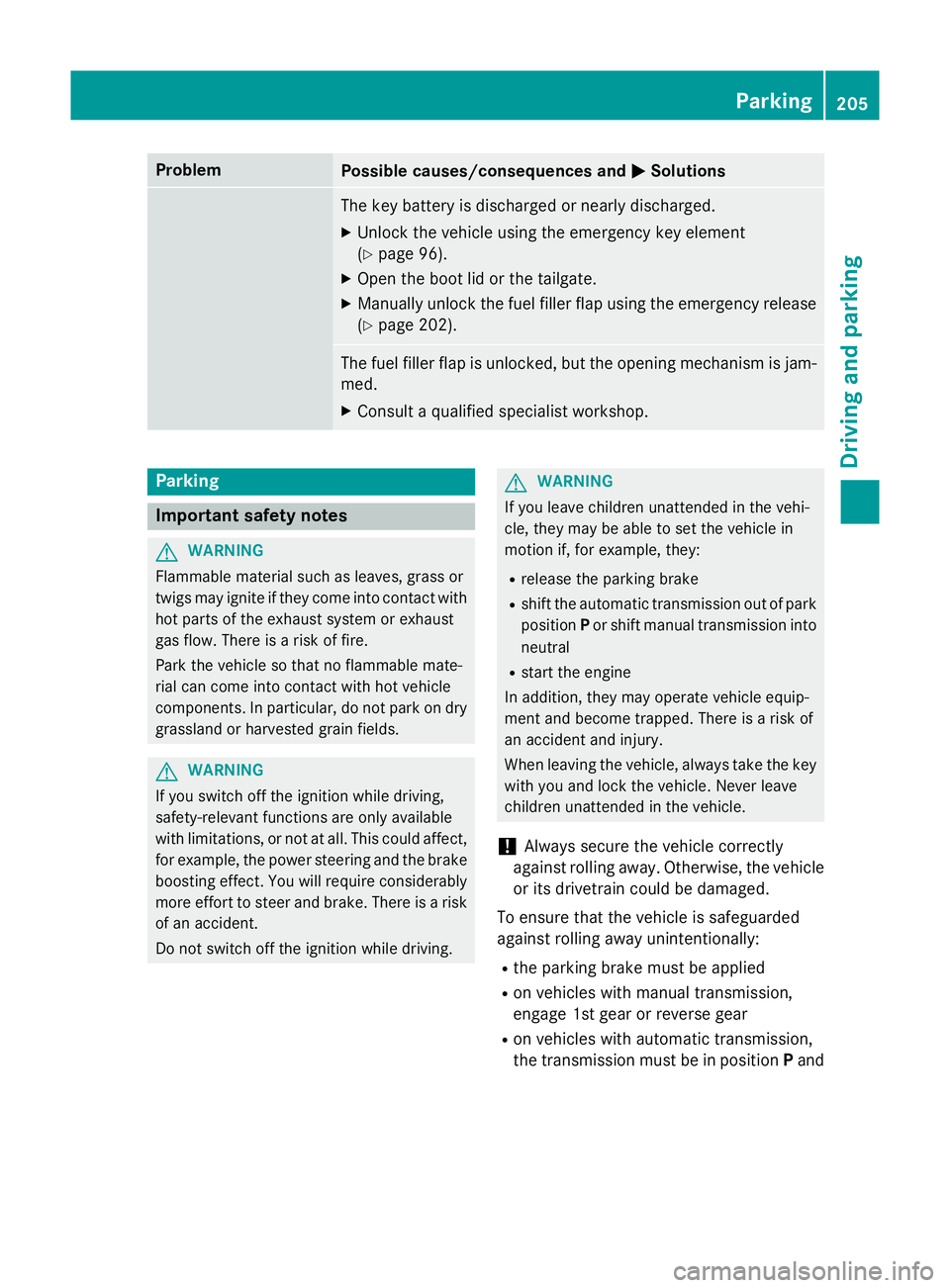
Problem
Possible causes/consequences and
M
MSolutions The key battery is discharged or nearly discharged.
X Unlock the vehicle using the emergency key element
(Y page 96).
X Open the boot lid or the tailgate.
X Manuallyu nlock the fuel filler flap using the emergency release
(Y page 202). The fuel filler flap is unlocked, but the opening mechanism is jam-
med.
X Consult aqualified specialist workshop. Parking
Important safety notes
G
WARNING
Flammable material such as leaves, grass or
twigs may ignite if they come into contact with hot parts of the exhaust system or exhaust
gas flow. There is arisk of fire.
Park the vehicle so that no flammable mate-
rial can come into contact with hot vehicle
components. In particular, do not park on dry grassland or harvested grain fields. G
WARNING
If you switch off the ignition while driving,
safety-relevant functions are only available
with limitations, or not at all. This could affect, for example, the power steering and the brake
boosting effect.Y ou will require considerably
more effort to steer and brake. There is arisk
of an accident.
Do not switch off the ignition while driving. G
WARNING
If you leave children unattended in the vehi-
cle, they may be able to set the vehicle in
motion if, for example, they:
R release the parking brake
R shift the automatic transmission out of park
position Por shift manual transmission into
neutral
R start the engine
In addition, they may operate vehicle equip-
ment and become trapped. There is arisk of
an accident and injury.
When leaving the vehicle, always take the key with you and lock the vehicle. Never leave
children unattended in the vehicle.
! Always secure the vehicle correctly
against rolling away.O therwise, the vehicle
or its drivetrain could be damaged.
To ensure that the vehicle is safeguarded
against rolling away unintentionally:
R the parking brake must be applied
R on vehicles with manual transmission,
engage 1st gear or reverse gear
R on vehicles with automatic transmission,
the transmission must be in position Pand Parking
205Driving and parking Z
Page 209 of 497
the key must be remove
dfromt he ignition
lock
R the front wheels must be turned towards
the kerb on steep uphill or downhil lgradi-
ents Switchin
goffthe engine
Important safety notes G
WARNING
Th ea utomatic transmission switches to neu-
tra lposit ionNwhen yo uswitch off the engine.
Th ev ehicl emayrollaway. There is ariskofan
accident.
After switching off the engine ,alway sswitch
to parking position P.Prevent the parked vehi-
cle fro mrolling away by applying the parking
brake.
Vehicle swithm anual transmission X
Shift to eithe r1st gear or revers egear R.
X Turn the key to position 0in the ignition
lock and remove it.
Th eimm obiliser is activated.
X Firml ydepress the parking brake.
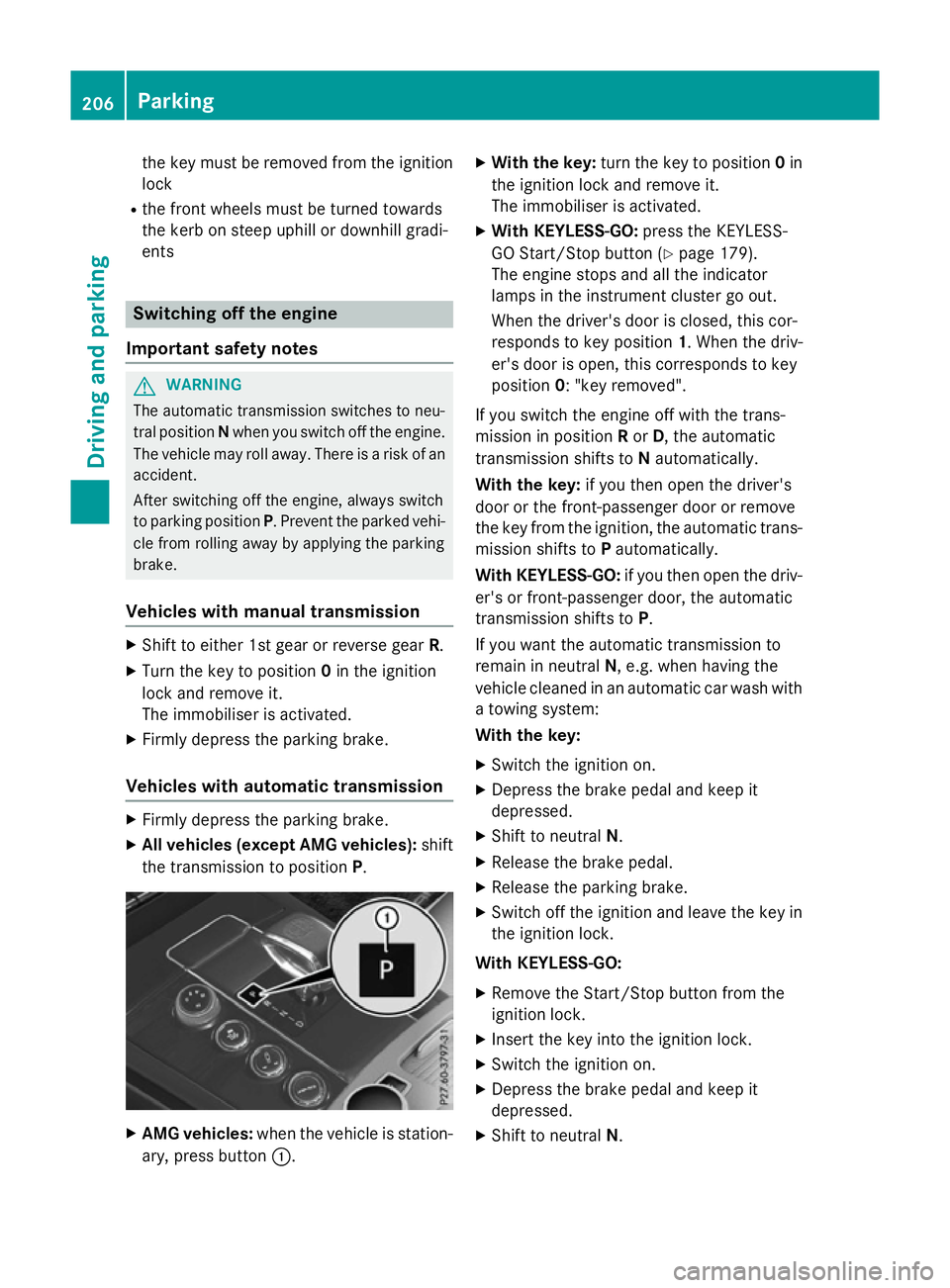
Vehicle switha utomatic transmission X
Firml ydepress the parking brake.
X Allv eh icle s(exce pt AM Gvehicles): shift
the transmission to position P.X
AM Gvehicles: when the vehicl eisstation-
ary, press button :. X
Wit hthe key: turnthe key to position 0in
the ignition lock and remove it.
Th eimm obiliser is activated.
X Wit hKEYLESS -GO:press the KEYLESS-
GO Start/Stop button (Y page 179).
Th ee ngine stops and al lthe indicator
lamps in the instrument cluste rgoout.
When the driver's door is closed, thi scor-
responds to key position 1.Whent he driv-
er' sd ooriso pen, thi scorresponds to key
position 0:"keyr emoved".
If yo uswitch the engine off with the trans-
mission in position Ror D,t he automatic
transmission shifts to Nautomatically.
Wit hthe key: if youtheno pent he driver's
door or the front-passenge rdoororr emove
the key fro mthe ignition, the automatic trans-
mission shifts to Pautomatically.
Wit hKEYLESS -GO:if youtheno pent he driv-
er' sorf ront-passenge rdoor, the automatic
transmission shifts to P.
If yo uwantthe automatic transmission to
remai ninneutral N,e.g.w henh avin gthe
vehicl ecleane dinana utomatic car wash with
at owing system:
Wit hthe key:
X Switch the ignition on.
X Depres sthe brake peda land kee pit
depressed.
X Shift to neutral N.
X Releas ethe brake pedal.
X Releas ethe parking brake.
X Switch off the ignition and leav ethe key in
the ignition lock.
Wit hKEYLESS -GO:
X Remov ethe Start/Stop button fro mthe
ignition lock.
X Insert the key into the ignition lock.
X Switch the ignition on.
X Depres sthe brake peda land kee pit
depressed.
X Shift to neutral N.206
ParkingDriving an
dparking
Page 210 of 497
X
Releas ethe brak epedal.
X Releas ethe parkin gbrake.
X Switc hoff th eignition and leav ethe keyin
th ei gnition lock.
The engin ecan be switched off while th evehi-
cle is in motion by pressing and holdin gthe
Start/Sto pbutto nfor about three seconds.
This function operate sind ependentl yofthe
ECO start/sto pautomatic engin eswitch-off
function. Parking brake
G
WARNING
If you mus tbrak ethe vehicl ewitht he parking
brake, th ebrakin gdistanc eisconsid erably
longer and th ewheels could lock. This increa-
ses th eriskofs kiddin gand an accident.
Only use th eparkin gbrak etob rakethe vehi-
cle when th eservic ebrak eisf aulty. Do not
apply th eparkin gbrak etoo firmly. If the
wheels lock, release th eparkin gbrak euntil
th ew heels begi nturning again. G
WARNING
If you leav echildren unattended in th evehi-
cle ,the ym ay be able to set th evehicl ein
motion if, for example, they:
R release th eparkin gbrake
R shift th eautomati ctransmission out of park
position Por shift manual transmission into
neutral
R start th eengine
In addition ,the ym ay operate vehicl eequip-
men tand become trapped .There is ariskof
an acciden tand injury.
Whe nleavin gthe vehicle, always tak ethe key
wit hyou and loc kthe vehicle. Never leave
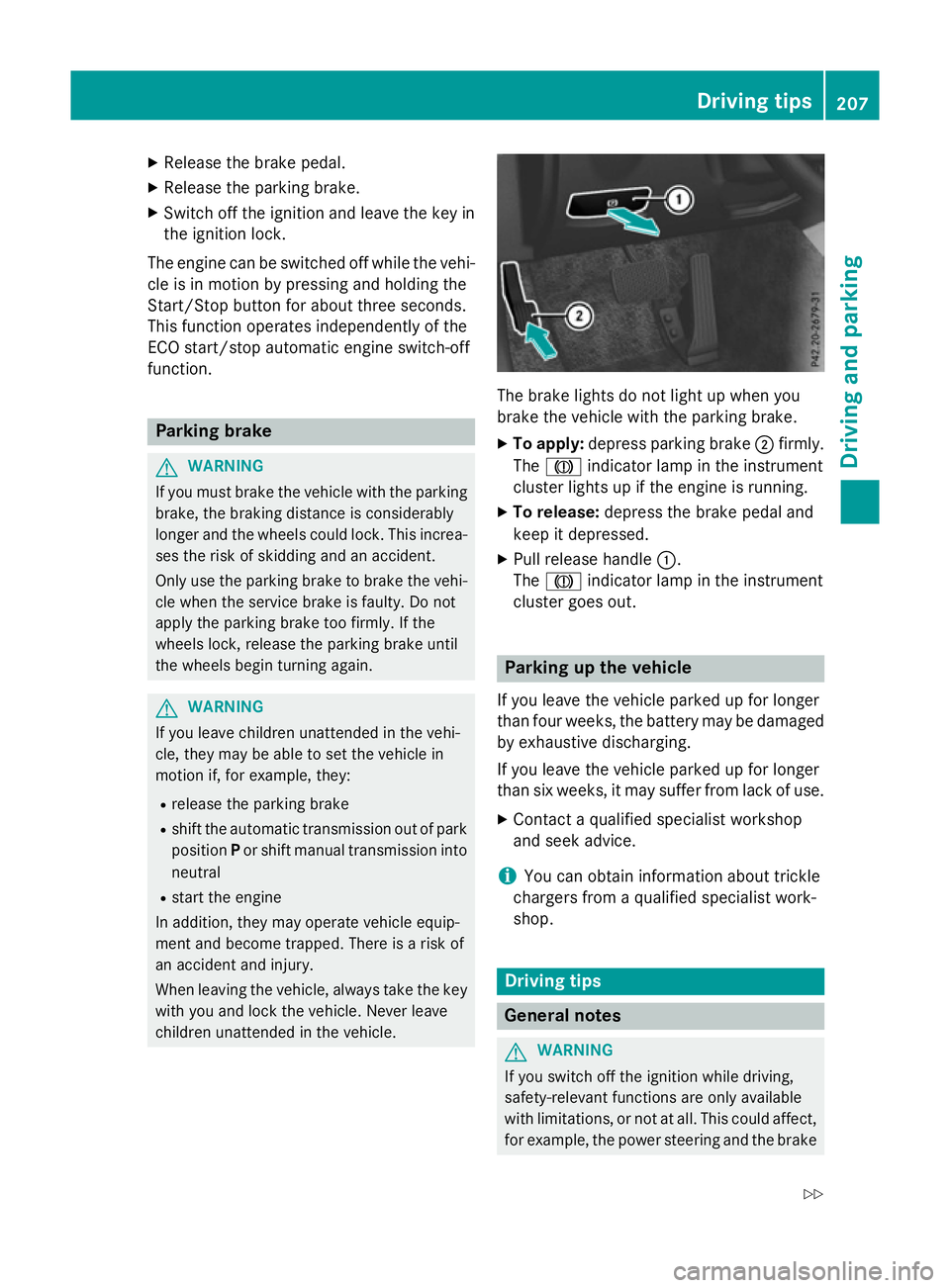
children unattended in th evehicle. The brak
elights do no tligh tupw hen you
brak ethe vehicl ewitht he parkin gbrake.
X To apply: depress parkin gbrake ;firmly.
The J indicato rlamp in th einstrument
cluste rlights up if th eengineisr unning.
X To release: depress thebrak epedal and
keep it depressed.
X Pull release handle :.
The J indicato rlamp in th einstrument
cluste rgoeso ut. Parking up th
evehicle
If you leav ethe vehicl eparked up for longer
than fou rweeks, th ebattery may be damaged
by exhaustive discharging.
If you leav ethe vehicl eparked up for longer
than six weeks, it may suffer from lack of use.
X Contac taqualified specialist workshop
and see kadvice.
i You can obtain information about trickle
chargers from aqualified specialist work-
shop. Driving tips
Genera
lnotes G
WARNING
If you switch off th eignition while driving,
safety-relevant function sare only available
wit hlimitations, or no tatall. This could affect,
for example, th epowe rsteerin gand th ebrake Driving tips
207Driving and pa rking
Z