2015 MERCEDES-BENZ E-CLASS CABRIOLET key
[x] Cancel search: keyPage 21 of 349
Skibag
................................................ 275
SMS
See also Digital Owner's Manual ... 263
Snow chains ...................................... 324
Sockets
General notes ................................ 280
Rear compartment .........................2 81
Soft top
AIRCAP ............................................ 95
Cleaning ......................................... 298
Closing manually in an emer-
gency ............................................... 90
Display message ............................ 252
Draught stop ................................... .94
Fitting/removing the AIRCAP
draught stop .................................... 96
Important safety notes .................... 88
Opening/closing (with key) .............. 90
Opening/closing (with soft-top
switch) ............................................. 89
Problem (malfunction) ..................... 98
Re-locking ........................................ 94
Soft-top switch .................................... 89
Sound
Switching on/off ........................... 264
Specialist workshop ............................ 27
Speed, controlling
see Cruise control
Speedometer
Activating/deactivating the addi-
tional speedometer ........................ 223
Digital ............................................ 216
In the Instrument cluster ................ .31
Segments ...................................... 213
Selecting a display uni t.................. 223
SPEEDTRONIC
Deactivating variable ..................... 167
Display message ............................ 244
Function/note s............................. 165
Important safety notes .................. 165
LIM indicator lamp ......................... 166
Permanent ..................................... 168
Selecting ........................................ 166
Storing the current speed .............. 166
Variabl e......................................... 166
Start/stop function
see ECO start/stop function Starting (engine)
................................ 140
STEER CONTROL .................................. 71
Steering
Display message ............................ 251
Steering Assist and Stop&Go Pilot
(DISTRONIC PLUS)
Activating/deactivating ................. 222
Display message ............................ 245
Steering assistant STEER CON-
TROL
see STEER CONTROL
Steering wheel
Adjusting (electrically) ................... 107
Adjusting (manually) ...................... 107
Button overview ............................... 32
Buttons (on-board computer) ......... 214
Cleaning ......................................... 302
Gearshift paddle s........................... 151
Important safety notes .................. 106
Steering wheel heating .................. 107
Storing settings (memory func-
tion) ............................................... 112
Steering wheel gearshift paddles .... 151
Steering wheel heating
Problem (malfunction) ................... 109
Switching on/of f........................... 107
Stowage areas ................................... 272
Stowage compartments
Armrest (under) ............................. 274
Centre console .............................. 273
Cup holde r..................................... 277
Glove compartment ....................... 273
Important safety information ......... 272
Under driver's seat/front-
passenger sea t.............................. 274
Stowage net ....................................... 274
Stowage space
Stowage net ................................... 274
Stowage well beneath the boot
floor .................................................... 277
Summer tyres .................................... 323
Sun visor ............................................ 279
Surround lighting (on-board com-
puter) .................................................. 225
Switching on media mode
Via the device list .......................... 270 18
Index
Page 24 of 349
Variable SPEEDTRONIC
see SPEEDTRONIC
Vehicle
Correct use ...................................... 27
Data acquisition ............................... 27
Display message ............................ 248
Electronics ..................................... 335
Equipment ....................................... 25
Implied warranty .............................. 27
Individual settings .......................... 223
Leaving parked up ......................... 159
Locking (in an emergency) ............... 82
Locking (key) ................................... 74
Lowering ........................................ 332
Pulling away ................................... 141
Raising ........................................... 330
Registration ..................................... 27
Securing from rolling away ............ 330
Tow-starting ................................... 315
Towing away .................................. 315
Transporting .................................. 317
Unlocking (in an emergency) ........... 82
Unlocking (key) ................................ 74
Vehicle data ................................... 342
Vehicle data ....................................... 342
Vehicle dimensions ........................... 342
Vehicle emergency locking ................ 82
Vehicle identification number
see VIN
Vehicle identification plate .............. 336
Vehicle tool kit .................................. 305
Video
Operating the DVD ......................... 218
See also Digital Owner's Manua l... 263
VIN
Seat ............................................... 337
Type plate ...................................... 336 W
Warning and indicator lamps ABS ................................................ 256
Brakes ........................................... 255
Distance warning signal ................. 261
ESP ®
.............................................. 256
ESP ®
OFF ....................................... 257
Fuel tank ........................................ 259
General notes ................................ 253 LIM (cruise control) ........................ 163
LIM (DISTRONIC PLUS) .................. 169
LIM (variable SPEEDTRONIC) ......... 166
Overview .......................................... 31
PASSENGER AIR BAG OFF ............... 38
Reserve fue l................................... 259
Seat belt ........................................ 254
Tyre pressure monitor ................... 262
Warning triangle ................................ 304
Washer fluid
Display message ............................ 252
Wheel and tyre combinations
Tyres .............................................. 333
Wheel bolt tightening torque ........... 332
Wheel chock ...................................... 330
Wheels
Changing a whee l.......................... 328
Changing/replacing ....................... 329
Checking ........................................ 321
Cleaning ......................................... 299
Emergency spare wheel ................. 333
Fitting a new wheel ........................ 332
Fitting a wheel ............................... 329
Important safety notes .................. 321
Information on driving .................... 321
Removing a whee l.......................... 331
Storing ........................................... 329
Tightening torque ........................... 332
Wheel size/tyre size ...................... 333
Wind deflector (cleaning instruc-
tions) .................................................. 298
Windows
Cleaning ......................................... 299
see Side windows
Windscreen
Demisting ...................................... 129
Windscreen washer fluid
see Windscreen washer system
Windscreen washer system
Important safety notes .................. 342
Topping up ..................................... 293
Windscreen wipers
Problem (malfunction) ................... 122
Replacing the wiper blades ............ 120
Switching on/of f........................... 120
Winter operation
Important safety notes .................. 323
Radiator cover ............................... 291 Index
21
Page 26 of 349
Introduction
The printed Owner's Manual provides informa-
tion about the safe operation of your vehicle.
The Digital Owner's Manual additionally
describes further functions and equipment fit-
ted in your vehicle. The functions of the vehicle
and multimedia system are described in the Dig-
ital Owner's Manual. You can call up the Digital
Owner's Manual via the multimedia system.
i You will not incur any costs when calling up
the Digital Owner's Manual. The Digital Own-
er's Manual works without connecting to the
Internet.
There are three ways to access the topics of the Digital Owner's Manual:
R Visual search
The visual search allows you to explore your
vehicle "virtually". Starting from either the
vehicle exterior view or interior view, you can access many of the different topics covered
by the Digital Owner's Manual. To access the
vehicle interior section, select the "Vehicle
interior" view.
R Keyword search
The keyword search allows you to search for a
keyword by entering characters. Further
information can be found in the Digital Own-
er's Manual in the "Audio 20" or "COMAND
Online" section under the "Character entry
(telephony)" keyword.
R Contents
You can select individual sections in the con-
tents.
i The Digital Owner's Manual is deactivated
for safety reasons while driving. Operation
Calling up the Digital Owner's Manual
X Press the Øbutton in the centre console.
The overview relating to the vehicle appears.
X Select the "Owner's Manual" menu item by
turning 3or pressing 7the controller.
X Confirm 7the message about the warning
and safety notes.
The basic menu for the Digital Owner's Man-
ual appears. Operating the Digital Owner's Manual
General notes Please observe the information about the oper-
ation of the controller (Y page 264).
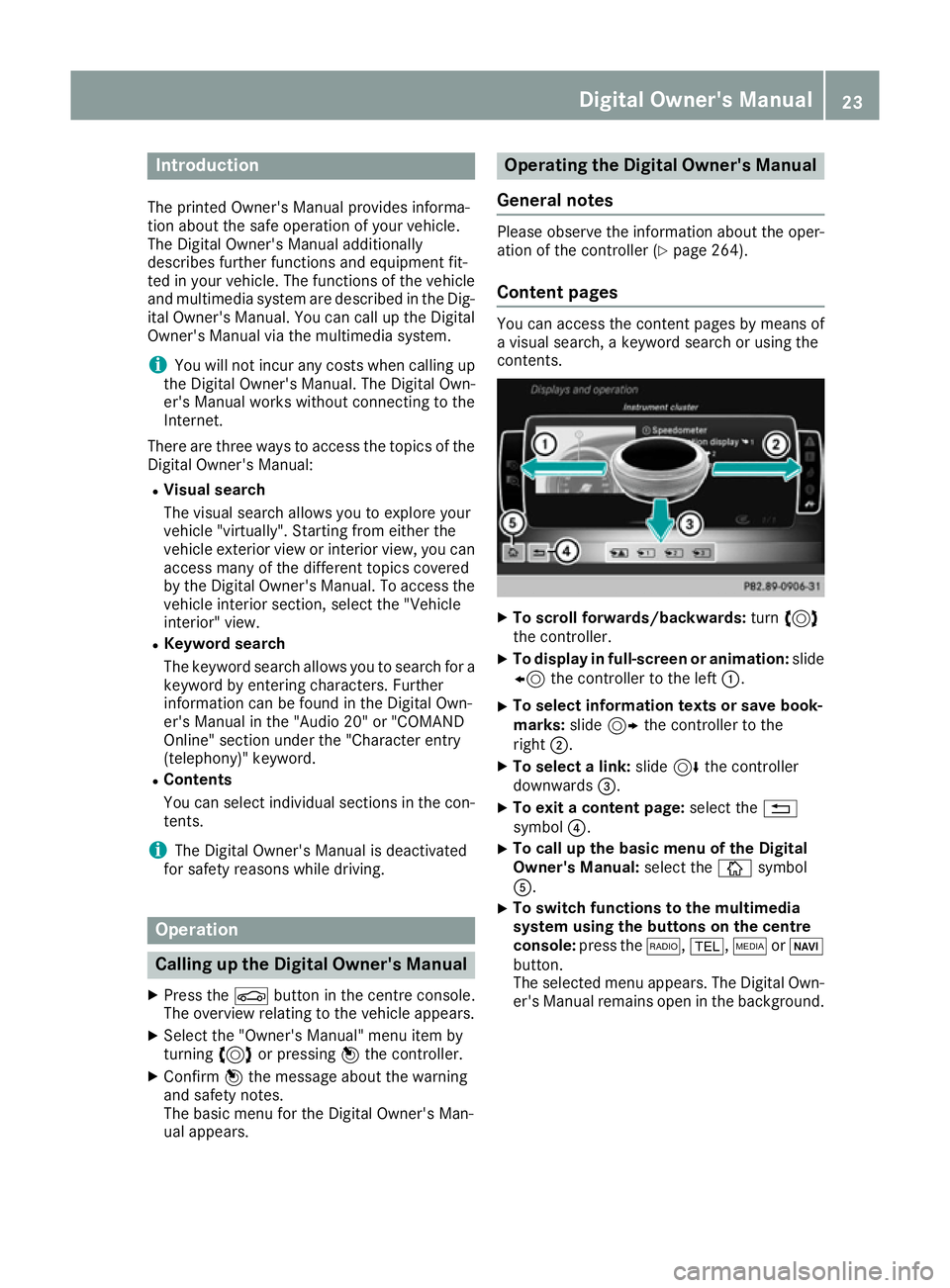
Content pages You can access the content pages by means of
a visual search, a keyword search or using the
contents.
X
To scroll forwards/backwards: turn3
the controller.
X To display in full-screen or animation: slide
8 the controller to the left :.
X To select information texts or save book-
marks:
slide9 the controller to the
right ;.
X To select a link: slide6the controller
downwards =.
X To exit a content page: select the%
symbol ?.
X To call up the basic menu of the Digital
Owner's Manual:
select theÞsymbol
A.
X To switch functions to the multimedia
system using the buttons on the centre
console: press the $,%,ÕorØ
button.
The selected menu appears. The Digital Own- er's Manual remains open in the background. Digital Owner's Manual
23
Page 40 of 349
Panic alarm
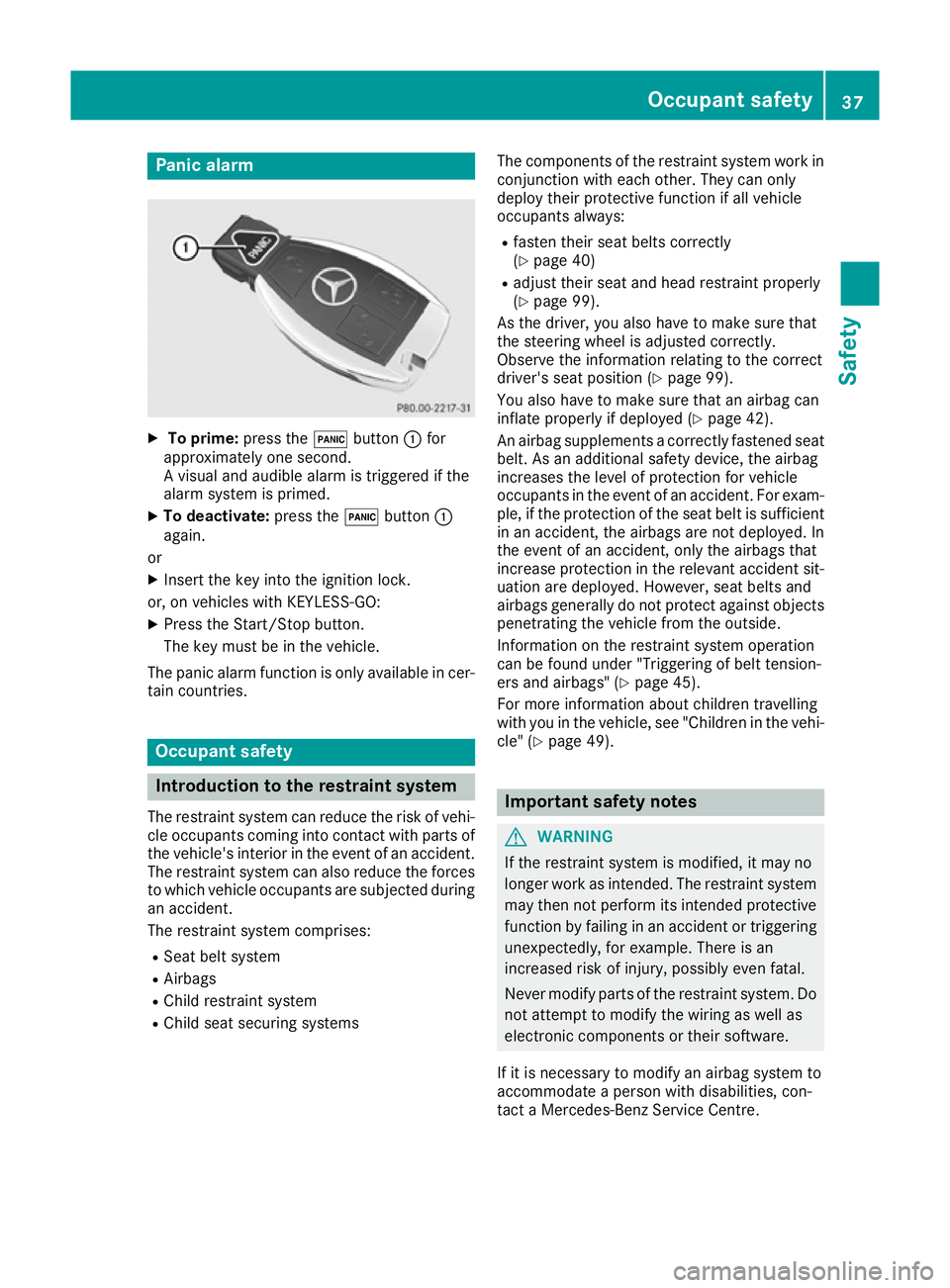
X
To prime: press the!button :for
approximately one second.
A visual and audible alarm is triggered if the
alarm system is primed.
X To deactivate: press the!button :
again.
or
X Insert the key into the ignition lock.
or, on vehicles with KEYLESS‑GO: X Press the Start/Stop button.
The key must be in the vehicle.
The panic alarm function is only available in cer- tain countries. Occupant safety
Introduction to the restraint system
The restraint system can reduce the risk of vehi- cle occupants coming into contact with parts of
the vehicle's interior in the event of an accident.
The restraint system can also reduce the forces to which vehicle occupants are subjected during
an accident.
The restraint system comprises:
R Seat belt system
R Airbags
R Child restraint system
R Child seat securing systems The components of the restraint system work in
conjunction with each other. They can only
deploy their protective function if all vehicle
occupants always:
R fasten their seat belts correctly
(Y page 40)
R adjust their seat and head restraint properly
(Y page 99).
As the driver, you also have to make sure that
the steering wheel is adjusted correctly.
Observe the information relating to the correct
driver's seat position (Y page 99).
You also have to make sure that an airbag can
inflate properly if deployed (Y page 42).
An airbag supplements a correctly fastened seat belt. As an additional safety device, the airbag
increases the level of protection for vehicle
occupants in the event of an accident. For exam-
ple, if the protection of the seat belt is sufficient in an accident, the airbags are not deployed. In
the event of an accident, only the airbags that
increase protection in the relevant accident sit- uation are deployed. However, seat belts and
airbags generally do not protect against objects penetrating the vehicle from the outside.
Information on the restraint system operation
can be found under "Triggering of belt tension-
ers and airbags" (Y page 45).
For more information about children travelling
with you in the vehicle, see "Children in the vehi-
cle" (Y page 49). Important safety notes
G
WARNING
If the restraint system is modified, it may no
longer work as intended. The restraint system
may then not perform its intended protective function by failing in an accident or triggering
unexpectedly, for example. There is an
increased risk of injury, possibly even fatal.
Never modify parts of the restraint system. Do not attempt to modify the wiring as well as
electronic components or their software.
If it is necessary to modify an airbag system to
accommodate a person with disabilities, con-
tact a Mercedes-Benz Service Centre. Occupant safety
37Safety Z
Page 43 of 349
tentionally or fail to be deployed when
required. There is an increased risk of injury,
possibly even fatal.
Never modify safety belts, seat belt tension-
ers, seat belt anchorages and inertia reels.
Ensure that seat belts are not damaged or
worn and are clean. After an accident, have
the seat belts checked immediately at a quali- fied specialist workshop.
Mercedes-Benz recommends that you only use
seat belts which have been approved specifi-
cally for your vehicle by Mercedes-Benz. Other-
wise, your vehicle's general operating permit
could be invalidated.
Correct seat belt use Pay attention to the safety notes about the seat
belt (Y page 39).
All vehicle occupants must fasten their seat
belts correctly before you start driving. You
must also make sure that all vehicle occupants
have fastened their seat belts correctly during
the journey.
When fastening your seat belt, always make
sure that:
R the seat belt tongue is inserted into the belt
buckle that belongs to the seat.
R the seat belt is tightened across your body.
Avoid wearing bulky clothing, e.g. a winter
coat.
R the seat belt is not twisted.
Only then can the forces which occur be dis-
tributed over the area of the belt.
R the shoulder section of the belt is routed
across the centre of your shoulder.
The shoulder section of the belt must not
come into contact with your neck or be routed
under your arm.
R The lap belt must be taut and as low as pos-
sible over your lap.
The lap belt must always be routed across
your hip joints and not across your abdomen.
Pregnant women must take particular care
with this. If necessary, push the lap belt down to your hip joint and pull it tight using the
shoulder section of the belt.
R The seat belt is not routed over sharp, pointed
or fragile objects. If such objects are located on or in your cloth-
ing, e.g. pens, keys, spectacles, etc. stow
these in a suitable location.
R Only one person should use each seat belt at
any one time.
Babies and children must never travel sitting
on the lap of another vehicle occupant. In the
event of an accident, they could be crushed
between the vehicle occupant and seat belt.
R Do not secure any objects with a seat belt if
the seat belt is being used by one of the vehi- cle's occupants.
Also ensure that no objects are placed
between a person and the seat. e.g. a cush-
ion.
Seat belts are solely intended to secure and
restrain persons. To secure objects, luggage or
loads, always observe the "Loading guidelines"
(Y page 272).
Fastening a seat belt Observe the safety notes on the seat belt
(Y
page 39) and the information on the correct
use of the seat belt (Y page 40). G
WARNING
If the seat-belt extender extends during the
journey, the seat belt is not sitting correctly
across your body. The seat belt then cannot
perform its intended protective function.
There is an increased risk of injury, possibly
even fatal.
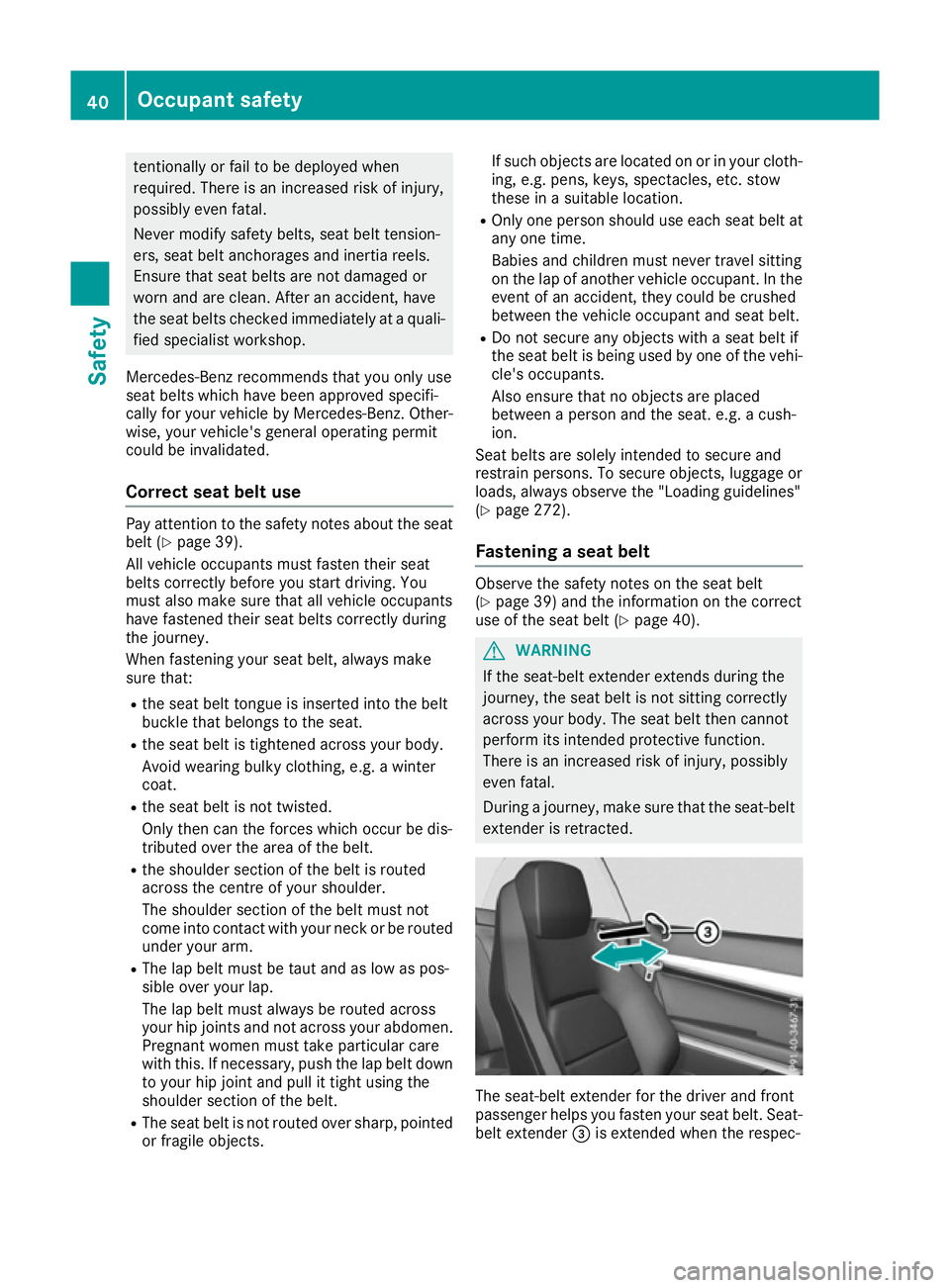
During a journey, make sure that the seat-belt extender is retracted. The seat-belt extender for the driver and front
passenger helps you fasten your seat belt. Seat- belt extender =is extended when the respec- 40
Occupant safetySafety
Page 44 of 349
tive door is closed and the key is turned to posi-
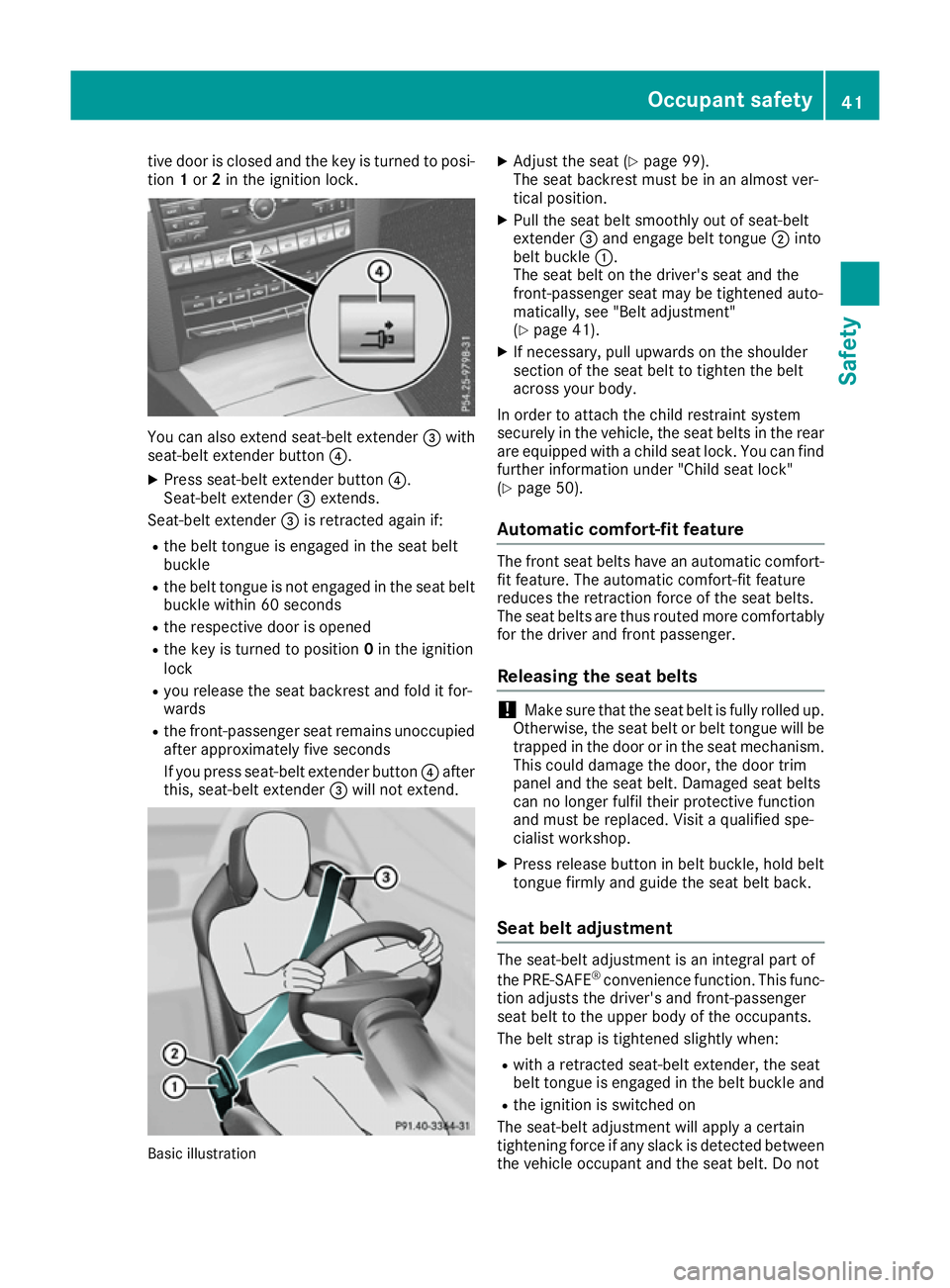
tion 1or 2in the ignition lock. You can also extend seat-belt extender
=with
seat-belt extender button ?.
X Press seat-belt extender button ?.
Seat-belt extender =extends.
Seat-belt extender =is retracted again if:
R the belt tongue is engaged in the seat belt
buckle
R the belt tongue is not engaged in the seat belt
buckle within 60 seconds
R the respective door is opened
R the key is turned to position 0in the ignition
lock
R you release the seat backrest and fold it for-
wards
R the front-passenger seat remains unoccupied
after approximately five seconds
If you press seat-belt extender button ?after
this, seat-belt extender =will not extend. Basic illustration X
Adjust the seat (Y page 99).
The seat backrest must be in an almost ver-
tical position.
X Pull the seat belt smoothly out of seat-belt
extender =and engage belt tongue ;into
belt buckle :.
The seat belt on the driver's seat and the
front-passenger seat may be tightened auto-
matically, see "Belt adjustment"
(Y page 41).
X If necessary, pull upwards on the shoulder
section of the seat belt to tighten the belt
across your body.
In order to attach the child restraint system
securely in the vehicle, the seat belts in the rear
are equipped with a child seat lock. You can find
further information under "Child seat lock"
(Y page 50).
Automatic comfort-fit feature The front seat belts have an automatic comfort-
fit feature. The automatic comfort-fit feature
reduces the retraction force of the seat belts.
The seat belts are thus routed more comfortably for the driver and front passenger.
Releasing the seat belts !
Make sure that the seat belt is fully rolled up.
Otherwise, the seat belt or belt tongue will be
trapped in the door or in the seat mechanism.
This could damage the door, the door trim
panel and the seat belt. Damaged seat belts
can no longer fulfil their protective function
and must be replaced. Visit a qualified spe-
cialist workshop.
X Press release button in belt buckle, hold belt
tongue firmly and guide the seat belt back.
Seat belt adjustment The seat-belt adjustment is an integral part of
the PRE-SAFE
®
convenience function. This func-
tion adjusts the driver's and front-passenger
seat belt to the upper body of the occupants.
The belt strap is tightened slightly when:
R with a retracted seat-belt extender, the seat
belt tongue is engaged in the belt buckle and
R the ignition is switched on
The seat-belt adjustment will apply a certain
tightening force if any slack is detected between
the vehicle occupant and the seat belt. Do not Occupant safety
41Safety Z
Page 52 of 349
The PRE-SAFE
®
PLUS braking application is can-
celled:
R if the accelerator pedal is depressed when a
gear is engaged
R if the risk of a collision passes or is no longer
detected
R if DISTRONIC PLUS indicates an intention to
pull away
If the hazardous situation passes without result- ing in an accident, the original settings are
restored. Automatic measures after an acci-
dent
Immediately after an accident, the following
measures may be implemented, depending on
the type and severity of the impact:
R the hazard warning lamps are activated
R the emergency lighting is activated
R the vehicle doors are unlocked
R the front side windows are lowered
R vehicles with a memory function: the electri-
cally adjustable steering wheel is raised
R the engine is switched off and the fuel supply
is cut off
R vehicles with the Mercedes-Benz emergency
call system: automatic emergency call Children in the vehicle
Important safety notes
Accident statistics show that children secured
in the rear seats are safer than children secured in the front seats. For this reason, Mercedes-
Benz strongly advises that you fit a child
restraint system on a rear seat. Children are
generally better protected there.
If a child younger than twelve years old and
under 1.50 m in height is travelling in the vehi-
cle:
R always secure the child in a child restraint
system suitable for Mercedes-Benz vehicles.
The child restraint system must be appropri-
ate to the age, weight and size of the child.
R be sure to observe the instructions and safety
notes in this section in addition to the child
restraint system manufacturer's installation
instructions. G
WARNING
If you leave children unattended in the vehi-
cle, they may be able to set the vehicle in
motion if, for example, they:
R release the parking brake
R shift the automatic transmission out of park
position Por shift manual transmission into
neutral
R start the engine
In addition, they may operate vehicle equip-
ment and become trapped. There is a risk of
an accident and injury.
When leaving the vehicle, always take the key with you and lock the vehicle. Never leave
children unattended in the vehicle. G
WARNING
If persons (particularly children) are exposed
to heat or cold for a prolonged period, there is a risk of serious or even fatal injuries. Never
leave persons (particularly children) unatten-
ded in the vehicle. G
WARNING
If the child restraint system is placed in direct sunlight, the parts could become very hot.
Children could be suffer burns by touching
these parts, in particular on the metallic parts
of the child restraint system. There is a risk of injury.
If you and your child leave the vehicle, always
make sure that the child restraint system is
not in direct sunlight. Cover it with a blanket, for example. If the child restraint system has
been exposed to direct sunlight, leave it to
cool down before securing the child in it.
Never leave children unattended in the vehi-
cle.
Always ensure that all vehicle occupants have
their seat belts fastened correctly and are sitting
properly. Particular attention must be paid to
children.
Observe the safety notes on the seat belt
(Y page 39) and the notes on how to use the seat
belt properly (Y page 40). Children in the vehicle
49Safety Z
Page 56 of 349

PASSENGER AIR BAG OFF indicator lamp
:
shows you whether the front-passenger front
airbag is disabled.
X Turn the key to position 1or 2in the ignition
lock or, on vehicles with KEYLESS-GO, press
the Start/Stop button once or twice.
The system carries out a self-diagnosis.
The PASSENGER AIR BAG OFF indicator lamp
must light up for approximately six seconds.
If, after the system self-test, the
PASSENGER AIR BAG OFF indicator lamp:
R lights up , the front-passenger front airbag is
disabled. It will then not be deployed in the
event of an accident.
R is not lit , the sensor system did not detect a
child restraint system with transponder for
automatic child seat recognition. If, in the
case of an accident, all deployment criteria
are met, the front-passenger front airbag is
deployed. G
WARNING
Electronic devices on the front-passenger
seat can affect the function of the automatic
child seat recognition, for example:
R laptop
R mobile phone
R transponder cards such as ski passes or
access passes
The front-passenger front airbag could deploy unintentionally or not function as intended
during an accident. This poses an increased
risk of injury or even fatal injury.
Do not place any of the devices mentioned
above or similar devices on the front-
passenger seat. Be aware of the status of the front-passenger front airbag both before and
during the journey. Child restraint system on the front-
passenger seat
General notes Accident statistics show that children secured
in the rear seats are safer than children secured
in the front seats. For this reason, Mercedes- Benz strongly advises that you fit a child
restraint system on a rear seat.
Vehicles with automatic child seat recognition
on the co-driver's seat: if it is absolutely neces-
sary to fit a child restraint system to the co-driv- er's seat, always observe the notes on "Auto-
matic child seat recognition on the co-driver's
seat" (Y page 53).
You can thus avoid the risks that could arise as
a result of:
R a child restraint system that is not detected
by the automatic child seat recognition's sen-
sor system
R the unintentional disabling of the co-driver's
front airbag
R the unsuitable positioning of the child
restraint system, e.g. too close to the dash-
board. Please observe the warning notice on the co-
driver's sun visor, see the illustration. G
WARNING
If you secure a child in a child restraint system on the front-passenger seat and the
PASSENGER AIR BAG OFF indicator lamp is
off, the front-passenger front airbag can
deploy in the event of an accident. The child
could be struck by the airbag. This poses an
increased risk of injury or even fatal injury.
Make sure that the front-passenger front air-
bag has been disabled. The PASSENGER AIR-BAG OFF indicator lamp must be lit.
NEVER use a rearward-facing child restraint on a seat protected by an ACTIVE AIRBAG in front of
it, DEATH or SERIOUS INJURY to the CHILD can
occur. Children in the vehicle
53Safety Z