Page 273 of 878

2732-4. Using other driving systems
2
When driving ■ Turning off both TRAC and VSC systems
To turn the TRAC and VSC sys-
tems off, press and hold the switch
for 3 seconds or more while the
vehicle is stopped. A message will be shown on the
multi-information display and VSC
off indicator light will come on.
Press the switch again to turn the
systems back on.■
When the message is displayed on the multi-information display showing that
TRAC has been disabled even if the VSC off switch has not been pressed
TRAC and hill-start assist control cannot be operated. Contact your Lexus dealer.■
Sounds and vibrations caused by th e ABS, VSC, TRAC and brake assist ●
A sound may be heard from the engine compartment when the hybrid system is
started or just after the vehicle begins to move. This sound does not indicate that
a malfunction has occurred in any of these systems. ●
Any of the following conditions may occur when the above systems are operat-
ing. None of these indicates that a malfunction has occurred.
• Vibrations may be felt through the vehicle body and steering.
• A motor sound may be heard after the vehicle comes to a stop.
• The brake pedal may pulsate slightly after the ABS is activated.
• The brake pedal may move down s lightly after the ABS is activated.■
EPS operation sound
When the steering wheel is operated, a motor sound (whirring sound) may be
heard. This does not indicate a malfunction.
■
Reactivation of the TRAC /VSC systems
Turning off the hybrid system after turning off the TRAC/VSC systems will automat-
ically reactivate them.
Page 274 of 878
2742-4. Using other driving systems
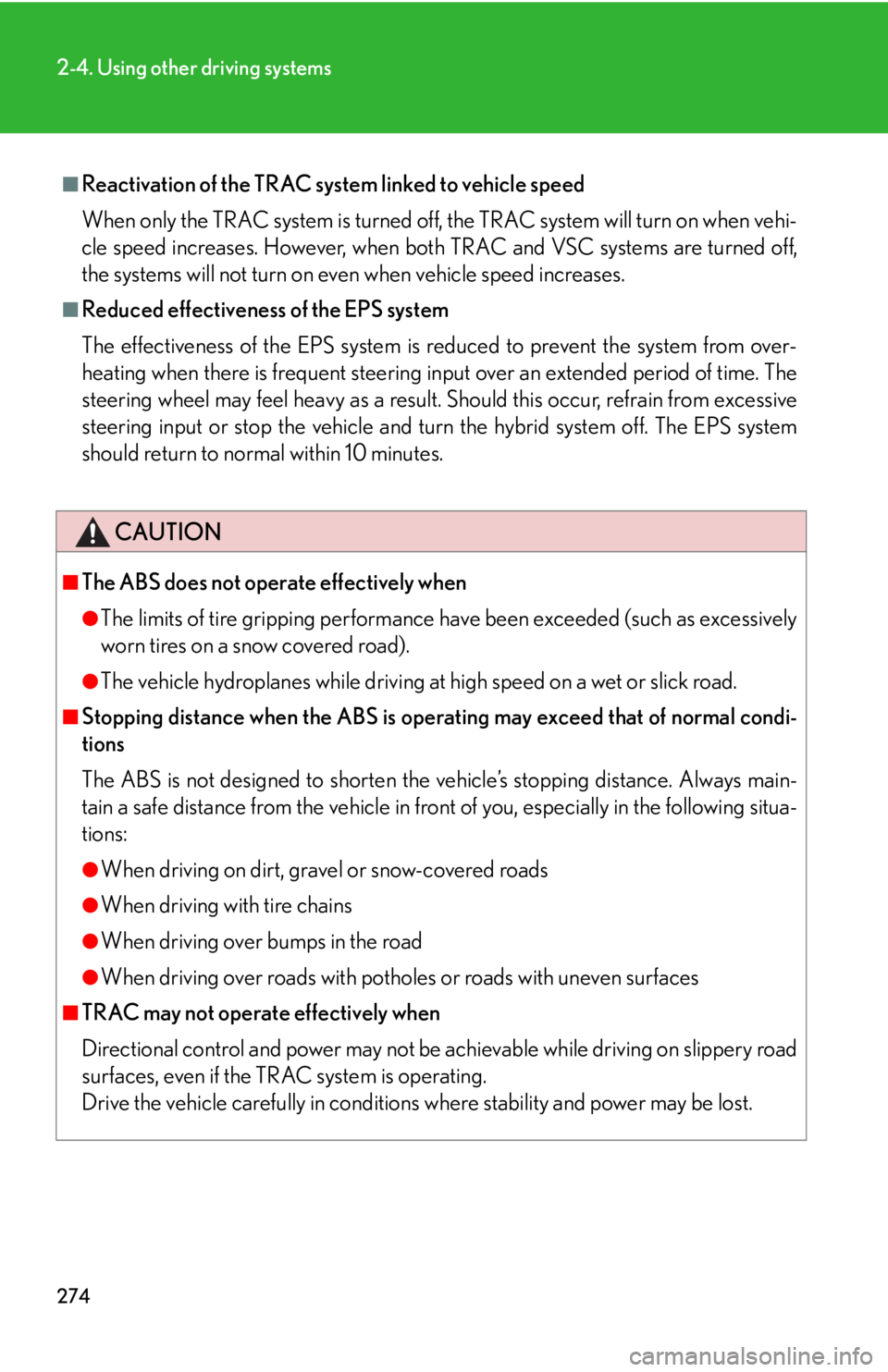
■
Reactivation of the TRAC sy stem linked to vehicle speed
When only the TRAC system is turned off, the TRAC system will turn on when vehi-
cle speed increases. However, when both TRAC and VSC systems are turned off,
the systems will not turn on even when vehicle speed increases.■
Reduced effectiveness of the EPS system
The effectiveness of the EPS system is reduced to prevent the system from over-
heating when there is frequent steering in put over an extended period of time. The
steering wheel may feel heavy as a result. Should this occur, refrain from excessive
steering input or stop the vehicle and turn the hybrid system off. The EPS system
should return to normal within 10 minutes.
CAUTION■
The ABS does not operate effectively when ●
The limits of tire gripping performance have been exceeded (such as excessively
worn tires on a snow covered road).●
The vehicle hydroplanes while driving at high speed on a wet or slick road.■
Stopping distance when the ABS is operating may exceed that of normal condi-
tions
The ABS is not designed to shorten the vehicle’s stopping dist ance. Always main-
tain a safe distance from the vehicle in fron t of you, especially in the following situa-
tions: ●
When driving on dirt, gravel or snow-covered roads●
When driving with tire chains●
When driving over bumps in the road●
When driving over roads with potholes or roads with uneven surfaces■
TRAC may not operate effectively when
Directional control and power may not be ac hievable while driving on slippery road
surfaces, even if the TRAC system is operating.
Drive the vehicle carefully in conditions where stability and power may be lost.
Page 275 of 878

2752-4. Using other driving systems
2
When driving CAUTION■
When the VSC is activated
The slip indicator light flashes. Always drive carefully. Reckless driving may cause
an accident, resulting in death or serious injury. Exercise particular care when the
indicator light flashes.■
When the TRAC/VSC systems are turned off
Be especially careful and drive at a speed appropriate to the road conditions. As
these are the systems to help ensure vehicle stability and driving force, do not turn
the TRAC/VSC systems off unless necessary.■
Replacing tires
Make sure that all tires are of the same size, brand, tread pattern and total load
capacity. In addition, make sure that the tires are inflated to the recommended tire
inflation pressure level.
The ABS and VSC systems will not function correctly if different tires are installed
on the vehicle.
Contact your Lexus dealer for further info rmation when replacing tires or wheels.■
Handling of tires and suspension
Using tires with any kind of problem or modifying the suspension will affect the driv-
ing assist systems, and may cause a system malfunction.
Page 294 of 878
2942-5. Driving information
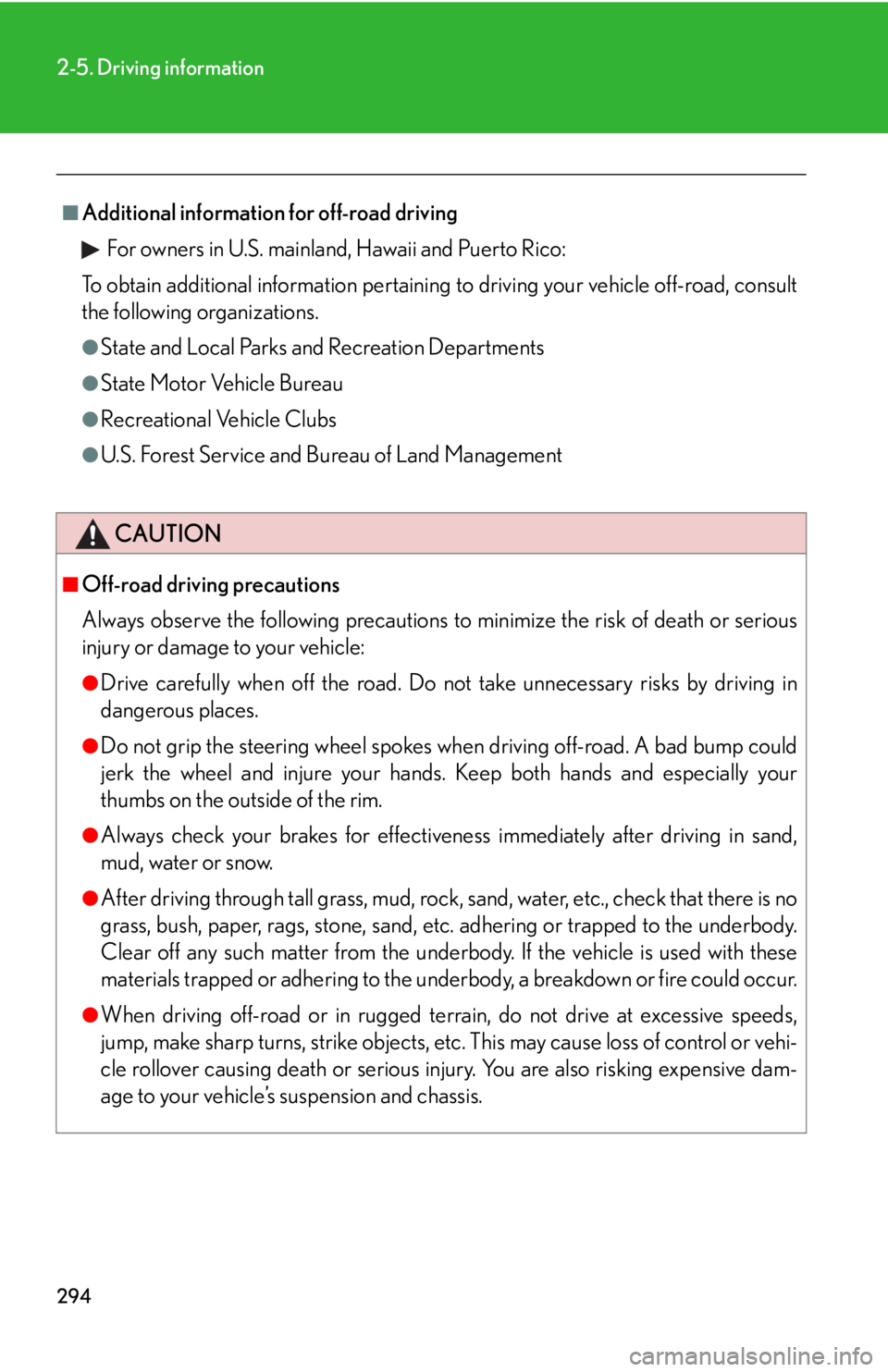
■
Additional information for off-road driving
For owners in U.S. mainland, Hawaii and Puerto Rico:
To obtain additional information pertaining to driving your vehicle off-road, consult
the following organizations. ●
State and Local Parks and Recreation Departments●
State Motor Vehicle Bureau●
Recreational Vehicle Clubs●
U.S. Forest Service and Bureau of Land Management
CAUTION■
Off-road driving precautions
Always observe the following precautions to minimize the risk of death or serious
injury or damage to your vehicle: ●
Drive carefully when off the road. Do not take unnecessary risks by driving in
dangerous places.●
Do not grip the steering wheel spokes wh en driving off-road. A bad bump could
jerk the wheel and injure your hands. Keep both hands and especially your
thumbs on the outside of the rim.●
Always check your brakes for effectiveness immediately after driving in sand,
mud, water or snow.●
After driving through tall grass, mud, rock , sand, water, etc., check that there is no
grass, bush, paper, rags, stone, sand, etc. adhering or trapped to the underbody.
Clear off any such matter from the underbody. If the vehicle is used with these
materials trapped or adhering to the underbody, a breakdown or fire could occur.●
When driving off-road or in rugged te rrain, do not drive at excessive speeds,
jump, make sharp turns, strike objects, etc. This may cause loss of control or vehi-
cle rollover causing death or serious injury. You are also risking expensive dam-
age to your vehicle’s suspension and chassis.
Page 295 of 878

2952-5. Driving information
2
When driving NOTICE■
To prevent water damage
Take all necessary safety measures to ensure that water damage to the hybrid bat-
tery, hybrid system or other components does not occur. ●
Water entering the engine compartment may cause severe damage to the hybrid
system. Water entering the interior may cause the hybrid battery stowed under
the rear seats to short circuit.●
Water entering the hybrid transmission will cause deterioration in transmission
quality. The malfunction indicator may come on, and the vehicle may not be driv-
able.●
Water can wash the grease from wheel bearings, causing rusting and premature
failure, and may also enter the hybrid transmission case, reducing the gear oil’s
lubricating qualities.■
When you drive through water
If driving through water, such as when crossing shallow streams, first check the
depth of the water and the bottom of the riverbed for firmness. Drive slowly and
avoid deep water.■
Inspection after off-road driving ●
Sand and mud that has accumulated around brake discs may affect braking effi-
ciency and may damage brake system components.●
Always perform a maintenance inspection after each day of off-road driving that
has taken you through rough terrain, sand, mud, or water. For scheduled mainte-
nance information, refer to the “Warra nty and Services Guide/Owner’s Manual
Supplement/Schedul ed Maintenance”.
Page 303 of 878
3032-5. Driving information
2
When driving
Selecting tire chains
Use the correct tire chain size when mounting the tire chains. Chain size
is regulated for each tire size.
Side chain:
0.12 in. (3 mm) in diameter
0.98 in. (25 mm) in length
0.43 in. (10.8 mm) in width
Cross chain:
0.15 in. (3.9 mm) in diameter
1.00 in. (25.3 mm) in length
0.54 in. (13.8 mm) in width
Regulations on the use of tire chains
Regulations regarding the use of tire chains vary depending on location
and type of road. Always check local regulations before installing chains. ■ When driving the vehicle
Accelerate the vehicle slowly, keep a safe distance between you and
the vehicle ahead, and drive at a reduced speed suitable to road
conditions.
■ When parking the vehicle
Park the vehicle and move the shif t lever to P without setting the
parking brake. The parking brake may freeze up, preventing it from
being released. If necessary, bl ock the wheels to prevent inadvert-
ent sliding or creeping.
Page 304 of 878

3042-5. Driving information
■
Tire chain installation
Observe the following precautions when installing and removing chains: ●
Install and remove tire chains in a safe location. ●
Install tire chains on the front tires only. Do not install tire chains on the rear tires.●
Install the tire chains on front tires as tightly as possible. Re tighten chains after
driving 1 /4 1/2 mile (0.5 1.0 km).●
Install tire chains following the instructions provided with the tire chains.
CAUTION■
Driving with snow tires
Observe the following precautions to reduce the risk of accidents.
Failure to do so may result in a loss of vehicle control and cause death or serious
injury. ●
Use tires of the size specified for your vehicle.●
Maintain the recommended level of air pressure.●
Do not drive in excess of 75 mph (120 km/h ), regardless of the type of snow tires
being used.●
Use snow tires on all, not just some wheels.■
Driving with tire chains
Observe the following precautions to reduce the risk of accidents.
Failure to do so may result in the vehicle being unable to be driven safely, and may
cause death or serious injury. ●
Do not drive in excess of the speed limit specified for the tire chains being used,
or 30 mph (50 km/h), whichever is lower.
●
Avoid driving on bumpy road surfaces or over potholes.
●
Avoid sudden acceleration, abrupt stee ring, sudden braking and shifting opera-
tions that cause sudden engine braking.
●
Slow down sufficiently before entering a curve to ensure that vehicle control is
maintained.
Page 310 of 878
3102-5. Driving information
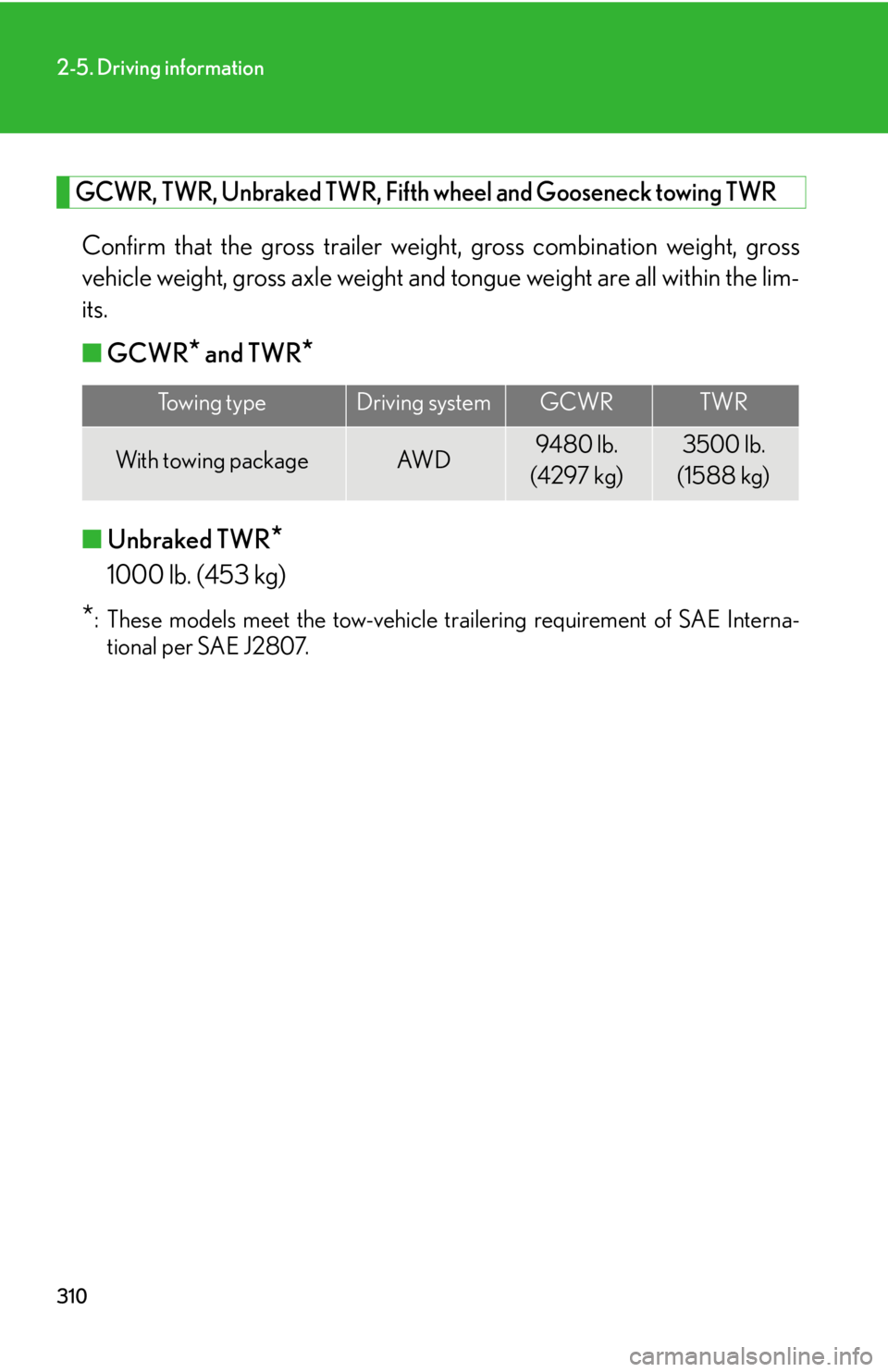
GCWR, TWR, Unbraked TWR, Fifth wheel and Gooseneck towing TWR
Confirm that the gross trailer weight , gross combination weight, gross
vehicle weight, gross axle weight and tongue weight are all within the lim-
its.
■ GCWR
* and TWR
*
■ Unbraked TWR
*1000 lb. (453 kg)
* : These models meet the tow-vehicle trailering requirement of SAE Interna-
tional per SAE J2807. To w i n g t y p e Driving system GCWR TWR
With towing package AW D 9480 lb.
(4297 kg) 3500 lb.
(1588 kg)