Page 721 of 878

7214-3. Do-it-yourself maintenance
4
Maintenance and care ■
Discharge headlights (if equipped)
If voltage to the discharge bulbs is insufficient, the bulbs may not come on, or may
go out temporarily. The discharge bulbs will come on when normal power is
restored.■
LED light bulbs
The LED headlight low beams (if equipped), daytime running lights, parking lights,
front side marker lights, LED front fog ligh ts (if equipped), side turn signal lights,
stop lights, high mounted stoplight and licence plate lights consist of a number of
LEDs. If any of the LEDs burn out, take your vehicle to your Lexus dealer to have the
light replaced.■
Condensation build-up on the inside of the lens
Temporary condensation build-up on the inside of the headlight lens does not indi-
cate a malfunction. Contact your Lexus dealer for more information in the following
situations: ●
Large drops of water are built up on the inside of the lens.●
Water has built up in side the headlight.
CAUTION■
Replacing light bulbs ●
Turn off the lights. Do not attempt to replace the bulb immediately after turning
off the lights.
The bulbs become very hot and may cause burns.●
Do not touch the glass portion of the li ght bulb with bare hands. When it is
unavoidable to hold the glass portion, use and hold with a clean dry cloth to avoid
getting moisture and oils on the bulb.
Also, if the bulb is scratched or dropped, it may blow out or crack.
●
Fully install light bulbs and any parts used to secure them. Failure to do so may
result in heat damage, fire, or water en tering the headlight unit. This may damage
the headlights or cause condensation to build up on the lens.
Page 722 of 878
7224-3. Do-it-yourself maintenance
CAUTION
■
Discharge headlights (if equipped) ●
Contact your Lexus dealer be fore replacing discharge he adlights (including light
bulbs).●
Do not touch the discharge headlight’s high voltage socket when the headlights
are turned on.
An extremely high voltage of 30000 V wi ll be discharged and could result in
serious injury or death by electric shock.●
Do not attempt to take apart or repair the low beam discharge headlight bulbs,
connectors, power supply circuits, or related components.
Doing so could result in electric shock and serious injury or death.■
To prevent damage or fire
Make sure bulbs are fully seated and locked. ●
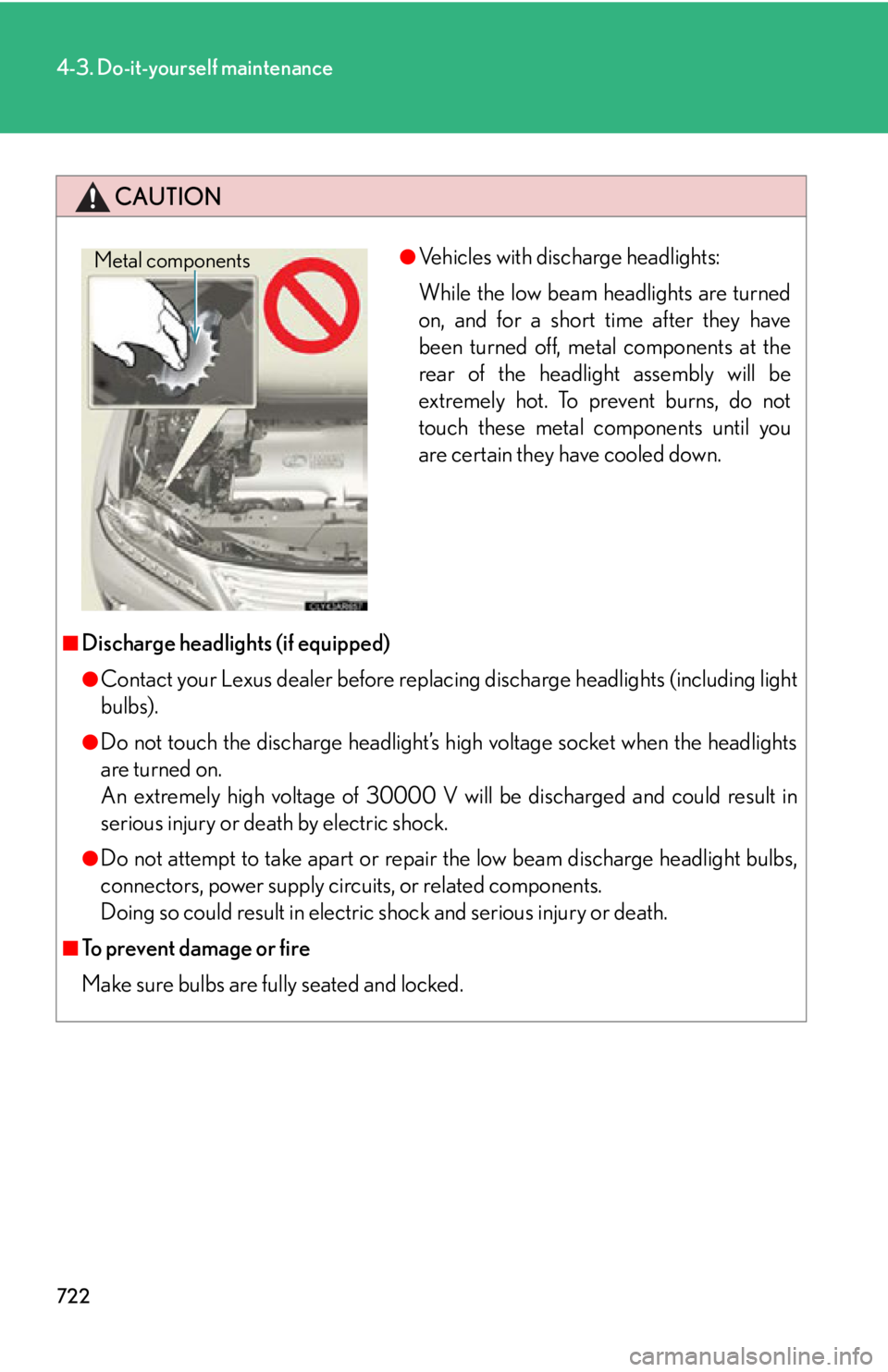
Vehicles with discharge headlights:
While the low beam headlights are turned
on, and for a short time after they have
been turned off, metal components at the
rear of the headlight assembly will be
extremely hot. To prevent burns, do not
touch these metal components until you
are certain they have cooled down.Metal components
Page 723 of 878
7234-3. Do-it-yourself maintenance
4
Maintenance and care
Page 742 of 878

5
When trouble arises
7415-2. Steps to take in an emergency
CAUTION■
Maintenance of the tires
Each tire, including the spare (if provided ), should be checked monthly when cold
and inflated to the inflation pressure re commended by the vehicle manufacturer on
the vehicle placard or tire inflation pressure label (tire and load information label).
(If your vehicle has tires of a different size than the size indicated on the vehicle
placard or tire inflation pressure label [t ire and load information label], you should
determine the proper tire inflation pressure for those tires.)
As an added safety feature, your vehicl e has been equipped with a tire pressure
monitoring system (TPMS-tire pressure wa rning system) that illuminates a low tire
pressure telltale (tire pressure warning light) when one or more of your tires is sig-
nificantly under-inflated. Accordingly, when the low tire pressure telltale (tire pres-
sure warning light) illuminates, you should stop and check your tires as soon as
possible, and inflate them to the proper pressure. Driving on a significantly under-
inflated tire causes the tire to overheat an d can lead to tire failure. Under-inflation
also reduces fuel efficiency and tire tread life, and may affect the vehicle's handling
and stopping ability.
Please note that the TPMS (tire pressure warning system) is not a substitute for
proper tire maintenance, and it is the driver's responsibility to maintain correct tire
pressure, even if under-inflation has not reached the level to trigger illumination of
the TPMS low tire pressure telltale (tire pressure warning light).
Your vehicle has also been equipped with a TPMS (tire pressure warning system)
malfunction indicator to indicate when th e system is not operating properly. The
TPMS (tire pressure warning system) malf unction indicator is combined with the
low tire pressure telltale (tire pressure warning light). When the system detects a
malfunction, the telltale will flash for approximately one minute and then remain
continuously illuminated. This sequence will continue upon subsequent vehicle
start-ups as long as the malfunction exists . When the malfunction indicator is illumi-
nated, the system may not be able to detect or signal low tire pressure as intended.
TPMS (tire pressure warning system) malfunctions may occur for a variety of rea-
sons, including the installation of replacem ent or alternate tires or wheels on the
vehicle that prevent the TPMS (tire pressure warning system) from functioning
properly. Always check the TPMS (tire pressure warning system) malfunction tell-
tale after replacing one or more tires or wheels on your vehicle to ensure that the
replacement or alternate tires and wheels allow the TPMS (tire pressure warning
system) to continue to function properly.
Page 751 of 878
7505-2. Steps to take in an emergency
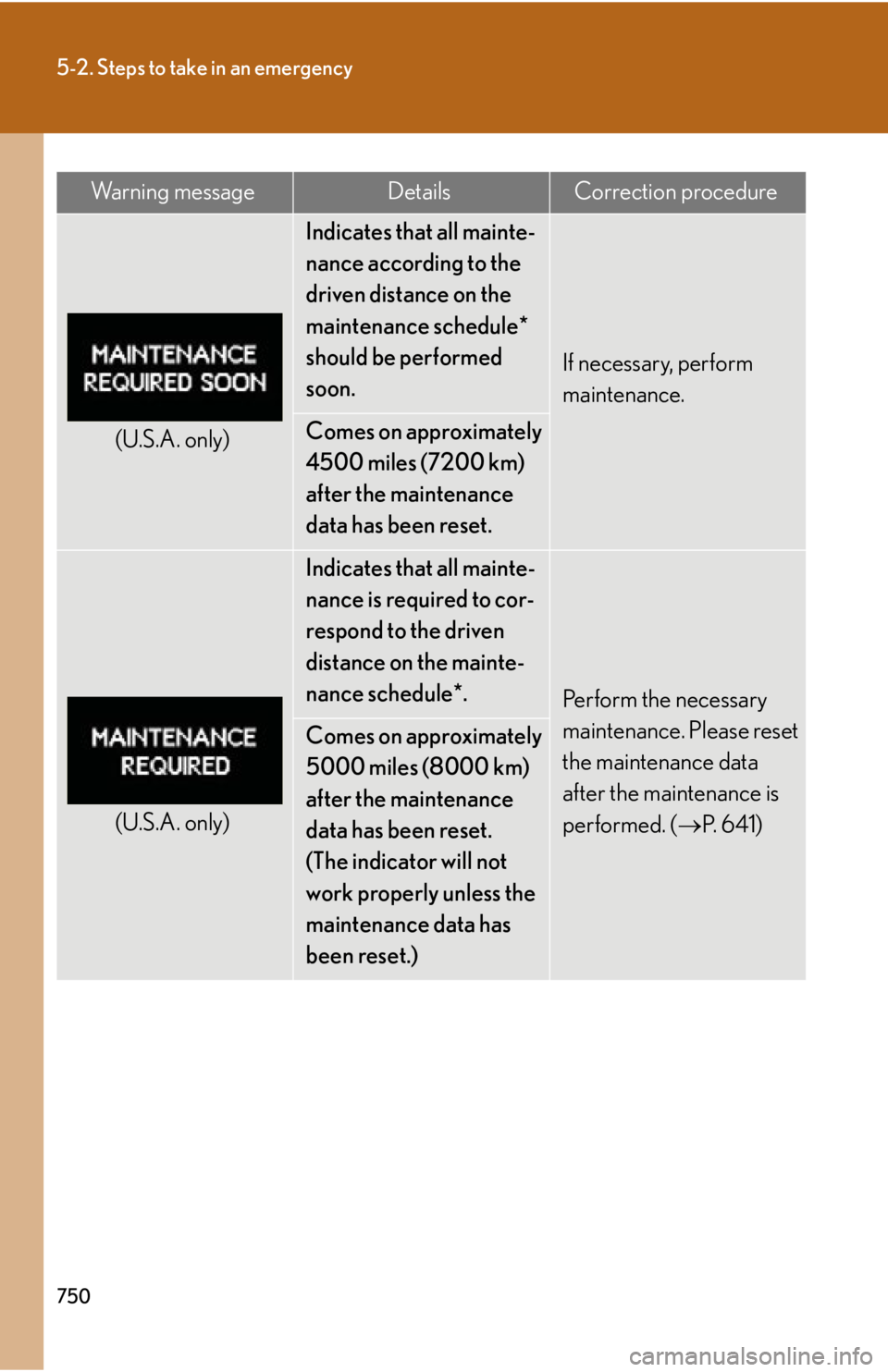
(U.S.A. only) Indicates that all mainte-
nance according to the
driven distance on the
maintenance schedule*
should be performed
soon. If necessary, perform
maintenance.
Comes on approximately
4500 miles (7200 km)
after the maintenance
data has been reset.
(U.S.A. only) Indicates that all mainte-
nance is required to cor-
respond to the driven
distance on the mainte-
nance schedule*.
Perform the necessary
maintenance. Please reset
the maintenance data
after the maintenance is
performed. ( P. 6 4 1 )Comes on approximately
5000 miles (8000 km)
after the maintenance
data has been reset.
(The indicator will not
work properly unless the
maintenance data has
been reset.)Wa r n i n g m e s s a g e Details Correction procedure
Page 755 of 878
7545-2. Steps to take in an emergency
*: Refer to the separate “Scheduled Maintenance” or “Owner's Manual Supple-
ment” for the maintenance interval applicable to your vehicle. (Flashes) Indicates that the
“POWER” switch is
turned off or turned to
ACCESSORY mode and
the driver's door is
opened while the lights
are turned on. Turn the lights off.
(Flashes) Indicates that the driver’s
door is opened when the
hybrid transmission is out
of P with the hybrid sys-
tem on. Shift the shift lever to P.
(If equipped) Indicates that the Blind
Spot Monitor sensors or
the surrounding area on
the bumper is dirty or
covered with ice. Clean the sensor and its
surrounding area on the
bumper.
(Flashes) Indicates that the accel-
erator pedal is depressed
while the shift lever is in
N. Release the accelerator
pedal and shift the shift
lever to D or R.Wa r n i n g m e s s a g e Details Correction procedure
Page 798 of 878
Vehicle specifications
6
7976-1. Specifications
Maintenance data
(fuel, oil level, etc.) .............. 798
Fuel information ...................... 810
Tire information....................... 813
6-2. Customization
Customizable features ........ 825
6-3. Initialization
Items to initialize .................... 837
Page 799 of 878
7986-1. Specifications
Maintenance data (fue l, oil level, etc.)Dimensions and weight
* 1
: Unladen vehicles
* 2
: Vehicles without roof antenna and roof rails
* 3
: Vehicles with roof antenna but without roof rails
* 4
: Vehicles with roof rails
* 5
: AWD models with towing package onlyOverall length 187.8 in. (4770 mm)
Overall width 74.2 in. (1885 mm)
Overall height
* 1
66.3 in. (1685 mm)
* 2
66.7 in. (1695 mm)
* 3
67.9 in. (1725 mm)
* 4
Wheelbase 107.9 in. (2740 mm)
Tr e a d Front 64.2 in. (1630 mm)
Rear 64.0 in. (1625 mm)
Vehicle capacity weight
(Occupants + luggage) 2WD
825 lb. (370 kg)
AW D
885 lb. (400 kg)
Trailer Weight Rating
(trailer weight + cargo weight)
* 5
3500 lb. (1588 kg)