2015 LEXUS RX350 weight
[x] Cancel search: weightPage 314 of 886
3142-5. Driving information
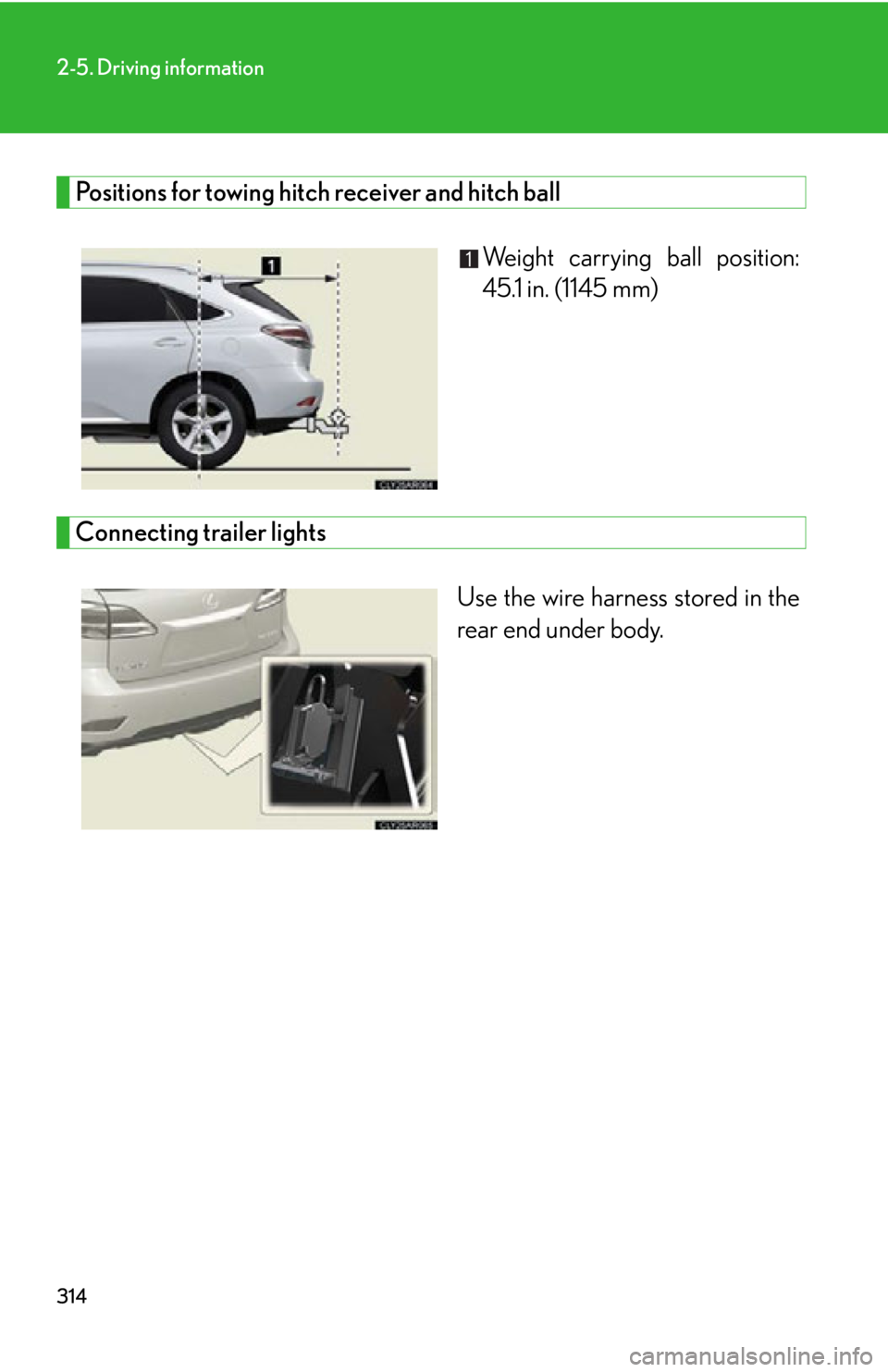
Positions for towing hitch receiver and hitch ball
Weight carrying ball position:
45.1 in. (1145 mm)
Connecting trailer lights
Use the wire harness stored in the
rear end under body.
Page 319 of 886
3192-5. Driving information
2
When driving ■
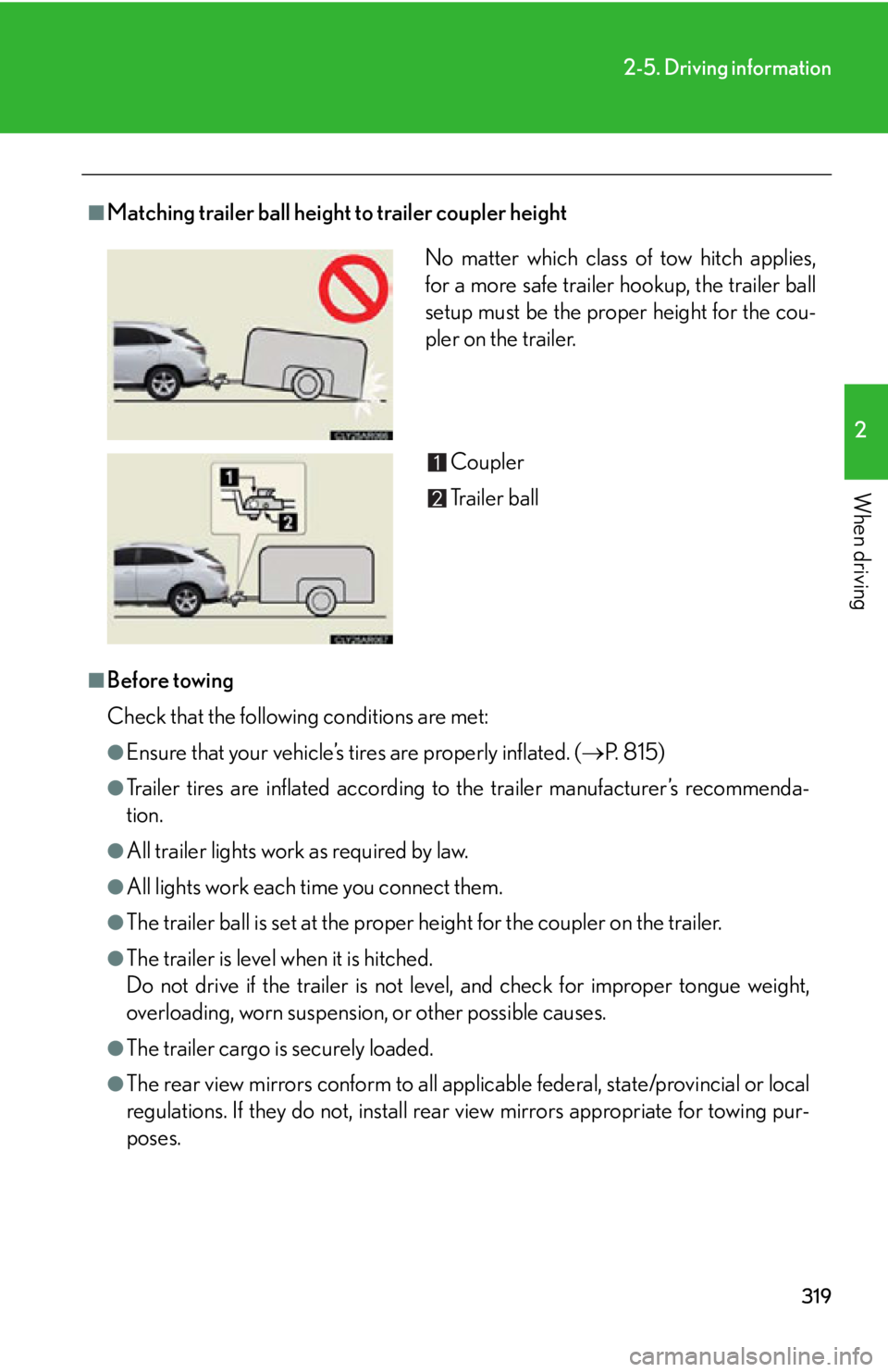
Matching trailer ball height to trailer coupler height
■
Before towing
Check that the following conditions are met: ●
Ensure that your vehicle’s ti res are properly inflated. ( P. 8 1 5 )●
Trailer tires are inflated according to the trailer manufacturer’s recommenda-
tion.●
All trailer lights work as required by law.●
All lights work each time you connect them.●
The trailer ball is set at the proper height for the coupler on the trailer.●
The trailer is level when it is hitched.
Do not drive if the trailer is not level, and check for improper tongue weight,
overloading, worn suspension , or other possible causes.
●
The trailer cargo is securely loaded.
●
The rear view mirrors conform to all applicable federal, state/provincial or local
regulations. If they do not, install rear view mirrors appropriate for towing pur-
poses. No matter which class of tow hitch applies,
for a more safe trailer hookup, the trailer ball
setup must be the proper height for the cou-
pler on the trailer.
Coupler
Trailer ball
Page 320 of 886

3202-5. Driving information
■
Break-in schedule
If your vehicle is new or equipped with any new power train components (such as
an engine, transmission, differential or wheel bearing), Lexus recommends that you
do not tow a trailer until the vehicle has been driven for over 500 miles (800 km).
After the vehicle has been driven for over 500 miles (800 km), you can start tow-
ing. However, for the next 500 miles (800 km), drive the vehicle at a speed of less
than 50 mph (80 km/h) when towing a trailer, and avoid full throttle acceleration.■
Maintenance ●
If you tow a trailer, your vehicle will require more frequent maintenance due to
the additional load. (See “Warranty and Services Guide”, “Owner's Manual
Supplement” or “Scheduled Maintenance”.)●
Retighten the fixing bolts of the towing ball and bracket after approximately
600 miles (1000 km) of trailer towing.■
If trailer sway occurs
One or more factors (crosswinds, passing vehicles, rough roads, etc.) can adversely
affect handling of your vehicle and trailer, causing instability. ●
If trailer swaying occurs:
• Firmly grip the steering wheel. Steer straight ahead.
Do not try to control trailer sway ing by turning the steering wheel.
• Begin releasing the accelerator peda l immediately but very gradually to
reduce speed.
Do not increase speed. Do not apply vehicle brakes.
If you make no extreme correction with the steering or brakes, your vehicle and
trailer should stabilize. ●
After the trailer swaying has stopped:
• Stop in a safe place. Get all occupants out of the vehicle.
• Check the tires of the vehicle and the trailer.
• Check the load in the trailer.
Make sure the load has not shifted.
Make sure the tongue weight is appropriate, if possible.
• Check the load in the vehicle.
Make sure the vehicle is not ov erloaded after occupants get in.
If you cannot find any problems, the speed at which trailer swaying occurred is
beyond the limit of your particular vehicle-trailer combination.
Drive at a lower speed to prevent instability. Remember that swaying of the towing
vehicle-trailer increases as speed increases.
Page 321 of 886

3212-5. Driving information
2
When driving CAUTION■
Trailer towing precautions
To tow a trailer safely, use extreme care an d drive the vehicle in accordance with the
trailer’s characteristics and operating conditions. Failure to do so could cause an
accident resulting in death or serious injury. Vehicle stability and braking perfor-
mance are affected by trailer stability, brake setting and performance, and the hitch.
Your vehicle will handle differently when towing a trailer.■
To avoid accident or injury ●
Do not exceed the TWR, unbraked TWR, GCWR, GVWR or GAWR.●
If the gross trailer weight is over 2000 lb. (907 kg), a sway control device with
sufficient capacity is required.●
Adjust the tongue weight within the appropriate range. Place heavier loads as
close to the trailer axle as possible.●
Do not exceed 65 mph (104 km/h), the posted towing speed limit or the speed
limit for your trailer as set forth in your trailer owner’s manual, whichever is lowest.
Slow down sufficiently before making a turn, in cross winds, on wet or slippery
surface, etc. to help avoid an accident. If you experience a vehicle-trailer instabil-
ity from reducing a certain speed, slow down and make sure you keep your vehi-
cle speed under the speed of which you experience the instability.●
Do not make jerky, abrupt or sharp turns.●
Do not apply the brakes suddenly as you may skid, resulting in jackknifing and
loss of vehicle control. This is especially true on wet or slippery surfaces.●
Do not exceed the trailer hitch assembly weight, gross vehicle weight, gross axle
weight and trailer tongue weight capacities.●
Do not use cruise control when towing.●
Slow down and downshift before descending steep or long downhill grades. Do
not make sudden downshifts while descending steep or long downhill grades.
●
Vehicle-trailer instability is more likely on steep long downhills. Before descend-
ing steep or long downhill grades, slow down and downshift. Do not make sudden
downshifts when descending steep or lo ng downhill grades. Avoid holding the
brake pedal down too long or applying the brakes too frequently. This could
cause the brakes to overheat and result in reduced braking efficiency.
●
Do not tow a trailer when the compact spare tire is installed on your vehicle.
Page 322 of 886
3222-5. Driving information
CAUTION■
Hitch
Trailer hitch assemblies have different weight capacities established by the hitch
manufacturer. Even though the vehicle may be physically capable of towing a
higher weight, the operator must determin e the maximum weight rating of the par-
ticular hitch assembly and never exceed the maximum weight rating specified for
the trailer-hitch. Exceeding the maximum weight rating se t by the trailer-hitch man-
ufacturer can cause an accident resulting in death or serious personal injuries.■
When towing a trailer
Lexus recommends trailers with brakes that conform to any applicable federal and
state/provincial regulations. ●
If the gross trailer weight exceeds unbraked TWR, trailer brakes are required.
Lexus recommends trailers with brakes that conform to all applicable federal and
state/provincial regulations.●
Never tap into your vehicle’s hydraulic system, as this will lower the vehicle’s brak-
ing effectiveness.●
Never tow a trailer without using a safety chain securely attached to both the
trailer and the vehicle. If damage occurs to the coupling unit or hitch ball, there is
danger of the trailer wand ering into another lane.
NOTICE■
When installing a trailer hitch
Use only the position recommended by your Lexus dealer. Do not install the trailer
hitch on the bumper; this may cause body damage.■
Do not directly splice trailer lights
Do not directly splice trailer lights. Direct ly splicing trailer li ghts may damage your
vehicle’s electrical system and cause a malfunction.
Page 685 of 886

6854-3. Do-it-yourself maintenance
4
Maintenance and care
Installing tire pressure warning valves and transmitters
When replacing tires or wheels, tire pressure warning valves and trans-
mitters must also be installed.
When new tire pressure warning va lves and transmitters are installed,
new tire pressure warning valve and transmitter ID codes must be regis-
tered in the tire pressure warning co mputer and the tire pressure warning
system must be initialized. Have tire pressure warning valve and transmit-
ter ID codes registered by your Lexus dealer. ( P. 6 8 7 )
Initializing the tire pressure warning system
■ The tire pressure warning system must be initialized in the following
circumstances:
● When rotating the tires
● When the tire inflation pressure is changed such as when changing
travelling speed or load weight
● When changing the tire size
When the tire pressure warning sy stem is initialized, the current tire
inflation pressure is set as the benchmark pressure.■ The tire pressure warning system
Your Lexus is equipped with a tire pressure warning system that uses
tire pressure warning valves and tr ansmitters to detec t low tire infla-
tion pressure before serious problems arise. ( P. 74 7 )
Page 688 of 886

6884-3. Do-it-yourself maintenance
■
Maximum load of tire
Check that the number given by dividing the maximum load by 1.10 of the replace-
ment tire is greater than 1 /2 of the Gr oss Axle Weight Ratings (GAWR) of either
the front axle or the rear axle, whichever is greater.
■
Tire types
1 Summer tires
Summer tires are high-speed performance tires best suited to highway driving
under dry conditions. Since summer tires do not have the same traction perfor-
mance as snow tires, summer tires are inadequate for driving on snow-covered
or icy roads. For driving on snow-covered roads or icy roads, the use of snow tires
is recommended. When installing snow tires, be sure to replace all four tires.
2 All season tires
All season tires are designed to provide better traction in snow and to be ade-
quate for driving in most winter conditions , as well as for use year round. All sea-
son tires, however, do not have adequa te traction performance compared with
snow tires in heavy or loos e snow. Also, all season tires fall short in acceleration
and handling performance compared with summer tires in highway driving.
3Snow tires
For driving on snow-covered roads or ic y roads, we recommend using snow tires.
If you need snow tires, select tires of the same size, construction and load capac-
ity as the originally installed tires. Since your vehicle has radial tires as original
equipment, make sure your snow tires also have radial construction. Do not install
studded tires without first checking local regulations for possible restrictions.
Snow tires should be installed on all wheels. ( P. 3 0 2 )For the GAWR, see the Certification Label.
For the maximum load of the tire, see the load
limit at maximum cold tire inflation pressure
mentioned on the sidewall of the tire.
(
P. 8 2 1 )
Page 695 of 886

6954-3. Do-it-yourself maintenance
4
Maintenance and care ■
Effects of incorrect tire inflation pressure
Driving with incorrect tire inflation pressure may result in the following: ●
Reduced fuel efficiency●
Reduced driving comfort and tire life●
Reduced safety●
Damage to the drive train
If a tire needs frequent inflating, have it checked by your Lexus dealer.■
Instructions for checking tire pressure
When checking tire inflation pressure, observe the following: ●
Check only when the tires are cold.
If your vehicle has been parked for at least 3 hours or has not been driven for
more than 1 mile or 1.5 km, you will get an accurate cold tire inflation pressure
reading.●
Always use a tire pressure gauge.
The appearance of the tire can be mislea ding. In addition, tire inflation pressure
that is even just a few pounds off can degrade ride and handling.●
Do not reduce tire inflation pressure after driving. It is normal for tire inflation
pressure to be higher after driving.●
Never exceed the vehicle capacity weight.
Passengers and luggage weight should be placed so that the vehicle is bal-
anced.