Page 119 of 886
11911-7. Safety information
Before driving SRS airbags The SRS airbags inflate when the vehi cle is subjected to certain types of
severe impacts that may cause significant injury to the occupants. They
work together with the seat belts to he lp reduce the risk of death or serious
injury.
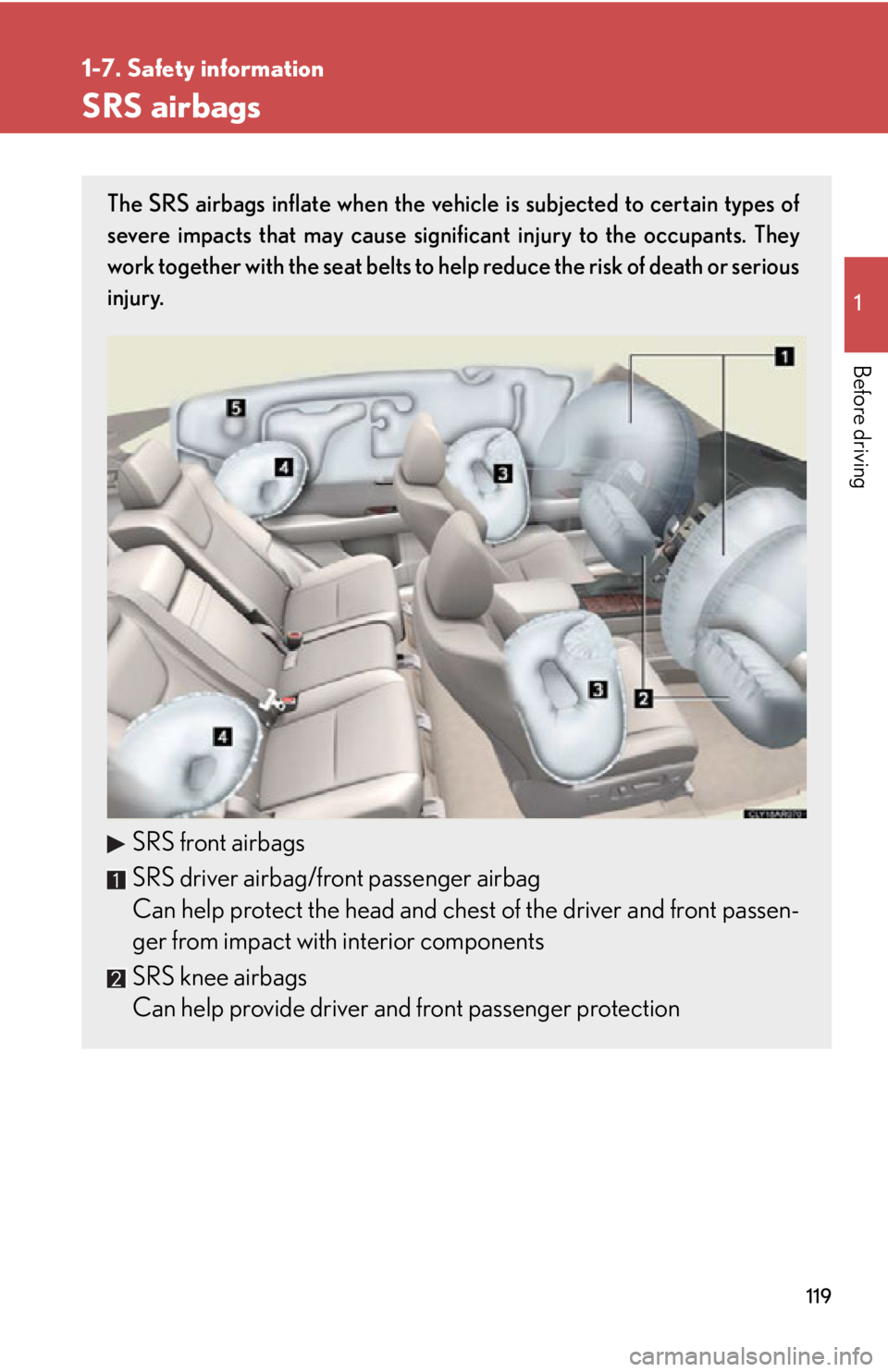
SRS front airbags
SRS driver airbag/front passenger airbag
Can help protect the head and ches t of the driver and front passen-
ger from impact with interior components
SRS knee airbags
Can help provide driver and front passenger protection
Page 120 of 886
1201-7. Safety information
SRS side and curtain shield airbags
Front SRS side airbags
Can help protect the torso of the front seat occupants
Rear SRS side airbags
Can help protect the torso of o ccupants in the rear outer seats
SRS curtain shield airbags
● Can help protect primarily the head of occupants in the outer
seats
● Can help prevent the occupants from being thrown from the
vehicle in the event of vehicle rollover
Page 121 of 886
1211-7. Safety information
1
Before driving SRS airbag system components
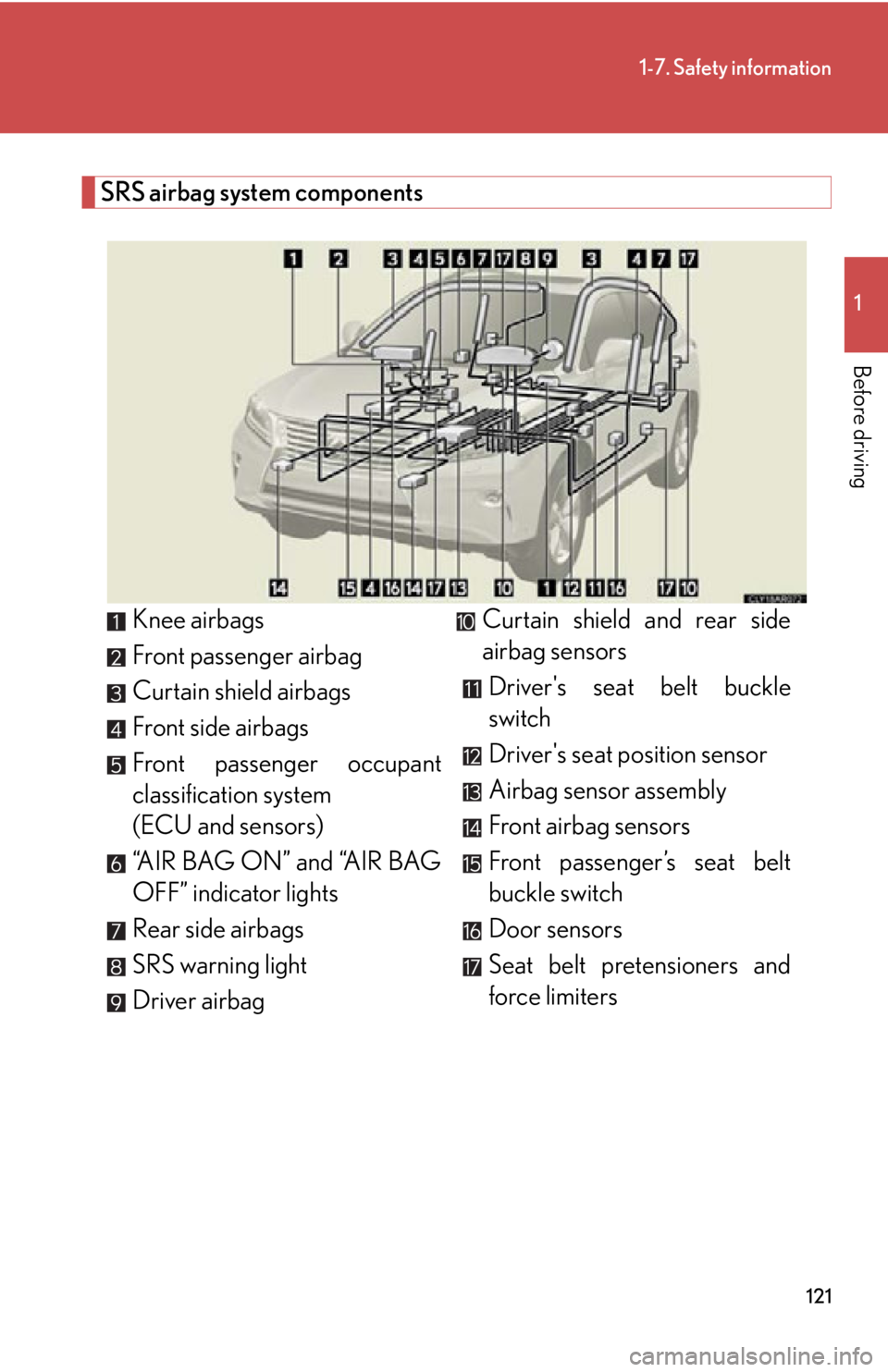
Knee airbags
Front passenger airbag
Curtain shield airbags
Front side airbags
Front passenger occupant
classification system
(ECU and sensors)
“AIR BAG ON” and “AIR BAG
OFF” indicator lights
Rear side airbags
SRS warning light
Driver airbag Curtain shield and rear side
airbag sensors
Driver's seat belt buckle
switch
Driver's seat position sensor
Airbag sensor assembly
Front airbag sensors
Front passenger’s seat belt
buckle switch
Door sensors
Seat belt pretensioners and
force limiters
Page 122 of 886

1221-7. Safety information
Your vehicle is equipped with AD VANCED AIRBAGS designed based
on the US motor vehicl e safety standards (FMV SS208). The airbag sen-
sor assembly (ECU) controls airbag deployment based on information
obtained from the sensors etc. show n in the system components diagram
above. This information includes cras h severity and occupant informa-
tion. As the airbags deploy, a chemica l reaction in the infla tors quic kly fills
the airbags with non-toxi c gas to help restrain th e motion of the occu-
pants.■
If the SRS airbags deploy (inflate) ●
Bruising and slight abrasion s may result from contact with a deploying (inflating)
SRS airbag.●
A loud noise and white powder will be emitted.●
Parts of the airbag module (steering wheel hub, airbag cover and inflator) as
well as the seats, parts of the front and rear pillars, and roof side rails, may be hot
for several minutes. The airbag itself may also be hot.●
The windshield may crack.●
For Safety Connect subscribers, if the SR S airbags deploy or in the event of a
severe rear-end collision, the system is designed to send an emergency call to
the response center, notifying them of the vehicle’s location (without needing to
push the “SOS” button) and an agent will attempt to speak with the occupants
to ascertain the level of emergency and assistance required. If the occupants
are unable to communicate, the agent automatically treats the call as an emer-
gency and helps to dispatch the necessary emergency services. ( P. 6 4 2 )■
SRS airbag deployment conditions (SRS front airbags) ●
The SRS front airbags will deploy in the event of an impact that exceeds the
set threshold level (the level of force corresponding to an approximately 12 -
18 mph [20 - 30 km/h] frontal collision with a fixed wall that does not move or
deform).
However, this threshold velocity will be considerably higher in the following situa-
tions:
• If the vehicle strikes an object, such as a parked vehicle or sign pole, which
can move or deform on impact
• If the vehicle is involved in an underride collision, such as a collision in which
the front of the vehicle “underrides”, or goes under, the bed of a truck
Page 123 of 886
1231-7. Safety information
1
Before driving ●
Depending on the type of collision, it is possible that only the seat belt preten-
sioners will activate.●
The SRS front airbags for the front passenger will not activate if there is no pas-
senger sitting in the front passenger seat . However, the SRS front airbags for the
front passenger may deploy if luggage is put in the seat, even if the seat is unoc-
cupied. ( P. 1 3 2 )■
SRS airbag deployment conditions (SRS side airbags and curtain shield airbags)
The SRS side airbags and SRS curtain shield airbags will deploy in the event of an
impact that exceeds the set threshold level (the level of force corresponding to the
impact force produced by an approximately 3300 lb. [1500 kg] vehicle colliding
with the vehicle cabin from a direction perp endicular to the vehicle orientation at an
approximate speed of 12 - 18 mph [20 - 30 km/h]).
The SRS curtain shield airbags will deploy in the event of vehicle rollover.■
Conditions under which the SRS airbags may deploy (inflate), other than a colli-
sion (SRS front airbags)
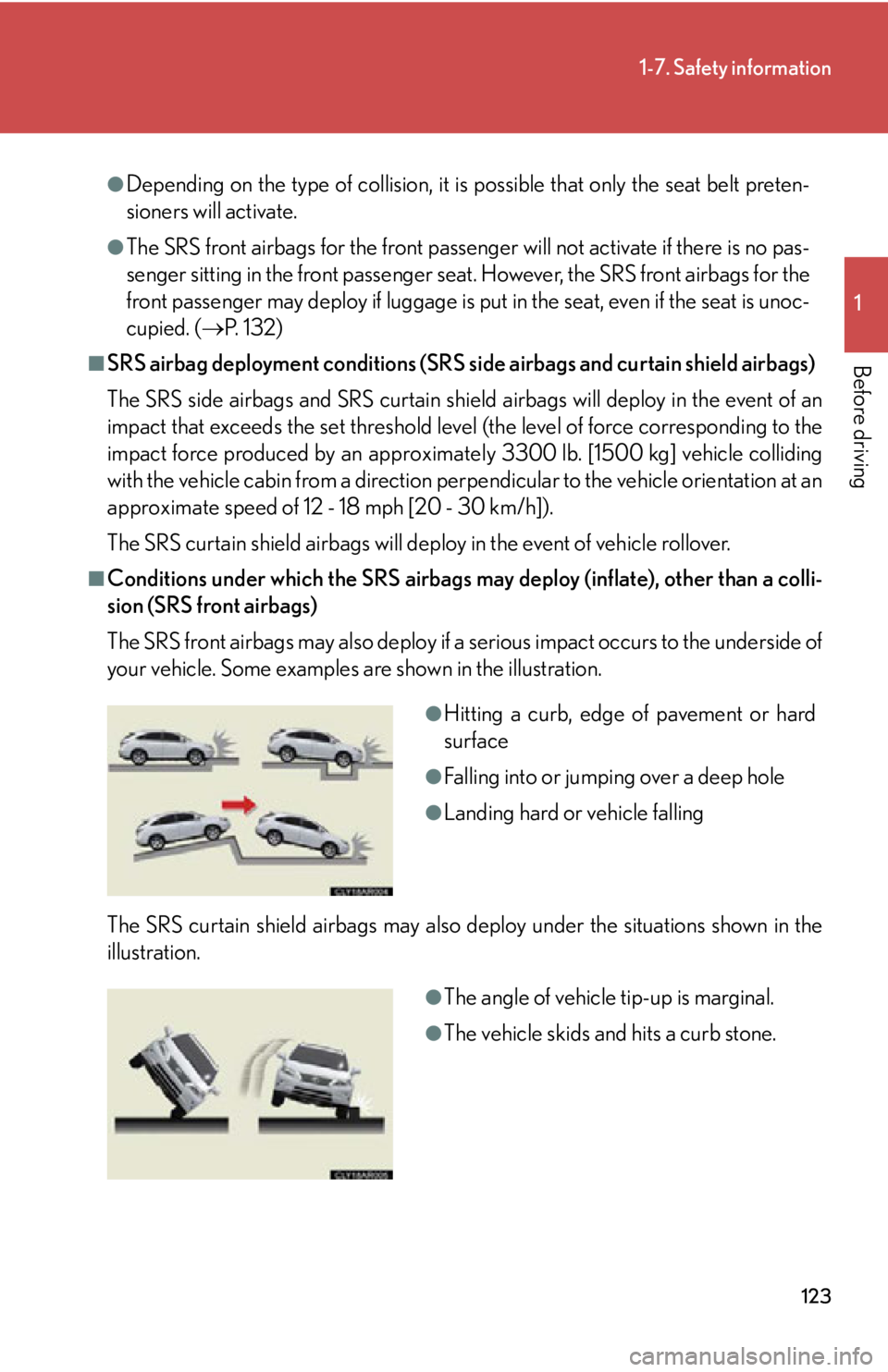
The SRS front airbags may also deploy if a serious impact occurs to the underside of
your vehicle. Some examples are shown in the illustration.
The SRS curtain shield airbags may also deploy under the situations shown in the
illustration. ●
Hitting a curb, edge of pavement or hard
surface ●
Falling into or jumping over a deep hole ●
Landing hard or vehicle falling
●
The angle of vehicle tip-up is marginal.
●
The vehicle skids and hits a curb stone.
Page 124 of 886
1241-7. Safety information
■
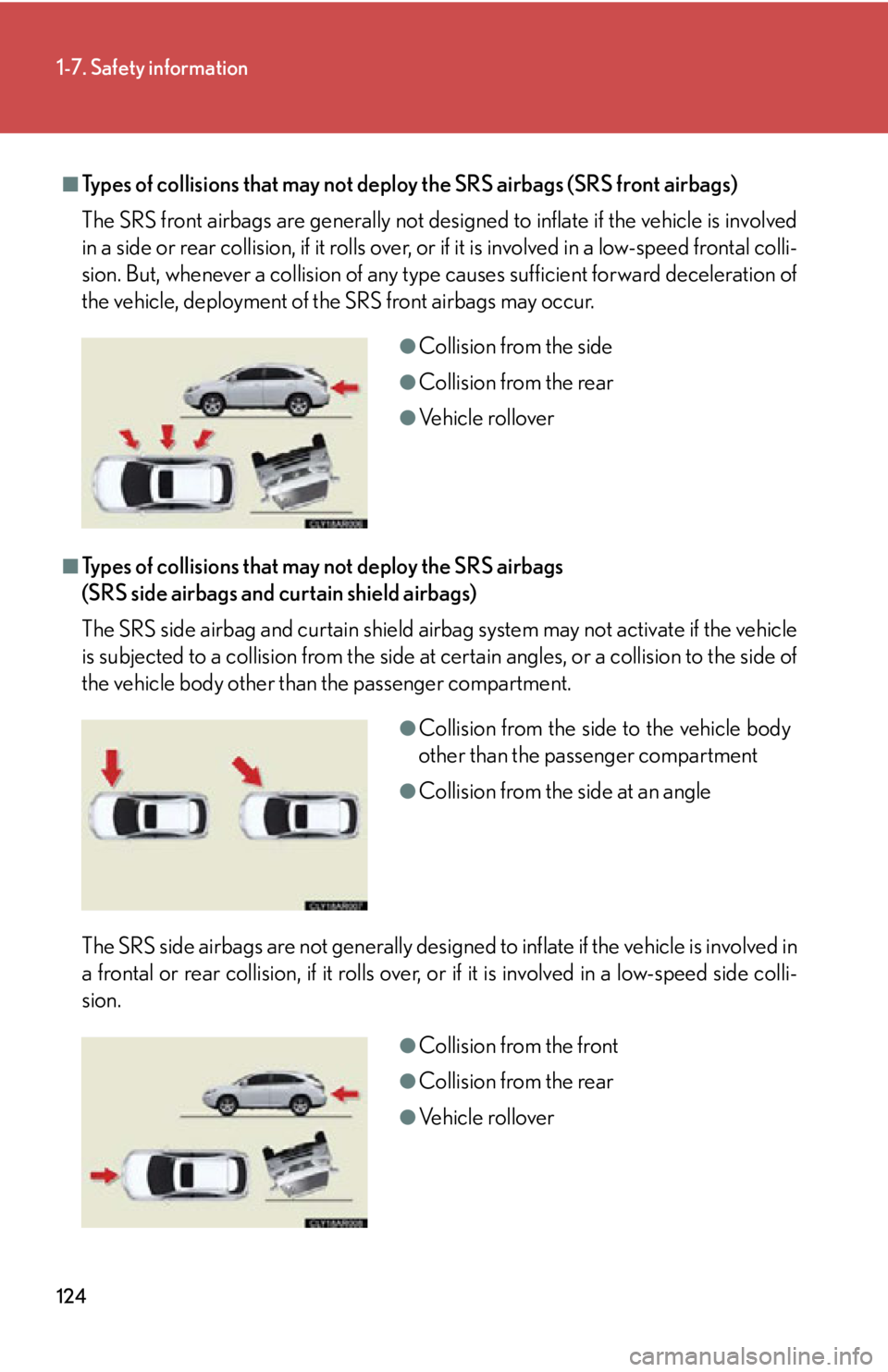
Types of collisions that may not deploy the SRS airbags (SRS front airbags)
The SRS front airbags are generally not designed to inflate if the vehicle is involved
in a side or rear collision, if it rolls over, or if it is involved in a low-speed frontal colli-
sion. But, whenever a collision of any type causes sufficient forward deceleration of
the vehicle, deployment of th e SRS front airbags may occur.
■
Types of collisions that may not deploy the SRS airbags
(SRS side airbags and curtain shield airbags)
The SRS side airbag and curtain shield ai rbag system may not activate if the vehicle
is subjected to a collision from the side at certain angles, or a collision to the side of
the vehicle body other than the passenger compartment.
The SRS side airbags are not generally designed to inflate if the vehicle is involved in
a frontal or rear collision, if it rolls over, or if it is involved in a low-speed side colli-
sion. ●
Collision from the side ●
Collision from the rear ●
Vehicle rollover
●
Collision from the side to the vehicle body
other than the passenger compartment ●
Collision from the side at an angle
●
Collision from the front
●
Collision from the rear
●
Vehicle rollover
Page 125 of 886

1251-7. Safety information
1
Before driving The SRS curtain shield airbags are not generally designed to inflate if the vehicle is
involved in a frontal or rear collision, if it pi tches end over end, or if it is involved in a
low-speed side collision.
■
When to contact your Lexus dealer
In the following cases, the vehicle will require inspection and/or repair. Contact
your Lexus dealer as soon as possible. ●
Any of the SRS airbags has been inflated. ●
Collision from the front ●
Collision from the rear ●
Pitching end over end
●
The front of the vehicle is damaged or
deformed, or was involved in an accident
that was not severe enough to cause the
SRS airbags to inflate.
●
A portion of the doors is damaged or
deformed, or the vehicle was involved in an
accident that was not severe enough to
cause the SRS side airbags and curtain
shield airbags to inflate.
●
The pad section of the steering wheel,
dashboard near the front passenger airbag
or lower portion of the instrument panel is
scratched, cracked, or otherwise dam-
aged.
Page 126 of 886
1261-7. Safety information
●
The surface of the seats with the side air-
bag is scratched, cracked, or otherwise
damaged.
●
The portion of the front pillars, rear pillars
or roof side rail garnishes (padding) con-
taining the curtain shield airbags inside is
scratched, cracked, or otherwise dam-
aged.