Page 794 of 886
7945-2. Steps to take in an emergency
Starting the engine
Ensure that the shift lever is in P and depress the brake pedal.
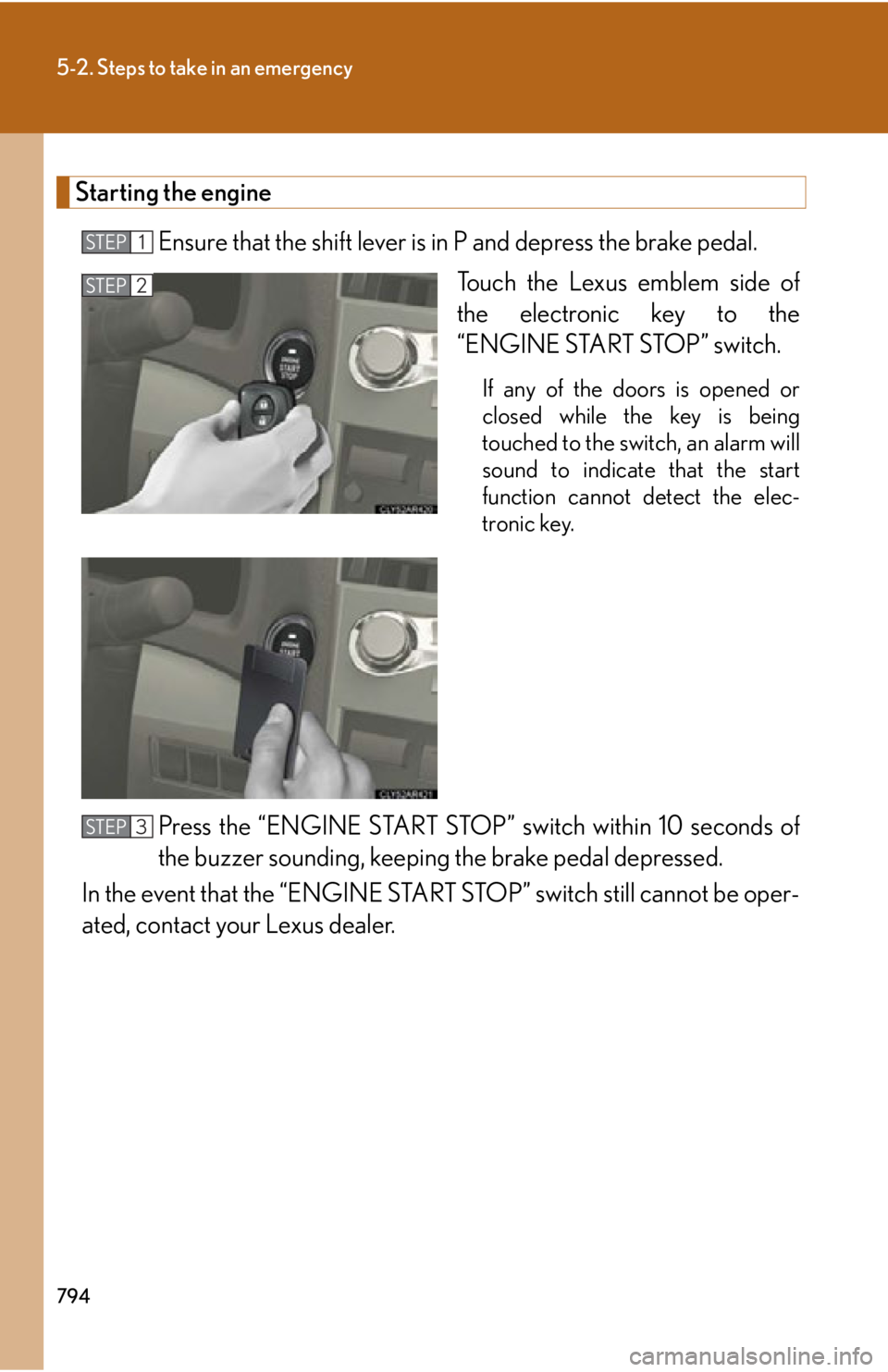
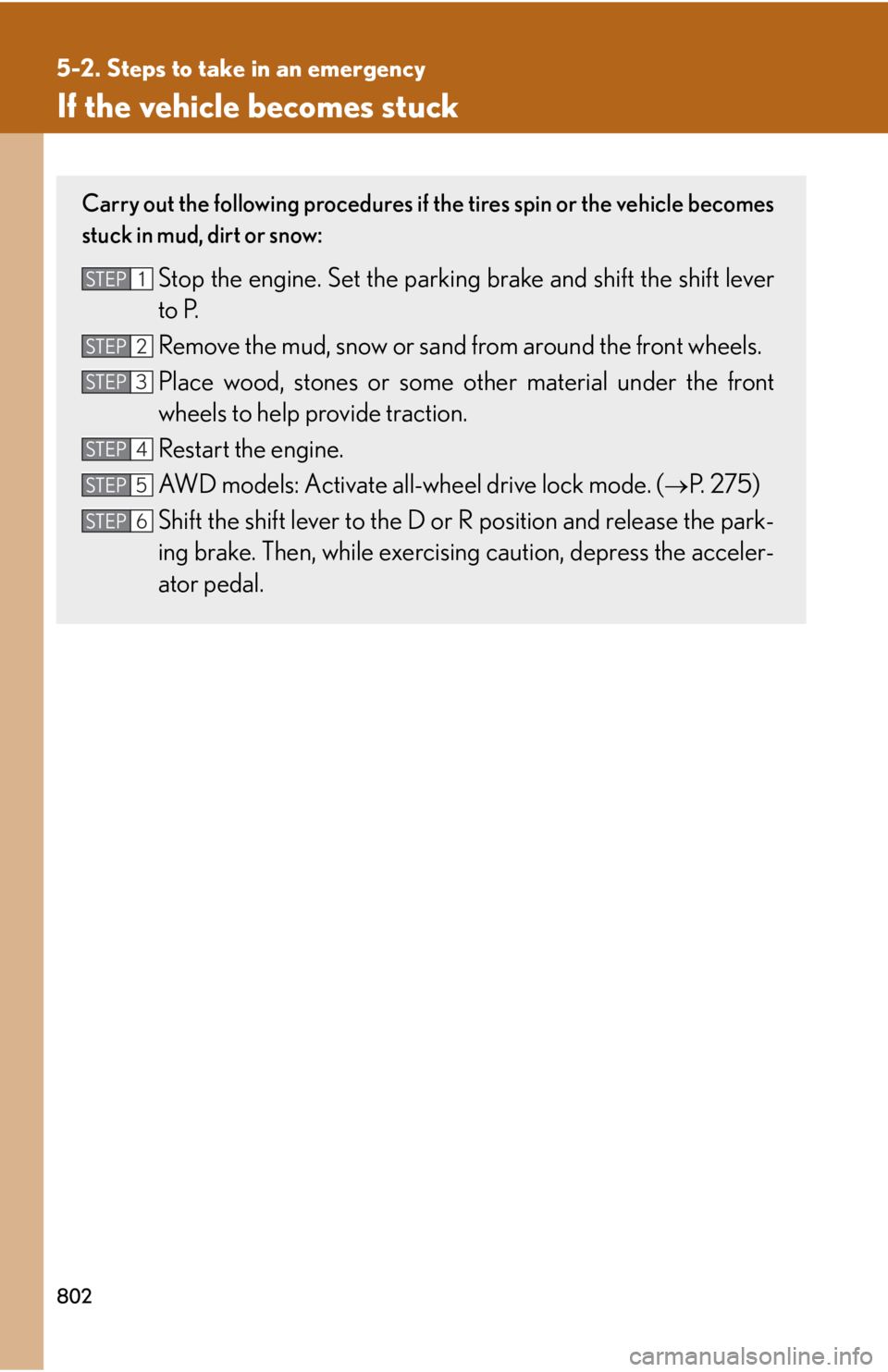
Touch the Lexus emblem side of
the electronic key to the
“ENGINE START STOP” switch. If any of the doors is opened or
closed while the key is being
touched to the switch, an alarm will
sound to indicate that the start
function cannot detect the elec-
tronic key.
Press the “ENGINE START STOP” switch within 10 seconds of
the buzzer sounding, keeping the brake pedal depressed.
In the event that the “ENGINE START STOP” switch still cannot be oper-
ated, contact your Lexus dealer. STEP 1
STEP 2
STEP 3
Page 795 of 886
5
When trouble arises
7955-2. Steps to take in an emergency
■
Stopping the engine
Shift the shift lever to P and press the “ENGINE START STOP” switch as you nor-
mally do when stopping the engine.■
Replacing the key battery
As the above procedure is a temporary measure, it is recommended that the elec-
tronic key battery be replaced immediately when the battery is depleted.
( P. 7 0 1 )■
Changing “ENGINE START STOP” switch modes
Within 10 seconds of the buzzer sounding, release the brake pedal and press the
“ENGINE START STOP” switch.
The engine does not start and modes will be changed each time the switch is
pressed. ( P. 166)
Page 802 of 886
8025-2. Steps to take in an emergency
If the vehicle becomes stuck Carry out the following procedures if the tires spin or the vehicle becomes
stuck in mud, dirt or snow:
Stop the engine. Set the parking brake and shift the shift lever
to P.
Remove the mud, snow or sand from around the front wheels.
Place wood, stones or some ot her material under the front
wheels to help provide traction.
Restart the engine.
AWD models: Activate all-wheel drive lock mode. (
P. 275)
Shift the shift lever to the D or R position and release the park-
ing brake. Then, while exercising caution, depress the acceler-
ator pedal.STEP 1
STEP 2
STEP 3
STEP 4
STEP 5
STEP 6
Page 804 of 886
8045-2. Steps to take in an emergency
If your vehicle has to be stopped in an emergency
CAUTION
■
If the engine has to be turned off while driving
Power assist for the brakes and steering wh eel will be lost, making the brake pedal
harder to depress and the steering wheel heavier to turn. Decelerate as much as
possible before turning off the engine.Only in an emergency, such as if it becomes impossible to stop the vehicle
in the normal way, stop the vehicle using the following procedure:
Steadily step on the brake pe dal with both feet and firmly
depress it. Do not pump the brake pedal repeatedly as this will increase the
effort required to slow the vehicle.
Shift the shift lever to N.
If the shift lever is shifted to N
After slowing down, stop the vehicl e in a safe place by the road.
Stop the engine.
If the shift lever cannot be shifted to N
Keep depressing the brake pedal with both feet to reduce vehi-
cle speed as much as possible.
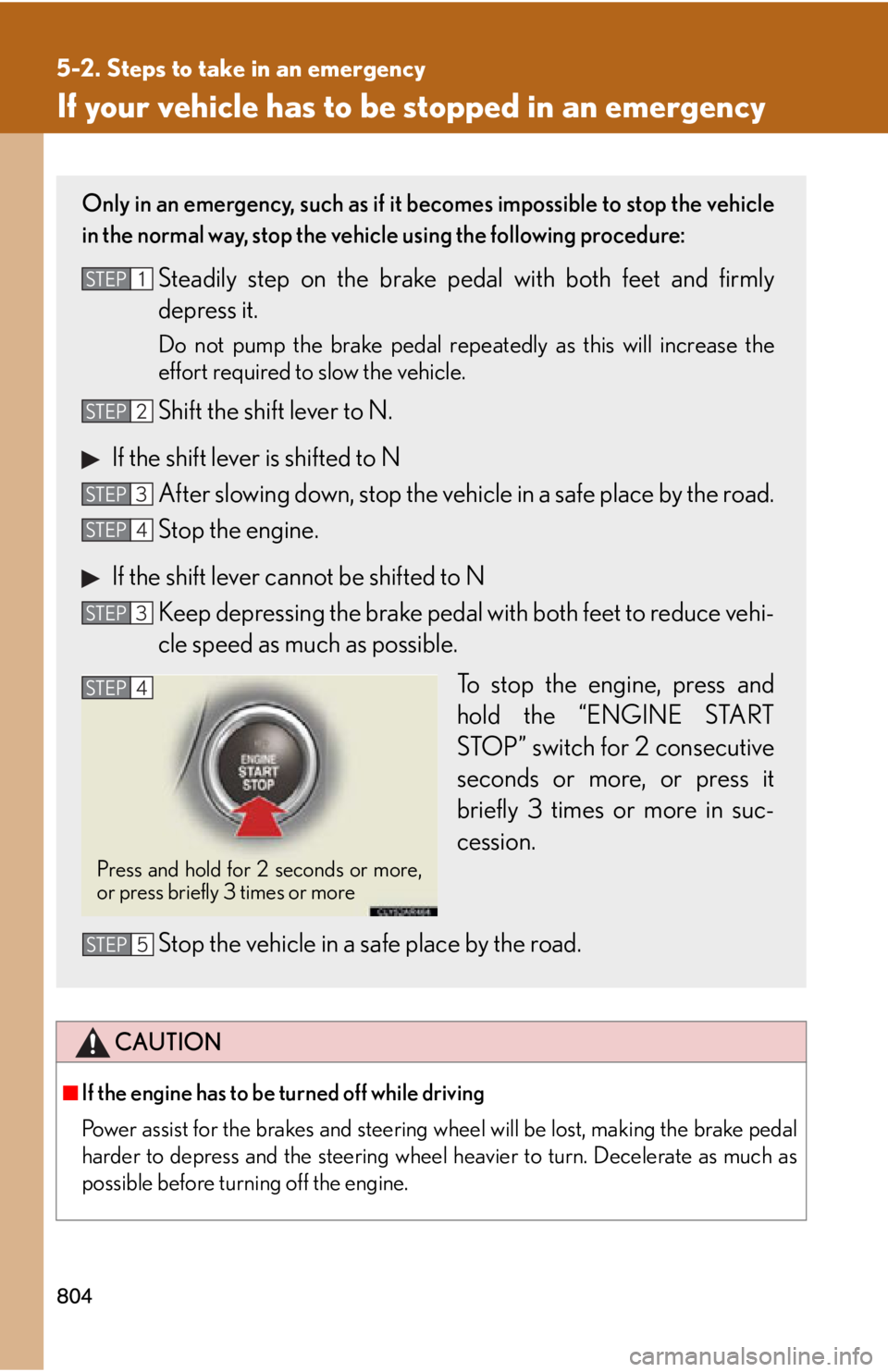
To stop the engine, press and
hold the “ENGINE START
STOP” switch for 2 consecutive
seconds or more, or press it
briefly 3 times or more in suc-
cession.
Stop the vehicle in a safe place by the road.STEP 1
STEP 2
STEP 3
STEP 4
STEP 3
STEP 4
Press and hold for 2 seconds or more,
or press briefly 3 times or more
STEP 5
Page 816 of 886
8146-1. Specifications
Brakes
* 1
: Minimum pedal clearance when depressed with a force of 112 lbf (500 N, 51
kgf) while the engine is running
* 2
: Parking brake pedal travel when depressed with a force of 67.5 lbf (300 N, 31
kgf)
SteeringPe d a l c l e a r a n c e
* 1
3.5 in. (88 mm) Min.
Pedal free play 0.04
0.24 in. (1
6 mm)
Brake pad wear limit 0.04 in. (1.0 mm)
Parking brake lining wear limit 0.04 in. (1.0 mm)
Parking brake pedal travel
* 2
7
10 clicks
Fluid type SAE J1703 or FMVSS No.116 DOT 3
Free play Less than 1.2 in. (30 mm)
Page 830 of 886
8286-1. Specifications
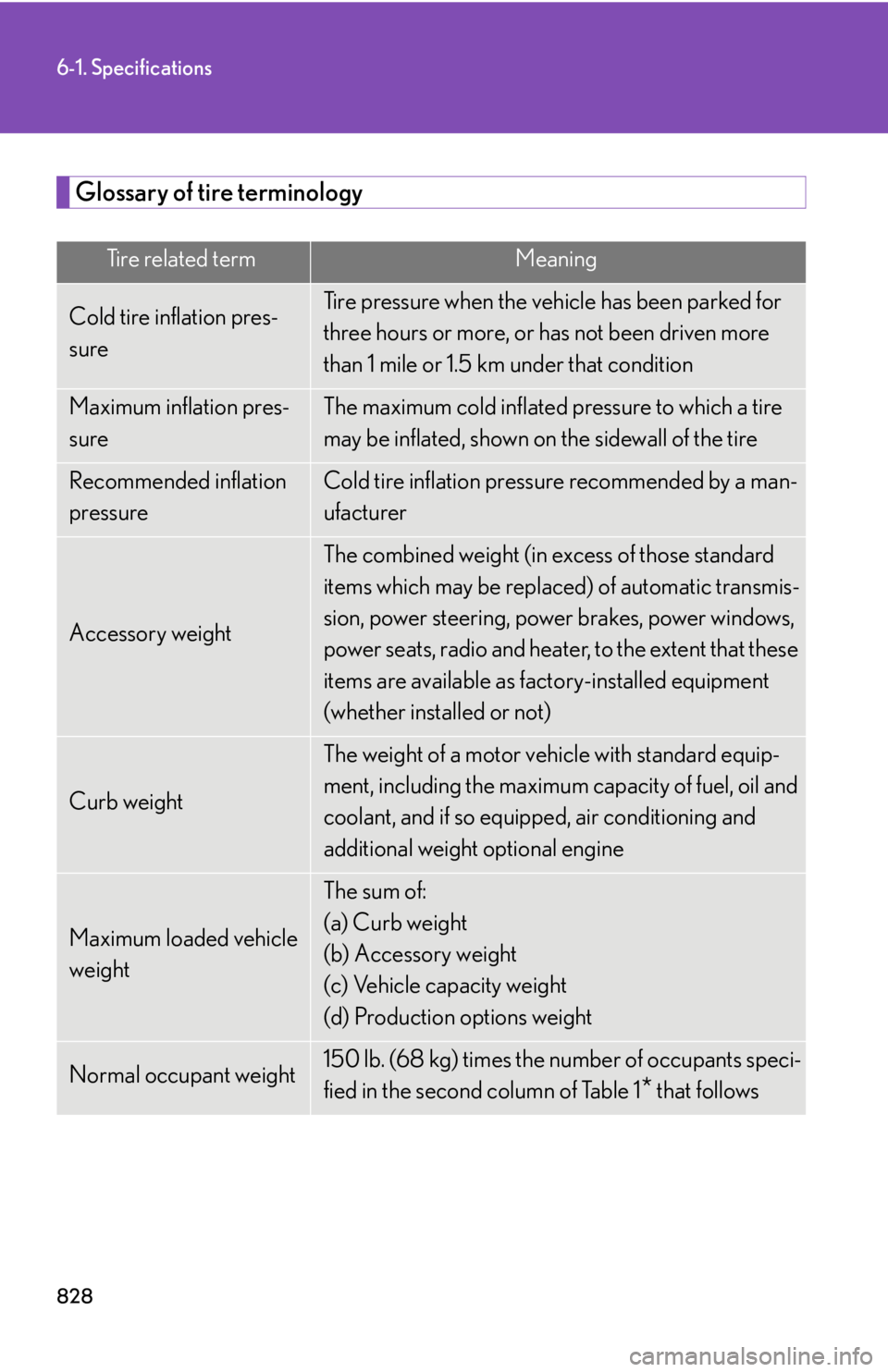
Glossary of tire terminology Tire related term Meaning
Cold tire inflation pres-
sure Tire pressure when the vehicle has been parked for
three hours or more, or has not been driven more
than 1 mile or 1.5 km under that condition
Maximum inflation pres-
sure The maximum cold inflated pressure to which a tire
may be inflated, shown on the sidewall of the tire
Recommended inflation
pressure Cold tire inflation pressure recommended by a man-
ufacturer
Accessory weight The combined weight (in excess of those standard
items which may be replaced) of automatic transmis-
sion, power steering, power brakes, power windows,
power seats, radio and heater, to the extent that these
items are available as factory-installed equipment
(whether installed or not)
Curb weight The weight of a motor vehicle with standard equip-
ment, including the maximum capacity of fuel, oil and
coolant, and if so equipp ed, air conditioning and
additional weight optional engine
Maximum loaded vehicle
weight The sum of:
(a) Curb weight
(b) Accessory weight
(c) Vehicle capacity weight
(d) Production options weight
Normal occupant weight 150 lb. (68 kg) times the number of occupants speci-
fied in the second column of Table 1
* that follows
Page 831 of 886

8296-1. Specifications
6
Vehicle specifications Tire related term Meaning
Occupant distribution Distribution of occupants in a vehicle as specified in
the third column of Table 1
* below
Production options
weight The combined weight of installed regular production
options weighing over 5 lb. (2.3 kg) in excess of the
standard items which they replace, not previously
considered in curb weight or accessory weight,
including heavy duty brakes, ride levelers, roof rack,
heavy duty battery, and special trim
Rim A metal support for a tire or a tire and tube assembly
upon which the tire beads are seated
Rim diameter
(Wheel diameter) Nominal diameter of the bead seat
Rim size designation Rim diameter and width
Rim type designation The industry manufacturer's designation for a rim by
style or code
Rim width Nominal distance between rim flanges
Vehicle capacity weight
(Total load capacity) The rated cargo and luggage load plus 150 lb. (68
kg) times the vehicle's designated seating capacity
Vehicle maximum load on
the tire The load on an individual tire that is determined by
distributing to each axle its share of the maximum
loaded vehicle weight, and dividing by two
Vehicle normal load on
the tire The load on an individual tire that is determined by
distributing to each axle its share of curb weight,
accessory weight, and normal occupant weight (dis-
tributed in accordance with Table 1
* below), and
dividing by two
We a t h e r s i d e The surface area of the rim not covered by the
inflated tire
Page 836 of 886
8346-2. Customization
Customizable features
Customizing vehicle features
It is possible to customize certain ve hicle features using the multi-infor-
mation switches. *
*: For instructions on customizing vehicle features using the navigation
system screen, refer to the “Navigation System Owner’s Manual”.
For instructions on customizing vehi cle features u sing the Display
Audio system screen: P. 3 3 7
When customizing vehicle features, ensu re that the vehicle is parked in a
safe place with the shift lever in P and the parking brake set.
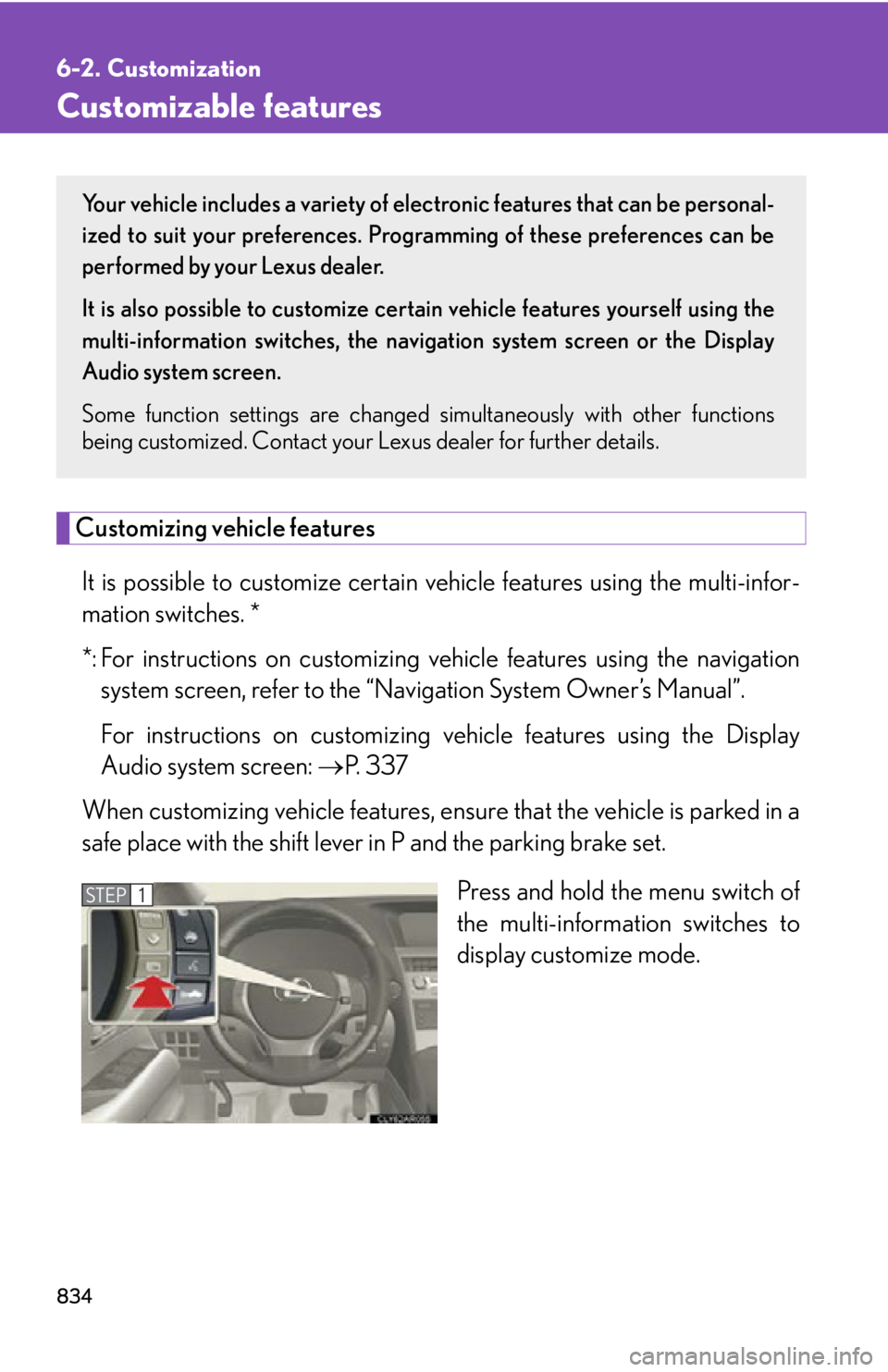
Press and hold the menu switch of
the multi-information switches to
display customize mode.Your vehicle includes a variety of elec tronic features that can be personal-
ized to suit your preferences. Programming of these preferences can be
performed by your Lexus dealer.
It is also possible to customize certain vehicle features yourself using the
multi-information switches, the navigation system screen or the Display
Audio system screen.
Some function settings are changed simultaneously with other functions
being customized. Contact your Lexus dealer for further details.
STEP 1