2015 KIA VENGA air condition
[x] Cancel search: air conditionPage 62 of 480

62
❖❖Please see this page instead of page 7-78 in owner's manual.
Diesel Particulate Filter (if equipped)
The Diesel Particulate Filter (DPF) sys-
tem removes the soot in the exhaust gas.
Unlike a disposable air filter, the DPF
system automatically burns (oxidizes)
and removes the accumulated soot
according to the driving condition. In
other words, the active burning by engine
control system and high exhaust gas
temperature caused by normal/high driv-
ing condition burns and removes the
accumulated soot.
However, if the vehicle continues to be
driven at repeated short distance or driv-
en at low speed for long time, the accu-
mulated soot may not be automatically
removed because of low exhaust gas
temperature. More than a certain amountof soot deposited, the malfunction indica-
tor light ( ) illuminates. When the malfunction indicator light
blinks, it may stop blinking by driving the
vehicle at more than 60km/h (37 mph) orat more than second gear with 1500 ~
2500 engine rpm for a certain time (for
about 25 minutes). If the malfunction indicator light contin-
ues to be blinked in spite of the proce-
dure, we recommend that the system be
checked by an authorised Kia dealer.
If you continue to drive with the malfunc-
tion indicator light blinking for a long
time, the DPF system can be damaged
and fuel consumption can be worsen.
Lean NOx Trap (if equipped)
The Lean NOx Trap (LNT) system
removes the nitrogen oxide in the
exhaust gas. The smell can occur in the
exhaust gas depending on the quality of
the fuel and it can degrade NOx reduc-
tion performance, please use the regulat-
ed automotive diesel fuel.
EMISSION CONTROL SYSTEM
CAUTION
- Diesel Fuel
(if equipped with DPF)
It is recommended to use the regu- lated automotive diesel fuel for
diesel vehicle equipped with theDPF system.
If you use diesel fuel including highsulfur (more than 50 ppm sulfur) and
unspecified additives, it can causethe DPF system to be damaged and white smoke can be emitted.
YN leaflet-ENG(RHD)-A1PO-EA48A(L).qxp 11/6/2014 5:14 PM Page 62
Page 106 of 480

323
Safety features of your vehicle
✽✽NOTICE
Both the driver's and front passen- ger's pre-tensioner seat belts will be
activated in certain frontal collisions.
The pre-tensioner seat belts can be
activated, where the frontal collision is
severe enough, together with the air
bags.
When the pre-tensioner seat belts are activated, a loud noise may be heard
and fine dust, which may appear to be
smoke, may be visible in the passenger
compartment. These are normal oper-
ating conditions and are not haz-
ardous.
Although it is harmless, the fine dust may cause skin irritation and should
not be breathed for prolonged periods.
Wash all exposed skin areas thorough-
ly after an accident in which the pre-
tensioner seat belts were activated.
✽
✽ NOTICE
Because the sensor that activates the
SRS air bag is connected with the pre-
tensioner seat belt, the SRS air bag
warning light ( ) on the instrument
panel will illuminate for approximately
6 seconds after the ignition switch has
been turned to the ON position, and
then it should turn off.
WARNING
Pre-tensioners are designed to operate only one time. After acti-
vation, pre-tensioner seat belts
must be replaced. All seat belts,
of any type, should always be
replaced after they have been
worn during a collision.
(Continued)
CAUTION
If the pre-tensioner seat belt is notworking properly, this warning light
will illuminate even if there is nomalfunction of the SRS air bag. Ifthe SRS air bag warning light does not illuminate when the ignition
switch is turned to ON, or if it remains illuminated after illuminat-ing for approximately 6 seconds, or
if it illuminates whilst the vehicle isbeing driven, we recommend that the system be inspected by anauthorised Kia dealer.WARNING
To obtain maximum benefit from a pre-tensioner seat belt:
1. The seat belt must be worn cor- rectly and adjusted to the proper
position. Please read and follow
all of the important information
and precautions about your vehi-
cle’s occupant safety features –
including seat belts and air bags –
that are provided in this manual.
2. Be sure you and your passen- gers always wear seat belts prop-
erly.
YN RHD 3.QXP 11/20/2014 7:16 PM Page 23
Page 126 of 480

343
Safety features of your vehicle
SRS components and functions
The SRS consists of the following com- ponents:
1. Driver's front air bag module
2. Passenger's front air bag module*
3. Side air bag modules*
4. Curtain air bag modules*
5. Retractor pre-tensioner assemblies*
6. Air bag warning light
7. SRS control module (SRSCM)
8. Front impact sensors
9. Side impact sensors*10. Passenger’s front air bag ON/OFF
indicator (front passenger's seat only)*
11. Passenger’s front air bag ON/OFF switch*
* if equipped
The SRSCM continually monitors all SRS components whilst the ignition
switch is ON to determine if a crash
impact is severe enough to require air
bag deployment or pre-tensioner seat
belt deployment.
The SRS air bag warning light on the
instrument panel will illuminate for about
6 seconds after the ignition switch is
turned to the ON position, after which the
air bag warning light should go out.
WARNING
If any of the following conditions
occurs, this indicates a malfunction
of the SRS. We recommend that the
system be inspected by an autho-
rised Kia dealer.
The light does not turn on briefly when you turn the ignition ON.
The light stays on after illuminat- ing for approximately 6 seconds.
The light comes on whilst the vehicle is in motion.
The light blinks when the ignition switch is in ON position.
OAM039049R/Q
YN RHD 3.QXP 11/20/2014 7:17 PM Page 43
Page 128 of 480

345
Safety features of your vehicle
Driver's and passenger's front air
bag (if equipped)
Your vehicle is equipped with a
Supplemental Restraint (Air Bag) System
and lap/shoulder belts at both the driver
and passenger seating positions.
WARNING
If an air bag deploys, there may be a loud noise followed by a fine
dust released in the vehicle.These conditions are normal and
are not hazardous - the air bags
are packed in this fine powder.
The dust generated during air
bag deployment may cause skin
or eye irritation as well as aggra-
vate asthma for some persons.
Always wash all exposed skin
areas thoroughly with lukewarmwater and a mild soap after an
accident in which the air bags
were deployed.
The SRS can function only when the ignition switch is in the ONposition.
Before you replace a fuse or dis- connect a battery terminal, turn
the ignition switch to the LOCK
position and remove the ignition
key. Never remove or replace the
air bag related fuse(s) when the
ignition switch is in the ON posi-
tion. Failure to heed this warning
will cause the SRS air bag warn-
ing light to illuminate.
OYN039024R
OYN039025R
Driver’s front air bag
Passenger’s front air bag
WARNING
Do not install or place any acces- sories (drink holder, cassette
holder, sticker, etc.) on the front
passenger's panel above the
glove box in a vehicle with a pas-
senger's air bag. Such objects
may become dangerous projec-
tiles and cause injury if the pas-
senger's air bag inflates.
When installing a container of liq- uid air freshener inside the vehi-
cle, do not place it near the
instrument cluster nor on the
instrument panel surface.
It may become a dangerous pro-
jectile and cause injury if the pas-
senger's air bag inflates.
B240B05L
Passenger’s front air bag
YN RHD 3.QXP 11/20/2014 7:17 PM Page 45
Page 134 of 480

351
Safety features of your vehicle
The side air bags are designed to deploy
only during certain side-impact collisions,
depending on the crash severity, angle,
speed and point of impact. The side air
bags are not designed to deploy in all
side impact situations.(Continued)
Do not use any accessory seatcovers.
Use of seat covers could reduce or prevent the effectiveness of the system.
Do not install any accessories on the side or near the side air bag.
Do not place any objects over the air bag or between the air bag
and yourself.
Do not place any objects (an umbrella, bag, etc.) between the
front door and the front seat.
Such objects may become dan-
gerous projectiles and cause
injury if the supplemental side air
bag inflates.
To prevent unexpected deploy- ment of the side air bag that may
result in personal injury, avoidimpact to the side impact sensor
when the ignition switch is on.
If seat or seat cover is damaged, we recommend that the system
be serviced by an authorised Kia
dealer.WARNING
Do not allow the passengers to lean their heads or bodies onto
doors, put their arms on the doors,
stretch their arms out of the win-
dow, or place objects between the
doors and passengers when theyare seated on seats equipped with
side and/or curtain air bags.
The side air bag is supplemental to the driver's and the passen-
ger's seat belt systems and is not
a substitute for them. Therefore
your seat belts must be worn at
all times whilst the vehicle is in
motion. The air bags deploy only
in certain side impact conditions
severe enough to cause signifi-
cant injury to the vehicle occu-pants.
For best protection from the side air bag system and to avoid being
injured by the deploying side air
bag, both front seat occupantsshould sit in an upright position
with the seat belt properly fas-
tened. The driver's hands shouldbe placed on the steering wheelat the 9:00 and 3:00 positions.
The passenger's arms and handsshould be placed on their laps.
(Continued)
YN RHD 3.QXP 11/20/2014 7:17 PM Page 51
Page 136 of 480
353
Safety features of your vehicle
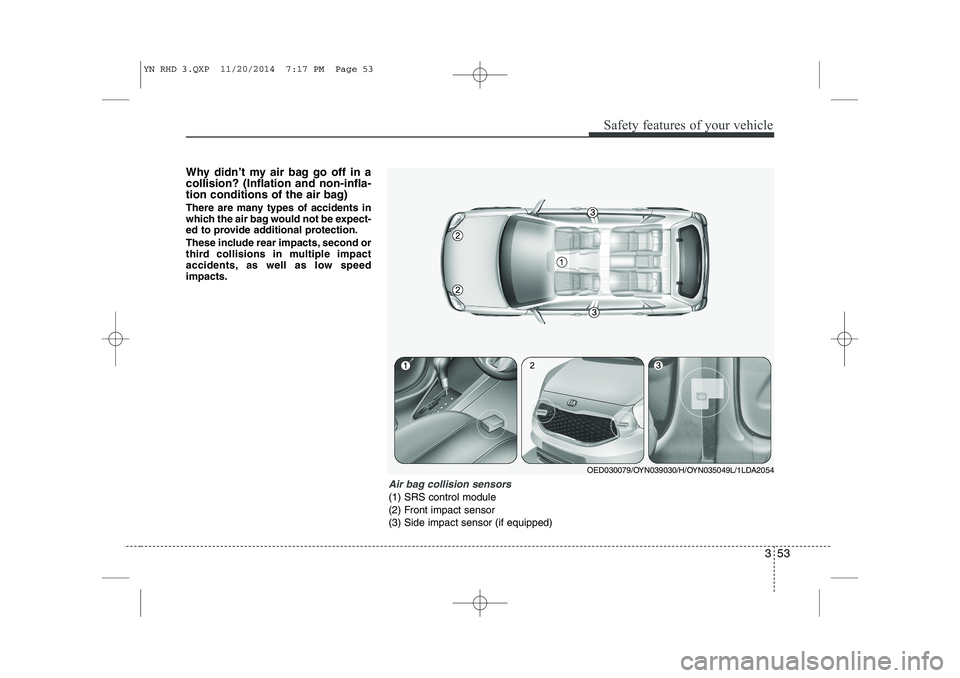
Why didn’t my air bag go off in a collision? (Inflation and non-infla-
tion conditions of the air bag)
There are many types of accidents in
which the air bag would not be expect-
ed to provide additional protection.
These include rear impacts, second or
third collisions in multiple impact
accidents, as well as low speedimpacts.
Air bag collision sensors
(1) SRS control module
(2) Front impact sensor
(3) Side impact sensor (if equipped)
OED030079/OYN039030/H/OYN035049L/1LDA2054
YN RHD 3.QXP 11/20/2014 7:17 PM Page 53
Page 137 of 480

Safety features of your vehicle
54
3
Air bag inflation conditions
Front air bags
Front air bags are designed to inflate in a frontal collision depending on the intensi-
ty, speed or angles of impact of the frontcollision.
WARNING
Do not hit or allow any objects to impact the locations where air
bags or sensors are installed.
This may cause unexpected air
bag deployment, which could
result in serious personal injuryor death.
If the installation location or angle of the sensors is altered in
any way, the air bags may deploy
when they should not or they may
not deploy when they should,
causing severe injury or death.
Therefore, do not try to perform
maintenance on or around the air
bag sensors. We recommend that
the system be serviced by an
authorised Kia dealer.
(Continued)(Continued)
Problems may arise if the sensorinstallation angles are changed
due to the deformation of the
front bumper, body or B pillar
where side collision sensors are
installed. We recommend that the
system be serviced by an autho-
rised Kia dealer.
Your vehicle has been designed to absorb impact and deploy the
air bag(s) in certain collisions.
Installing aftermarket bumper
guards or replacing a bumper
with non-genuine parts may
adversely affect your vehicles
collision and air bag deployment
performance.
OYN035050L/H
YN RHD 3.QXP 11/20/2014 7:17 PM Page 54
Page 138 of 480

355
Safety features of your vehicle
Side air bags (if equipped)
Side air bags (side and/or curtain air bags) are designed to inflate when an
impact is detected by side collision sen-sors depending on the strength, speed orangles of impact resulting from a sideimpact collision.Although the front air bags (driver’s and
front passenger’s air bags) are designed
to inflate only in frontal collisions, they
also may inflate in other types of colli-sions if the front impact sensors detect a
sufficient impact. Side air bags (side
and/or curtain air bags) are designed to
inflate only in side impact collisions, but
they may inflate in other collisions if theside impact sensors detect a sufficientimpact.
If the vehicle chassis is impacted by
bumps or objects on unimproved roads
or sidewalks, air bags may deploy. Drive
carefully on unimproved roads or on sur-
faces not designed for vehicle traffic to
prevent unintended air bag deployment.
Air bag non-inflation conditions
In certain low-speed collisions the air
bags may not deploy. The air bags are
designed not to deploy in such cases
because they may not provide benefits
beyond the protection of the seat belts
in such collisions.
OYN035045L
OYN032056
OYN035051L/H
YN RHD 3.QXP 11/20/2014 7:17 PM Page 55