2015 KIA CEED reset
[x] Cancel search: resetPage 404 of 1210

Driving your vehicle
58
5
To drive over the preset speed limit you
must depress hard on the accelerator
pedal (more than approximately 80%)
until the kick down mechanism works
with a clicking noise. Then the set speed
limit will blink and chime will sound until
you return the vehicle speed within thespeed limit.
✽✽
NOTICE
Depressing the accelerator pedal less than approximately 50%, the vehicle
will not speed over the preset speed
limit but maintain the vehicle speed
within the speed limit.
A clicking noise heard from the kick
down mechanism by depressing the
accelerator pedal fully is a normal
condition.
To turn off the speed limit con-
trol, do one of the following:
Move the lever up ( ).
Move the lever down ( ). (If you
move the lever down, the cruise sys-
tem will turn on)
Turn the ignition off.
If you press the O (CANCEL) button
once, the set speed limit will cancel, but
it will not turn the system off. If you wish
to reset the speed limit, move the lever
up (to RES+) or down (to SET-) on your
steering wheel to your desired speed.CAUTION
The “---” indicator will blink if there is a problem with speed limit con-trol system.
If this occurs, we recommend thatthe system be checked by an
authorized Kia dealer.
OJD053023OJD052033/OJD052046
■
Normal vision
■Supervision
JD eng 5.QXP 3/4/2015 2:52 PM Page 58
Page 460 of 1210
Maintenance
Engine compartment . . . . . . . . . . . . . . . . . . . . . . . . 7-3
Maintenance services . . . . . . . . . . . . . . . . . . . . . . . . 7-6 Owner’s responsibility . . . . . . . . . . . . . . . . . . . . . . . . . 7-6
Owner maintenance precautions . . . . . . . . . . . . . . . . 7-6
Engine compartment precautions (Diesel engine). . . 7-7
Owner maintenance . . . . . . . . . . . . . . . . . . . . . . . . . 7-8 Owner maintenance schedule . . . . . . . . . . . . . . . . . . . 7-8
Scheduled maintenance service . . . . . . . . . . . . . . . 7-10 For Europe, Except Russia . . . . . . . . . . . . . . . . . . . . . 7-11
Except Europe, For Russia . . . . . . . . . . . . . . . . . . . . . 7-22
Explanation of scheduled maintenance items . . . . 7-34
Engine oil . . . . . . . . . . . . . . . . . . . . . . . . . . . . . . . . . 7-37 Checking the engine oil level . . . . . . . . . . . . . . . . . . . . 7-37
Changing the engine oil and filter . . . . . . . . . . . . . . . 7-38
Engine coolant . . . . . . . . . . . . . . . . . . . . . . . . . . . . . 7-39 Checking the coolant level . . . . . . . . . . . . . . . . . . . . . . 7-39
Changing the coolant . . . . . . . . . . . . . . . . . . . . . . . . . . 7-41
Brake/clutch fluid . . . . . . . . . . . . . . . . . . . . . . . . . . 7-42 Checking the brake fluid level . . . . . . . . . . . . . . . . . . 7-42
Washer fluid . . . . . . . . . . . . . . . . . . . . . . . . . . . . . . . 7-43 Checking the washer fluid level . . . . . . . . . . . . . . . . . 7-43
Parking brake - hand type . . . . . . . . . . . . . . . . . . . 7-43 Checking the parking brake . . . . . . . . . . . . . . . . . . . . 7-43
Fuel filter (for Diesel) . . . . . . . . . . . . . . . . . . . . . . . 7-44 Draining water from fuel filter . . . . . . . . . . . . . . . . . . 7-44 Extracting air from the fuel filter . . . . . . . . . . . . . . . . 7-44
Air cleaner . . . . . . . . . . . . . . . . . . . . . . . . . . . . . . . . 7-45 Filter replacement . . . . . . . . . . . . . . . . . . . . . . . . . . . . 7-45
Climate control air filter . . . . . . . . . . . . . . . . . . . . . 7-47 Filter inspection . . . . . . . . . . . . . . . . . . . . . . . . . . . . . . 7-47
Filter replacement . . . . . . . . . . . . . . . . . . . . . . . . . . . . 7-47
Wiper blades . . . . . . . . . . . . . . . . . . . . . . . . . . . . . . . 7-49 Blade inspection . . . . . . . . . . . . . . . . . . . . . . . . . . . . . . 7-49
Blade replacement . . . . . . . . . . . . . . . . . . . . . . . . . . . . 7-49
Battery. . . . . . . . . . . . . . . . . . . . . . . . . . . . . . . . . . . . 7-52 For best battery service . . . . . . . . . . . . . . . . . . . . . . . . 7-52
Battery capacity label . . . . . . . . . . . . . . . . . . . . . . . . . 7-53
Battery recharging . . . . . . . . . . . . . . . . . . . . . . . . . . . . 7-53
Reset items . . . . . . . . . . . . . . . . . . . . . . . . . . . . . . . . . . 7-54
Tires and wheels . . . . . . . . . . . . . . . . . . . . . . . . . . . . 7-55 Tire care. . . . . . . . . . . . . . . . . . . . . . . . . . . . . . . . . . . . . 7-55
Recommended cold tire inflation pressures. . . . . . . . 7-55
Checking tire inflation pressure . . . . . . . . . . . . . . . . . 7-57
Tire rotation . . . . . . . . . . . . . . . . . . . . . . . . . . . . . . . . . 7-58
Wheel alignment and tire balance . . . . . . . . . . . . . . . 7-59
Tire replacement . . . . . . . . . . . . . . . . . . . . . . . . . . . . . . 7-59
Wheel replacement . . . . . . . . . . . . . . . . . . . . . . . . . . . . 7-61
Tire traction . . . . . . . . . . . . . . . . . . . . . . . . . . . . . . . . . 7-61
Tire maintenance . . . . . . . . . . . . . . . . . . . . . . . . . . . . . 7-61
Tire sidewall labeling . . . . . . . . . . . . . . . . . . . . . . . . . . 7-61
Low aspect ratio tire . . . . . . . . . . . . . . . . . . . . . . . . . . 7-65
7
JD eng 7.QXP 3/4/2015 3:29 PM Page 1
Page 513 of 1210

Maintenance
54
7
Reset items
Items should be reset after the battery
has been discharged or the battery hasbeen disconnected.
Auto up/down window (See chapter 4)
Sunroof (See chapter 4)
Trip computer (See chapter 4)
Climate control system
(See chapter 4)
Audio (See chapter 4)(Continued)
Wear eye protection when check- ing the battery during charging.
Disconnect the battery charger in the following order.
1. Turn off the battery charger
main switch.
2. Unhook the negative clamp from the negative battery ter- minal.
3. Unhook the positive clamp from the positive battery termi-nal.
Before performing maintenance or recharging the battery, turn offall accessories and stop the
engine.
The negative battery cable must be removed first and installed
last when the battery is discon-nected.
JD eng 7.QXP 3/4/2015 3:30 PM Page 54
Page 518 of 1210

759
Maintenance
Wheel alignment and tire balance
The wheels on your vehicle were aligned and balanced carefully at the
factory to give you the longest tire life
and best overall performance.
In most cases, you will not need to
have your wheels aligned again.
However, if you notice unusual tire
wear or your vehicle pulling one way
or the other, the alignment may needto be reset.
If you notice your vehicle vibrating
when driving on a smooth road, your
wheels may need to be rebalanced.Tire replacement
If the tire is worn evenly, a tread wear indicator will appear as a solid band
across the tread. This shows there isless than 1.6 mm (1/16 in.) of tread
left on the tire. Replace the tire when
this happens.
Do not wait for the band to appear
across the entire tread before replac-
ing the tire.
✽✽
NOTICE
We recommend that when replacing
tires, use the same originally sup-
plied with the vehicles.
If not, that affects driving perform-
ance.
CAUTION
Improper wheel weights can damage your vehicle's alu-minum wheels. Use only approved wheel weights.
CAUTION
When replacing the tires,recheck and tighten the wheelnuts after driving about 1,000 km (620miles). If the steering wheelshakes or the vehicle vibrateswhile driving, the tire is out ofbalance. Align the tire balance. If the problem is not solved, werecommend that you contact anauthorized kia dealer.
OEN076053
Tread wear indicator
JD eng 7.QXP 3/4/2015 3:30 PM Page 59
Page 527 of 1210

Maintenance
68
7
Fuse switch
Always, put the fuse switch at the ON position.
If you move the switch to the OFF posi- tion, some items such as audio and digi-
tal clock must be reset and transmitter
(or smart key) may not work properly.
When the fuse switch is in the OFF posi-
tion, a message "Turn on fuse switch" will
illuminate on the cluster.
✽✽
NOTICE
If you need to park your vehicle for pro-
longed periods more than 1 month,
move the fuse switch to the OFF position
to prevent the battery being discharged.
Engine compartment panel fuse replacement
1. Turn the ignition switch and all other switches off.
OGD071019
OGD071021
Diesel onlyOJD072017
CAUTION
Always place the fuse switch in
the ON position while driving the
vehicle.
Do not move the fuse switch repeatedly. The fuse switch maybe worn out.
JD eng 7.QXP 3/4/2015 3:30 PM Page 68
Page 624 of 1210
Safety features of your vehicle
4
3
Front seat
Manual adjustment
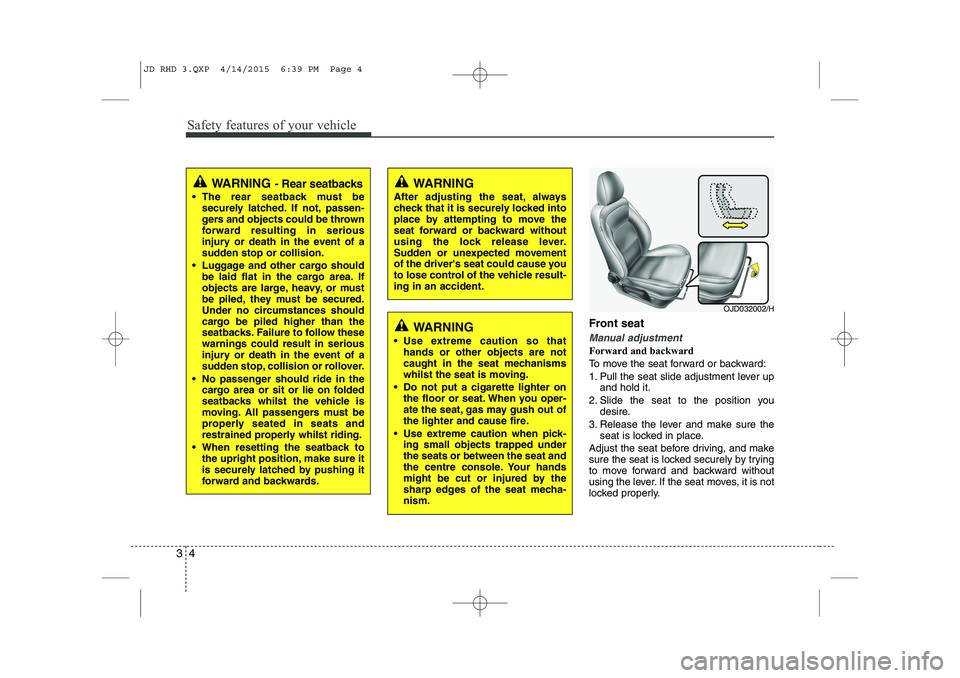
Forward and backward
To move the seat forward or backward:
1. Pull the seat slide adjustment lever up
and hold it.
2. Slide the seat to the position you desire.
3. Release the lever and make sure the seat is locked in place.
Adjust the seat before driving, and make
sure the seat is locked securely by trying
to move forward and backward without
using the lever. If the seat moves, it is not
locked properly.
WARNING - Rear seatbacks
The rear seatback must be securely latched. If not, passen-
gers and objects could be thrown
forward resulting in serious
injury or death in the event of a
sudden stop or collision.
Luggage and other cargo should be laid flat in the cargo area. If
objects are large, heavy, or must
be piled, they must be secured.
Under no circumstances should
cargo be piled higher than the
seatbacks. Failure to follow thesewarnings could result in serious
injury or death in the event of a
sudden stop, collision or rollover.
No passenger should ride in the cargo area or sit or lie on folded
seatbacks whilst the vehicle is
moving. All passengers must be
properly seated in seats and
restrained properly whilst riding.
When resetting the seatback to the upright position, make sure it
is securely latched by pushing it
forward and backwards.WARNING
After adjusting the seat, always
check that it is securely locked into
place by attempting to move the
seat forward or backward without
using the lock release lever.
Sudden or unexpected movement
of the driver's seat could cause you
to lose control of the vehicle result-ing in an accident.
WARNING
Use extreme caution so that hands or other objects are not
caught in the seat mechanisms
whilst the seat is moving.
Do not put a cigarette lighter on the floor or seat. When you oper-
ate the seat, gas may gush out of
the lighter and cause fire.
Use extreme caution when pick- ing small objects trapped underthe seats or between the seat and
the centre console. Your hands
might be cut or injured by the
sharp edges of the seat mecha-nism.
OJD032002/H
JD RHD 3.QXP 4/14/2015 6:39 PM Page 4
Page 686 of 1210

Features of your vehicle
Keys . . . . . . . . . . . . . . . . . . . . . . . . . . . . . . . . . . . . . 4-4• Record your key number . . . . . . . . . . . . . . . . . . . . . 4-4
• Key operations . . . . . . . . . . . . . . . . . . . . . . . . . . . . . . 4-4
• Immobiliser system . . . . . . . . . . . . . . . . . . . . . . . . . . 4-4
Remote keyless entry . . . . . . . . . . . . . . . . . . . . . . . 4-6 • Remote keyless entry system operations . . . . . . . . . 4-6
• Transmitter precautions . . . . . . . . . . . . . . . . . . . . . . 4-8
• Battery replacement . . . . . . . . . . . . . . . . . . . . . . . . . 4-9
Smart key . . . . . . . . . . . . . . . . . . . . . . . . . . . . . . . . 4-11 • Smart key function . . . . . . . . . . . . . . . . . . . . . . . . . . 4-11
• Smart key precautions. . . . . . . . . . . . . . . . . . . . . . . . 4-13
• Door lock/unlock in an emergency situation . . . . . . 4-13
Theft-alarm system . . . . . . . . . . . . . . . . . . . . . . . . 4-14 • Armed stage . . . . . . . . . . . . . . . . . . . . . . . . . . . . . . . . 4-14
• Theft-alarm stage . . . . . . . . . . . . . . . . . . . . . . . . . . . . 4-15
• Disarmed stage . . . . . . . . . . . . . . . . . . . . . . . . . . . . . . 4-16
Door locks . . . . . . . . . . . . . . . . . . . . . . . . . . . . . . . . 4-17 • From outside. . . . . . . . . . . . . . . . . . . . . . . . . . . . . . . . 4-17
• From inside . . . . . . . . . . . . . . . . . . . . . . . . . . . . . . . . . 4-18
• Deadlocks . . . . . . . . . . . . . . . . . . . . . . . . . . . . . . . . . . 4-20
• Door lock/unlock features . . . . . . . . . . . . . . . . . . . . . 4-20
• Child-protector rear door lock . . . . . . . . . . . . . . . . . 4-21
Tailgate . . . . . . . . . . . . . . . . . . . . . . . . . . . . . . . . . . 4-22 • Opening the tailgate. . . . . . . . . . . . . . . . . . . . . . . . . . 4-22
• Closing the tailgate . . . . . . . . . . . . . . . . . . . . . . . . . . 4-22
• Emergency tailgate safety release . . . . . . . . . . . . . . 4-23
Windows . . . . . . . . . . . . . . . . . . . . . . . . . . . . . . . . . 4-24 • Power windows. . . . . . . . . . . . . . . . . . . . . . . . . . . . . . 4-25
• Manual windows . . . . . . . . . . . . . . . . . . . . . . . . . . . . 4-27 Bonnet . . . . . . . . . . . . . . . . . . . . . . . . . . . . . . . . . . . 4-28
• Opening the bonnet . . . . . . . . . . . . . . . . . . . . . . . . . . 4-28
• Closing the bonnet . . . . . . . . . . . . . . . . . . . . . . . . . . . 4-29
Fuel filler lid . . . . . . . . . . . . . . . . . . . . . . . . . . . . . . 4-30 • Opening the fuel filler lid . . . . . . . . . . . . . . . . . . . . . 4-30
• Closing the fuel filler lid . . . . . . . . . . . . . . . . . . . . . . 4-30
Panorama sunroof . . . . . . . . . . . . . . . . . . . . . . . . . 4-33 • Sunroof open warning . . . . . . . . . . . . . . . . . . . . . . . . 4-33
• Sunshade . . . . . . . . . . . . . . . . . . . . . . . . . . . . . . . . . . . 4-34
• Sliding the sunroof . . . . . . . . . . . . . . . . . . . . . . . . . . . 4-34
• Tilting the sunroof . . . . . . . . . . . . . . . . . . . . . . . . . . . 4-34
• Closing the sunroof . . . . . . . . . . . . . . . . . . . . . . . . . . 4-35
• Resetting the sunroof . . . . . . . . . . . . . . . . . . . . . . . . . 4-36
Steering wheel . . . . . . . . . . . . . . . . . . . . . . . . . . . . 4-37 • Electronic power steering . . . . . . . . . . . . . . . . . . . . . 4-37
• Tilt & telescopic steering . . . . . . . . . . . . . . . . . . . . . . 4-38
• Heated steering wheel . . . . . . . . . . . . . . . . . . . . . . . . 4-38
• Horn . . . . . . . . . . . . . . . . . . . . . . . . . . . . . . . . . . . . . . 4-39
• Flex steering wheel. . . . . . . . . . . . . . . . . . . . . . . . . . . 4-40
Mirrors . . . . . . . . . . . . . . . . . . . . . . . . . . . . . . . . . . 4-42 • Inside rearview mirror . . . . . . . . . . . . . . . . . . . . . . . 4-42
• Outside rearview mirror . . . . . . . . . . . . . . . . . . . . . . 4-43
Instrument cluster (Normal vision) . . . . . . . . . . . 4-46 • Instrument panel illumination . . . . . . . . . . . . . . . . . 4-47
• Gauges . . . . . . . . . . . . . . . . . . . . . . . . . . . . . . . . . . . . . 4-47
• Manual transaxle shift indicator . . . . . . . . . . . . . . . 4-49
• Automatic transaxle shift position indicator . . . . . . 4-49
• Double clutch transmission shift indicator . . . . . . . 4-50
• Speed limiter indicator . . . . . . . . . . . . . . . . . . . . . . . 4-51
4
JD RHD 4a(~171).QXP 4/14/2015 6:55 PM Page 1
Page 710 of 1210

425
Features of your vehicle
Power windows
The ignition switch must be in the ON
position for power windows to operate.
Each door has a power window switch
that controls the door’s window. The dri-
ver’s door has a master power window
switch that controls all the windows in the
vehicle. Also, the driver has a power win-
dow lock switch which can block the
operation of rear passenger windows.
The power windows can be operated for
approximately 30 seconds after the igni-
tion key is removed or turned to the ACC
or LOCK position. However, if the front
doors are opened, the power windows
cannot be operated even within the 30
seconds period.
✽NOTICE
Whilst driving with the rear windows
down or with the sunroof (if equipped)
in an open (or partially open position),
your vehicle may demonstrate a
wind buffeting or pulsation noise. This
noise is a normal occurrence and can be
reduced or eliminated by taking the fol-
lowing actions. If the noise occurs with
one or both of the rear windows down,
partially lower both front windows
approximately one inch. If you experi-
ence the noise with the sunroof open,
slightly reduce the size of the sunroof
opening.
Window opening and closing
Ty p e A
To open or close a window, press down
or pull up the front portion of the corre-
sponding switch to the first detent posi-tion (5). Type B - Auto up/down window
(if equipped)
Pressing or pulling up the power window
switch momentarily to the second detent
position (6) completely lowers or lifts the
window even when the switch is released.
To stop the window at the desired position
whilst the window is in operation, pull up
or press down and release the switch.
✽NOTICE
If the power window does not operate
normally, the automatic power window
system must be reset as follows:
1. Turn the ignition switch to the ON position.
2. Close the window and continue
pulling up the power window switch
for at least 1 second after the window
is completely closed.
OJD042020ROJD042019R
JD RHD 4a(~171).QXP 4/14/2015 6:56 PM Page 25