2015 KIA CEED bulb
[x] Cancel search: bulbPage 599 of 1210

Index
8
I
Key positions . . . . . . . . . . . . . . . . . . . . . . . . . . . . . . . . . 5-5
Keys . . . . . . . . . . . . . . . . . . . . . . . . . . . . . . . . . . . . . . . . 4-4
Label
Air bag warning label . . . . . . . . . . . . . . . . . . . . . . . 3-65
Air conditioner compressor label . . . . . . . . . . . . . . 8-12
Refrigerant label . . . . . . . . . . . . . . . . . . . . . . . . . . . . 8-13
Tire sidewall labeling . . . . . . . . . . . . . . . . . . . . . . . . 7-61
Tire specification and pressure label . . . . . . . . . . . 8-12
Vehicle certification label . . . . . . . . . . . . . . . . . . . . . 8-11
Lane Departure Warning System . . . . . . . . . . . . . . . 5-59
Lane Departure Warning System Mode. . . . . . . . . . 4-69
Lap/shoulder belt . . . . . . . . . . . . . . . . . . . . . . . . . . . . 3-23
LCD display information . . . . . . . . . . . . . . . . . . . . . . 4-73
LCD display warnings and indicators (instrument panel display) . . . . . . . . . . . . . . . . . . . . 4-90
Calender . . . . . . . . . . . . . . . . . . . . . . . . . . . . . . . . . . 4-90
Clock . . . . . . . . . . . . . . . . . . . . . . . . . . . . . . . . . . . . . 4-90
Icy road warning . . . . . . . . . . . . . . . . . . . . . . . . . . . 4-91
Outside ambient Temperature . . . . . . . . . . . . . . . . 4-90
LDWS (Lane Departure Warning System) . . . . . . . 5-59
Light bulbs. . . . . . . . . . . . . . . . . . . . . . . . . . . . . . . . . . 7-89 Lighting . . . . . . . . . . . . . . . . . . . . . . . . . . . . . . . . . . . 4-111
AFLS (Adaptive Front Lighting System) . . . . . . . 4-118
Auto light/AFLS position . . . . . . . . . . . . . . . . . . . . 4-113
Battery saver function . . . . . . . . . . . . . . . . . . . . . . 4-111
Daytime running light (DRL) . . . . . . . . . . . . . . . . 4-116
Front fog light . . . . . . . . . . . . . . . . . . . . . . . . . . . . . 4-116
Headlamp delay function . . . . . . . . . . . . . . . . . . . . 4-111
Headlight (Headlamp) welcome function . . . . . . . 4-111
Headlight leveling device . . . . . . . . . . . . . . . . . . . . 4-117
Headlight position . . . . . . . . . . . . . . . . . . . . . . . . . . 4-113
High - beam operation . . . . . . . . . . . . . . . . . . . . . . 4-114
Position light position . . . . . . . . . . . . . . . . . . . . . . . 4-112
Rear fog light. . . . . . . . . . . . . . . . . . . . . . . . . . . . . . 4-116
Static bending light . . . . . . . . . . . . . . . . . . . . . . . . . 4-112
Turn signals . . . . . . . . . . . . . . . . . . . . . . . . . . . . . . . 4-115
Lubricants and capacities . . . . . . . . . . . . . . . . . . . . . . 8-8
Luggage net (holder) . . . . . . . . . . . . . . . . . . . . . . . . 4-162
Luggage rail system . . . . . . . . . . . . . . . . . . . . . . . . . 4-167
Luggage room lamp . . . . . . . . . . . . . . . . . . . . . . . . . 4-125
Luggage side tray . . . . . . . . . . . . . . . . . . . . . . . . . . . 4-155
Luggage tray . . . . . . . . . . . . . . . . . . . . . . . . . . . . . . . 4-154
Lumbar support (Automatic Seat) . . . . . . . . . . . . . . . 3-7
Lumbar support (Manual seat) . . . . . . . . . . . . . . . . . . 3-5
L
K
JD eng Index.QXP 3/12/2015 3:06 PM Page 8
Page 601 of 1210

Index
10
I
Paddle shifter . . . . . . . . . . . . . . . . . . . . . . . . . . . . . . . 5-28
Panorama sunroof . . . . . . . . . . . . . . . . . . . . . . . . . . . 4-33
Parking assist system . . . . . . . . . . . . . . . . . . . . . . . . . 4-96
Parking brake-Hand type . . . . . . . . . . . . . . . . . . . . . 7-43
Passenger’s front air bag ON/OFF indicator . . . . . . 3-46
Passenger’s front air bag ON/OFF switch . . . . . . . . 3-52
Position light position . . . . . . . . . . . . . . . . . . . . . . . . 4-112
Power brakes . . . . . . . . . . . . . . . . . . . . . . . . . . . . . . . . 5-33
Power outlet . . . . . . . . . . . . . . . . . . . . . . . . . . . . . . . . 4-159
Power window lock button. . . . . . . . . . . . . . . . . . . . . 4-26
Pre-tensioner seat belt . . . . . . . . . . . . . . . . . . . . . . . . 3-25
Push starting . . . . . . . . . . . . . . . . . . . . . . . . . . . . . . . . . 6-7
Rear combination light bulb replacement . . . . . . . 7-103
Rear parking assist system. . . . . . . . . . . . . . . . . . . . . 4-92
Rear seat . . . . . . . . . . . . . . . . . . . . . . . . . . . . . . . . . . . 3-14
Rear view camera . . . . . . . . . . . . . . . . . . . . . . . . . . . 4-110
Rear window wiper . . . . . . . . . . . . . . . . . . . . . . . . . . 4-122
Recommended cold tire inflation pressures . . . . . . . 7-55
Recommended lubricants and capacities . . . . . . . . . . 8-8
Recommended SAE viscosity number . . . . . . . . . . 8-10
Recommends Engine oil . . . . . . . . . . . . . . . . . . . . . . . 8-9 Refrigerant label . . . . . . . . . . . . . . . . . . . . . . . . . . . . . 8-13
Remote keyless entry
Battery replacement . . . . . . . . . . . . . . . . . . . . . . . . . . 4-9
Remote keyless entry . . . . . . . . . . . . . . . . . . . . . . . . . . 4-6
Replacement light bulb . . . . . . . . . . . . . . . . . . . . . . . 7-89
Road warning . . . . . . . . . . . . . . . . . . . . . . . . . . . . . . . . 6-2
Rocking the vehicle . . . . . . . . . . . . . . . . . . . . . . . . . . . 5-64
Roof antenna . . . . . . . . . . . . . . . . . . . . . . . . . . . . . . . 4-172
Room lamp . . . . . . . . . . . . . . . . . . . . . . . . . . . . . . . . 4-124
Roof rack . . . . . . . . . . . . . . . . . . . . . . . . . . . . . . . . . . 4-170
Scheduled maintenance service . . . . . . . . . . . . . . . . . 7-10
Maintenance under severe usage conditions (except Europe, for Russia) . . . . . . . . . . . . . . . . . . 7-32
Maintenance under severe usage conditions (for Europe, except Russia) . . . . . . . . . . . . . . . . . . 7-20
Normal maintenance schedule (except Europe, for Russia) . . . . . . . . . . . . . . . . . . 7-22
Normal maintenance schedule (for Europe, except Russia) . . . . . . . . . . . . . . . . . . 7-11
Seat belts . . . . . . . . . . . . . . . . . . . . . . . . . . . . . . . . . . . 3-20
Hight adjustment . . . . . . . . . . . . . . . . . . . . . . . . . . . 3-23
Lap/shoulder belt . . . . . . . . . . . . . . . . . . . . . . . . . . . 3-23
Pre-tensioner seat belt . . . . . . . . . . . . . . . . . . . . . . . 3-25
Seat belt warning . . . . . . . . . . . . . . . . . . . . . . . . . . . 3-21
Seat warmer(front) . . . . . . . . . . . . . . . . . . . . . . . . . . . 3-12
R
S
P
JD eng Index.QXP 3/12/2015 3:06 PM Page 10
Page 768 of 1210

483
Features of your vehicle
Your vehicle is equipped with dual-diago-
nal braking systems. This means you still
have braking on two wheels even if one
of the dual systems should fail. With only
one of the dual systems working, more
than normal pedal travel and greaterpedal pressure are required to stop the
car. Also, the car will not stop in as short
a distance with only a portion of the
brake system working. If the brakes fail
whilst you are driving, shift to a lower
gear for additional engine braking and
stop the car as soon as it is safe to do so.
To check bulb operation, check whether
the parking brake and brake fluid warning
light illuminates when the ignition switchis in the ON position.Electric Parking Brake(EPB) malfunction indicator (if equipped)
The EPB malfunction indicator will illumi-
nate when the ignition switch is turned
ON, but should go off after approximate-
ly 3 seconds. If the warning light does not
come on, or continuously remains on we
recommend that the system be checked
by an authorised Kia dealer.
Also, the EPB malfunction indicator may illuminate when the ESC indicator comes
on to indicate that the ESC is not working
properly, but if this occurs, it does notindicate the EPB has malfunctioned.
For more details, refer to "EPB" in sec- tion 5.
Anti-lock brake system
(ABS) warning light
This light illuminates if the ignition switch
is turned ON and goes off in approxi-
mately 3 seconds if the system is operat-
ing normally.
If the ABS warning light remains on,
comes on whilst driving, or does not
come on when the ignition switch is
turned to the ON position, this indicates
that there may be a problem with the
ABS.
If this occurs, we recommend that the
system be checked by an authorised Kia
dealer. The normal braking system will
still be operational, but without the assis-
tance of the anti-lock brake system.
WARNING
Driving the vehicle with a warning light on is dangerous. If the brakewarning light remains on, we recom-mend that the system be checked by an authorised Kia dealer.
EPB
JD RHD 4a(~171).QXP 4/14/2015 7:00 PM Page 83
Page 800 of 1210

4 115
Features of your vehicle
Turn signals and lane change sig- nals
The ignition switch must be on for the
turn signals to function. To turn on the
turn signals, move the lever up or down
(A). Green arrow indicators on the instru-
ment panel indicate which turn signal is
operating.
They will self-cancel after a turn is com-
pleted. If the indicator continues to flash
after a turn, manually return the lever to the OFF position.
To signal a lane change, move the turn
signal lever slightly and hold it in position
(B). The lever will return to the OFF posi-tion when released.If an indicator stays on and does not
flash or if it flashes abnormally, one of the
turn signal bulbs may be burned out andwill require replacement.
One-touch lane change function
(if equipped)
To activate an one-touch lane change
function, move the turn signal lever
slightly and then release it. The lane
change signals will blink 3 times.
You can inactivate one-touch lane
change function in “Auto triple turn” of
“User setting”. Refer to “User setting” inchapter 4.
✽NOTICE
If an indicator flash is abnormally quick
or slow, bulb may be burned out or have
a poor electrical connection in the cir-
cuit.OED040804
JD RHD 4a(~171).QXP 4/14/2015 7:02 PM Page 115
Page 1024 of 1210
Driving your vehicle
74
5
Turn signals when towing a trailer
When you tow a trailer, your vehicle has
to have a different turn signal flasher and
extra wiring. The green arrows on your
instrument panel will flash whenever you
signal a turn or lane change. Properly
connected, the trailer lights will also flash
to alert other drivers you’re about to turn,
change lanes, or stop.
When towing a trailer, the green arrows
on your instrument panel will flash for
turns even if the bulbs on the trailer are
burned out. Thus, you may think drivers
behind you are seeing your signals
when, in fact, they are not. It is important
to check occasionally to be sure the trail-
er bulbs are still working. You must also
check the lights every time you discon-
nect and then reconnect the wires.
Do not connect a trailer lighting system
directly to your vehicle’s lighting system.
Use only an approved trailer wiring har-
ness.
An authorised Kia dealer can assist you
in installing the wiring harness.
Driving on grades
Reduce speed and shift to a lower gear
before you start down a long or steep
downgrade. If you don’t shift down, you
might have to use your brakes so much
that they would get hot and no longer
operate efficiently.
On a long uphill grade, shift down and
reduce your speed to around 70 km/h (45mph) to reduce the possibility of engine
and transaxle overheating.
If your trailer weighs more than the max-
imum trailer weight without trailer brakes
and you have an automatic transaxle,
you should drive in D (Drive) when tow-
ing a trailer.
Operating your vehicle in D (Drive) when
towing a trailer will minimise heat build up
and extend the life of your transaxle.
WARNING
Failure to use an approved trailer wiring harness could result in dam-
age to the vehicle electrical system
and/or personal injury.
CAUTION
When towing a trailer on steep grades (in excess of 6%) pay close
attention to the engine coolant temperature gauge to ensure theengine does not overheat.
If the coolant temperature redwarning light illuminates or the coolant temperature gauge movestowards “130”, pull over and stop as soon as it is safe to do so, and
allow the engine to idle until it cools down. You may proceed oncethe engine has cooled sufficiently.
You must decide driving speed depending on trailer weight anduphill grade to reduce the possi- bility of engine and transaxleoverheating.
JD RHD 5.QXP 2/17/2015 10:35 AM Page 74
Page 1065 of 1210
Fuses . . . . . . . . . . . . . . . . . . . . . . . . . . . . . . . . . . . . . 7-68 Fuse/relay panel description . . . . . . . . . . . . . . . . . . . . 7-73
Light bulbs . . . . . . . . . . . . . . . . . . . . . . . . . . . . . . . . 7-91 Front light replacement . . . . . . . . . . . . . . . . . . . . . . . . 7-92
Headlight and front fog light aiming (for Europe) . . 7-97
Side repeater light bulb replacement . . . . . . . . . . . . . 7-105
Rear combination light bulb replacement . . . . . . . . . 7-105
High mounted stop light bulb replacement . . . . . . . . 7-110
License plate light bulb replacement . . . . . . . . . . . . . 7-110
Interior light bulb replacement. . . . . . . . . . . . . . . . . . 7-111
Appearance care. . . . . . . . . . . . . . . . . . . . . . . . . . . . 7-112 Exterior care . . . . . . . . . . . . . . . . . . . . . . . . . . . . . . . . . 7-112
Interior care . . . . . . . . . . . . . . . . . . . . . . . . . . . . . . . . . 7-117
Emission control system . . . . . . . . . . . . . . . . . . . . . 7-118
7
JD RHD 7.QXP 4/14/2015 6:29 PM Page 2
Page 1070 of 1210
77
Maintenance
Engine compartment precautions (Diesel engine)
• The injector operates at high voltage(maximum 200v). Therefore, the follow-
ing accidents may occur.
- Direct contact with the injector or
injector wiring may cause electric
shock or damage your muscle or
nerve system.
- The electromagnetic wave from the operating injector may cause the arti-
ficial heart pacemaker to malfunction.
Follow the safety tips provided below, when you are checking the engine
room whilst the engine is running.
- Do not touch the injector, injector
wirings, and the engine computer
whilst the engine is running.
- Do not remove the injector connector whilst the engine is running.
- People using pacemakers must not go near the engine whilst the engine
is starting or running.
WARNING - Maintenance
work
Performing maintenance work on a vehicle can be dangerous. You
can be seriously injured whilst
performing some maintenance
procedures. If you lack sufficient
knowledge and experience or the
proper tools and equipment to do
the work, we recommend that the
system be serviced by an autho-
rised Kia dealer.
Working under the bonnet with the engine running is dangerous.
It becomes even more dangerous
when you wear jewelry or loose
clothing. These can become
entangled in moving parts and
result in injury. Therefore, if you
must run the engine whilst work-
ing under the bonnet, make cer-
tain that you remove all jewelry
(especially rings, bracelets,
watches, and necklaces) and all
neckties, scarves, and similar
loose clothing before gettingnear the engine or cooling fans.CAUTION
Do not put heavy objects or apply
excessive force on top of the
engine cover (if equipped) or fuel related parts.
When you inspect the fuel system (fuel lines and fuel injection
devices), we recommend that you contact an authorised Kia dealer.
Do not drive long time with the engine cover (if equipped)removed.
When checking the engine room, do not go near fire.
Fuel, washer fluid, etc. are flam-mable oils that may cause fire.
Before touching the battery, igni- tion cables and electrical wiring,
you should disconnect the battery"-" terminal. You may get an elec-tric shock from the electric current.
When you remove the interior trim cover with a flat bed (-) driver, be
careful not to damage the cover.
Be careful when you replace and clean bulbs to avoid burns orelectrical shock.
JD RHD 7.QXP 4/14/2015 6:29 PM Page 7
Page 1132 of 1210
769
Maintenance
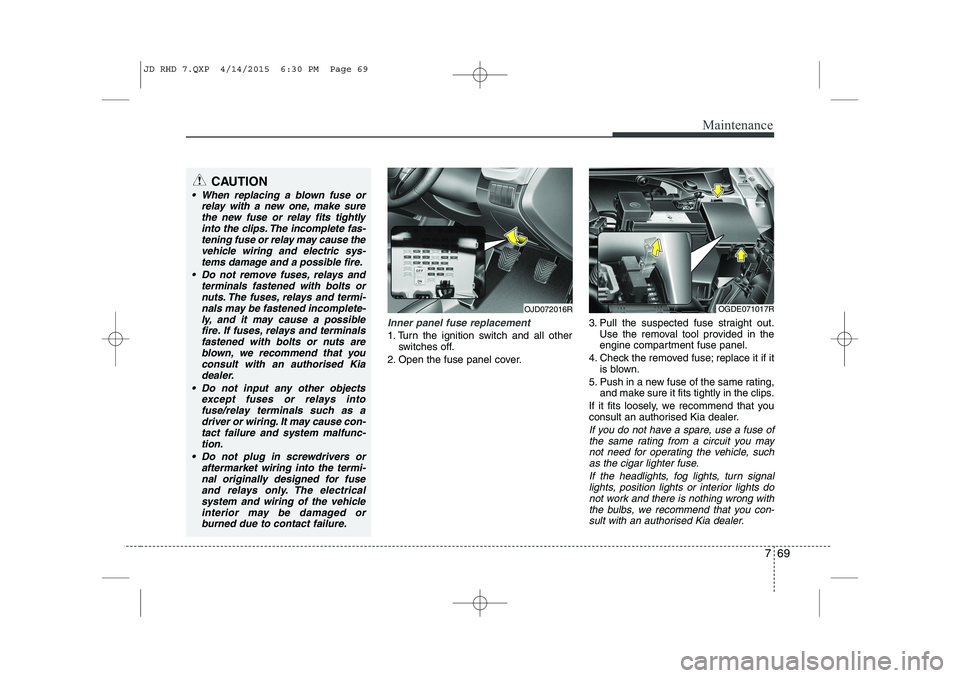
Inner panel fuse replacement
1. Turn the ignition switch and all otherswitches off.
2. Open the fuse panel cover. 3. Pull the suspected fuse straight out.
Use the removal tool provided in the
engine compartment fuse panel.
4. Check the removed fuse; replace it if it is blown.
5. Push in a new fuse of the same rating, and make sure it fits tightly in the clips.
If it fits loosely, we recommend that you
consult an authorised Kia dealer.
If you do not have a spare, use a fuse of the same rating from a circuit you may
not need for operating the vehicle, suchas the cigar lighter fuse.
If the headlights, fog lights, turn signallights, position lights or interior lights do not work and there is nothing wrong with
the bulbs, we recommend that you con- sult with an authorised Kia dealer.
OJD072016ROGDE071017R
CAUTION
When replacing a blown fuse or relay with a new one, make sure
the new fuse or relay fits tightly into the clips. The incomplete fas-tening fuse or relay may cause the vehicle wiring and electric sys-
tems damage and a possible fire.
Do not remove fuses, relays and terminals fastened with bolts ornuts. The fuses, relays and termi-
nals may be fastened incomplete-ly, and it may cause a possiblefire. If fuses, relays and terminalsfastened with bolts or nuts are
blown, we recommend that youconsult with an authorised Kiadealer.
Do not input any other objects except fuses or relays intofuse/relay terminals such as adriver or wiring. It may cause con-tact failure and system malfunc-
tion.
Do not plug in screwdrivers or aftermarket wiring into the termi-nal originally designed for fuse and relays only. The electrical
system and wiring of the vehicle interior may be damaged orburned due to contact failure.
JD RHD 7.QXP 4/14/2015 6:30 PM Page 69