2015 KIA CEED tire pressure
[x] Cancel search: tire pressurePage 452 of 1210

What to do in an emergency
26
6
Tire Pressure Monitoring System (TPMS) malfunc-tion indicator
The TPMS malfunction indicator will
illuminate after it blinks for approxi-
mately one minute when there is a
problem with the Tire Pressure
Monitoring System. If the system is
able to correctly detect an under infla-
tion warning at the same time as sys-
tem failure then the TPMS malfunc-tion indicator remains illuminated after
blinking for approximately 1 minute.
We recommend that the system be
checked by an authorized Kia dealer to
determine the cause of the problem.
WARNING - Low pressure
damage
Significantly low tire pressure
makes the vehicle unstable and
can contribute to loss of vehicle
control and increased brakingdistances.
Continued driving on low pres- sure tires can cause the tires to
overheat and fail.CAUTION
In winter or cold weather, the low tire pressure telltale mayilluminate if the tire pressure was adjusted to the recom-mended tire inflation pressurein warm weather. It does not mean your TPMS is malfunction-ing because the decreased tem-perature leads to a proportional lowering of tire pressure.
When you drive your vehiclefrom a warm area to a cold areaor from a cold area to a warmarea, or the outside temperature is greatly higher or lower, youshould check the tire inflationpressure and adjust the tires to the recommended tire inflationpressure.
JD eng 6.QXP 3/12/2015 3:05 PM Page 26
Page 453 of 1210

627
What to do in an emergency
Changing a tire with TPMS
If you have a flat tire, the low Tire
Pressure and Position telltales will
come on. We recommend that the
system be checked by an authorized
Kia dealer. Each wheel is equipped with a tire pressure sensor mounted inside the
tire behind the valve stem. You must
use TPMS specific wheels. It is rec-
ommended that you have your tires
serviced by an authorized Kia dealer.If you drive the vehicle for about 10
minutes at speeds above 25 km/h
after replaceing the low pressure tire
with the spare tire, the below willhappen:
The TPMS malfunction indicator
may blink for approximately 1
minute and then remain continuous-
ly illuminated because the TPMSsensor is not mounted on the
sparewheel.CAUTION
The TPMS malfunction indica-
tor may blink for approximate-ly 1 minute and then remaincontinuously illuminated if thevehicle is moving around elec- tric power supply cables orradios transmitter such as atpolice stations, government and public offices, broadcast-ing stations, military installa-tions, airports, or transmitting towers, etc. This can interferewith normal operation of theTire Pressure Monitoring System (TPMS).
The TPMS malfunction indica- tor may blink for approximate-ly 1 minute and then remaincontinuously illuminated if snow chains are used or someseparate electronic devicessuch as notebook computer, mobile charger, remote starteror navigation etc., are used inthe vehicle. This can interfere with normal operation of theTire Pressure MonitoringSystem (TPMS).
CAUTION
We recommend that you use thesealant approved by Kia.
The sealant on the tire pressuresensor and wheel shall be elem-inated when you replace the tire with a new one.
JD eng 6.QXP 3/12/2015 3:05 PM Page 27
Page 454 of 1210

What to do in an emergency
28
6
You may not be able to identify a low
tire by simply looking at it. Alwaysuse a good quality tire pressuregauge to measure the tire's inflation
pressure. Please note that a tire that
is hot (from being driven) will have ahigher pressure measurement than atire that is cold (from sitting station-
ary for at least 3 hours and driven
less than 1.6 km (1 mile) during that
3 hour period).
Allow the tire to cool before measur-
ing the inflation pressure. Always be
sure the tire is cold before inflating to
the recommended pressure.
A cold tire means the vehicle has
been sitting for 3 hours and driven forless than 1.6 km (1 mile) in that 3
hour period.
WARNING - Protecting
TPMS
Tampering with, modifying, or
disabling the Tire PressureMonitoring System (TPMS) com-
ponents may interfere with thesystem's ability to warn the driv-
er of low tire pressure condi-
tions and/or TPMS malfunctions.
Tampering with, modifying, or
disabling the Tire PressureMonitoring System (TPMS) com-
ponents may void the warranty
for that portion of the vehicle.
WARNING - TPMS
The TPMS cannot alert you to severe and sudden tire dam-
age caused by external factors
such as nails or road debris.
If you feel any vehicle instabil- ity, immediately take your foot
off the accelerator, apply the
brakes gradually and with
light force, and slowly move to
a safe position off the road.
CAUTION
We recommend that you use the
sealant approved by Kia if yourvehicle is equipped with a Tire Pressure Monitoring System.The liquid sealant can damagethe tire pressure sensors.
WARNING - For EUROPE
Do not modify the vehicle, it may interfere with the TPMS function.
The wheels on the market do not have a TPMS sensor.
For your safety, we recom-
mend that you use parts for
replacement from an author-
ized Kia dealer.
If you use the wheels on the market, use a TPMS sensor
approved by a Kia dealer. If
your vehicle is not equipped
with a TPMS sensor or TPMS
does not work properly, you
may fail the periodic vehicle
inspection conducted in your
country.
❈
❈ All vehicles sold in the
EUROPE market during
below period must be
equipped with TPMS.
- New model vehicle : Nov. 1, 2012 ~
- Current model vehicle : Nov. 1, 2014~ (Based on vehi-
cle registrations)
JD eng 6.QXP 3/12/2015 3:05 PM Page 28
Page 459 of 1210

633
What to do in an emergency
EMERGENCY COMMODITY (IF EQUIPPED)
There are some emergency commodities
in the vehicle to help you respond to theemergency situation.
Fire extinguisher
If there is small fire and you know how to
use the fire extinguisher, take the follow-
ing steps carefully.
1. Pull the pin at the top of the extin- guisher that keeps the handle from being accidentally pressed.
2. Aim the nozzle toward the base of the fire.
3. Stand approximately 2.5 m (8 ft) away from the fire and squeeze the handle
to discharge the extinguisher. If you
release the handle, the discharge will
stop.
4. Sweep the nozzle back and forth at the base of the fire. After the fire appears
to be out, watch it carefully since it
may re-ignite. First aid kit
There are some items such as scissors,
bandage and adhesive tape and etc. in
the kit to give first aid to an injured per-son.
Triangle reflector
Place the triangle reflector on the road to
warn oncoming vehicles during emer-
gencies, such as when the vehicle is
parked by the roadside due to any prob-
lems.
Tire pressure gauge (If equipped)
Tires normally lose some air in day-to-
day use, and you may have to add a few
pounds of air periodically and it is not
usually a sign of a leaking tire, but of nor-
mal wear. Always check tire pressurewhen the tires are cold because tire pres-
sure increases with temperature. To check the tire pressure, take the fol-
lowing steps:
1. Unscrew the inflation valve cap that is
located on the rim of the tire.
2. Press and hold the gauge against the tire valve. Some air will escape as you
begin and more will escape if you don't
press the gauge in firmly.
3. A firm non-leaking push will activate the gauge.
4. Read the tire pressure on the gauge to know whether the tire pressure is lowor high.
5. Adjust the tire pressures to the speci- fied pressure. Refer to “Tires and
wheels” in chapter 8.
6. Reinstall the inflation valve cap.
JD eng 6.QXP 3/12/2015 3:06 PM Page 33
Page 460 of 1210
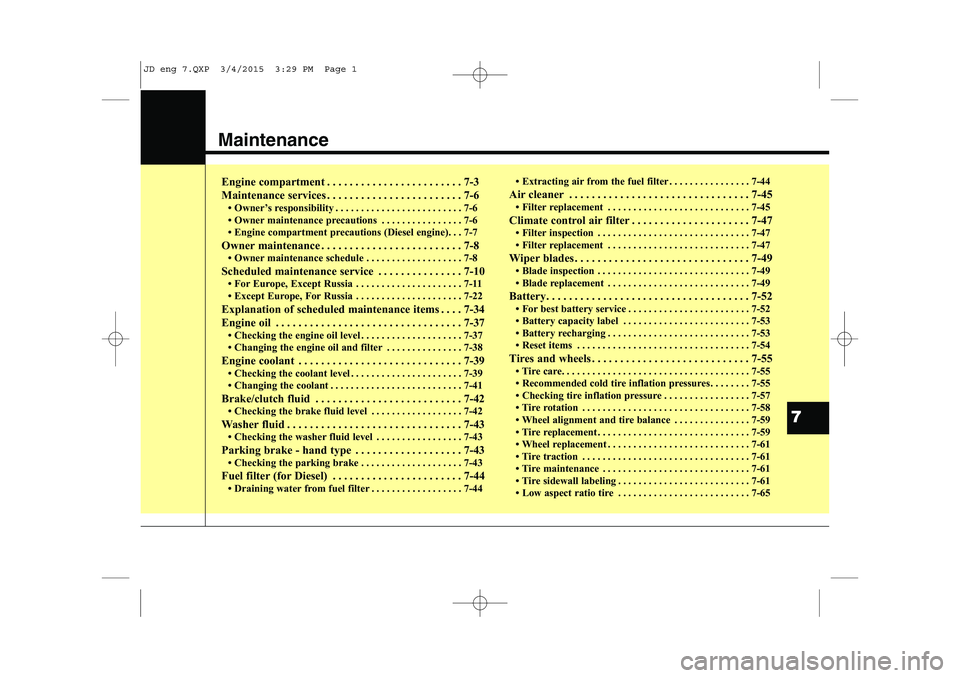
Maintenance
Engine compartment . . . . . . . . . . . . . . . . . . . . . . . . 7-3
Maintenance services . . . . . . . . . . . . . . . . . . . . . . . . 7-6 Owner’s responsibility . . . . . . . . . . . . . . . . . . . . . . . . . 7-6
Owner maintenance precautions . . . . . . . . . . . . . . . . 7-6
Engine compartment precautions (Diesel engine). . . 7-7
Owner maintenance . . . . . . . . . . . . . . . . . . . . . . . . . 7-8 Owner maintenance schedule . . . . . . . . . . . . . . . . . . . 7-8
Scheduled maintenance service . . . . . . . . . . . . . . . 7-10 For Europe, Except Russia . . . . . . . . . . . . . . . . . . . . . 7-11
Except Europe, For Russia . . . . . . . . . . . . . . . . . . . . . 7-22
Explanation of scheduled maintenance items . . . . 7-34
Engine oil . . . . . . . . . . . . . . . . . . . . . . . . . . . . . . . . . 7-37 Checking the engine oil level . . . . . . . . . . . . . . . . . . . . 7-37
Changing the engine oil and filter . . . . . . . . . . . . . . . 7-38
Engine coolant . . . . . . . . . . . . . . . . . . . . . . . . . . . . . 7-39 Checking the coolant level . . . . . . . . . . . . . . . . . . . . . . 7-39
Changing the coolant . . . . . . . . . . . . . . . . . . . . . . . . . . 7-41
Brake/clutch fluid . . . . . . . . . . . . . . . . . . . . . . . . . . 7-42 Checking the brake fluid level . . . . . . . . . . . . . . . . . . 7-42
Washer fluid . . . . . . . . . . . . . . . . . . . . . . . . . . . . . . . 7-43 Checking the washer fluid level . . . . . . . . . . . . . . . . . 7-43
Parking brake - hand type . . . . . . . . . . . . . . . . . . . 7-43 Checking the parking brake . . . . . . . . . . . . . . . . . . . . 7-43
Fuel filter (for Diesel) . . . . . . . . . . . . . . . . . . . . . . . 7-44 Draining water from fuel filter . . . . . . . . . . . . . . . . . . 7-44 Extracting air from the fuel filter . . . . . . . . . . . . . . . . 7-44
Air cleaner . . . . . . . . . . . . . . . . . . . . . . . . . . . . . . . . 7-45 Filter replacement . . . . . . . . . . . . . . . . . . . . . . . . . . . . 7-45
Climate control air filter . . . . . . . . . . . . . . . . . . . . . 7-47 Filter inspection . . . . . . . . . . . . . . . . . . . . . . . . . . . . . . 7-47
Filter replacement . . . . . . . . . . . . . . . . . . . . . . . . . . . . 7-47
Wiper blades . . . . . . . . . . . . . . . . . . . . . . . . . . . . . . . 7-49 Blade inspection . . . . . . . . . . . . . . . . . . . . . . . . . . . . . . 7-49
Blade replacement . . . . . . . . . . . . . . . . . . . . . . . . . . . . 7-49
Battery. . . . . . . . . . . . . . . . . . . . . . . . . . . . . . . . . . . . 7-52 For best battery service . . . . . . . . . . . . . . . . . . . . . . . . 7-52
Battery capacity label . . . . . . . . . . . . . . . . . . . . . . . . . 7-53
Battery recharging . . . . . . . . . . . . . . . . . . . . . . . . . . . . 7-53
Reset items . . . . . . . . . . . . . . . . . . . . . . . . . . . . . . . . . . 7-54
Tires and wheels . . . . . . . . . . . . . . . . . . . . . . . . . . . . 7-55 Tire care. . . . . . . . . . . . . . . . . . . . . . . . . . . . . . . . . . . . . 7-55
Recommended cold tire inflation pressures. . . . . . . . 7-55
Checking tire inflation pressure . . . . . . . . . . . . . . . . . 7-57
Tire rotation . . . . . . . . . . . . . . . . . . . . . . . . . . . . . . . . . 7-58
Wheel alignment and tire balance . . . . . . . . . . . . . . . 7-59
Tire replacement . . . . . . . . . . . . . . . . . . . . . . . . . . . . . . 7-59
Wheel replacement . . . . . . . . . . . . . . . . . . . . . . . . . . . . 7-61
Tire traction . . . . . . . . . . . . . . . . . . . . . . . . . . . . . . . . . 7-61
Tire maintenance . . . . . . . . . . . . . . . . . . . . . . . . . . . . . 7-61
Tire sidewall labeling . . . . . . . . . . . . . . . . . . . . . . . . . . 7-61
Low aspect ratio tire . . . . . . . . . . . . . . . . . . . . . . . . . . 7-65
7
JD eng 7.QXP 3/4/2015 3:29 PM Page 1
Page 467 of 1210

Maintenance
8
7
OWNER MAINTENANCE
We recommend that the following lists
are vehicle checks and inspections that
should be performed by the owner or an
authorized Kia dealer at the frequencies
indicated to help ensure safe, depend-
able operation of your vehicle.
If you have any question, we recommend
that you consult an authorized Kia deal-
er.
These Owner Maintenance Checks are
generally not covered by warranties and
you may be charged for labor, parts and
lubricants used. Owner maintenance schedule
When you stop for fuel:
Check the engine oil level.
Check coolant level in coolant reser-
voir.
Check the windshield washer fluid level.
Look for low or under-inflated tires.
Check the radiator and condenser. Check if the front of the radiator and
condenser are clean and not blocked
with leaves, dirt or insects etc.
If any of the above parts are extremely
dirty or you are not sure of their condi-
tion, we recommend that you contact
an authorized Kia dealer.
While operating your vehicle:
Note any changes in the sound of theexhaust or any smell of exhaust fumes
in the vehicle.
Check for vibrations in the steering wheel. Notice any increased steering
effort or looseness in the steering
wheel, or change in its straight-aheadposition.
Notice if your vehicle constantly turns slightly or “pulls” to one side when trav-
eling on smooth, level road.
When stopping, listen and check for unusual sounds, pulling to one side,
increased brake pedal travel or “hard-
to-push” brake pedal.
If any slipping or changes in the oper- ation of your transaxle occurs, check
the transaxle fluid level.
Check manual transaxle operation, including clutch operation.
Check automatic transaxle/double clutch transmission P (Park) function.
Check parking brake.
Check for fluid leaks under your vehicle (water dripping from the air conditioning
system during or after use is normal).
WARNING
Be careful when checking your
engine coolant level when the
engine is hot. Scalding hot coolant
and steam may blow out under
pressure. This could cause burns
or other serious injury.
JD eng 7.QXP 3/4/2015 3:29 PM Page 8
Page 468 of 1210

79
Maintenance
At least monthly:
Check coolant level in the enginecoolant reservoir.
Check the operation of all exterior lights, including the stoplights, turn sig-
nals and hazard warning flashers.
Check the inflation pressures of all tires including the spare.
At least twice a year
(i.e., every Spring and Fall) :
Check radiator, heater and air condi- tioning hoses for leaks or damage.
Check windshield washer spray and wiper operation. Clean wiper blades
with clean cloth dampened with wash-er fluid.
Check headlight alignment.
Check muffler, exhaust pipes, shields and clamps.
Check the lap/shoulder belts for wear and function.
Check for worn tires and loose wheel lug nuts.
At least once a year :
Clean body and door drain holes.
Lubricate door hinges and checks, andhood hinges.
Lubricate door and hood locks and latches.
Lubricate door rubber weatherstrips.
Check the air conditioning system.
Inspect and lubricate automatic transaxle linkage and controls.
Clean battery and terminals.
Check the brake (and clutch) fluid level.
JD eng 7.QXP 3/4/2015 3:29 PM Page 9
Page 471 of 1210

Maintenance
12
7
NORMAL MAINTENANCE SCHEDULE - FOR EUROPE, EXCEPT RUSSIA (CONT.)
30,000 km (20,000 miles) or 24 months
❑ Inspect air cleaner filter
❑ Inspect air conditioner refrigerant/compressor (if equipped)
❑ Inspect battery condition
❑ Inspect brake lines, hoses and connections
❑ Inspect brake pedal, clutch pedal (if equipped)
❑ Inspect all electrical system
❑ Inspect disc brakes and pads
❑ Inspect drive shafts and boots
❑ Inspect exhaust system
❑ Inspect front suspension ball joints
❑ Inspect fuel lines, fuel hoses and connections (Diesel)
❑ Inspect parking brake (Hand type)
❑ Inspect steering gear rack, linkage and boots
❑ Inspect tire (pressure & tread wear) (30,000 km (20,000 miles) or 12 months)
❑ Inspect intercooler, in/out hose, air intake hose
(Gasoline T-GDI) (Every 15,000 km (10,000 miles))
❑ Replace brake/clutch fluid
❑ Replace climate control air filter
❑ Replace engine oil and filter (Diesel) * 1
*2
*3
* 5
(Continued)
(Continued)
❑
Replace engine oil and filter (Gasoline) * 1
*4
*5
(30,000 km (20,000 miles) or 12 months)
❑ Replace engine oil and filter (Gasoline T-GDI) * 1
*5
(Every 15,000 km (10,000 miles) or 12months)
❑ Replace fuel filter cartridge (Diesel) * 6
❑ Add fuel additives (Gasoline) * 12
(Every 15,000 km (10,000 miles) or 12months)
❈ Inspect : Inspect and if necessary, adjust, correct, clean or
replace.
JD eng 7.QXP 3/4/2015 3:29 PM Page 12