Page 520 of 1210

761
Maintenance
Wheel replacement
When replacing the metal wheels for
any reason, make sure the new
wheels are equivalent to the original
factory units in diameter, rim widthand offset.Tire traction
Tire traction can be reduced if you
drive on worn tires, tires that are
improperly inflated or on slippery
road surfaces. Tires should be
replaced when tread wear indicators
appear. To reduce the possibility of
losing control, slow down whenever
there is rain, snow or ice on the road. Tire maintenance In addition to proper inflation, correct wheel alignment helps to decrease
tire wear. If you find a tire is worn
unevenly, have your dealer check thewheel alignment.
When you have new tires installed,
make sure they are balanced. This
will increase vehicle ride comfort and
tire life. Additionally, a tire should
always be rebalanced if it is removedfrom the wheel.Tire sidewall labeling
This information identifies and
describes the fundamental charac-
teristics of the tire and also provides
the tire identification number (TIN)
for safety standard certification. TheTIN can be used to identify the tire incase of a recall.
1. Manufacturer or brand name
Manufacturer or Brand name is
shown.
I030B04JM
1
1
2
34
5,6
7
WARNING
A wheel that is not the correct
size may adversely affect wheel
and bearing life, braking and
stopping abilities, handling
characteristics, ground clear-
ance, body-to-tire clearance,
snow chain clearance,speedometer and odometer cal-
ibration, headlight aim and
bumper height.
JD eng 7.QXP 3/4/2015 3:30 PM Page 61
Page 521 of 1210

Maintenance
62
7
2. Tire size designation
A tire’s sidewall is marked with a tire
size designation. You will need this
information when selecting replace-
ment tires for your car. The following
explains what the letters and num-
bers in the tire size designationmean.
Example tire size designation:
(These numbers are provided as an
example only; your tire size designa-
tor could vary depending on your
vehicle.) 195/65R15 91H
P - Applicable vehicle type (tires
marked with the prefix “P’’ are
intended for use on passenger
vehicles or light trucks; however,
not all tires have this marking).
195 - Tire width in millimeters.
65 - Aspect ratio. The tire’s chapter height as a percentage of its width.
R - Tire construction code (Radial).
15 - Rim diameter in inches. 91 - Load Index, a numerical code
associated with the maximum
load the tire can carry.
H - Speed Rating Symbol. See the speed rating chart in this chapter
for additional information.
Wheel size designation
Wheels are also marked with impor-
tant information that you need if you
ever have to replace one. The follow-
ing explains what the letters and
numbers in the wheel size designa-tion mean.
Example wheel size designation: 6.0JX15
6.0 - Rim width in inches. J - Rim contour designation.
15 - Rim diameter in inches. Tire speed ratings
The chart below lists many of the dif-
ferent speed ratings currently being
used for passenger cars. The speed
rating is part of the tire size designa-
tion on the sidewall of the tire. Thissymbol corresponds to that tire's
designed maximum safe operatingspeed.
S 180 km/h (112 mph)
T 190 km/h (118 mph)
H 210 km/h (130 mph)
V 240 km/h (149 mph)
W 270 km/h (167 mph) Y 300 km/h (186 mph)
Maximum Speed
Speed
Rating
Symbol
JD eng 7.QXP 3/4/2015 3:30 PM Page 62
Page 556 of 1210
797
Maintenance
Aiming point
OJD073051
< Ground Height >< Distance between lamps >
H1 : Height between the head lamp bulb center and ground (Low beam)
H2 : Height between the head lamp bulb center and ground (High beam)
H3 : Height between the fog lamp bulb center and ground
W1 : Distance between the two head lamp bulbs centers (Low beam)
W2 : Distance between the two head lamp bulbs centers (High beam)
W3 : Distance between the two fog lamp bulbs centers
JD eng 7.QXP 3/4/2015 3:33 PM Page 97
Page 580 of 1210

Specifications & Consumer information
2
8
DIMENSIONS
Itemmm (in)
3 Door 5 DoorWagon
Overall length4,310 (169.7)4,310 (169.7)4,505 (177.4)
Overall width1,780 (70.1)
2,035 (80.1) * 11,780 (70.1)
2,035 (80.1) * 11,780 (70.1)
2,035 (80.1) * 1
Overall height Except Russia1,430 (56.3)
1,425 (56.1) * 21,470 (57.9)
1,465 (57.7) * 21,485 (58.5)
1,480 (58.3) * 2
For Russia1,440 (56.7)1,480 (58.3)1,495 (58.9)
Front tread
195/65R15Steel wheel1,563 (61.5)1,563 (61.5)1,563 (61.5)
205/55R16Steel wheel1,553 (61.1)1,553 (61.1)1,553 (61.1)
Aluminum wheel1,555 (61.2)1,555 (61.2)1,555 (61.2)
225/45R17Aluminum wheel1,549 (61.0)1,549 (61.0)1,549 (61.0)
225/40R18Aluminum wheel1,545 (60.8)1,545 (60.8)-
Rear tread
195/65R15Steel wheel1,571 (61.9)1,571 (61.9)1,571 (61.9)
205/55R16Steel wheel1,561 (61.5)1,561 (61.5)1,561 (61.5)
Aluminum wheel1,563 (61.5)1,563 (61.5)1,563 (61.5)
225/45R17Aluminum wheel1,557 (61.3)1,557 (61.3)1,557 (61.3)
225/40ZR18Aluminum wheel1,553 (61.1)1,553 (61.1)-
Wheelbase2,650 (104.3)
*
1
: Width including outside mirrors (except T-GDI engine)
* 2
: Emission Package
JD eng 8.QXP 3/4/2015 3:12 PM Page 2
Page 622 of 1210
Safety features of your vehicle
2
3
Driver’s seat
(1) Seat adjustment, forward/backward
(2) Seatback recliner
(3) Seat adjustment, height
(4) Lumbar support*
(5) Seat warmer*
(6) Headrest adjustment
(7) Walk-in seat
(for 3 door vehicle only)
Front passenger seat
(8) Seat adjustment, forward/backward
(9) Seatback recliner(10) Seat adjustment, height*
(11) Lumbar support*
(12) Seat warmer*
(13) Walk-in seat (for 3 door vehicle only)
(14) Headrest adjustment Rear seat
(15) Armrest*
(16) Headrest adjustment
(17) Split folding rear seat
* : if equipped
SEAT
OJD033001R
■ Type A
■Type B
JD RHD 3.QXP 4/14/2015 6:39 PM Page 2
Page 625 of 1210
35
Safety features of your vehicle
Seatback angle
Turn the control knob forward or rearward
to move the seatback to the desired
angle.Seat cushion height (if equipped)
To change the height of the seat cushion,
push the lever upwards or downwards.
• To lower the seat cushion, push down
the lever several times.
To raise the seat cushion, pull up the lever several times. Lumbar support (if equipped)
The lumbar support can be adjusted by
pressing the lumbar support switch onthe side of the seat.
1. Press the front portion of the switch to
increase support, or the rear portion of
the switch, to decrease support.
2. Release the switch once it reaches the desired position.
OJD032003/HOJD032004/HOJD032055/H
JD RHD 3.QXP 4/14/2015 6:40 PM Page 5
Page 627 of 1210
37
Safety features of your vehicle
Seatback angle
1. Push the control switch forward orrearward to move the seatback to the
desired angle.
2. Release the switch once the seat reaches the desired position. Seat cushion height (if equipped)
1. Pull the front portion of the control
switch up to raise or down to lower the
front part of the seat cushion. Pull the
rear portion of the control switch up to
raise or down to lower the rear part ofthe seat cushion.
2. Release the switch once the seat reaches the desired position. Lumbar support (if equipped)
The lumbar support can be adjusted by
pressing the lumbar support switch onthe side of the seat.
1. Press the front portion of the switch to
increase support, or the rear portion of
the switch, to decrease support.
2. Release the switch once it reaches the desired position.
OJD032006/HOJD032007/HOJD032008/H
JD RHD 3.QXP 4/14/2015 6:40 PM Page 7
Page 630 of 1210
Safety features of your vehicle
10
3
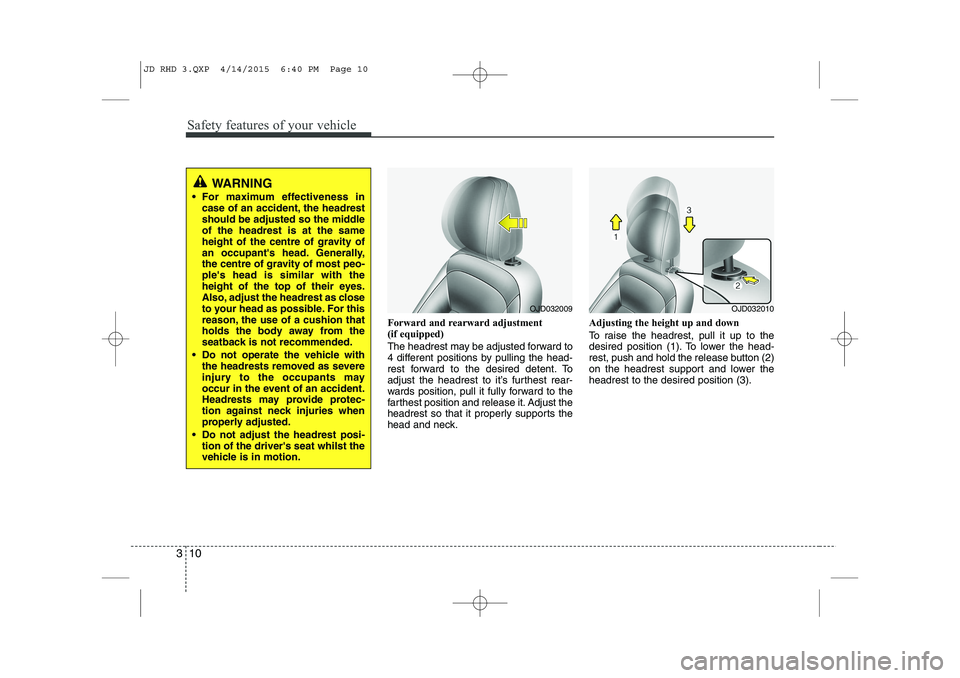
Forward and rearward adjustment
(if equipped)
The headrest may be adjusted forward to
4 different positions by pulling the head-
rest forward to the desired detent. To
adjust the headrest to it’s furthest rear-
wards position, pull it fully forward to the
farthest position and release it. Adjust the
headrest so that it properly supports the
head and neck. Adjusting the height up and down
To raise the headrest, pull it up to the
desired position (1). To lower the head-
rest, push and hold the release button (2)
on the headrest support and lower theheadrest to the desired position (3).
WARNING
For maximum effectiveness in case of an accident, the headrest
should be adjusted so the middleof the headrest is at the same
height of the centre of gravity of
an occupant's head. Generally,
the centre of gravity of most peo-ple's head is similar with the
height of the top of their eyes.
Also, adjust the headrest as close
to your head as possible. For this
reason, the use of a cushion that
holds the body away from the
seatback is not recommended.
Do not operate the vehicle with the headrests removed as severe
injury to the occupants may
occur in the event of an accident.
Headrests may provide protec-
tion against neck injuries when
properly adjusted.
Do not adjust the headrest posi- tion of the driver's seat whilst the
vehicle is in motion.
OJD032009OJD032010
JD RHD 3.QXP 4/14/2015 6:40 PM Page 10


