Page 412 of 695

•Defrost
Air is directed through the windshield and side
window demist outlets. Use this mode with maxi-
mum blower and temperature settings for best wind-
shield and side window defrosting.
•Air Conditioner Control
Push this button to turn on the air
conditioning during manual operation
only. When the air conditioning is
turned on, cool dehumidified air will
flow through the outlets selected with
the Mode control dial. Push this but-
ton a second time to turn OFF the air
conditioning. An LED in the button illuminates when
manual compressor operation is selected.
•Recirculation Control
The system will automatically control recircu-
lation. However, pushing the Recirculation
Control button will put the system in recircu-
lation mode. This can be used when outside
conditions such as smoke, odors, dust, or high humidity
are present. Activating recirculation will cause the LED in
the control button to illuminate.
NOTE:
•When the ignition switch is turned to the LOCK
position, the recirculation feature will be cancelled.
410 UNDERSTANDING YOUR INSTRUMENT PANEL
Page 417 of 695
STARTING AND OPERATING
CONTENTS
!STARTING PROCEDURES................420
▫Manual Transmission — If Equipped.......420
▫Automatic Transmission — If Equipped.....421
▫Normal Starting.......................421
▫Extreme Cold Weather (Below –20°F Or
−29°C).............................421
▫If Engine Fails To Start.................422
▫After Starting........................424
!ENGINE BLOCK HEATER — IF EQUIPPED . . .424
!MANUAL TRANSMISSION — IF EQUIPPED . . .424
▫Shifting.............................425
▫Downshifting........................426
▫Reverse Shifting......................428
!AUTOMATIC TRANSMISSION —
IF EQUIPPED.........................429
▫Key Ignition Park Interlock...............431
▫Brake/Transmission Shift Interlock System . . .431
▫Five-Speed Automatic Transmission — If
Equipped...........................431
▫Gear Ranges.........................433
5
Page 418 of 695

!AUTOSTICK..........................439
▫Operation...........................439
!FOUR–WHEEL DRIVE OPERATION (COMMAND-
TRAC I® OR ROCK-TRAC®)..............441
▫Operating Instructions/Precautions........441
▫Shift Positions........................443
▫Shifting Procedure.....................445
!TRAC-LOK® REAR AXLE — IF EQUIPPED . . .446
!AXLE LOCK (TRU–LOK®) — RUBICON
MODELS............................446
!ELECTRONIC SWAY BAR DISCONNECT —
IF EQUIPPED.........................447
!ON-ROAD DRIVING TIPS................449
!OFF-ROAD DRIVING TIPS................450
▫Side Step Removal — If Equipped..........450
▫The Basics Of Off-Road Driving...........451
▫When To Use 4L (Low) Range.............452
▫Simultaneous Brake And Throttle Operation. . .452
▫Driving In Snow, Mud And Sand..........453
▫Crossing Obstacles (Rocks And Other
High Points).........................454
▫Hill Climbing........................457
▫Driving Through Water.................460
▫After Driving Off-Road.................462
!POWER STEERING.....................464
▫Power Steering Fluid Check..............465
!PARKING BRAKE......................466
416 STARTING AND OPERATING
Page 419 of 695
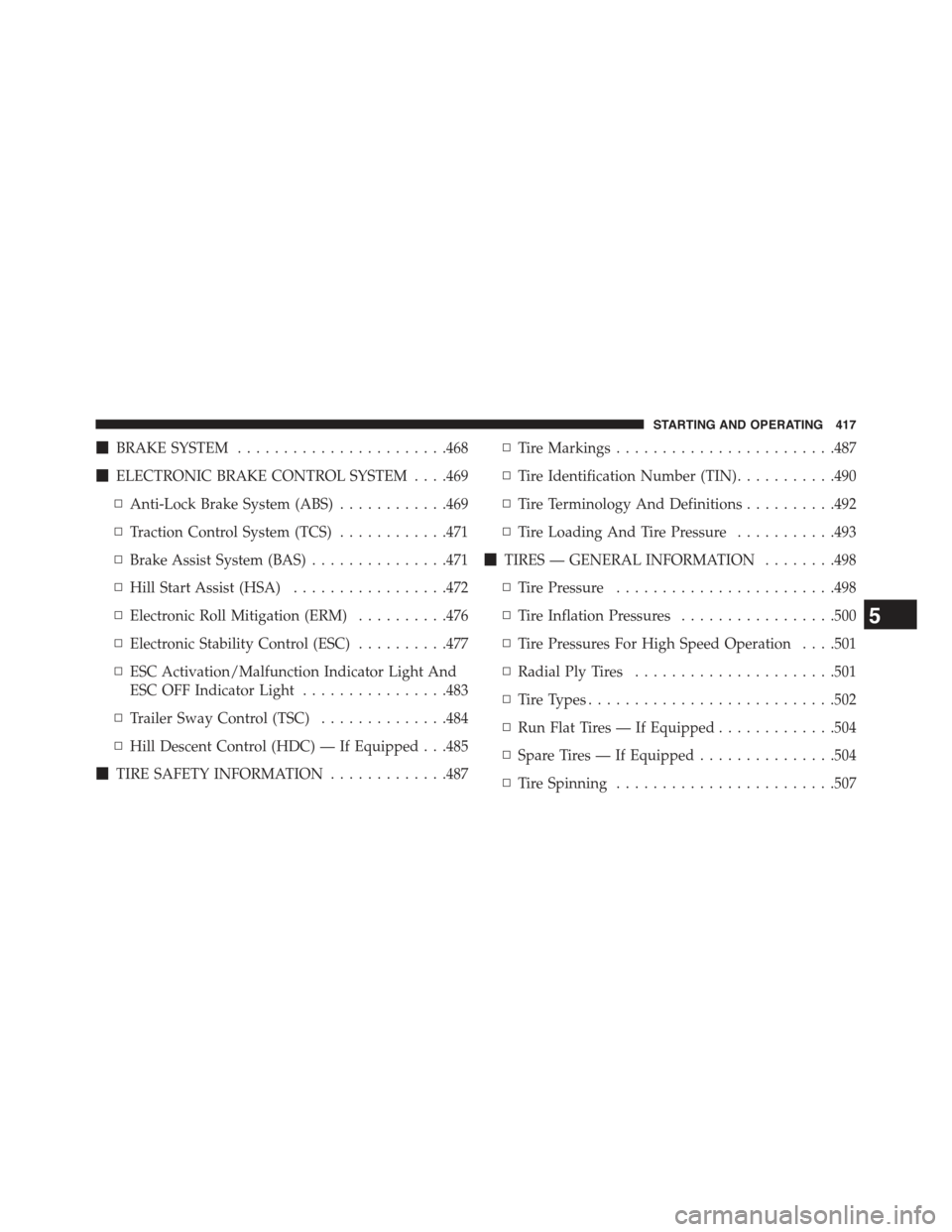
!BRAKE SYSTEM.......................468
!ELECTRONIC BRAKE CONTROL SYSTEM . . . .469
▫Anti-Lock Brake System (ABS)............469
▫Traction Control System (TCS)............471
▫Brake Assist System (BAS)...............471
▫Hill Start Assist (HSA).................472
▫Electronic Roll Mitigation (ERM)..........476
▫Electronic Stability Control (ESC)..........477
▫ESC Activation/Malfunction Indicator Light And
ESC OFF Indicator Light................483
▫Trailer Sway Control (TSC)..............484
▫Hill Descent Control (HDC) — If Equipped . . .485
!TIRE SAFETY INFORMATION.............487
▫Tire Markings........................487
▫Tire Identification Number (TIN)...........490
▫Tire Terminology And Definitions..........492
▫Tire Loading And Tire Pressure...........493
!TIRES — GENERAL INFORMATION........498
▫Tire Pressure........................498
▫Tire Inflation Pressures.................500
▫Tire Pressures For High Speed Operation . . . .501
▫Radial Ply Tires......................501
▫Tire Types...........................502
▫Run Flat Tires — If Equipped.............504
▫Spare Tires — If Equipped...............504
▫Tire Spinning........................507
5
STARTING AND OPERATING 417
Page 422 of 695

STARTING PROCEDURES
Before starting your vehicle, adjust your seat, adjust both
inside and outside mirrors, and fasten your seat belts.
WARNING!
•When leaving the vehicle, always remove the Key
Fob from the ignition and lock your vehicle.
•Never leave children alone in a vehicle, or with
access to an unlocked vehicle. Allowing children to
be in a vehicle unattended is dangerous for a
number of reasons. A child or others could be
seriously or fatally injured. Children should be
warned not to touch the parking brake, brake pedal
or the shift lever.
(Continued)
WARNING!(Continued)
•Do not leave the Key Fob in or near the vehicle (or
in a location accessible to children), and do not
leave Keyless Enter-N-Go™ in the ACC or ON/
RUN mode. A child could operate power windows,
other controls, or move the vehicle.
Manual Transmission — If Equipped
Apply the parking brake, place the shift lever in NEU-
TRAL, and press the clutch pedal before starting the
vehicle. This vehicle is equipped with a clutch interlock-
ing ignition system. It will not start unless the clutch
pedal is pressed to the floor.
Four-Wheel Drive Models Only
In 4L mode, this vehicle will start regardless of whether
or not the clutch pedal is pressed to the floor. This feature
enhances off-road performance by allowing the vehicle to
start when in 4L without having to press the clutch pedal.
420 STARTING AND OPERATING
Page 423 of 695

The “4WD Indicator Light” will illuminate when the
transfer case has been shifted into this mode.
Automatic Transmission — If Equipped
Start the vehicle with the shift lever in the PARK position
(vehicle can also be started in NEUTRAL). Apply the
brake before shifting to any driving range.
Normal Starting
NOTE:Normal starting of either a cold or a warm engine
is obtained without pumping or pressing the accelerator
pedal.
Cycle the ignition switch to the START position and
release when the engine starts. If the engine fails to start
within 10 seconds, cycle the ignition switch to the
LOCK/OFF position, wait 10 to 15 seconds, then repeat
the “Normal Starting” procedure.
Tip Start Feature — Automatic Transmission Only
Turn the ignition switch to the START position and
release it as soon as the starter engages. The starter motor
will continue to run, but will automatically disengage
itself when the engine is running. If the engine fails to
start, the starter will disengage automatically in 10 sec-
onds. If this occurs, turn the ignition switch to the LOCK
position, wait 10 to 15 seconds, then repeat the “Normal
Starting” procedure.
Extreme Cold Weather (Below –20°F Or−29°C)
To ensure reliable starting at these temperatures, use of
an externally powered electric engine block heater (avail-
able from your authorized dealer) is recommended.
5
STARTING AND OPERATING 421
Page 425 of 695

CAUTION!
To prevent damage to the starter, do not crank the
engine for more than 15 seconds at a time. Wait 10 to
15 seconds before trying again.
If the engine has been flooded, it may start to run, but not
have enough power to continue running when the key is
released. If this occurs, continue cranking with the accel-
erator pedal pushed all the way to the floor. Release the
accelerator pedal and the key once the engine is running
smoothly.
If the engine shows no sign of starting after two 15-
second periods of cranking with the accelerator pedal
held to the floor, repeat the “Normal Starting” or “Ex-
treme Cold Weather” procedures.
With Tip Start — Automatic Transmission Only
If the engine fails to start after you have followed the
“Normal Starting” or “Extreme Cold Weather” proce-
dures, it may be flooded. To clear any excess fuel, push
the accelerator pedal all the way to the floor and hold it.
Then, turn the ignition switch to the START position and
release it as soon as the starter engages. The starter motor
will disengage automatically in 10 seconds. Once this
occurs, release the accelerator pedal, turn the ignition
switch to the LOCK position, wait 10 to 15 seconds, then
repeat the “Normal Starting” procedure.
CAUTION!
To prevent damage to the starter, wait 10 to 15
seconds before trying again.
5
STARTING AND OPERATING 423
Page 426 of 695
After Starting
The idle speed is controlled automatically and it will
decrease as the engine warms up.
ENGINE BLOCK HEATER — IF EQUIPPED
The engine block heater warms the engine, and permits
quicker starts in cold weather. Connect the cord to a
standard 110-115 Volt AC electrical outlet with a
grounded, three-wire extension cord.
The engine block heater must be plugged in at least one
hour to have an adequate warming effect on the engine.
The engine block heater cord is found under the hood
bundled in front of the battery tray.
WARNING!
Remember to disconnect the engine block heater
cord before driving. Damage to the 110-115 Volt AC
electrical cord could cause electrocution.
MANUAL TRANSMISSION — IF EQUIPPED
WARNING!
You or others could be injured if you leave the
vehicle unattended without having the parking
brake fully applied. The parking brake should al-
ways be applied when the driver is not in the vehicle,
especially on an incline.
424 STARTING AND OPERATING

